a16z CSX, Coinbase backs Onchain potential project Glider in one article
TechFlow Selected TechFlow Selected
a16z CSX, Coinbase backs Onchain potential project Glider in one article
Glider is making new attempts in the on-chain asset management space.
 Navigating Web3 tides with focused insights
Written by: Patti, ChainCatcher
Onchain trading platform Glider is quietly rising.
Recently, Glider secured $4 million in funding led by a16z CSX, with participation from Coinbase Ventures, Uniswap Ventures, GSR, and other investment firms. This strong lineup has drawn significant attention from the crypto community, sparking widespread interest in the onchain asset management space and driving increasing momentum for Glider.
Pain Points in Onchain Asset Management
In traditional financial asset management, institutions like Bitwise and Grayscale typically adopt custodial models where user assets are centrally managed. According to Glider, while these traditional firms offer professional management services to some extent, they do so at the cost of users’ autonomy over their assets.
Brian Huang, co-founder of Glider, stated that Glider differentiates itself by not taking custody of users’ assets as traditional finance does, and this will be achieved through blockchain technology.
However, even onchain, portfolio management faces numerous challenges:
High technical complexity: In a multi-chain environment, heterogeneous gas tokens, bridge latency risks, and real-time requirements for rebalancing strategies make manual operations extremely difficult when responding to market volatility.
Severe infrastructure fragmentation: The lack of standardized interfaces across DeFi protocols forces users to frequently switch between AMMs, lending protocols, and options platforms.
Asymmetric returns and risks: Retail investors often fall into the trap of "a strategy becomes ineffective once public," while professional institutions gain an edge through quantitative models. This information asymmetry allows a small number of players to capture most of the onchain returns.
To address these issues, Glider proposes a new framework centered on balancing automated execution with user control.
Intent-Driven Modular System
Glider co-founder John Johnson said the company was founded out of frustration with the fragmented infrastructure that has long plagued cryptocurrency portfolio management. Glider aims to eliminate such friction entirely, enabling precise and automated cross-network execution.
The core idea is to build middleware for onchain asset management, decoupling strategy formulation, execution, and risk control into programmable modules. Users can either configure parameters based on personal needs or choose from smart templates provided by the platform.
At the heart of Glider’s product is an intent-driven modular architecture. Users only need to define investment goals and strategic intent; underlying chain abstraction technology automatically handles cross-chain operations, asset adjustments, and trade execution, significantly reducing manual workload.
Glider’s tech stack features a modular design with the following key characteristics:
Portfolio Construction
Users can customize investment strategies using intuitive asset allocation tools or curated templates.
Automated Execution
Glider locates liquidity across chains and manages rebalancing to trigger trades. When market conditions change, the system automatically executes predefined strategies.
Non-Custodial Integration
Users can connect any existing wallet (e.g., MetaMask, Rainbow, Safe, WalletConnect) without needing new seed phrases.
Lending Integration
Glider integrates with trusted DeFi lending protocols like AAVE to enable automatic borrowing and optimize yields. Users can leverage their assets for loans without transferring ownership, unlocking additional earning opportunities.
Collaborative Investing
Users can share and customize strategies, continuously refining their portfolios.
Integrated Backtesting
Users can test strategies using historical data directly within the Glider interface, comparing performance against benchmarks like BTC, ETH, and others—enabling better understanding of strategy behavior before deployment.
Team Background
Based on publicly disclosed information, the founding team primarily consists of Brian Huang and John Johnson.
Both co-founders bring impressive resumes, having previously worked at notable organizations including Anchorage Digital, XTX Markets, 0x, and Matcha. Other team members come from industry-leading companies such as Coinbase, MetaMask, 0x, Cega, and PoolTogether.
Brian Huang holds a PhD in Computer Science from MIT and served as Chief Architect at Anchorage Digital, leading the development of a cross-chain custody system supporting over 20 public blockchains.
John Johnson, an early core developer of the 0x protocol, led the reconstruction of Matcha’s aggregation trading engine—a project that set an industry record with $1.2 billion in daily trading volume.
Conclusion
Currently, Glider is still in technical testing, with its product scheduled to launch in the coming months.
According to its official website, access is currently invite-only, and the waitlist is open.

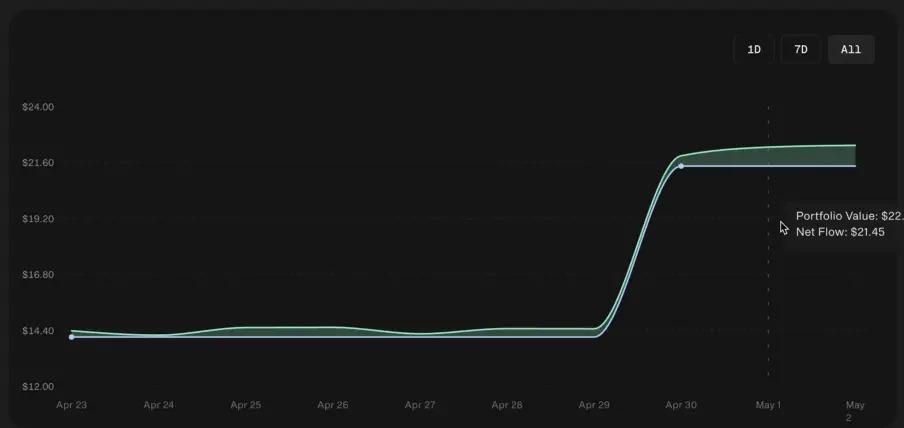
In addition, according to Glider builder@marcos_0x, further functionality is under active development. Currently, Glider can display the current value of a user’s portfolio and net flow of funds—an important visual indicator for understanding investment performance.
Furthermore, as disclosed by the team, Glider plans to generate revenue by charging users a management fee proportional to their assets under management.
As the cryptocurrency industry evolves from “financial experimentation” to a “value network,” true decentralization should not come at the expense of user experience—but rather internalize complexity through technological innovation.
Co-founder John Johnson once said: “Everyone should be able to precisely tailor their portfolios according to their own preferences, automate them, and invest freely within their risk tolerance and appetite.”
Perhaps only when onchain asset management becomes as simple and accessible as ETFs in traditional finance will DeFi transition from a geek toy into mainstream financial infrastructure.
Glider is making new strides in the field of onchain asset management.
Join TechFlow official community to stay tuned
Telegram:https://t.me/TechFlowDaily
X (Twitter):https://x.com/TechFlowPost
X (Twitter) EN:https://x.com/BlockFlow_News
 ChainCatcher 链捕手