Interview with DCG Founder: From Bitcoin Pioneer to AI Revolution — Barry's Cryptocurrency Empire and Vision for Bittensor
TechFlow Selected TechFlow Selected
Interview with DCG Founder: From Bitcoin Pioneer to AI Revolution — Barry's Cryptocurrency Empire and Vision for Bittensor
"I believe 99.9% of crypto tokens have no reason to exist and are worthless."
 Navigating Web3 tides with focused insights
By: Raoul Pal
Compiled by: Yuliya, PANews
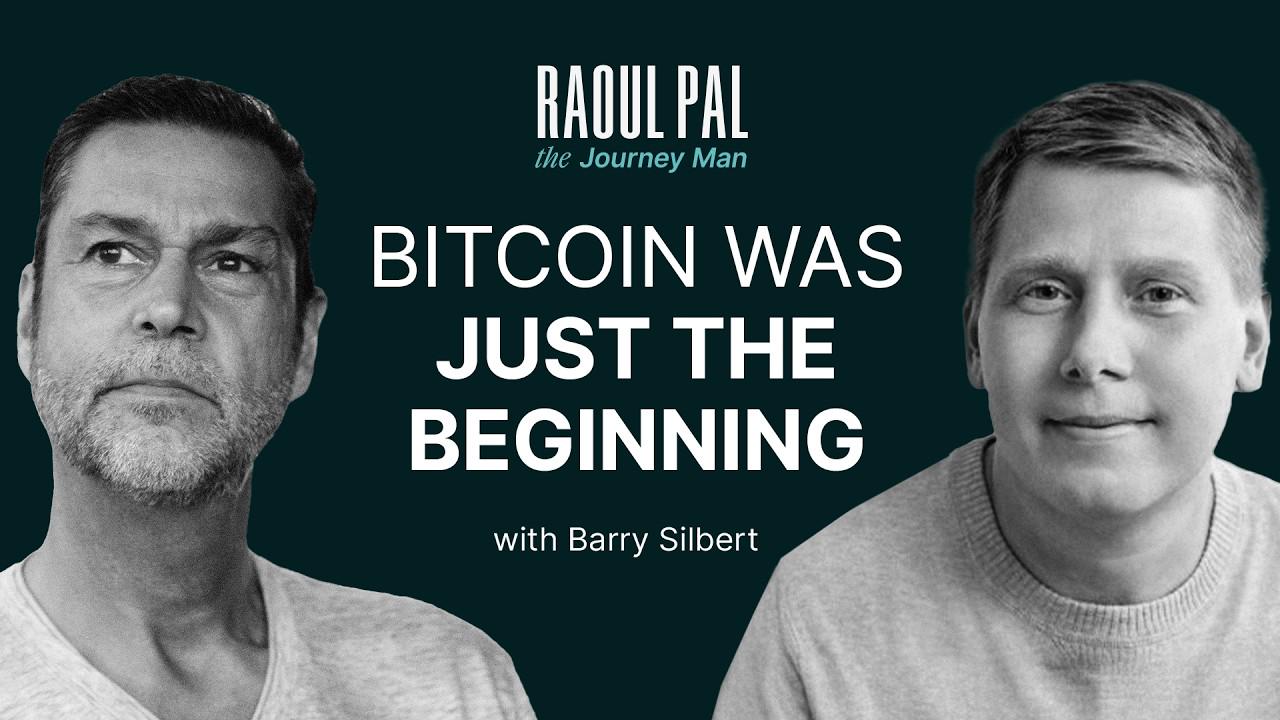
In today’s rapidly evolving cryptocurrency and blockchain landscape, Barry Silbert, founder and CEO of DCG (Digital Currency Group), stands as a pioneering figure. In his latest podcast interview with Raoul Pal, Barry shared his journey from early Bitcoin investor to building DCG and its subsidiaries—such as Grayscale and Foundry—navigating market cycles including the 2022 crypto collapse.
Today, Barry has set his sights on his next major bet—Bittensor. He elaborated on his role as founder and CEO of Yuma, and how Bittensor could become a decentralized intelligence layer even more transformative than Bitcoin. This article delves into Barry's experiences, DCG's evolution, the 2022 crisis, and his vision for Bittensor and the future of AI. PANews has compiled and translated this podcast episode.
The Bitcoin Awakening
Q: Barry, how did you transition from Wall Street to Bitcoin?
Barry: I started as an investment banker, but realized I wanted to build something new, so I founded Second Market—the first trading platform for private stocks and illiquid assets. During the 2008 credit crisis, when companies like Facebook and Twitter couldn’t raise funds through IPOs, Second Market became a critical channel for trading their shares.
In 2011, I first encountered Bitcoin through a Wired article and Jason Calacanis’ podcast. At the time, I was still cautious, believing the credit crisis hadn’t fully passed. I spent six months researching—reading extensively and talking to insiders. By early 2012, I realized Bitcoin could profoundly impact the world, and I decided to get involved before regretting missing out.
Q: What price did you initially buy Bitcoin at?
Barry: I bought hundreds of thousands of dollars worth of Bitcoin on Mt. Gox at $7–8 per coin. The price briefly rose to $30, then dropped to $5, before climbing again over the next 6–12 months to $50, $60, $70. That’s when I began investing in Bitcoin infrastructure companies—early bets on Coinbase, Chainalysis, Ripple, among the first generation of foundational projects.
Interestingly, I used Bitcoin to make these investments. If I had simply held onto that Bitcoin instead of deploying it, I would have done far better. Most of us early adopters share similar stories. In 2013, my wife and I had our first daughter. We were trying to get people to use Bitcoin—I remember spending 2,000 to 5,000 dollars worth of Bitcoin on gift cards, mostly for diapers. I’ve never gone back to calculate what that would be worth now, but clearly, that Bitcoin is astronomically valuable today.
Empire Building: The Birth of Grayscale and DCG
Q: How did Grayscale and DCG come about?
Barry: At the time, I was running Second Market. I told my board—including Chamath Palihapitiya—that I believed we should do something significant in Bitcoin. We already had tens of thousands of sophisticated investors looking for alternative, non-traditional investments. I understood the history of gold and gold investing—how gold ETFs acted as catalysts in making gold a legitimate, accessible asset class.
I decided to create a Bitcoin equivalent of the SPDR Gold ETF. We approached the SEC, but they knew nothing about Bitcoin. It quickly became clear that the SEC wouldn’t approve a Bitcoin ETF in 2013, so we did something groundbreaking—we launched it as a private instrument, then listed it publicly on the OTC QX market. That became the Grayscale Bitcoin Trust.
Because we were buying large amounts of Bitcoin, we also built a trading desk, began purchasing Bitcoin ourselves, and started investing from our balance sheet. Eventually, in 2014, Nasdaq called and wanted to acquire Second Market. I sold Second Market to Nasdaq and went all-in on Bitcoin. The investment product became Grayscale, the trading business became Genesis, and the portfolio evolved into DCG.
Q: How much in assets does Grayscale manage now?
Barry: I think around $30 billion by year-end. Grayscale was a pioneer with highly innovative product design, helping bring this asset class into the mainstream—even though many investors still find access challenging.
Grayscale now offers over 30 different products: Bitcoin Trust, Bitcoin Mini, Large Cap Trust (ticker GDLC), and single-asset trusts. The Grayscale model is about unlocking these tokens, opening the asset class to broader investors—transforming private trusts into publicly traded ones.
I like to think of Grayscale as the next Vanguard Group. Just as Vanguard pioneered index investing and PIMCO pioneered bond investing, Grayscale is pioneering crypto investing.
Q: What is DCG’s investment strategy?
Barry: We refer to the so-called “DCG playbook.” We identify protocols and tokens we believe have the potential to change the world, then bring our full capabilities to those ecosystems: investing, building, buying, educating, and creating access. This doesn’t happen often—I do it roughly once every five years—but when we do, we tend to succeed dramatically.
The uniqueness of DCG lies in being a private company, not a fund. As a private entity, I have the luxury of permanent capital and infinite time horizon. I can make long-term investment and capital allocation decisions. My job is essentially to try to foresee the world five or ten years ahead and place bets accordingly. I’ll be wrong more often than right—but when I’m right, the returns are massive.
Q: How did DCG grow into such a large enterprise?
Barry: We were uniquely positioned to act as a bridge between this asset class and traditional financial markets. Over the next few years, we launched Foundry, now the largest Bitcoin mining pool in the world. Before Foundry, U.S. Bitcoin mining was virtually nonexistent, while China controlled about 80% of global hash power.
We decided to bring Bitcoin mining to America by financing U.S. miners, bulk-purchasing equipment from manufacturers, and providing funding to help miners launch. As part of this, we built the mining pool—today, one-third of all Bitcoin transactions go through our Foundry USA pool.
We also acquired CoinDesk during the depths of the bear market for $300,000, grew it into a solid business, and sold it a year ago at a good price to my friend Brendan. We acquired Luno—a Coinbase-like platform focused on emerging markets, dominant in Nigeria and South Africa. To date, we’ve invested in around 300 companies and 50 different crypto assets.
Q: How does your mining business operate?
Barry: We run two businesses. One is Foundry, which operates the mining pool and builds the infrastructure enabling U.S. miners to mine Bitcoin and secure the network. It also has field operations—a team that essentially builds and runs facilities for numerous miners across the country. Foundry itself doesn’t take capital risk or speculate on hardware or Bitcoin prices. Its core mission is advancing U.S. Bitcoin mining infrastructure. For us, this is clearly a complex and challenging business—Bitcoin revenue is volatile—but we don’t have to make large capital investment decisions or evaluate hash rate economics.
The other business is Fortitude, where we actually mine ourselves. We developed or created the first “venture miner,” mining many different tokens—all proof-of-work (PoW) assets—and treating mining more like venture capital. It’s a great business, and not many miners approach it this way.
Crisis and Rebirth
Q: How did the 2022 crypto collapse happen?
Barry: During COVID, the global economy took a massive hit, and countries responded by “turning on the printing presses,” leading to soaring asset prices in 2021 and forming a bubble. Excessive leverage was widespread across asset classes, with complex, opaque relationships between known and unknown lenders and borrowers.
First, the Terra Luna depeg triggered a chain reaction. Then, Three Arrows Capital (3AC) failed to meet margin calls from Genesis in June—this became the spark. 3AC had borrowed from multiple sources, but its status as the largest borrower wasn’t widely known. When 3AC collapsed, numerous counterparties were affected. As the biggest lender and prime broker in the space, Genesis had to mark down its balance sheet post-3AC, resulting in an equity shortfall. Digital Currency Group (DCG) stepped in to support it.
Then the FTX collapse further eroded trust in the market. Counterparty confidence evaporated entirely. This trust crisis led to a “bank run” on Genesis and similar institutions, ultimately forcing Genesis to shut down and enter bankruptcy proceedings.
Q: What was it like personally going through this crisis?
Barry: It was difficult in many ways. Everything in crypto and social media gets amplified—both the good and the bad, including outright lies. It was shocking how willing people were to fabricate and believe falsehoods. I received numerous death threats during that period.
Additionally, I was surprised by how regulators wielded their power. Even harder was the fact that during this time, my daughter was diagnosed with cancer. So I was managing a business crisis while accompanying my daughter through chemotherapy and surgery. Thankfully, she’s been cancer-free for nine months now, and DCG is thriving once again.
New Frontiers: The Convergence of AI and xCrypto
Q: What shifted you from focusing solely on Bitcoin to broader crypto?
Barry: Partly because I have external shareholders and employees—so as the asset class grows and more applications emerge, it makes sense to stay open-minded toward other cryptos with real utility. I didn’t want to be a maximalist just for the sake of being one.
Another reason is that some very compelling teams emerged along the way, and I got excited about them. I love betting on underdogs, big ideas, and visionary people. I think most people now recognize there may not be much of value beyond Bitcoin—which is also my current view.
Q: What sparked your interest in the intersection of AI and blockchain?
Barry: For the past 12–13 years since I first bought Bitcoin, I’ve remained intellectually curious about everything emerging in our space. I believe 99.9% of crypto tokens have no reason to exist—they’re worthless. So my threshold for excitement is extremely high.
In recent years, as AI became a theme, I began appreciating its power. People on my team were introduced to a group that wrote a Bittensor whitepaper back in 2021 and were excited about it. I started exploring the crypto-AI intersection and noticed that many early applications treated crypto merely as a payment solution for AI, rather than building foundational infrastructure for AI.
After diving deep into Bittensor, I concluded it represents the next major era in crypto—on par with Bitcoin, Ethereum, NFTs, L2s, and DeFi. Last year, we decided to invest in Bittensor, build on it, educate the market, raise awareness, and create access. In the fall, I launched a new venture called Yuma, where I serve as CEO, focused on developing and promoting Bittensor—all while continuing to run DCG.
Why Bittensor Appeals to Bitcoin OGs and AI Enthusiasts
Q: What is Bittensor?
Barry: If you ask five people what Bittensor is, you might get fifteen answers. This reminds me of Bitcoin in 2012, when people described it as digital gold, blockchain, a payment system, or a global currency.
Bittensor is a decentralized intelligence network with a core vision: creating a global, permissionless platform that incentivizes global intelligence to solve any problem or challenge. This incentive mechanism is powered by a cryptocurrency. For non-crypto natives, Bittensor can be simply understood as the intelligent World Wide Web within the information internet. Anyone can launch a so-called “subnet” on this platform—each designed to harness global intelligence for specific tasks like computation, reasoning, data processing, or training. Subnets have already been deployed to predict Bitcoin prices or sports scores.
Looking back at internet history, 30 years ago the launch of the Mosaic browser triggered a Cambrian explosion of websites. Back then, people accessed the internet via Prodigy and America Online—similar in function to today’s OpenAI and Claude. Now, Bittensor is ushering in a new era of open, permissionless innovation, growing at a rapid pace.
Q: What excites you about Bittensor?
Barry: Bittensor has attracted widespread attention due to its unique fair launch and mission-driven community. Like Bitcoin, Bittensor started with a whitepaper, evolved into code, and launched without a VC round or pre-mine for the foundation or team. This means everyone who participates does so out of genuine interest in the technology—by earning or buying TAO tokens. The Bittensor community formed organically, united by shared purpose and ambitious goals. The project adopts Bitcoin’s tokenomics: a hard cap of 21 million tokens and a halving mechanism, making its economic model easy to understand. This design emphasizes not just cryptography, but how incentives can solve global problems—appealing to innovators aiming to change the world.
Q: How do subnets work?
Barry: In recent months, Bittensor underwent a major upgrade—each subnet now has its own token. This structure resembles blockchain L2 solutions, but with a key difference: all subnet tokens are traded in TAO. TAO serves as the functional currency, acting as the pricing base for all subnet tokens. When users speculate on which subnet will generate the most valuable intelligence, they buy subnet tokens—but since all trades occur through liquidity pools denominated in TAO, this indirectly increases demand for TAO. Currently, 88 subnets are live on Bittensor, with a new one launching every two days. Each subnet is independently operated by different teams, solving distinct intelligence challenges. Yet collectively, they drive adoption of the entire Bittensor network and TAO token. As more capital flows into subnet tokens, it ultimately flows into TAO, fueling ecosystem growth.
Two subnets might perform the same task, but if one excels, it could generate hundreds of millions in value for the entire ecosystem. As that subnet’s token surges, others rise too. This collaborative dynamic is unique in crypto—it reflects a spirit of mutual support rather than pure competition. On Ethereum or Solana, newly launched tokens rarely contribute value back to the base layer; teams focus on their own token’s success, not the health of ETH or SOL. This is somewhat similar to ETH-denominated NFT markets, but Bittensor’s subnet collaboration shows deeper interdependence and shared growth potential.
Q: Who makes up the Bittensor ecosystem?
Barry: Bitcoin OGs see the current market as resembling 2012–2013, with Bittensor priced around $200 and a market cap of approximately $1.5 billion.
Unlike Bitcoin’s early libertarian leanings, the Bittensor community consists largely of technically skilled AI enthusiasts with strong backgrounds. Over recent months, they’ve focused on building infrastructure to make the intelligence generated by subnets accessible and monetizable. Applications are rapidly emerging to help users discover, invest in, and track subnets.
During this market correction, community members are laser-focused on accelerating their projects, avoiding distractions from crypto volatility and macroeconomic noise. Everyone is working to build infrastructure and position their businesses and investments to gain first-mover advantage before the market matures further.
In this context, Grayscale recently launched the Bittensor Trust, replicating its successful 2013 Bitcoin Trust model. This marks Grayscale’s effort to enable broader investor access to Bittensor and Yuma’s ecosystem. The goal is to let investors—who know nothing about staking, exchanges, or Uniswap pools—still bet on what could become the Amazon of the intelligent web.
Our investment strategy centers on infrastructure, subnet tokens, and TAO itself. We typically avoid projects aimed at creating corporate value for equity or token holders, instead focusing purely on building the Bittensor ecosystem. Specifically, we’re seeking infrastructure projects akin to Coinbase, BitGo, and Chainalysis to advance Bittensor. We’ve launched an accelerator to help aspiring builders launch subnets, incentivizing top global talent to compete. Additionally, TAO holders can stake their tokens on the Yuma platform.
Q: How does Bittensor differ from Bitcoin mining?
Barry: There’s a fundamental difference in economic incentives. The Bitcoin network distributes about $12 billion annually to miners for securing the network. Bittensor, however, redirects these incentives to pay providers of compute, model owners, and data owners—effectively funding the network’s infrastructure. At current TAO prices, around $500 million is available across the network for participants to earn, potentially growing to $1 billion, $5 billion, or even $10 billion as TAO’s price rises. This incentive model attracts not only large corporations but also graduate students in dorm rooms, all competing to contribute the best solutions to the Bittensor network. It creates powerful economic alignment that drives innovation and network growth.
Q: How does Bittensor address the reality that AI costs are approaching zero?
Barry: Historically, accessing the internet through services like America Online and Prodigy was standard—until browsers enabled free access to the same content. Today, Bittensor is redefining this model by offering cheaper, faster access to compute, models, and data. Its open architecture allows anyone globally to participate, leveling the playing field. This innovation could enable the emergence of companies like Uber, Airbnb, and TikTok—businesses unimaginable in 1995.
Bittensor eliminates single points of failure, such as API restrictions from OpenAI or Meta, while providing redundancy and scalability. More importantly, it enables censorship-resistant, permissionless access—just like the original World Wide Web. Teams now need to consider how to monetize and sustainably utilize this generated intelligence. Bittensor isn’t just a technological advancement—it reaffirms the internet’s openness and innovative potential, unlocking infinite possibilities for future business models.
Q: What do you envision Bittensor becoming?
Barry: My boldest prediction for Bittensor is that it could become a superior version of Bitcoin as a global store of value. The Bitcoin network spends $10–12 billion annually to secure itself. Bittensor proposes a radical alternative: redirecting that capital to incentivize a global problem-solving network—rewarding people for tackling humanity’s biggest challenges. Imagine what could happen if that funding scaled from $1 billion to $2 billion, $5 billion, or even $10 billion. While securing the Bitcoin network is valuable, Bittensor shares Bitcoin’s tokenomics—halvings and decentralization—giving it immense potential.
Yet Bittensor carries the almost religious fervor of early Bitcoin adopters, but with a different mission. It’s not about digital gold, decentralized money, or removing government control over wallets. Instead, Bittensor aims to harness global intelligence to solve meaningful problems.
I believe the future of the internet is scalable intelligence, and Bittensor is exploring its decentralized application. Right now, new subnets are launching—some directly tied to AI, involving inference, training, or fine-tuning. These subnets use incentives to drive competition, applicable to any domain requiring human-driven contest. While Bittensor’s current use cases center on AI, its ultimate applications remain undefined. It provides an incentive layer for decentralized teams to work on behalf of others, fostering coordination and collaboration. Meanwhile, Yuma plans to release product solutions this year, enabling direct access to subnets.
Join TechFlow official community to stay tuned
Telegram:https://t.me/TechFlowDaily
X (Twitter):https://x.com/TechFlowPost
X (Twitter) EN:https://x.com/BlockFlow_News
 PANews