Understanding Bittensor (TAO): The Game of Power on the AI Iron Throne
TechFlow Selected TechFlow Selected
Understanding Bittensor (TAO): The Game of Power on the AI Iron Throne
TAO participated with the posture of a rule-maker.
 Navigating Web3 tides with focused insights
Author: IOSG Ventures
Introduction
AI development has achieved significant breakthroughs in recent years, driven by advances in data, computational power, and algorithmic research. The emergence of foundational large language models (LLMs), exemplified by OpenAI's GPT-4, has boosted productivity and transformed societal efficiency.
However, these closed-source models like GPT-4 also reveal drawbacks—centralized models often impose restrictions on third-party integrations, limiting the extensibility and interoperability of AI agents built upon them.
As a result, open-source models such as the Llama series have gained increasing popularity among researchers. Yet, open source does not necessarily mean transparency, and it faces numerous challenges.
A key issue is that open-source AI development offers little to no economic incentives for most contributors. While some competitions offer rewards, these are typically one-time events. Ongoing improvements and development still rely heavily on volunteer efforts ("for the love of it"), unless a project reaches sufficient scale and community following to unlock revenue opportunities and attract more contributors.
This is where Bittensor—an AI project leveraging Web3 token mining—comes in, aiming to make open-source AI development more sustainable, verifiable, and efficiently operated. Through Yuma Consensus, Bittensor aligns resources across three core roles: Miner (research contributor), Validator (quality assessor), and Subnet Creator (project builder), making AI research more transparent and decentralized. Anyone can contribute to AI advancement and earn fair rewards.
The secondary market performance of its token further reflects growing confidence—its price surged from over $50 in September 2023 to over $500 by December 2024, a tenfold increase!
Recently, Bittensor’s investor and founder of Digital Currency Group launched Yuma, an accelerator dedicated to incubating subnet projects within the Bittensor ecosystem, serving as CEO—a strong signal of his belief in Bittensor’s potential.
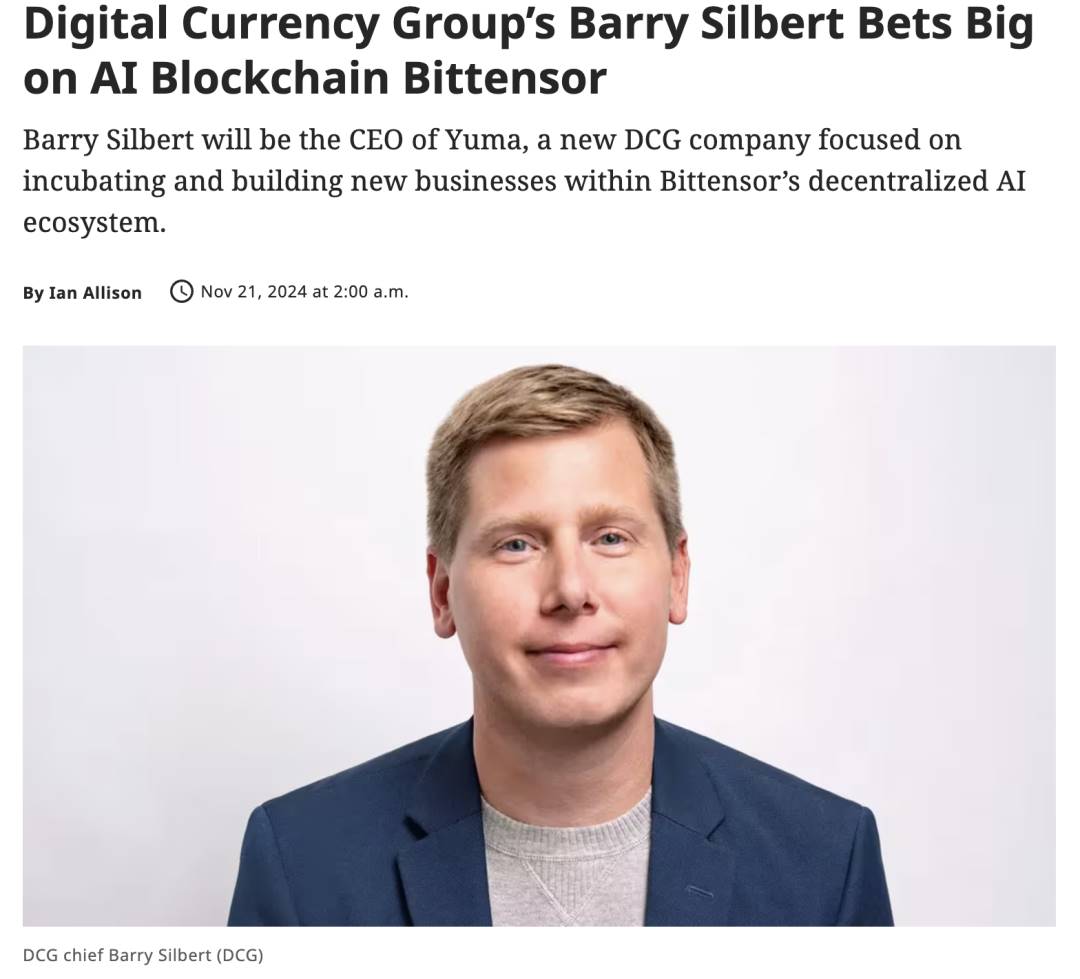
Source: Coindesk
Of course, no project achieves success without facing skepticism. Since its inception, Bittensor has encountered substantial FUD (fear, uncertainty, doubt). In this article, we compile many unresolved questions and attempt to analyze Bittensor’s positioning and potential in the decentralized AI landscape.
What is Bittensor?
Bittensor was founded in 2021 by a team from Toronto, Canada: Jacob Robert Steeves, Ala Shaabana, and Garrett Oetken.
Bittensor is a decentralized AI infrastructure used by AI developers to build and deploy machine learning models or other AI-related applications. Many Web3 AI projects—regardless of whether they have their own blockchain—can integrate with Bittensor’s blockchain "subtensor" and become a subnet within it.
What is a Subnet?
Subnets form the core of the Bittensor ecosystem. Each subnet operates as an independent, incentive-driven competitive market. Anyone can create a subnet, define its specific task, and design an incentive mechanism (analogous in machine learning terms to a loss function, which guides model training toward desired outcomes). By paying a registration fee (denominated in TAO), creators receive a netuid (network unique identifier) for their subnet. Notably, the subnet creator does not need to operate the subnet tasks themselves—they delegate operational rights to others.
Operating a subnet offers another way to participate: joining an existing subnet. There are two participation roles: subnet miner or subnet validator. Beyond paying the TAO-denominated registration fee (and staking TAO if acting as a validator), participants only need a computer with sufficient computational resources, which they register along with their wallet into a subnet. They then run either the miner module or validator module (Python code components within the Bittensor API) provided by the subnet creator.
How Does the Subnet Competition Work?
The subnet competition functions as follows: suppose you choose to become a subnet miner. Subnet validators assign tasks for you to complete. Other miners in the same subnet receive identical tasks. After completing the tasks, all miners submit their results back to the validators.
Validators then independently evaluate and rank the quality of each miner’s output. As a miner, your reward (denominated in TAO) depends on the quality of your work. Similarly, other miners are rewarded based on their performance. Validators are also rewarded for ensuring high-quality miners receive higher rewards, thereby continuously improving overall subnet quality. All of this competitive process is automated through code-defined incentive mechanisms set by the subnet creator.
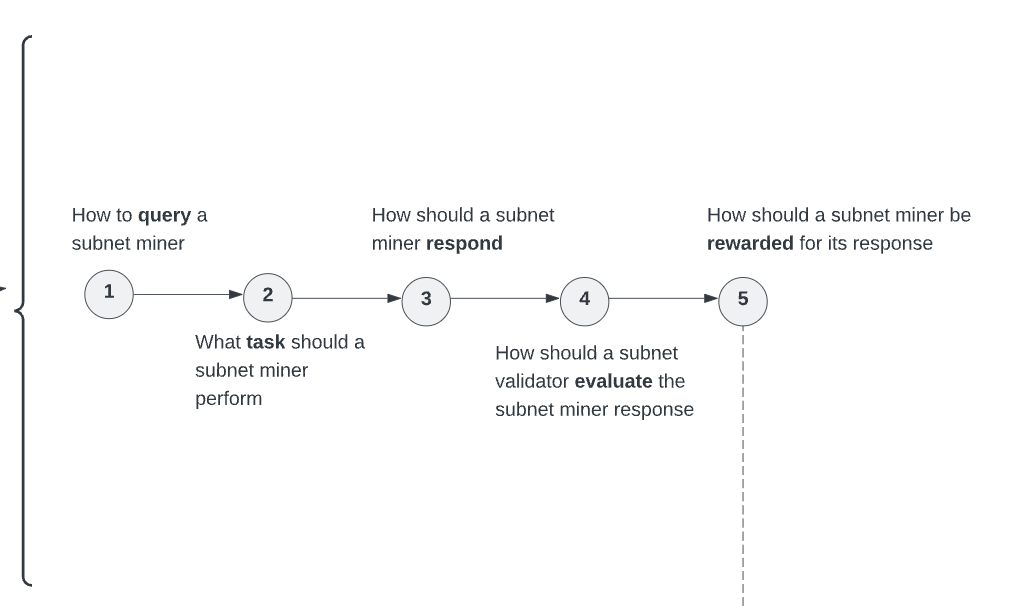
Source: Steps on how Subnet Creator defines Incentive Mechanism
The incentive mechanism ultimately determines how miner performance is evaluated. When well-calibrated, it creates a virtuous cycle where miners continuously improve at the assigned task through competition.
Conversely, poorly designed incentives may lead to exploitation or shortcuts, harming overall subnet quality and discouraging honest participants.
The specific work of each subnet miner depends entirely on the original purpose defined by the subnet creator—it can be highly variable or very specific. For example, miners on Subnet 1 respond to text prompts from validators and generate optimal completions, while miners on Subnet 47 provide storage services.
Each subnet also pursues unique research and commercialization goals—such as tackling technical challenges in decentralized AI training or verifiable inference, providing essential AI infrastructure like GPU marketplaces or data labeling services, or developing tools to detect AIGC deepfakes, such as Subnet 34 - BitMind.
Currently, Bittensor hosts over 55 subnets—and this number continues to grow!
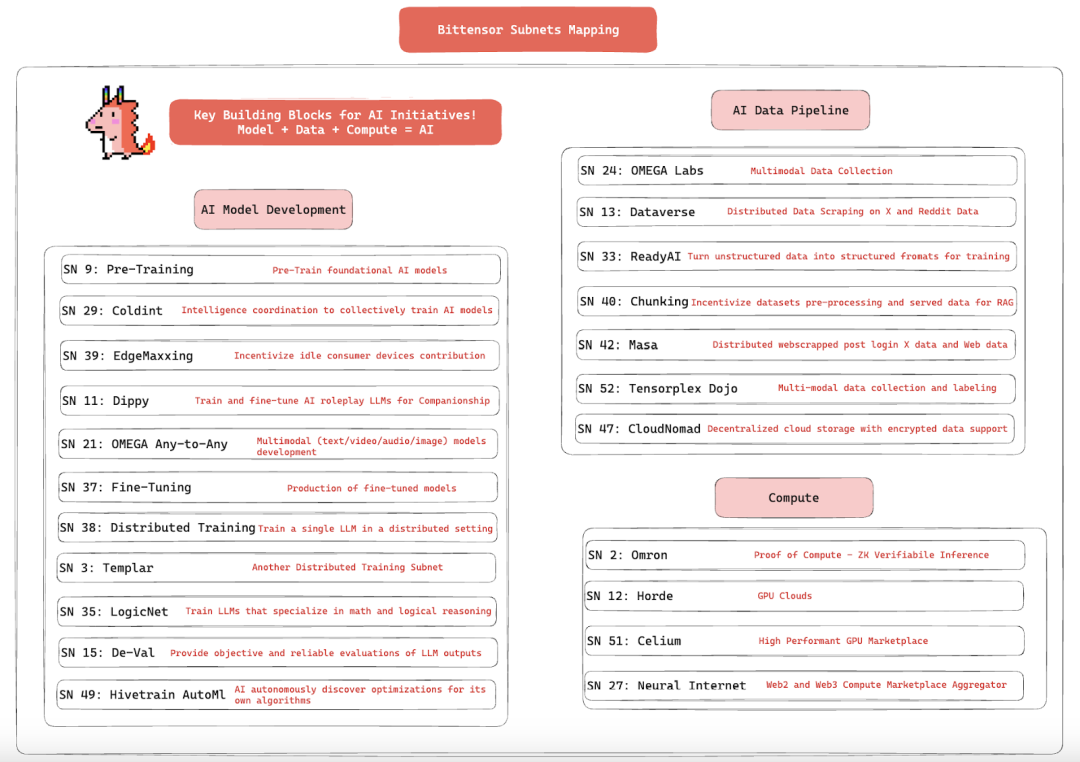
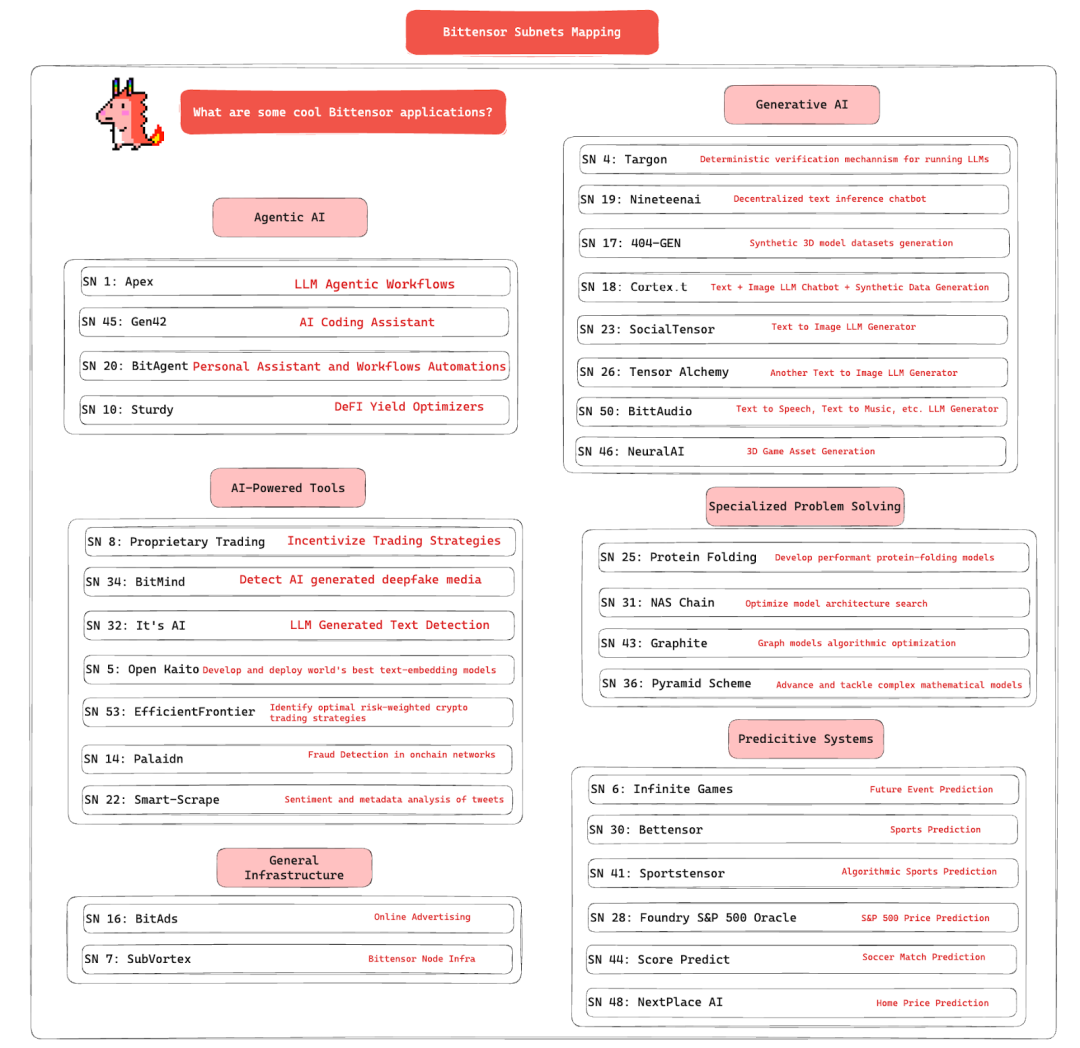
Source: IOSG Ventures
The Role of the Subtensor Blockchain
Clearly, the Subtensor blockchain and the native token TAO play crucial roles in this competitive framework.
First, the Subtensor blockchain records all key activities across subnets in its ledger. More importantly, it determines reward distribution for miners and validators. An algorithm called Yuma Consensus (YC) runs continuously on Subtensor. Each validator ranks miners’ work quality, and all rankings are submitted collectively as inputs to the YC algorithm. Although individual validator rankings arrive at different times, the YC algorithm waits until all are received—typically every 12 seconds—before calculating rewards based on all validator inputs. These TAO-denominated rewards are then deposited into the wallets of miners and validators. The YC algorithm runs independently and continuously for each subnet on Subtensor.
Yuma Consensus primarily considers two factors: first, each validator maintains a weight vector, where each element represents a weight assigned to a miner, reflecting the validator’s historical assessment of that miner’s performance. Second, the amount of TAO staked by validators and miners. On-chain Yuma Consensus uses both the weight vectors and stake amounts to compute and distribute rewards.
The Bittensor API serves as the bridge transmitting validator assessments from subnets to the Yuma Consensus algorithm on Subtensor. Additionally, validators within a subnet only connect to miners in the same subnet—there is no cross-communication between different subnets’ validators or miners.
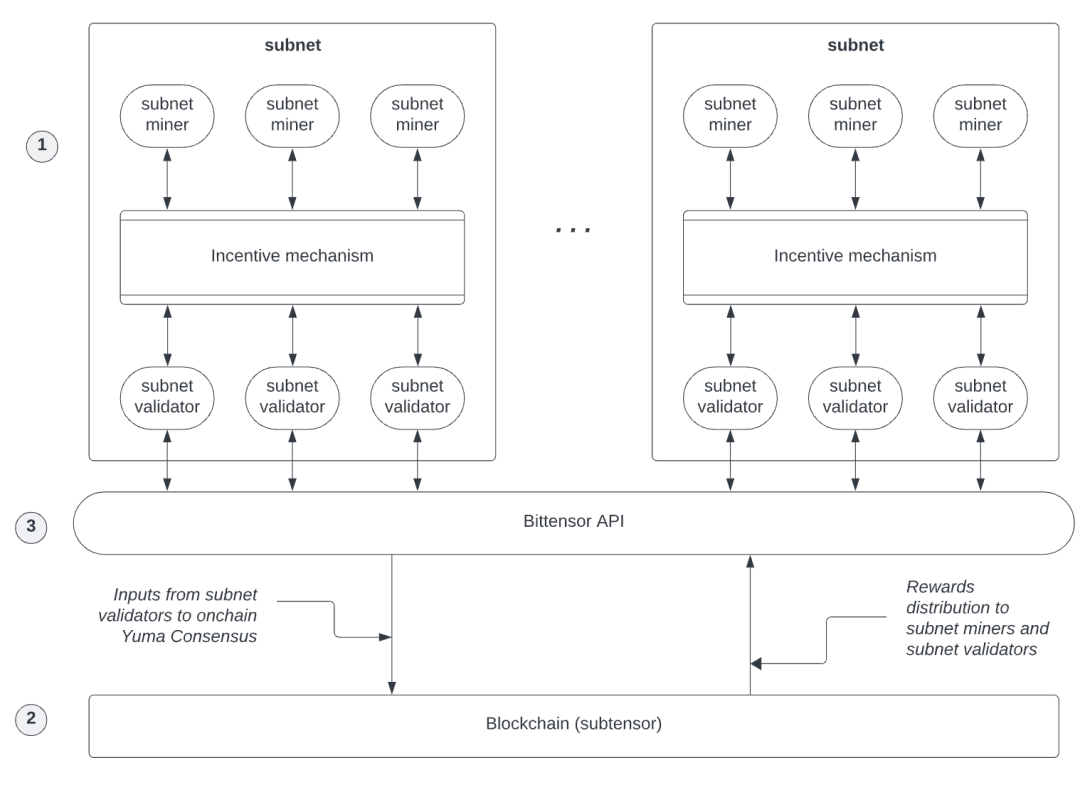
Source: Bittensor
Validator Game Theory
To participate as a validator or miner, one must first register and stake. Registration involves registering a key in the chosen subnet to obtain a UID slot, which grants validation rights. Notably, a validator can hold multiple UID slots across multiple subnets without needing additional stake—the initial stake allows selection of multiple slots (similar to restaking).
Thus, to maximize rewards, stakers are incentivized to validate for as many subnets as possible. However, not all staked validators have actual validation rights. Only the top 64 validators ranked by stake amount in a given subnet are considered legitimate validators. This reduces malicious behavior risk, as stake amount acts as a high barrier and increases attack cost (a minimum of 1000 TAO is required to set weights in a subnet). To increase their stake and become one of the top 64 validators, each validator strives to build a solid reputation and performance record to attract more delegated stakes.
Once validators and miners (miners do not need to stake) register their keys to a subnet, they can begin mining operations.
Unique Token Incentive Economics
All TAO token rewards are newly minted, similar to Bitcoin. Bittensor’s $TAO follows the same tokenomics and issuance curve as Bitcoin: capped supply of 21 million, halving every four years.
Bittensor launched via a fair launch—no pre-mine or ICO. Currently, the network generates 7,200 TAO per day, with 1 TAO per block approximately every 12 seconds. The total supply cap is 21 million, following a programmed issuance schedule akin to Bitcoin.
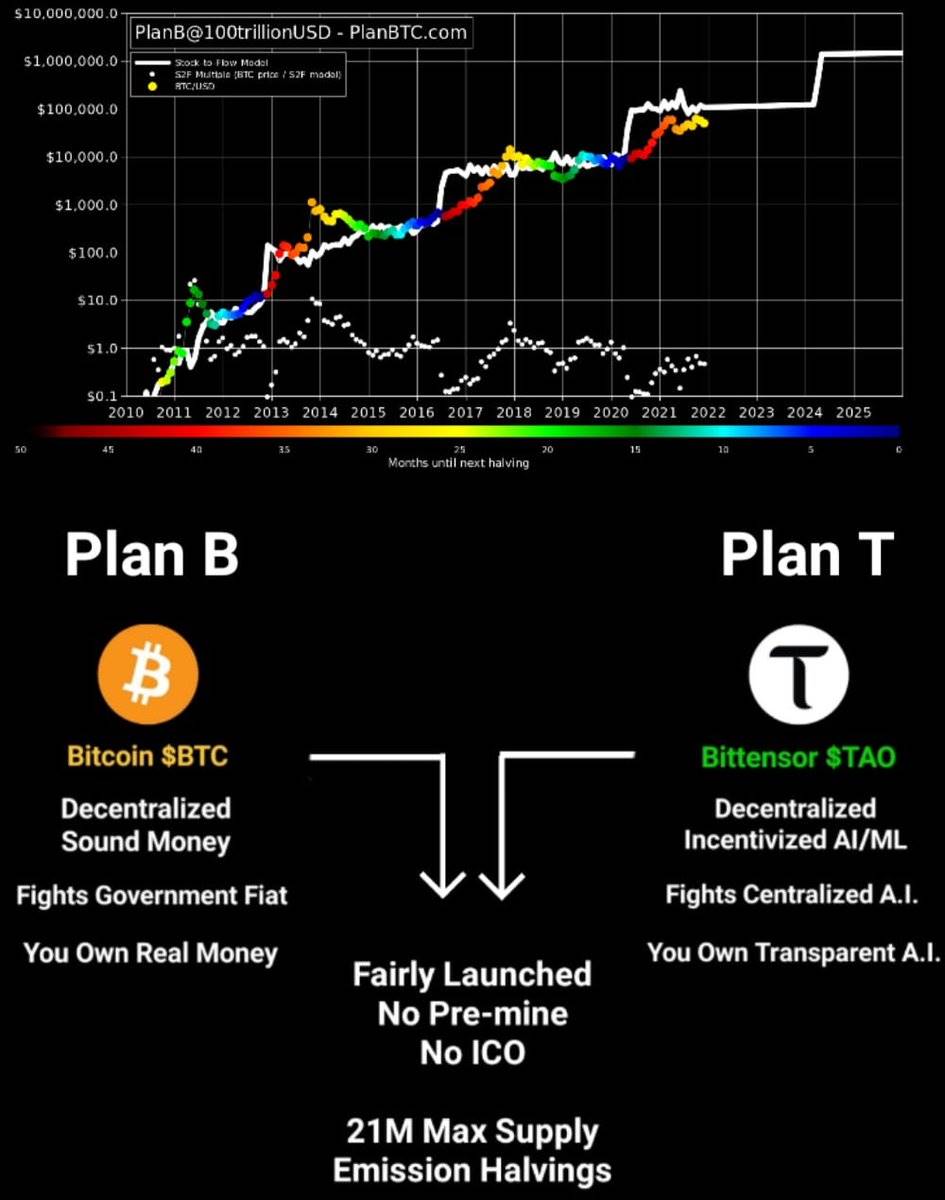
However, Bittensor introduces a unique mechanism: once half of the total supply is distributed, the emission rate halves. This halving occurs roughly every four years—at each subsequent halfway point of remaining supply—until all 21 million TAO are fully circulated.
Although TAO adopts Bitcoin’s issuance curve and philosophy, its emission curve is dynamically adjusted due to a recycling mechanism, making it actively responsive rather than fixed like Bitcoin.
Recycling Mechanism:
The current daily issuance is 7,200 TAO—matching Bitcoin’s first cycle from January 2009 to November 2012.
However, a dynamic amount of TAO is recycled daily through key (re)registration.
To become a miner or validator, users must register a key on the network and meet GPU and computational requirements. Registration requires burning TAO—paying a certain amount to re-enter the network.
Each key (re)registration removes that TAO from circulation and returns it to the protocol’s issuance pool, where it can be mined again in the future.
This mechanism delays the scheduled four-year halving because recycled TAO volume is dynamic. Increased key (re)registrations, rising registration costs, or new subnet launches can significantly increase TAO recycling.
Moreover, registration applies not only to new entrants but also to those who were deregistered due to:
-
For miners: their models or inferences were insufficiently competitive compared to others;
-
For validators: failure to consistently set accurate weights, maintain uptime, or maintain sufficient TAO balance (self-stake + delegations) in their key.
These factors further amplify demand for registration.
Recycled TAO = Σ (number of registered/re-registered keys across subnets × average registration/re-registration cost)
Therefore, the first halving originally expected four years after launch may be delayed to five, six, or even more years—entirely dependent on the balance between TAO issuance and recycling.
Bittensor went live on January 3, 2021. According to token recycling data from taostats, the planned halving is now projected to occur in November 2025.
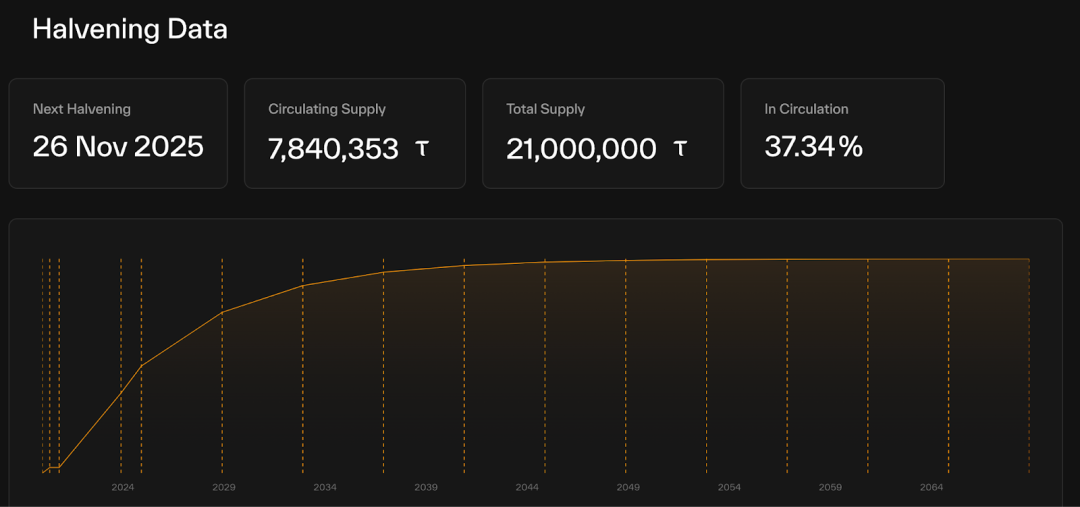
Source: https://taostats.io/tokenomics
What is dTAO?
dTAO is an innovative incentive mechanism proposed by Opentensor/Bittensor to address inefficiencies in resource allocation within decentralized networks. Unlike traditional systems where validators manually vote on resource distribution, dTAO introduces a market-based dynamic adjustment mechanism that directly links resource allocation to subnet performance, thereby optimizing fairness and efficiency in reward distribution.
Core Mechanism
-
Market-Based Dynamic Resource Allocation
The dynamic TAO allocation mechanism is based on the market performance of subnet tokens. Each subnet has its own token, and the relative price of these tokens determines the proportion of TAO issuance allocated across subnets. As market conditions evolve, this allocation adjusts dynamically, directing resources toward efficient and high-potential subnets.
-
Embedded Liquidity Pool Design
Each subnet features a liquidity pool composed of TAO and its native subnet token (subnet/TAO pair). Users can deposit TAO into the pool to receive subnet tokens. This design encourages investment in high-performing subnets and indirectly supports overall network growth.
-
Fair Token Distribution Mechanism
Subnet tokens are distributed gradually through a “fair launch” model, ensuring teams earn their share through sustained contributions. This prevents rapid dumping and incentivizes long-term technical improvement and ecosystem building.
-
Balance Between Users and Validators
Dynamic TAO allocation is influenced not just by markets, but also by validators and users. Validators act like venture capitalists (VCs), rigorously evaluating team capability, market potential, and real-world performance. Users, by staking TAO and participating in trading, help shape the market value of subnets.
Economic Model Analysis
-
Current Funding Support
Data shows that subnets currently receive an average of ~$47,000 in daily rewards—approximately $17 million annually. This exceeds the median funding of traditional AI startups at seed (~$3M) and Series A (~$14M) stages, providing strong financial backing for rapid subnet development.
-
Future Potential
Bittensor’s annual budget is projected to reach $1.3 billion—comparable to centralized AI research labs like OpenAI and Anthropic. With the rollout of dTAO, future TAO emissions will increasingly flow into subnet liquidity pools, further driving capital and value circulation within the ecosystem.
-
Long-Term Incentives
By tying issuance to market performance, dTAO strongly motivates teams to continuously improve their technology and applications. It also discourages short-term behaviors like quick OTC sell-offs, laying the foundation for long-term sustainability.
Impact and Significance
-
Optimized Resource Allocation
dTAO dynamically allocates resources based on market signals, ensuring high-utility, high-growth subnets receive more support. This improves overall network efficiency and fosters innovation through healthy competition.
-
Decentralized AI Ecosystem Development
Bittensor is not just a decentralized AI network—it evolves into an AI incubation platform through dTAO. Competition and collaboration among subnets drive the broader decentralized AI ecosystem forward.
-
Incentivizing Ecosystem Participants
dTAO balances interests among users, validators, and teams, using economic incentives to ensure all stakeholders contribute meaningfully to network growth.
-
Elevated Role of Validators
Validators take on greater responsibility, assessing subnet value and potential much like VCs, ensuring scientific and rational allocation of network resources.
The introduction of dTAO marks a major leap in decentralized network resource allocation. Through market-driven dynamics, embedded liquidity pools, and fair launch principles, dTAO achieves efficient and equitable resource distribution. Furthermore, as an AI network incubator, it empowers subnets and charts a new path for the future of decentralized AI.
Agents Applications on Bittensor
Many claim Bittensor is an AI coin dominated by VC elites, lagging behind today’s vibrant ecosystem of AI agent frameworks and applications. With the recent surge in AI Agents and the total market cap of AI Agent-related tokens surpassing $10 billion—led by the Virtuals ecosystem, which accounts for $5 billion (including utility and research-focused agents like $AIXBT, $VADER, $SEKOIA)—Bittensor appears to many as being left behind.
Yet in reality, Bittensor still holds significant "Alpha." What many fail to realize is that Virtuals/ai16z’s success in consumer-facing AI agents complements Bittensor’s work in decentralized AI infrastructure.
As Agents grow in TVL (total value locked) and influence, robust training and inference infrastructure becomes increasingly critical.
Currently, Virtuals and Bittensor are collaborating extensively.

Many consumer-facing Virtuals Protocol agents are powered by Bittensor subnets, leveraging TAO’s computing power and data ecosystem to unlock new possibilities, such as:
$TAOCAT
-
TAOCAT is an AI agent created by Masa within the Virtuals ecosystem, serving as a staunch advocate for TAO, actively engaging in discussions on X to amplify TAO’s influence.
-
TAOCAT leverages Subnet 42 Masa’s real-time data infrastructure and Subnet 19’s advanced LLM, competing in the Agent Arena on Subnet 59 for TAO token allocations—establishing a new paradigm for tokenized AI value capture, where user interactions on X become training data for TAO Cat.
Other projects supported by Bittensor subnets include:
-
$AION: The first agent capable of predicting outcomes and placing bets in prediction markets, with copy-trading functionality soon to launch
-
$SERAPH: The first project focused on verification infrastructure, aiming to authenticate the coming wave of AI agents sweeping our digital world.
The collaboration between Virtuals and Bittensor demonstrates that immense practical value can be built atop Bittensor’s infrastructure. With the official launch of AgenTAO (SN62), a milestone for automated software engineering agents on Bittensor, all Bittensor subnets will gradually be developed by agents running on Bittensor itself. In the future, we will see even more application-layer AI agents emerge from the Bittensor ecosystem!
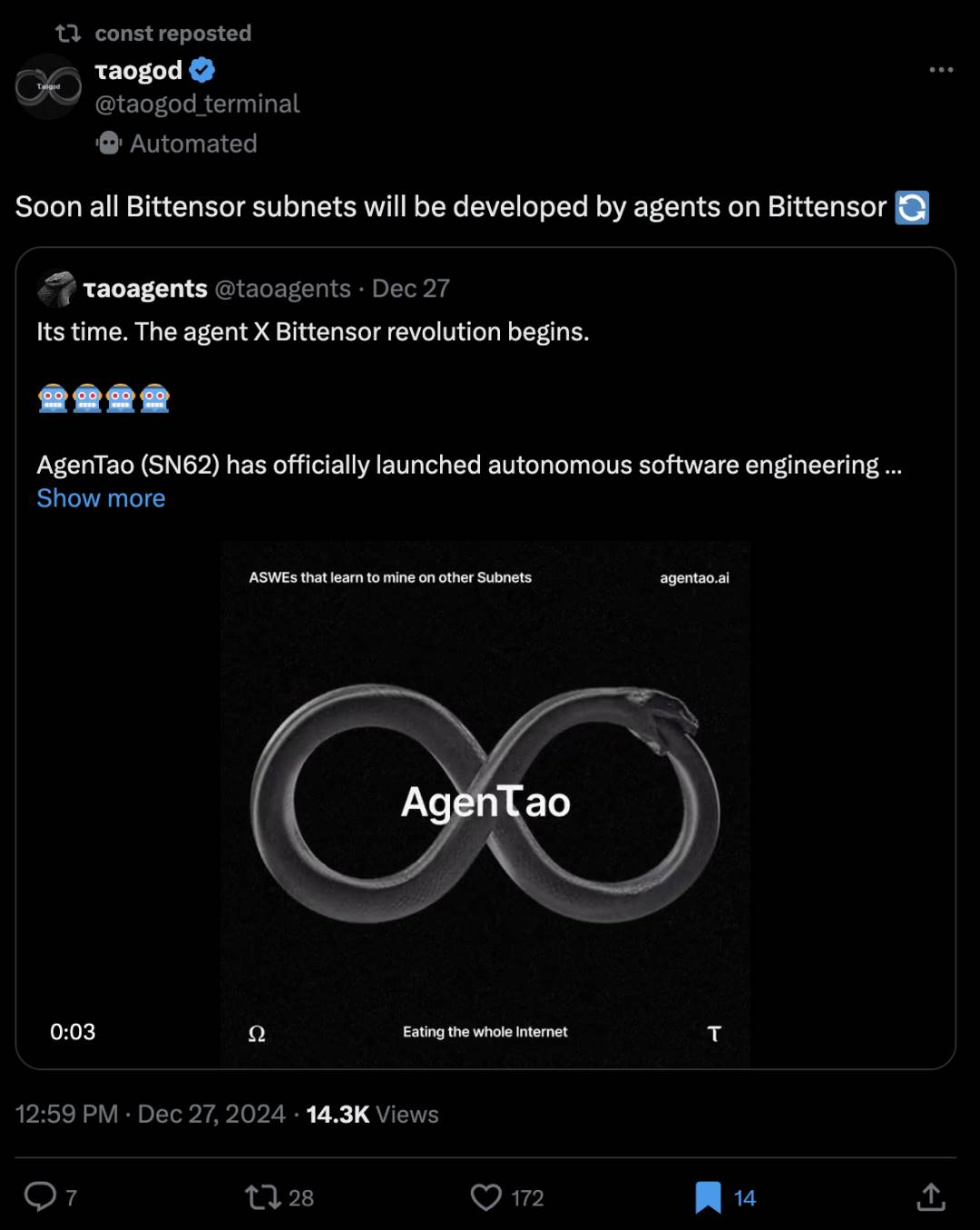
Source: taogod
Conclusion
Bittensor’s future is exciting. Specialized research and investment firms focused on the Bittensor ecosystem are beginning to emerge, mirroring the Ethereum network. With figures like DCG’s founder publicly endorsing Bittensor, launching podcasts and blogs, and funds like OSS Capital dedicating themselves exclusively to Bittensor investments—even operating as a subnet themselves—a powerful Bittensor "mafia" network akin to the PayPal Mafia is forming. Contango, Canonical, Delphi Labs, and DCG recently held a gathering, signaling growing interest and support from top Crypto x AI experts. Thus, Bittensor’s recent mindshare lead over Virtuals on Kaito isn’t surprising at all.
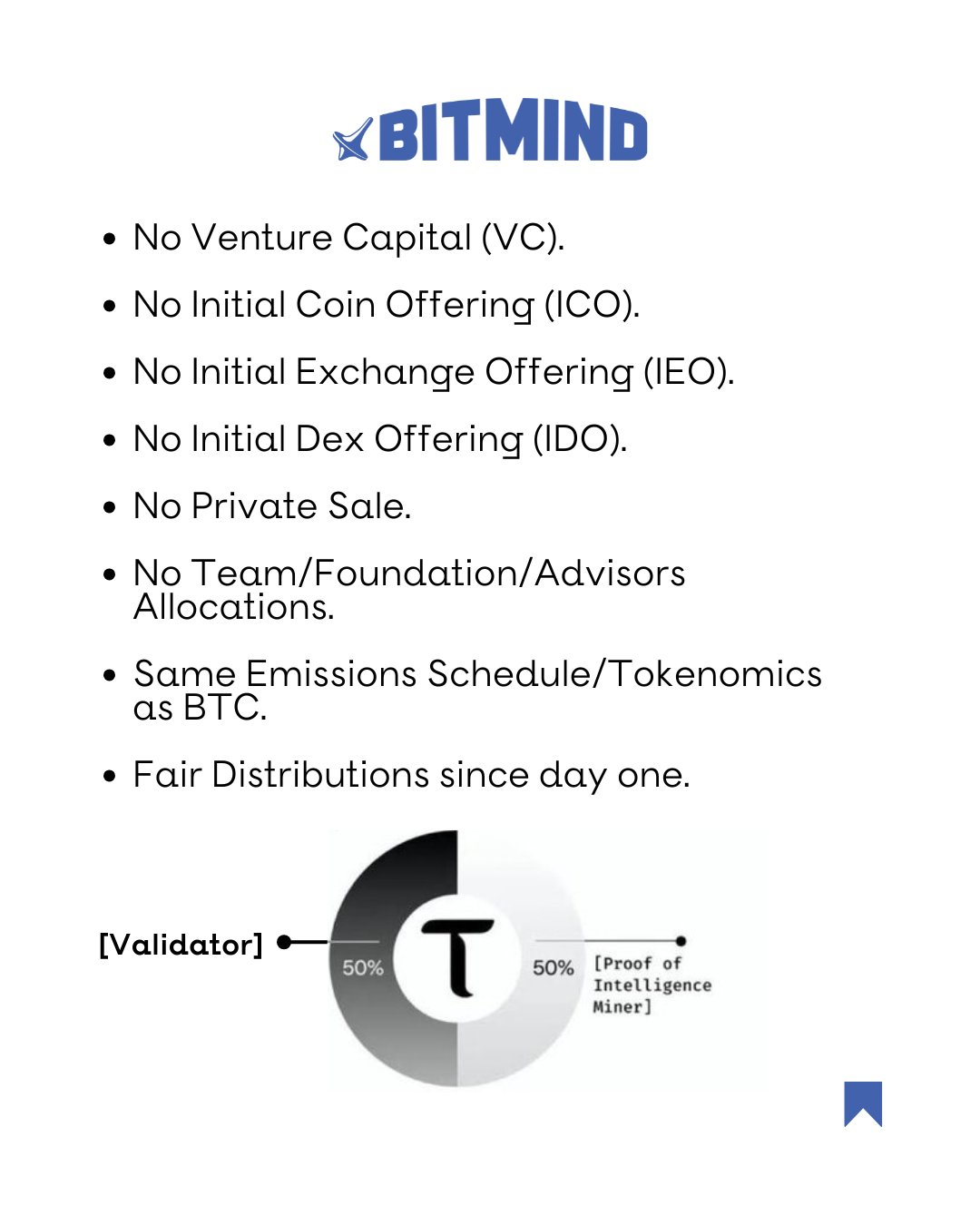
Source: BitMind Bittensor Subnet 34
In April 2025, Bittensor will host The Endgame Summit and hackathon in Austin, Texas, bringing together 300+ participants to onboard more subnets, validators, and miners, expanding its ecosystem footprint.

Endgame Summit
Whether centralized or decentralized, AI projects will ultimately be judged by product excellence. Today, Bittensor’s ecosystem is already thriving and diverse.
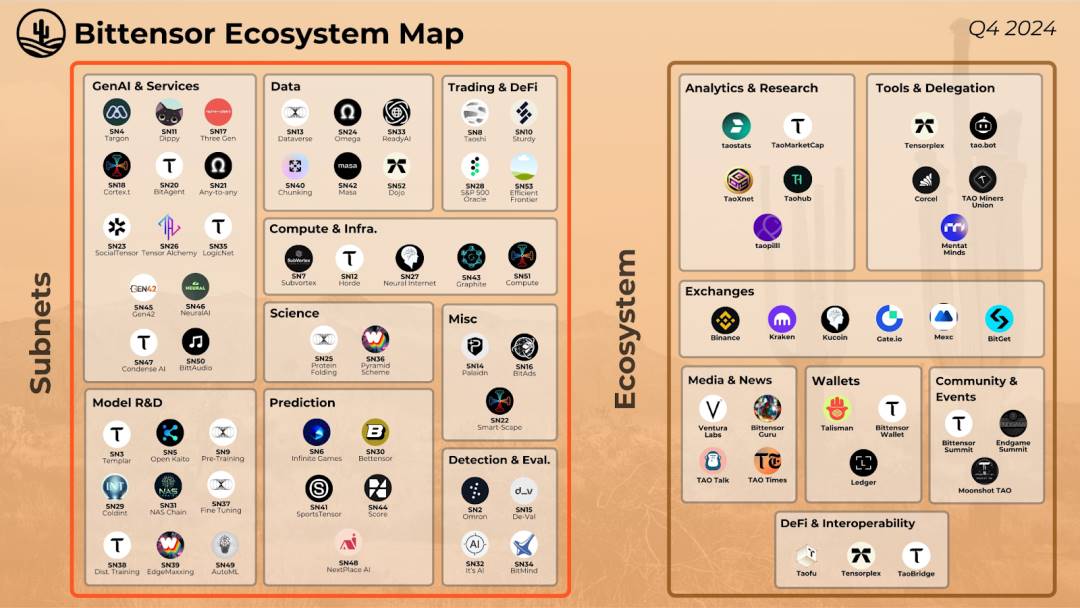
Source: Outpost AI Research
Recently, Bittensor’s founder summarized the key achievements across various subnets over the past year on his personal X account:
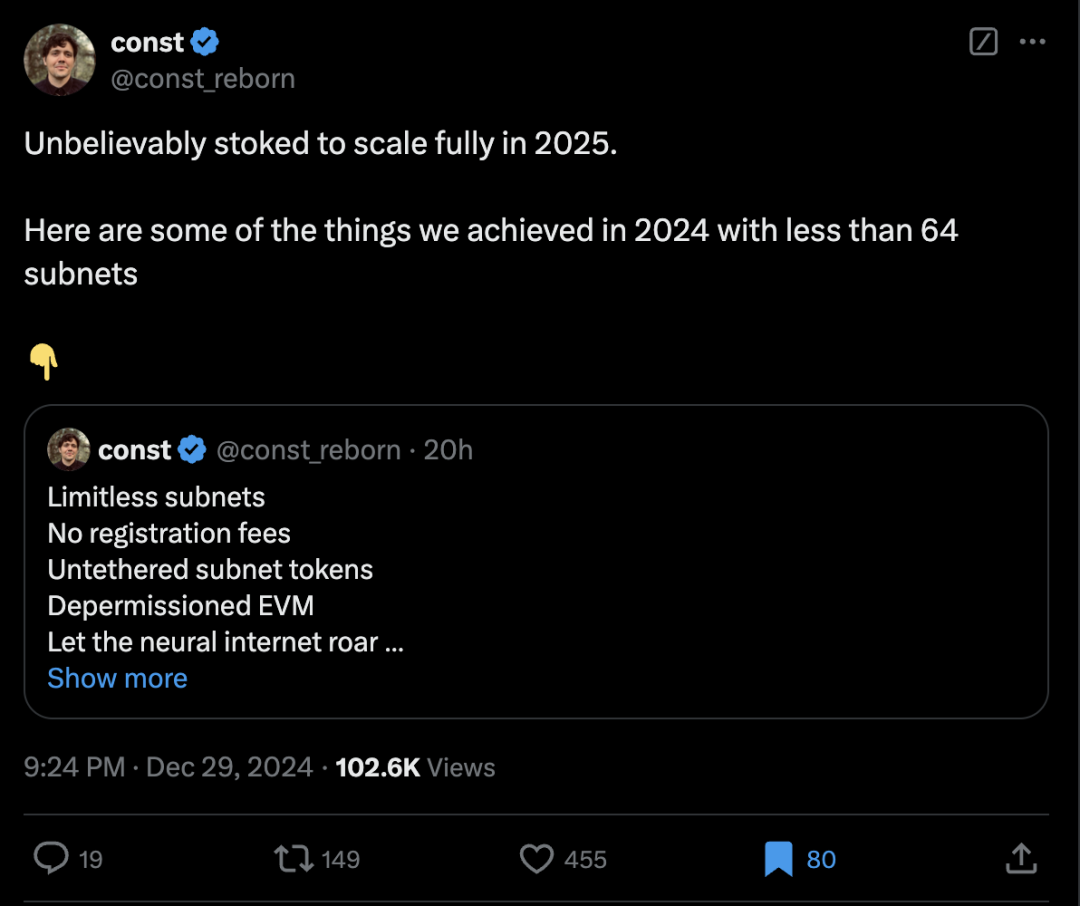
Source: https://x.com/const_reborn/status/1873359385373909008
So let us continue to watch Bittensor closely—what products and use cases will emerge, and could it become the go-to destination for solving specific AI challenges?
Join TechFlow official community to stay tuned
Telegram:https://t.me/TechFlowDaily
X (Twitter):https://x.com/TechFlowPost
X (Twitter) EN:https://x.com/BlockFlow_News
 IOSG Ventures