HTX Research | The Evolution of Bittensor: How dTAO Reshapes Open-Source AI Ecosystems with Market Incentives
TechFlow Selected TechFlow Selected
HTX Research | The Evolution of Bittensor: How dTAO Reshapes Open-Source AI Ecosystems with Market Incentives
In-depth analysis of the impact of the dTAO upgrade on the Bittensor ecosystem, focusing on its architectural innovations, economic model, and overall ecosystem dynamics.
 Navigating Web3 tides with focused insights
Author: Chloe Zheng
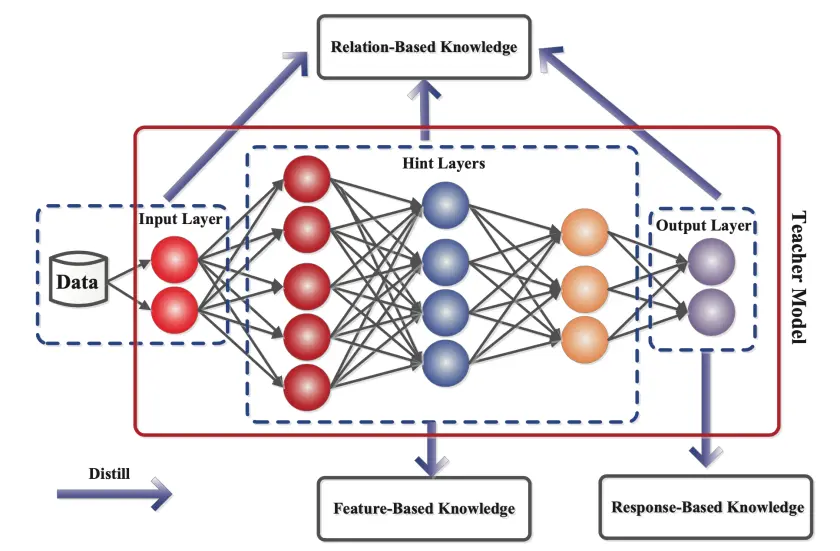
According to a 2023 study by Sequoia Capital, 85% of developers prefer fine-tuning existing models rather than training from scratch. Recent trends further validate this: DeepSeek has open-sourced its model and introduced model distillation, transferring reasoning logic from teacher models (large models) to student models (smaller models) to optimize knowledge compression and performance retention. Similarly, OpenAI’s ChatGPT O3 emphasizes post-training and reinforcement learning. Bittensor provides an open, decentralized platform enabling collaboration and sharing of AI models. In July 2024, Bittensor and Cerebras launched the BTLM-3b-8k open-source large language model (LLM), which garnered over 16,000 downloads on Hugging Face, demonstrating Bittensor's technical capabilities.
Despite launching in 2021, Bittensor remained largely absent during the AI Agent boom in Q4 2024, with its token price stagnating. On February 13, 2025, Bittensor launched the dTAO upgrade, aiming to optimize token issuance, improve fairness, and increase liquidity. This change is analogous to Virtuals Protocol launching an AI Agent LaunchPad, which led $VIRTUAL’s market cap to surge 50-fold in 2024.
The report “dTAO and the Evolution of Bittensor: Reshaping the Open-Source AI Ecosystem Through Market-Driven Incentives” analyzes the impact of the dTAO upgrade completed on February 13, 2025, focusing on architectural innovations, economic models, and overall ecosystem dynamics.
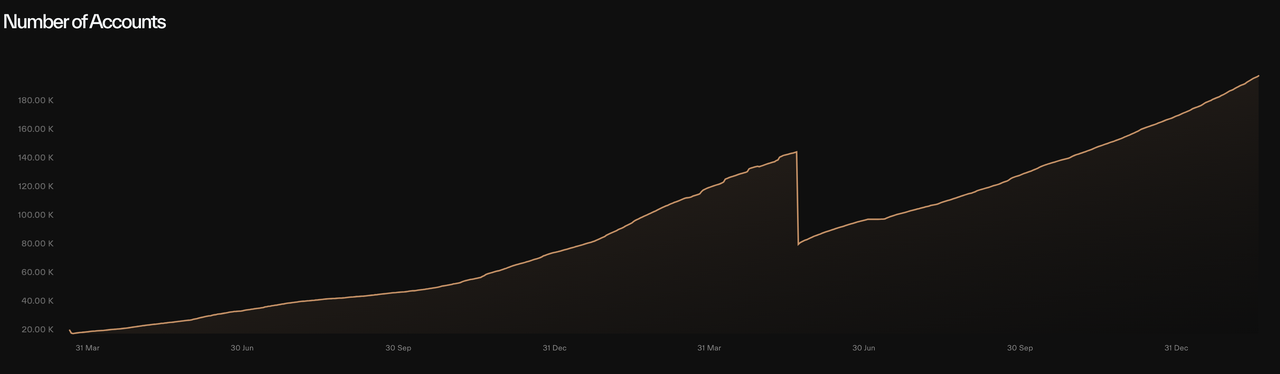
The number of accounts in the Bittensor system increased by 100%, growing from 100,000 at the beginning of 2024 to nearly 200,000
1. Bittensor's Basic Architecture
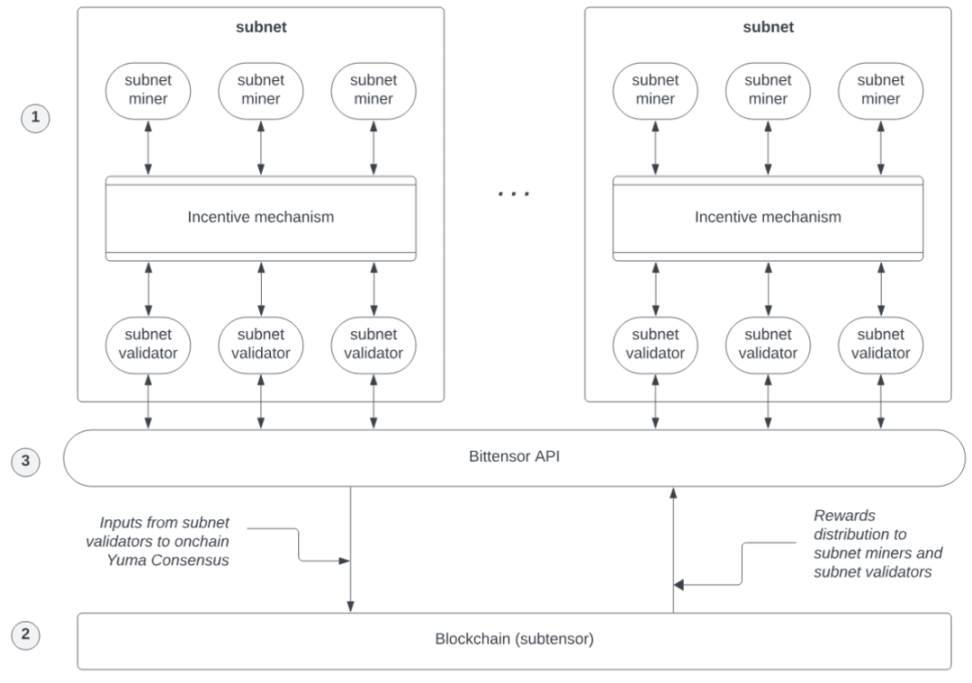
The Bittensor system consists of three main modules:
-
Subtensor Blockchain and its EVM-Compatible Layer (tao evm): Subtensor is a Layer 1 blockchain built using Polkadot’s Substrate SDK, responsible for managing the blockchain layer of the Bittensor network. Its EVM-compatible layer (tao evm) allows developers to deploy and run Ethereum smart contracts on the network, enhancing scalability and compatibility. The Subtensor blockchain produces a block every 12 seconds, minting one TAO token per block. Additionally, Subtensor records key activities within subnets, including validators’ score weights and staked token amounts. Every 360 blocks (approximately 72 minutes), the Yuma Consensus algorithm calculates emissions—tokens allocated to each of the 64 subnets.
-
Subnets: The Bittensor network includes 64 subnets, each dedicated to a specific type of AI model or application. This modular structure enhances efficiency and promotes specialization across different AI models. Each subnet’s incentive mechanism is defined by its owner, determining how tokens are distributed between miners and validators. For example, Subnet 1, operated by the Opentensor Foundation, focuses on text prompting. In this subnet, validators issue prompts similar to those in ChatGPT, and miners respond accordingly. Validators rank responses based on quality, periodically update weights, and upload them to the Subtensor blockchain. Every 360 blocks, Yuma Consensus computes and allocates emissions for the subnet.
-
Root Subnet: Serving as the network’s core, the root subnet coordinates and manages all other subnets, ensuring overall stability and coherence.
Bittensor API acts as a bridge, connecting validators within subnets to the Yuma Consensus mechanism on the Subtensor blockchain. Validators within the same subnet only connect to miners in that subnet; there is no cross-communication between validators and miners across different subnets.
This architecture enables Bittensor to effectively integrate blockchain technology with artificial intelligence, creating a decentralized and efficient AI ecosystem.
The tao evm EVM-compatible layer went live on December 30, 2024. It allows deployment and interaction with Ethereum smart contracts without any modifications, while all EVM operations execute solely on the Subtensor blockchain and do not interact with Ethereum. This means Bittensor smart contracts are confined to the Bittensor network and are independent of the Ethereum mainnet. Currently, tao evm remains in an early stage, hosting projects like TaoFi, which plans to develop AI-powered DeFi infrastructure, including a TAO-backed stablecoin, decentralized exchange, and liquid staking version of TAO.

1.1 Account System
1.1.1 Coldkey-Hotkey Dual-Key System
The dTAO account system adopts a Coldkey-Hotkey dual-key mechanism for enhanced security and flexibility. When creating a wallet, users can choose to generate it via a Chrome extension or locally. Wallets created through the Chrome extension are used for storing, sending, and receiving TAO, generating a coldkey (a 48-character string typically starting with "5") and a 12-word recovery phrase. Locally created wallets generate both a coldkey and a hotkey, where the hotkey is used for operations such as subnet creation, mining, and validation.
The primary reason for adopting the Coldkey-Hotkey system is that hotkeys are frequently used in daily subnet operations and face greater security risks, whereas coldkeys are primarily used for storing and transferring TAO, thereby reducing the risk of TAO loss. This dual-layer protection ensures secure and flexible account management.
In terms of binding relationships, one hotkey can be linked to one coldkey within the same subnet (though linking to coldkeys across different subnets is technically possible but not recommended). A single coldkey can bind multiple hotkeys.
1.1.2 Subnet UID System
1.1.2.1 Subnet UID Generation
After paying a registration fee of at least 100 TAO, the system generates a Subnet UID bound to your hotkey. This UID is required to participate in mining or validation within a subnet. To become a miner, you only need a hotkey, coldkey, and Subnet UID—then simply run Bittensor to start mining.
1.1.2.2 Requirements to Become a Validator
To become a subnet validator, one must stake at least 1,000 TAO, ranking among the top 64 stakers within each subnet. Notably, validators can hold multiple UID slots across subnets without needing additional stake (similar to restaking). This design increases the cost of malicious behavior since a significant stake (at least 1,000 TAO) makes attacks economically unfeasible. To maintain competitiveness, validators strive to build strong reputations and performance records to attract more delegated stakes, securing their position within the top 64.
1.1.2.3 Subnet Structure and Capacity Limits
-
Subnet 1: Has 1,024 UID slots, supports up to 128 validators, with a total limit of 1,024 combined validators and miners.
-
Other Subnets: Each has 256 UID slots, supports up to 64 validators, with a combined validator-miner cap of 256 per subnet.
1.1.2.4 Subnet Competition and Incentive Mechanism
Within each subnet, validators assign tasks to miners. After completing tasks, miners submit results back to validators, who evaluate and rank the quality of submissions. Miners receive TAO rewards based on output quality, while validators are also rewarded for accurately identifying high-performing miners, driving continuous quality improvement. This competitive process is fully automated via code-defined incentive mechanisms set by subnet creators, ensuring fair and efficient operation.
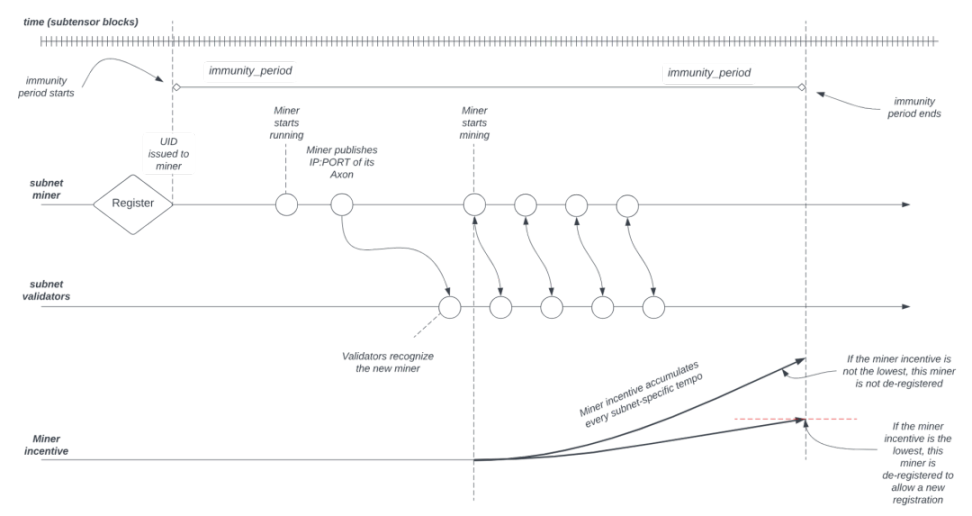
Each subnet has a 7-day protection period (immune period) starting when a miner registers a UID. During this time, miners accumulate rewards. If new miners register when all UID slots are full, the miner with the lowest accumulated reward is ejected, and their UID is reassigned.
1.2 Subnets Build a Multi-Layered Ecosystem
Bittensor subnets form a multi-tiered ecosystem where miners, validators, subnet creators, and consumers each play distinct roles in delivering high-quality AI services.
Miners: As core computational nodes, miners host AI models and provide inference and training services. They compete via point-to-point scoring and loss minimization to earn TAO rewards. Miner success depends directly on service quality and performance.
Validators: Responsible for evaluating miner outputs, building trust matrices, preventing collusion, and ensuring top performers receive higher rewards. Their ranking accuracy determines their own reward levels—the more consistent and precise the rankings, the greater the validator’s return.
Subnet Creators: Design customized subnets tailored to specific domains (e.g., NLP, computer vision), defining independent consensus rules, task workflows, and incentive structures. They act as network administrators with authority to allocate incentives within their subnets.
Consumers: Final users or enterprises who pay TAO to access AI services—such as querying APIs, obtaining training data, or leveraging compute resources for model training. They represent the end users of Bittensor-hosted AI models.
The overall workflow: Subnet validators generate queries and distribute them to all miners. Miners generate responses and return them to validators. Validators score responses based on quality, update miner weights, and regularly upload these weights to the blockchain. Through intense competition and natural selection, this mechanism continuously advances AI model development and optimizes the ecosystem.
1.2.1 Miner Layer
Miners serve as core computational nodes in the Bittensor network, with key responsibilities including:
-
Hosting AI Models and Providing Inference/Training Services: Miners host local machine learning models to deliver prediction services to client applications. When clients require predictions, requests are routed through the Bittensor network to registered miner-service providers, who process and return results.
-
Earning TAO Through P2P Ranking Competition: Miners compete in peer-reviewed rankings based on model performance and contribution to the network, earning TAO as incentives. This encourages ongoing optimization of model quality and delivery of superior AI services.
-
Ensuring High-Quality Model Contributions: Miners aim to deliver high-quality AI models to meet network demands and ensure service reliability. This improves their standing and rewards within the network while enhancing the overall performance and robustness of the Bittensor ecosystem.
By fulfilling these roles, miners make vital contributions to the efficient operation and growth of the Bittensor network.
Each miner fixes a model trained on dataset D to minimize the loss function Li = ED[Qfix]
Where:
-
Qfix is the error function
-
ED denotes the expectation over dataset D.
For instance, if Miner A provides a speech recognition model fAx, its loss function might be:
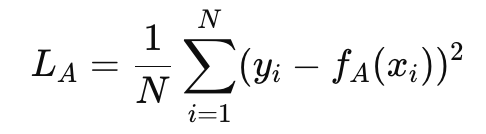
A lower LA (i.e., better model performance) leads to a higher ranking in P2P evaluation.
Each miner’s contribution is measured via Fisher Information Metric (FIM): Ri = W·S
Where:
-
W is the weight matrix representing pairwise scores among miners.
-
S is the miner’s staked amount (holdings) on the network.
If Miner A and Miner B mutually rate each other, the weight matrix would be:
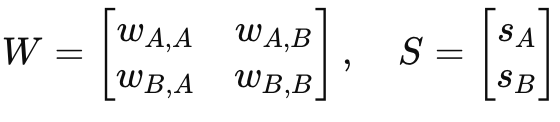
Miner A’s final ranking is:

If Miner A possesses a high-quality AI model, wB,A will be high, resulting in a higher RA and thus greater rewards.
Validator Layer
Validators ensure fair assessment of miners’ AI models, preventing collusion and malicious behavior. They act as referees within the network, guaranteeing delivery of high-quality AI services.
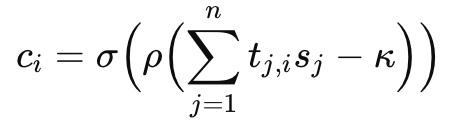
Validators rank miners by computing a trust matrix:
-
ci is the trust score of miner i.
-
tj,i represents miner j’s trust level toward miner i.
-
sj is miner j’s staked amount.
-
σ is the Sigmoid function, used for smooth scaling.
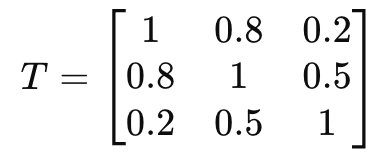
For example, suppose there are three miners A, B, and C, with the following trust matrix:
-
If Miner A has a well-performing model, both Miners B and C will highly trust A.
-
If Miner C’s model is mediocre, only Miner B may moderately trust C.
As a result, Miner A receives a higher trust score cA and earns more rewards, while Miner C receives a lower score.
1.2.2 Consumer Layer
In the Bittensor network, consumers refer to end users or enterprises who access AI services provided by miners by paying TAO tokens. This model allows consumers to leverage AI capabilities without owning or maintaining their own models, significantly lowering AI computation costs.
Specific use cases include:
-
Developers querying AI APIs: Developers can call Bittensor’s AI interfaces to obtain intelligent services for app development or feature integration.
-
Research institutions accessing AI training datasets: Research organizations can utilize network resources to access and analyze large-scale AI training datasets, supporting research projects and experiments.
-
Enterprises using Bittensor’s compute resources for AI model training: Companies can leverage Bittensor’s decentralized computing power to train and optimize proprietary AI models, advancing business intelligence.
Through this approach, Bittensor offers flexible and efficient access to AI services, promoting broader adoption and application of artificial intelligence.
1.2.3 Stake-Based Consensus Mechanism
Bittensor’s stake-based consensus mechanism addresses several critical issues:
-
Preventing Malicious Score Manipulation and Ensuring Fair Evaluation: Iterative correction w ← f(w) adjusts any weights deviating excessively from consensus (i.e., stake-weighted average w), reducing the influence of self-overrating by adversarial parties.
-
Rewarding High-Quality AI Contributors: Validators who consistently contribute high-quality outputs maintain higher rankings even after weight correction, as their reported weights align closely with the consensus value.
Stake-Based Game Model
We model the consensus system as a two-player game:
-
Honest party (main player) stakes: SH with 0.5 < SH ≤ 1
-
Adversarial party (opponent) stakes: 1 - SH
Both compete for fixed total rewards: eH + eC = 1, where eH and eC are rewards for honest and adversarial parties respectively.
After reward distribution, stakes are updated as:

The honest party assigns itself an objective weight wH and allocates 1−wH to the opponent.
In contrast, the adversary can freely choose its self-assigned weight wC at no cost, aiming to maximize the honest party’s expenditure:

Imagine judges in a competition. Honest judges give fair scores, while malicious ones (adversaries) may artificially inflate scores for favored contestants, forcing honest judges to work harder to remain competitive.
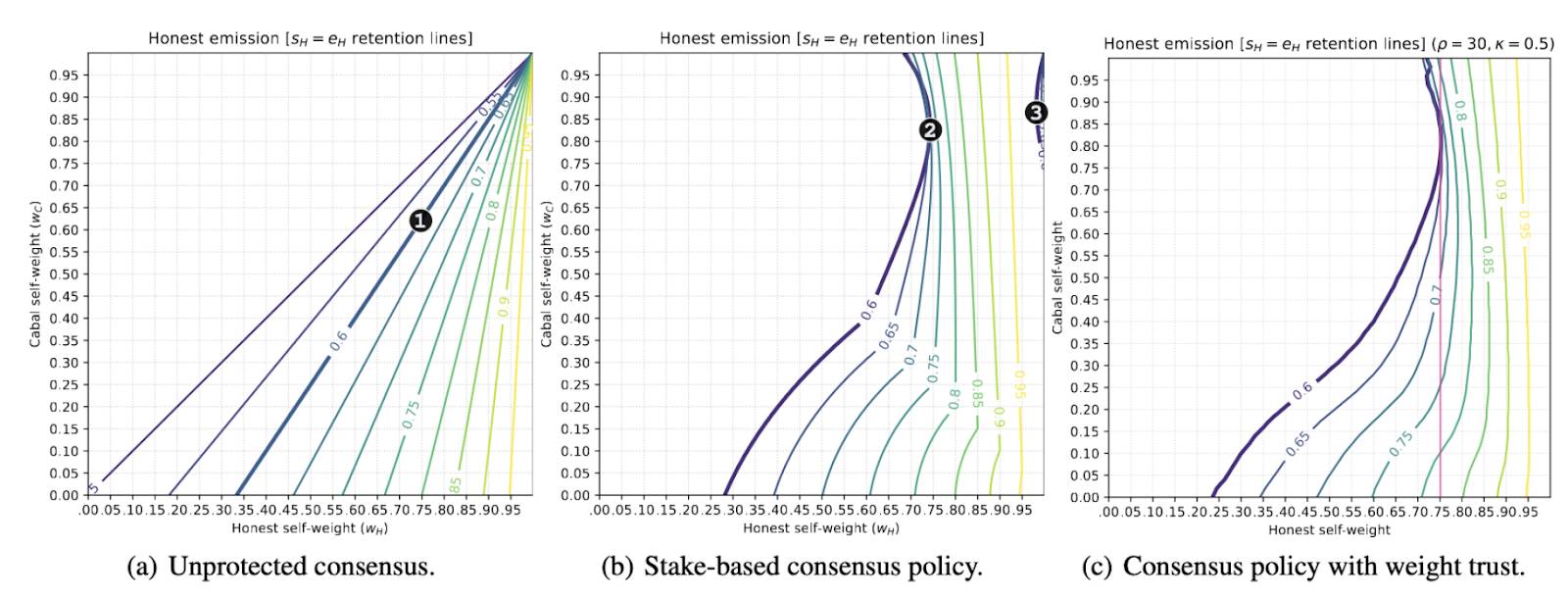
Since the honest party holds majority stake (sH > 0.5), they can implement an anonymous consensus strategy π, adjusting all weights without knowing player identities to optimize Nash equilibrium:

The goal is to adjust weights so that corrected weights satisfy:
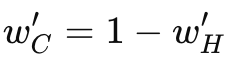
Thereby correcting errors:

The basic consensus strategy is defined as:
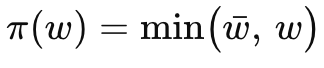
Where consensus weight w is the stake-weighted average:
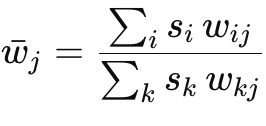
This strategy is then iterated:

Where η is the iteration count.
This resembles a precision-calibrated scale. If one side is too heavy, the system repeatedly adjusts until balance is restored. For example, when SH = 0.6 and initial wH = 1, after multiple iterations, even if the adversary reports a high wC (e.g., wC = 0.8), the honest party’s effective expenditure drops below 0.75.
1.2.3.1 Smoothing and Density Evolution
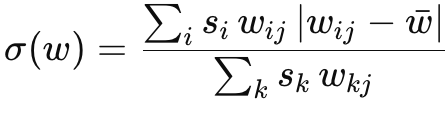
To prevent abrupt corrections from destabilizing the system, the correction function employs “smoothing.” We define the stake-weighted mean absolute deviation as:
Then, smoothed correction is given by:

Where parameter α (0 ≤ α < 1) controls the degree of smoothing.
This gradual adjustment resembles a driver smoothly braking during a turn rather than slamming the brakes. This incremental approach gently corrects minor weight differences, preserving overall system stability.
Extending to a two-team game (where |H| is the number of honest players and |C| is the number of adversarial players), each team’s weight distribution can be described by a density function pw. For honest players, assume weights follow a normal distribution:

The adversarial team’s distribution is analogous. The combined density distribution is:

Then apply the density evolution function:

Where gw = f⁻¹(w). After η iterations, each player’s final ranking is: r_i = ∫ f^η(p_i(w)) dw.
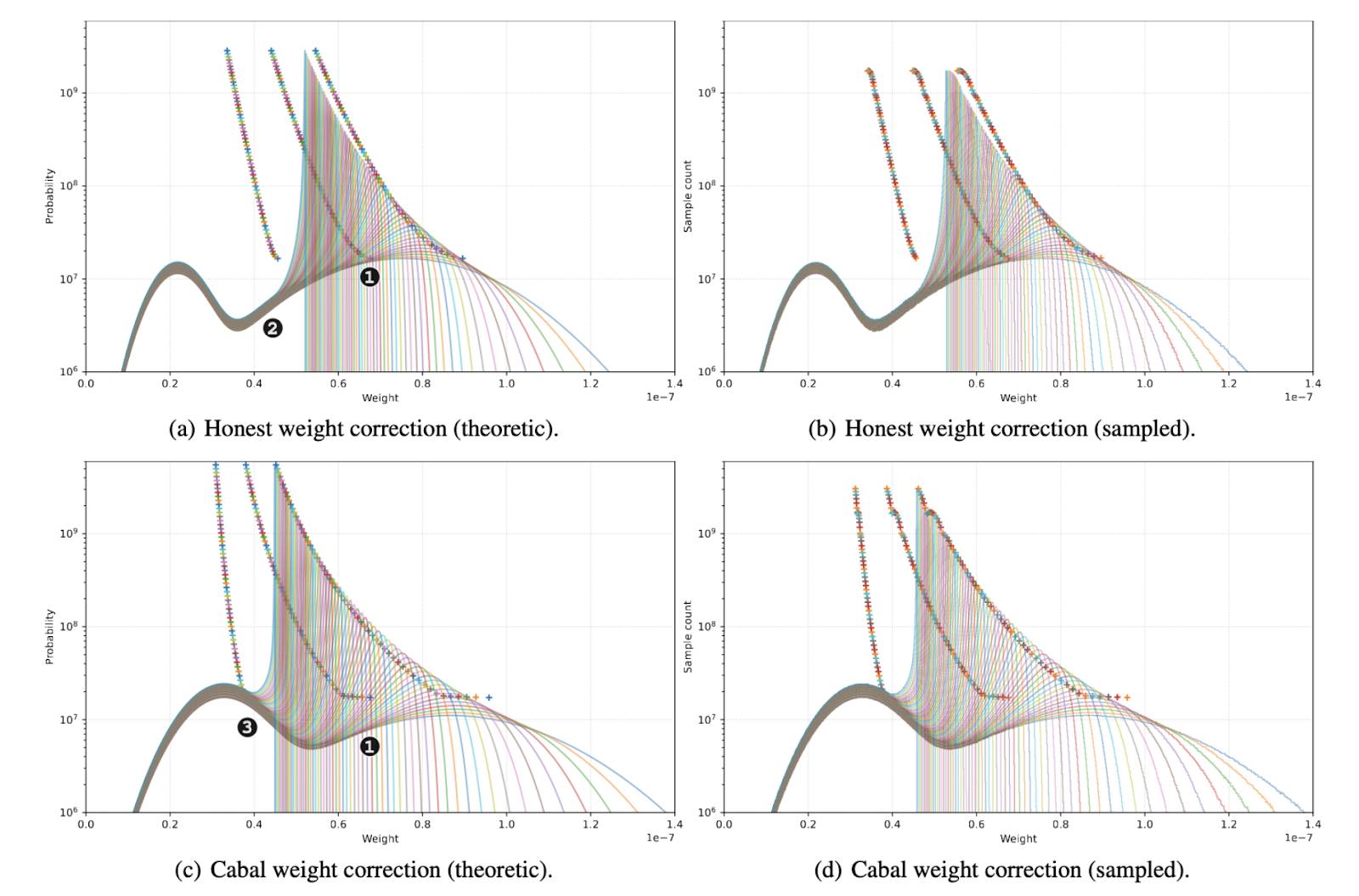
This process resembles statistical smoothing over large datasets. After multiple rounds of “smoothing,” each participant’s true ranking emerges. Crucially, density evolution compresses outlier weights (i.e., inflated weights from malicious players) more aggressively while minimally affecting honest players.
1.2.3.2 Weight Trust Mechanism and Zero-Weight Vulnerability Prevention
To prevent adversarial players from reporting near-zero weights to evade penalties, a weight trust mechanism is introduced. Define trust value T as: T = (W > 0) · S
That is, the total stake assigned to non-zero weights. Then apply a smooth threshold:
C = (1 + exp(−ρ(T − κ)))⁻¹
This mechanism ensures that if most participants assign zero weight to a node, its rewards are heavily penalized.
Similar to a community reputation system—only when most members recognize someone as trustworthy does that person receive full benefits; otherwise, attempts to manipulate the system by reporting zero weights are punished.
Current challenges include:
-
Zero-weight vulnerability: Adversarial players may report extremely low or zero weights to exploit reward distribution loopholes.
-
Imbalanced correction: In some cases, corrections may be overly aggressive or too mild, causing consensus bias.
-
High computational complexity: Density evolution and multiple iterations involve O(n²) computations, potentially burdening the blockchain environment.
The dTAO upgrade addresses these issues through the following improvements:
-
Optimized iteration and smoothing: Increase iteration count η and finely tune smoothing parameters α or δ to reduce zero-weight vulnerabilities and prevent over-correction.
-
Enhanced weight trust mechanism: More accurately detect non-zero weights and apply stricter thresholds so only nodes recognized by the majority receive full rewards.
-
Reduced computational overhead: Algorithmic optimizations lower computational costs, making it suitable for blockchain constraints without sacrificing theoretical accuracy.
Bittensor’s stake-based consensus mechanism combines mathematical modeling and game theory tools—using update formulas, weighted-average consensus, iterative correction, and density evolution—to automatically calibrate anomalous weight deviations and ensure fair final reward distribution.
This process resembles an intelligent balancing system or reputation mechanism that continuously self-calibrates to ensure fair scoring, incentivize top contributors, and prevent collusion and vote manipulation.
Building on this foundation, the dTAO upgrade introduces finer smoothing control and improved weight trust strategies, further enhancing system robustness and fairness. Thus, under adversarial conditions, honest contributors maintain a competitive edge while overall computational resource consumption is optimized and reduced.
2. Yuma Consensus: Dynamic Programmable Incentives and Consensus
Bitcoin built the world’s largest peer-to-peer computing network, allowing anyone to contribute local compute power to maintain the global ledger. Its incentive rules were fixed at design time, leading to relatively static ecosystem development.
In contrast, Yuma Consensus (YC) is a dynamic, programmable incentive framework. Unlike Bitcoin’s static incentives, YC integrates objective functions, staking rewards, and weight adjustment mechanisms directly into the consensus process. This means the system doesn’t rely solely on fixed rules but dynamically adjusts based on node contributions and behaviors, enabling fairer and more efficient reward allocation.
The YC consensus algorithm runs continuously on the Subtensor blockchain and operates independently for each subnet. Its main components include:
-
Validator Weight Vectors: Each subnet validator maintains a weight vector where each element represents their assigned score to every miner in the subnet. These weights are based on historical performance and used to rank miners. For example, if a validator’s weight vector is w = [wn], the resulting ranking reflects their assessment of each miner’s contribution level.
-
Impact of Staked Amount: Every validator and miner on-chain stakes a certain number of tokens. YC combines weight vectors and staked amounts to calculate reward distribution—forming a closed loop of “stake → weight → reward.”
-
Dynamic Subjective Consensus: Each participant assigns local weights to their ML models. These local weights are adjusted via consensus strategies and aggregated on-chain into global metrics. In essence, YC achieves large-scale consensus even in adversarial environments and dynamically adapts to changing node behaviors.
-
Reward Calculation and Distribution: Subnet validators collect their respective ranking results and submit them collectively as input to the YC algorithm. Despite rankings arriving at different times, Subtensor processes all ranking data roughly every 12 seconds. Based on this data, the system calculates rewards (in TAO) and deposits them into miners’ and validators’ wallets.
This integrated mechanism enables YC to fairly and continuously distribute rewards in a decentralized network, dynamically adapt to contribution quality, and maintain overall network security and efficiency.
2.1 Knowledge Distillation and Mixture of Experts (MoE): Collaborative Learning and Efficient Contribution Assessment
2.1.1 Knowledge Distillation (Digital Hivemind)
Bittensor introduces knowledge distillation—a concept akin to collaborative neuron activity in the human brain—where nodes collectively learn by sharing knowledge, exchanging data samples, and synchronizing model parameters.
In this process, nodes continuously exchange data and model parameters, forming a self-optimizing network over time for more accurate predictions. Each node contributes its knowledge to a shared pool, ultimately improving overall network performance, making it faster and better suited for real-time learning applications such as robotics and autonomous driving.
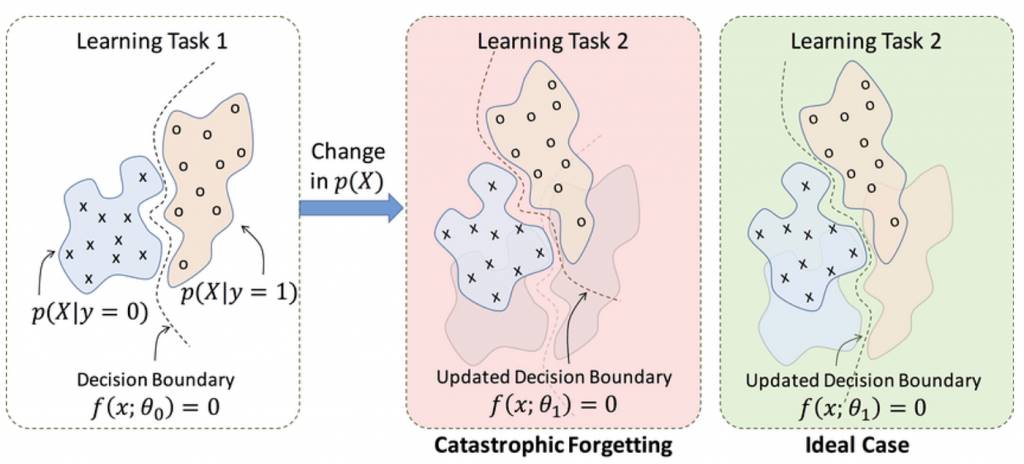
Crucially, this method effectively mitigates catastrophic forgetting—a common challenge in machine learning. Nodes can retain and expand existing knowledge while integrating new insights, enhancing network robustness and adaptability.
By distributing knowledge across multiple nodes, the Bittensor TAO network becomes more resilient to disruptions and potential data leaks. This resilience is particularly important for applications handling highly sensitive data such as financial and medical information.
2.1.2 Mixture of Experts (MoE)
Bittensor uses a distributed Mixture of Experts (MoE) model to optimize AI predictions, significantly improving accuracy and efficiency in solving complex problems through collaboration among specialized AI models. For example, when generating Python code annotated in Spanish, multilingual and coding-specialist models can collaborate to produce far higher-quality results than a single model could achieve.
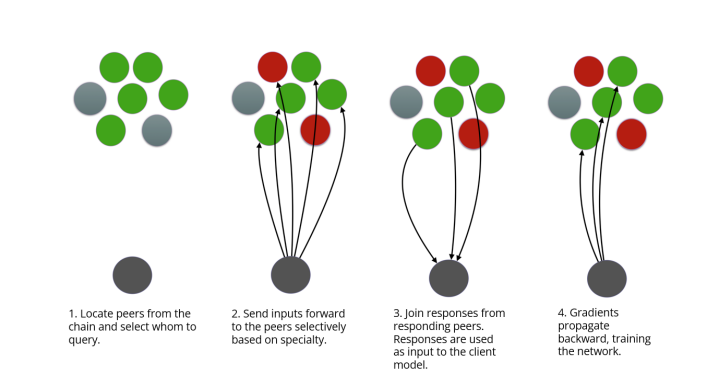
The core of the Bittensor protocol consists of parameterized functions, often called neurons, distributed in a peer-to-peer fashion. Each neuron records zero or more network weights and evaluates neighboring nodes’ value by mutually ranking neural networks, accumulating ranking scores onto a digital ledger. Higher-ranked nodes receive not only monetary rewards but also additional weights, establishing a direct link between node contribution and reward, enhancing network fairness and transparency. This mechanism creates a market where other intelligence systems can price information peer-to-peer over the internet, incentivizing nodes to continuously improve their knowledge and expertise. To ensure fair reward distribution, Bittensor adopts the Shapley value from cooperative game theory, offering an efficient method to allocate rewards based on individual contributions. Under YC consensus, validators score and rank specialized models and distribute rewards fairly according to Shapley principles, further enhancing network security, efficiency, and capacity for continuous improvement.
3. dTAO Upgrade
The Bittensor project faces several key issues in its resource allocation and economic model design:
-
Resource Overlap and Redundancy: Multiple subnets focus on similar tasks—such as text-to-image generation, text prompting, and price prediction—leading to duplicated and wasted resource allocation.
-
Lack of Real-World Use Cases: Some subnets (e.g., price prediction or sports outcome forecasting) have yet to demonstrate practical utility in real-world scenarios, potentially misaligning resource investment with actual demand.
-
"Bad Money Drives Out Good": High-quality subnets may struggle to secure sufficient funding and development space. With only a seven-day protection period, subnets lacking sufficient support from root validators may be prematurely eliminated.
-
Validator Centralization and Insufficient Incentives for New Subnets:
-
Root validators may not fully represent all TAO holders, and their evaluations may not reflect broad perspectives. Under Yuma Consensus, top validators dominate final scoring, but their assessments aren't always objective. Even if biases are detected, they may not be immediately corrected.
-
Additionally, validators lack incentives to migrate to new subnets, as moving from high-emission legacy subnets to low-emission new ones may result in immediate reward loss. Uncertainty about whether new subnets can eventually match established subnets' emission levels further reduces migration willingness.
Key Economic Model Issues:
A major flaw in Bittensor’s mechanism design is that although all participants earn TAO, no one actually pays TAO—creating persistent selling pressure. Currently, questions answered by miners aren’t posed by real users but provided by subnet owners—either simulating user queries or based on historical demand patterns. Therefore, even if miner responses are valuable, that value is captured entirely by subnet owners. Whether miners help owners refine algorithms or directly train products, the value generated by miners and validators is monopolized by subnet owners. In theory, subnet owners should pay for this value.
Moreover, subnet owners not only bear no costs but also receive 18% of their subnet’s emissions. This indicates the Bittensor ecosystem isn’t tightly coupled—participants remain loosely connected through development and collaboration. Projects on subnets can exit anytime without penalty (since registration fees are refunded). Currently, the primary mechanism for TAO recycling is registration fees paid by subnet miners and validators—but these fees are minimal and insufficient for effective value capture. Although staking has become a primary mechanism, the amount of TAO recycled via transaction fees and registration fees remains limited.
Staking takes two forms:
-
Validator Staking: Participants stake TAO to support network security and earn rewards, accounting for 75% of all issued TAO. Validators currently receive about 3,000 TAO daily, yielding an annualized return over 15%. However, after the first halving, this will drop to 1,500 TAO per day, reducing staking appeal and weakening its ability to balance token supply and demand.
-
Subnet Registration Staking: The addition of new subnets significantly impacts TAO supply. This presents a challenge because TAO’s total issuance is fixed; increasing the number of subnets dilutes rewards across all subnets, making it difficult for existing subnets to sustain operations and potentially leading some to exit the network.
These issues indicate that Bittensor’s resource allocation and economic model design require further optimization to ensure sustainable network development and fair incentives.
3.1 What Is dTAO?
dTAO is an innovative incentive mechanism proposed by the Bittensor network to address inefficient resource allocation in decentralized networks. It replaces traditional validator-vote-based allocation with a market-driven dynamic adjustment model, directly linking TAO emissions to the market performance of subnet tokens. Through embedded liquidity pools, it encourages users to stake TAO for subnet tokens, thereby supporting high-performing subnets.
It also adopts a fair issuance model, gradually distributing subnet tokens to ensure teams earn shares through long-term contributions. This balances the roles of validators and users—validators act like venture capitalists rigorously assessing technical and market potential, while users drive subnet value formation through staking and market trading.
3.1.1 Core Mechanisms of dTAO
3.1.1.1 Binding Validators and Teams to the Ecosystem: You Must Invest in Subnet Tokens to Earn Rewards
dTAO is driven by both market and technical factors. Each subnet configures a liquidity pool composed of TAO and its corresponding subnet token. When $TAO holders (validators and subnet owners) stake, they effectively buy $dTAO using $TAO. The quantity of $dTAO received follows this formula:

Pricing during exchange follows Uniswap V2’s constant product formula: τ·α = K
Where τ represents the amount of $TAO and α represents the amount of $dTAO. Without additional liquidity injection, K remains constant regardless of swap direction. Conversely, when $dTAO holders unstake—exchanging $dTAO for $TAO—the amount of $TAO received is calculated as:

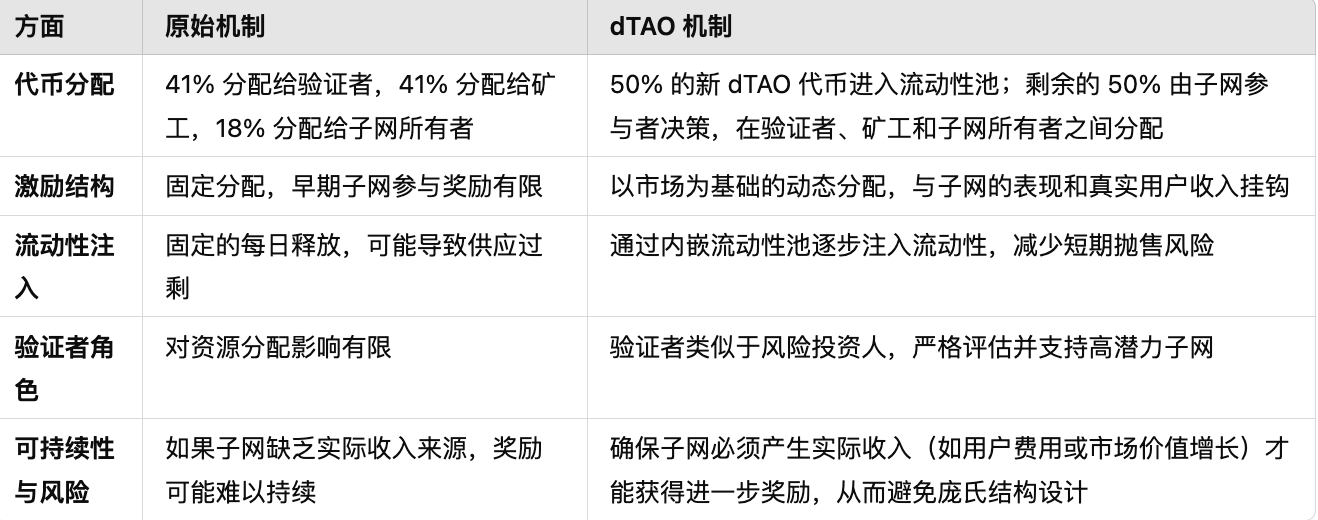
Unlike Uniswap V2, $dTAO liquidity pools do not allow direct liquidity additions. Except when the subnet owner initially creates the subnet, all new liquidity comes exclusively from newly allocated $TAO emissions and 50% of new $dTAO issuance. In other words, newly minted $TAO allocated to a subnet is not directly distributed to its validators, miners, or owner but is instead fully injected into the liquidity pool. Simultaneously, 50% of newly issued $dTAO is also added to the pool, while the remaining 50% is distributed among validators, miners, and owners according to the subnet’s own incentive rules.
This prevents teams from dumping large initial holdings, encouraging sustained contribution and technical iteration. Validators must act like venture capitalists, rigorously evaluating a subnet’s technology, market potential, and actual performance.
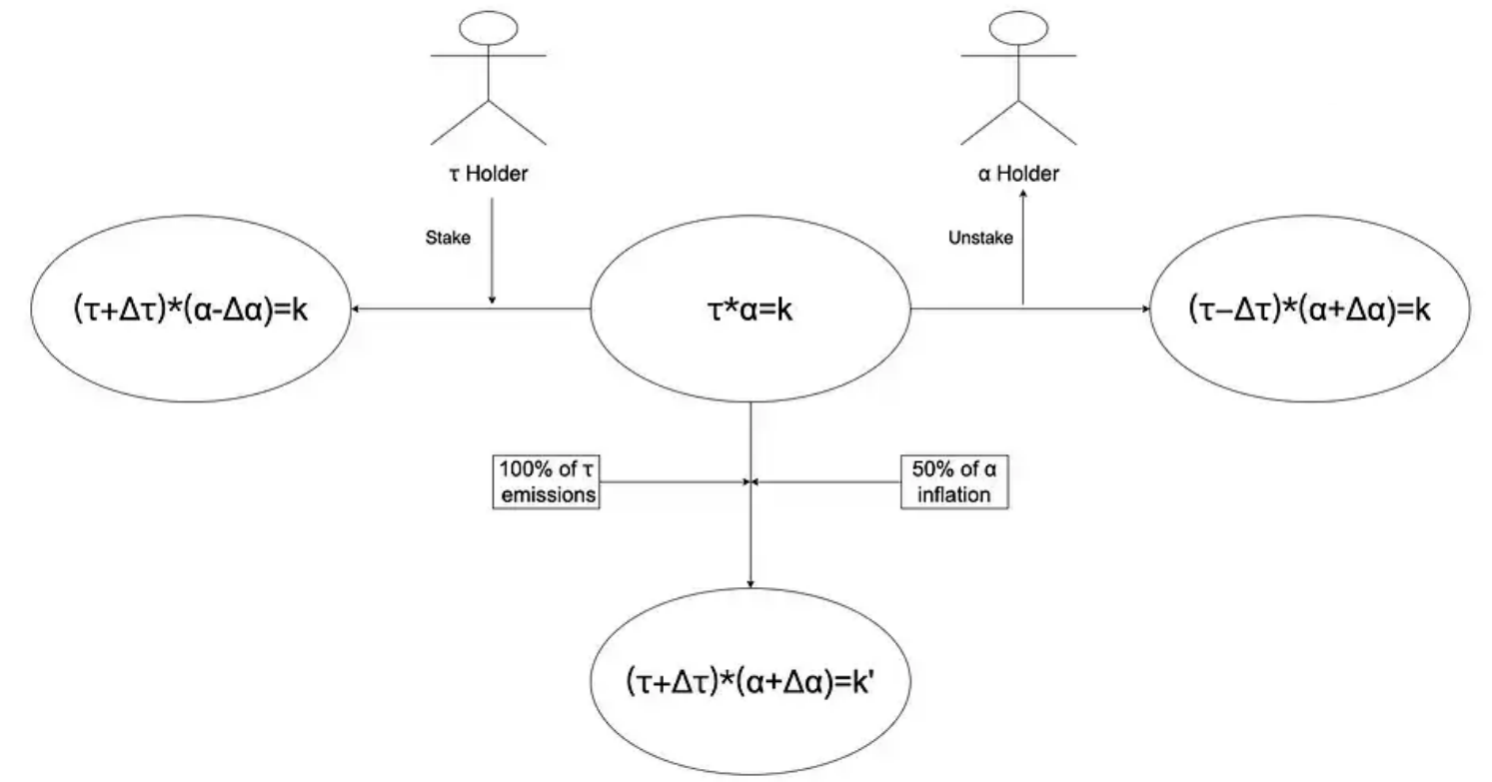
Staking/unstaking does not change K, but liquidity injections increase K to K′.
3.1.1.2 Subnets with the Highest Market-Priced Tokens Receive the Most $TAO Emissions
Previously, the proportion of new $TAO emissions allocated to each subnet was determined by validators on the Root Network—a model exposing potential flaws. For example, if root validators collude to allocate emissions to low-value subnets, they face no consequences.
dTAO eliminates the Root Network’s privilege and transfers decision-making power over $TAO allocation to all $TAO holders. Specifically, it implements Yuma Consensus V2, applying softmax to each subnet token’s price to determine its emission share:
|
|
|
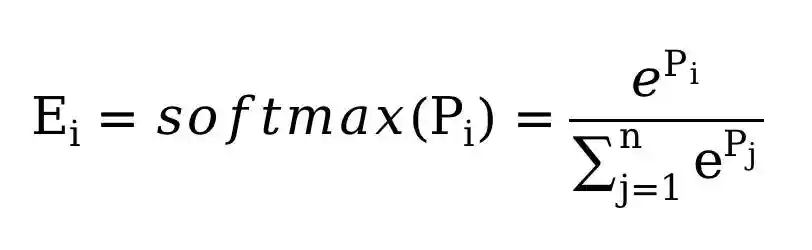
Softmax is a commonly used normalization function that converts each element in a vector to a non-negative value, preserves relative magnitudes, and ensures the sum of all elements equals 1.
Here, P is the price of $dTAO relative to $TAO, calculated as the ratio of $TAO to $dTAO quantities in the liquidity pool.
According to the formula, the higher a subnet token’s price relative to $TAO, the greater its share of new $TAO emissions.
3.1.1.3 Decentralizing Incentive Mechanism Design to Individual Subnets
Previously, $TAO incentives were distributed to validators, miners, and owners at a fixed 41%-41%-18% ratio.
dTAO empowers each subnet to issue its own “subnet token,” stipulating that while 50% of new issuance must go into the liquidity pool, the remaining 50% can be distributed among validators, miners, and owners as decided by the subnet participants.
This mechanism ensures only subnets that continuously improve products and attract users receive greater incentives, preventing Ponzi-like schemes focused on short-term gains.
3.1.2 Example Analysis
After the dTAO network upgrade, all subnets have now minted their corresponding $dTAO. The genesis supply of $dTAO equals the amount of $TAO previously locked by the subnet owner during creation. Of this, 50% of $dTAO is injected into the subnet’s liquidity pool, while the remaining 50% is allocated to the owner.
Suppose Subnet #1’s owner locked 1,000 $TAO—then the genesis $dTAO supply is also 1,000. Of this, 500 $dTAO and 1,000 $TAO are added as initial liquidity to the pool, while the remaining 500 $dTAO go to the owner.
Next, when a validator registers and stakes 1,000 $TAO in Subnet #1, they receive 250 $dTAO. The pool then contains 2,000 $TAO and 250 $dTAO.
Assume Subnet #1 receives 720 $TAO in daily block rewards. The liquidity pool automatically receives 720 $TAO daily. The amount of $dTAO injected daily depends on the subnet’s self-defined inflation rate.
3.2 Impact of dTAO
The introduction of dTAO fundamentally reshapes TAO’s distribution and staking mechanics. First, newly issued TAO is no longer unilaterally allocated by a few validators but is indirectly co-determined by all TAO holders through market behavior. This makes staking TAO resemble “buying” a subnet’s token rather than guaranteed passive income. Under this mechanism, short-term staking and unstaking have a far greater impact on dTAO prices than the actual volume of TAO earned, making staking returns highly uncertain.
The benefits are clear: the absolute control of top validators over block rewards disappears, dramatically increasing the cost for attackers to compromise the network via stake concentration. Meanwhile, high-potential latecomer subnets gain greater opportunities to succeed, and early validators backing quality subnets may see returns many times their initial investment. Furthermore, intensified subnet competition turns stakers into more rational investors who conduct thorough due diligence before selecting the most promising subnets.
Overall, the dTAO mechanism drives the entire ecosystem toward a more efficient, competitive, and market-oriented direction.
3.3 How Will the Bittensor Ecosystem Evolve After the dTAO Upgrade?
To analyze the impact of the dTAO upgrade, we must examine two key questions:
-
How does demand for subnets translate into demand for subnet tokens?
-
Can the introduction of subnet tokens create a “TAO summer,” accelerating innovation within the TAO ecosystem?
3.3.1 How Does Subnet Demand Translate Into Subnet Token Demand?
Initially, all subnet tokens start at the same price, with only small amounts of TAO and dTAO in each subnet’s liquidity pool. As a result, any trading activity can cause significant price volatility.
To join a subnet and earn rewards, users must first purchase dTAO subnet tokens and stake them with validators. This demand pushes up the price of dTAO within that subnet. As dTAO prices rise, the total value of dTAO in the liquidity pool increases, triggering automatic allocation of more TAO rewards to that subnet, enabling miners and stakers to earn higher returns.
This creates a positive feedback loop: users buy dTAO → price rises → higher price leads to more TAO issuance → more rewards attract additional users → further pushing up dTAO price
Conversely, if users begin mass-selling dTAO, its price falls, reducing the subnet’s TAO issuance and lowering participation. Overall, subnet token price fluctuations are primarily influenced by market supply and demand, liquidity pool size, and the system’s automated incentive mechanism.
This mechanism resembles the AI Agent Launchpad model, where users first buy platform tokens to invest in AI agent tokens. In AI Agent Launchpad ecosystems, once an AI agent token rapidly appreciates and generates wealth effects, massive inflows occur, further boosting demand for the platform token.
However, key differences exist between dTAO and AI Agent Launchpads:
-
In AI Agent Launchpad ecosystems, users typically use platform tokens to buy AI agent tokens only when their market cap is low (i.e., within internal markets).
-
Once an AI agent token reaches a certain valuation, users can sell it for ETH/SOL to realize profits, and new users can directly use ETH/SOL to purchase the token.
In contrast, in the dTAO system:
-
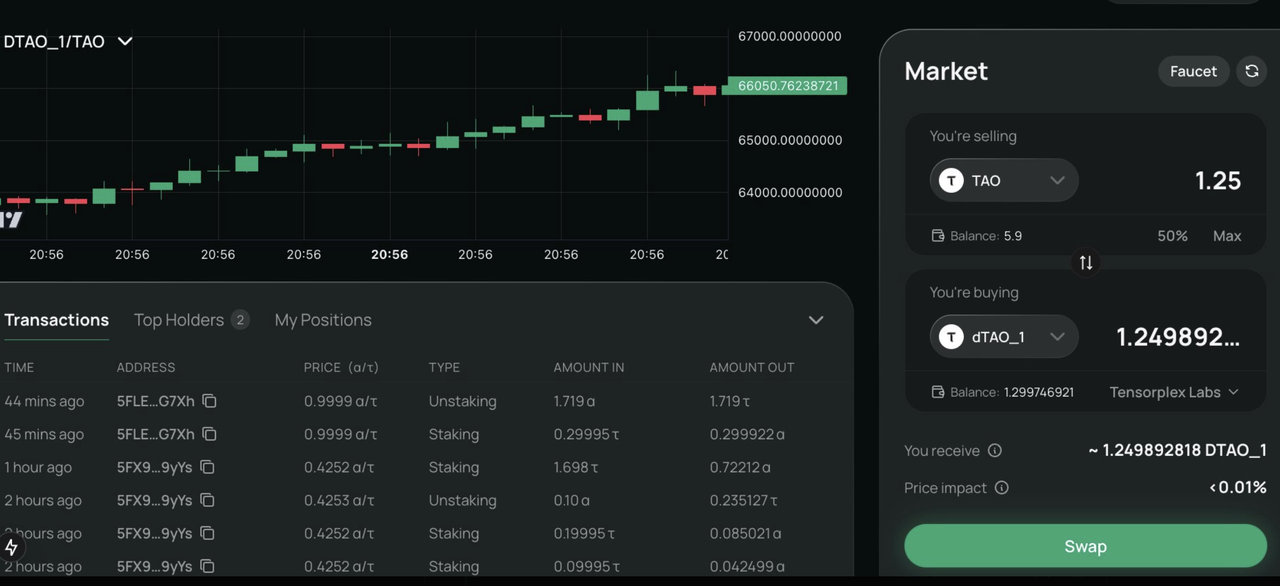
When dTAO prices rise and users wish to cash out or migrate to a higher-potential subnet, they can only exchange dTAO for TAO.
-
This process may cause significant volatility in the dTAO price within the liquidity pool.
Currently, users can trade dTAO tokens on Backprop Finance, providing secondary market liquidity for subnet tokens.
3.3.2 Unique Issuance Mechanism of the dTAO Ecosystem
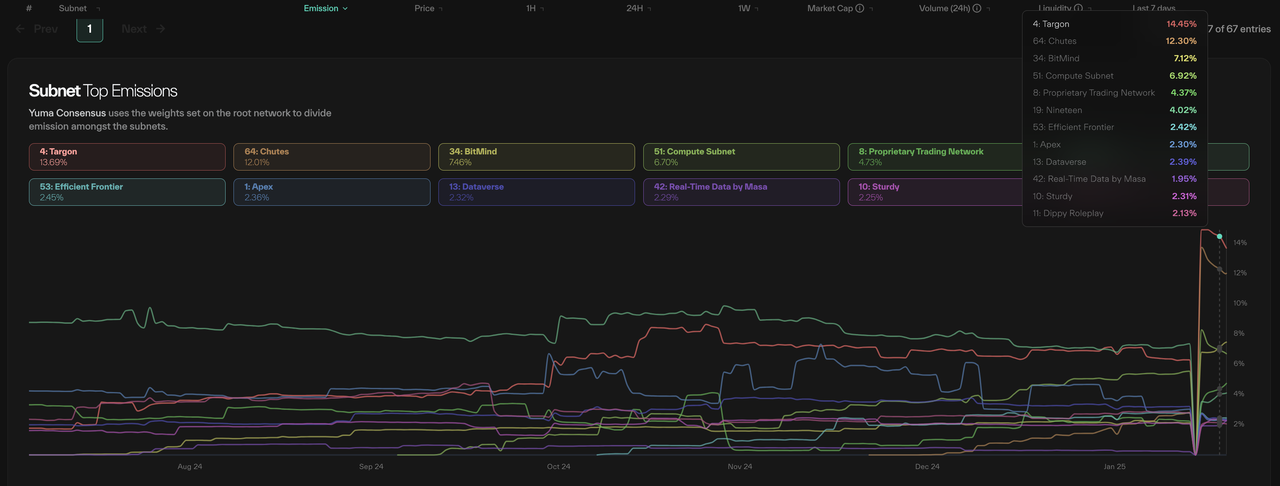
Another key aspect of the dTAO ecosystem is its unique token issuance mechanism. As shown below, after the dTAO upgrade, issuance is highly concentrated among the top few subnet projects. The top five subnets currently receive 40% of total emissions.
With 7,200 TAO distributed daily, and based on the TAO price as of February 18, 2025, the top five subnets alone receive approximately $1 million worth of TAO daily.
If the dTAO ecosystem evolves similarly to the Virtual ecosystem—where certain projects gain significant market attention—high-market-cap subnets will capture the vast majority of new TAO emissions.
For new projects to succeed, they must demonstrate strong potential to attract stakers, miners, and validators. This typically requires:
-
Participants migrating from other subnets, converting their TAO into the new subnet’s dTAO.
-
This may involve selling existing subnet tokens in liquidity pools, thereby increasing the new subnet’s market cap.
This competitive model may stimulate greater activity in the subnet token market and further drive innovation and development across the entire TAO ecosystem.
3.4 Does dTAO Solve the Problems in Bittensor’s Subnet Model?
3.4.1 Core Mechanism Issues Remain
The dTAO upgrade links TAO issuance to subnet token market performance, shifting resource allocation decisions from a few root validators to a market-driven model, aiming to encourage broader user engagement. While this partially alleviates inefficiencies caused by resource overlap—ensuring only high-performing subnets with strong token prices receive more TAO rewards—it fails to fundamentally resolve the following critical issues:
-
Resource Overlap and Redundancy: If multiple subnets focus on similar tasks (e.g., text generation, image generation, or price prediction), resource duplication and inefficient utilization persist even under market-driven adjustments.
-
No External Payment for Contributions: While all participants earn TAO, no external users pay for the value miners and validators create. This results in continuous selling pressure on TAO, as rewards are constantly issued without sustainable demand mechanisms to support TAO’s price.
-
Fake Models and Inadequate Evaluation Standards: Bittensor is evolving into an “outsourcing layer” within the AI tech stack, where token incentives quickly attract resources and allocate specific AI tasks. For example, Kaito AI outsources search engine development to a subnet, leveraging collective intelligence to reduce costs. While this incentive-driven model attracts developers in the short term, long-term success still depends on real demand and quality assurance. Testing the Cortex.t subnet revealed answers sourced directly from the OpenAI API, not generated by Bittensor miners. This suggests some subnets are merely “wrapper apps” that don’t truly utilize Bittensor’s decentralized AI compute. Some subnet validators rely on OpenAI outputs for comparison, introducing centralization risks. Additionally, some price-prediction subnets show low accuracy, limiting real-world applicability.
Improvement Directions: Enhancing Utility and Transparency
Join TechFlow official community to stay tuned
Telegram:https://t.me/TechFlowDaily
X (Twitter):https://x.com/TechFlowPost
X (Twitter) EN:https://x.com/BlockFlow_News
 HTX Research