








Understanding SEAL: Sui's New Solution for Decentralized Data Security
TechFlow Selected TechFlow Selected
Understanding SEAL: Sui's New Solution for Decentralized Data Security
Mysten Labs has launched a new decentralized key management solution on the Sui testnet.
 Navigating Web3 tides with focused insights
By Alex Liu, Foresight News
As the Web3 ecosystem continues to mature, issues such as privacy protection, access control, and key management have become increasingly prominent. On April 5, Mysten Labs launched SEAL, a new decentralized key management solution on the Sui Testnet. Below, we provide a comprehensive overview of SEAL from multiple dimensions including technical architecture, use cases, developer experience, and future outlook.
Background
In the traditional Web2 era, data encryption and access control often relied on centralized key management services (KMS), such as AWS KMS or GCP Cloud KMS. However, these solutions fail to meet Web3's requirements for decentralization, transparency, and user-controlled autonomy.
To address this challenge, Mysten Labs introduced SEAL—a decentralized approach to secure data encryption and access control. SEAL enables developers to build decentralized applications (DApps) without relying on a single trusted party, offering more flexible and robust data protection.
SEAL overcomes the limitations of traditional approaches, which are often constrained by narrow use cases or dependence on centralized infrastructure when protecting vast amounts of on-chain data. With SEAL, developers can manage encrypted data and access controls across different storage systems and application scenarios—without compromising security or performance—delivering a universal and efficient security solution for Web3 applications.
Technical Architecture
SEAL employs a multi-layered technical design to ensure secure and efficient data encryption, with several core components:
On-Chain Access Control
SEAL leverages Move smart contracts on the Sui blockchain to enforce access control. Developers can define fine-grained access policies within smart contracts, specifying exactly who can access decryption keys and under what conditions. These on-chain rules ensure transparency and tamper-proof permission validation, significantly enhancing data security.
Threshold Encryption
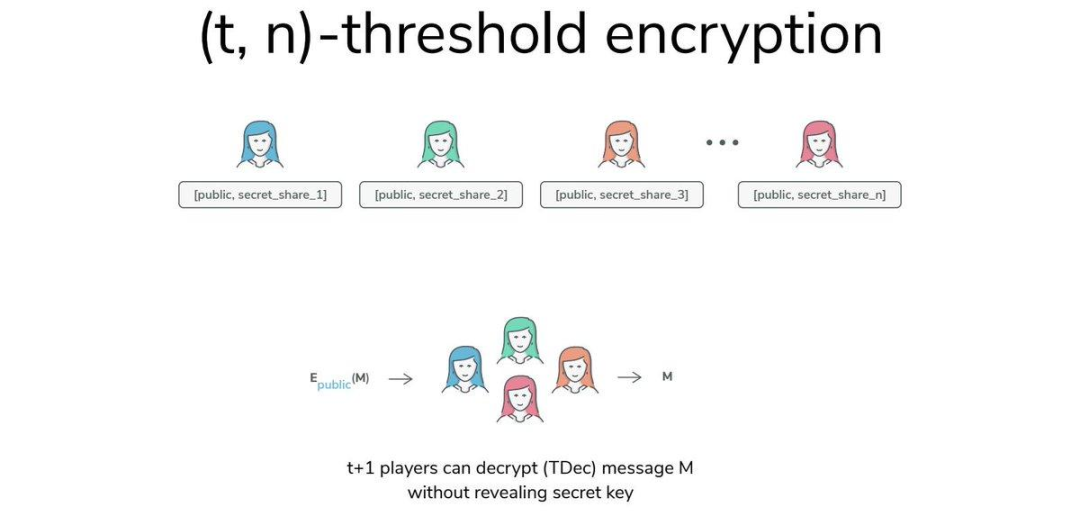
Traditional key management systems that rely on a single point of trust make stored keys vulnerable to attacks. SEAL instead uses threshold encryption, distributing decryption keys across multiple independent backend services. A complete key can only be reconstructed when a minimum number of shares (e.g., in a t-out-of-n scheme) are combined. This mechanism effectively mitigates risk—even if some key servers are compromised, the overall data remains secure.
Client-Side Encryption
SEAL emphasizes client-side encryption and decryption, meaning users perform encryption locally on their devices. As a result, even if SEAL’s servers or intermediate nodes are breached, attackers cannot access plaintext data—greatly strengthening the system’s privacy protections.
Storage Agnosticism
Unlike solutions limited to specific storage systems, SEAL is storage-agnostic. Whether using Walrus—a decentralized storage system built on Sui—or other on-chain or off-chain storage platforms, SEAL provides compatible encryption. This flexibility allows developers to choose the most suitable storage solution for their projects without worrying about encryption compatibility.
Use Cases
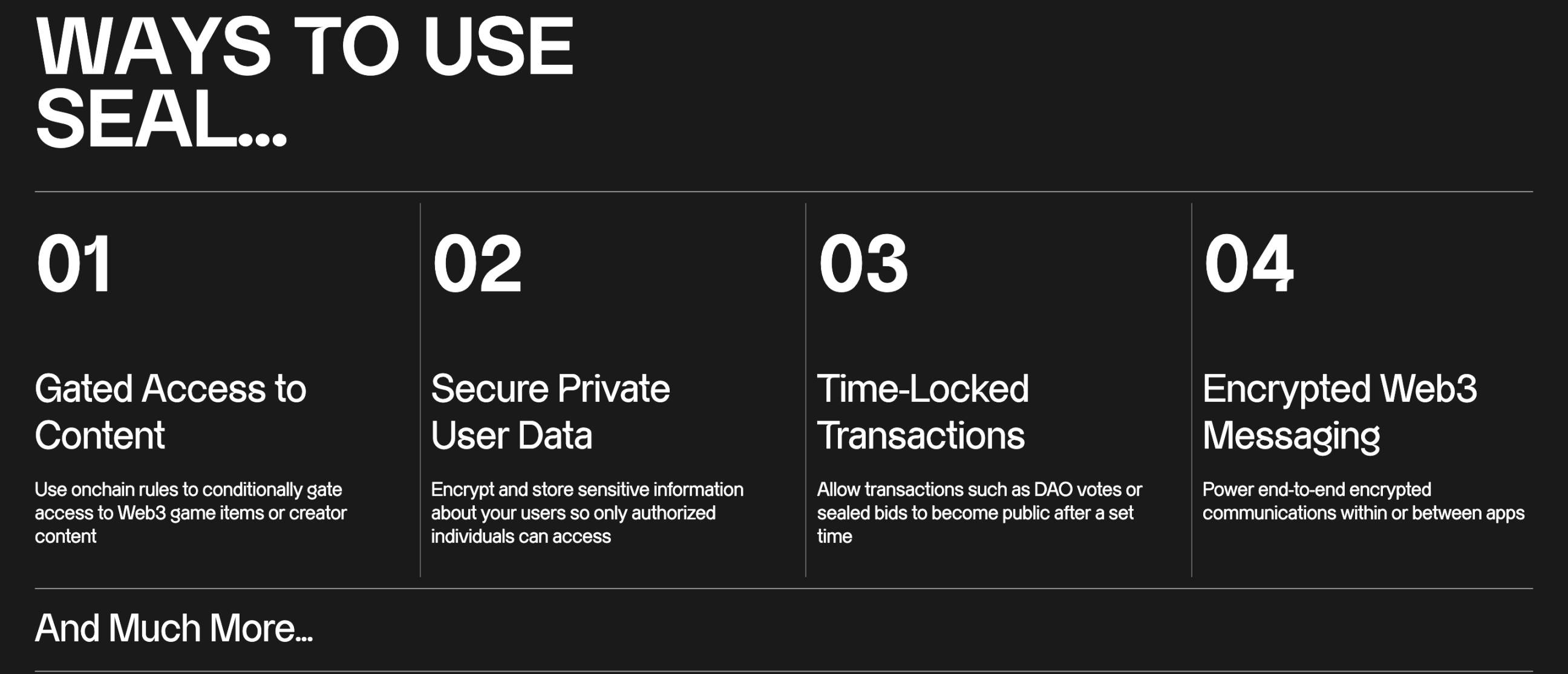
SEAL’s diverse and flexible use cases highlight its broad practical value. Below are several representative examples:
Paid Content and Tiered Access
In digital content distribution, creators increasingly seek ways to monetize exclusive content through paywalls or subscription models. With SEAL, creators can encrypt premium content and restrict decryption to users holding specific NFTs or who have paid a subscription fee. This model functions like an on-chain version of Patreon or Substack, protecting intellectual property while enabling precise, permission-based access.
Private Messaging and Data Transfer
Privacy is critical in decentralized chat and social applications. SEAL supports end-to-end encrypted messaging, ensuring that even on public blockchains, only the communicating parties can read messages. Developers can leverage SEAL to build secure, decentralized instant messaging apps, addressing privacy risks inherent in traditional social platforms.
NFT Transfers and Time-Locked Transactions
NFTs, as key blockchain assets, require secure transfer mechanisms. SEAL enables time-locked encryption for NFTs—allowing ownership transfers or unlocks only within predefined time windows. This feature suits closed auctions and also supports DAO voting and governance decisions.
Secure Storage of Sensitive User Data
In sectors like healthcare and identity verification, sensitive user data must be rigorously protected. SEAL encrypts data stored in Walrus or other systems and enforces access via on-chain controls, ensuring only authorized users can view it. This delivers a decentralized, efficient solution for safeguarding personal data.
Developer Experience
While technically innovative, SEAL also offers developers a full suite of SDKs and tooling to simplify integration and deployment. Using the SEAL SDK, developers can easily call encryption, decryption, and key management APIs without needing deep expertise in underlying cryptographic principles. Although there are no major ecosystem projects built on SEAL yet, official documentation and a sample application provide detailed guidance, helping developers rapidly prototype and debug in testnet environments.
Additionally, the SEAL test version is now live on Sui Testnet, allowing developers to experiment across various scenarios and submit feedback to Mysten Labs for continuous improvement in future releases. Its developer-friendly design and ease of integration make SEAL a compelling choice for Web3 builders.
Future Outlook
Although SEAL already offers robust core functionality, Mysten Labs’ roadmap extends far beyond the current implementation. Future enhancements may include:
-
Multi-Party Computation (MPC): Integrating MPC technology to enable more distributed decryption processes, further improving the security and reliability of key management.
-
Server-Side Encryption: To support lightweight front-end applications, server-side decryption options may be introduced in specific contexts, giving developers greater flexibility.
-
Digital Rights Management (DRM): Drawing from traditional media, SEAL could develop DRM capabilities similar to those used by platforms like Netflix or YouTube—protecting digital content rights while maintaining end-user security.
These additions will expand SEAL’s applicability beyond basic encryption and decryption, evolving it into a comprehensive decentralized data security platform—providing robust, end-to-end protection for the entire Web3 ecosystem.
Join TechFlow official community to stay tuned
Telegram:https://t.me/TechFlowDaily
X (Twitter):https://x.com/TechFlowPost
X (Twitter) EN:https://x.com/BlockFlow_News
 Foresight News






