In-depth Investigation: The Chaos, Truth, and Lies Behind 1,240 Data Centers in the United States
TechFlow Selected TechFlow Selected
In-depth Investigation: The Chaos, Truth, and Lies Behind 1,240 Data Centers in the United States
AI construction boom continues—who is paying the silent price?
 Navigating Web3 tides with focused insights
By: Zhidx, Wall Street Insights
Technology companies are building data centers at an unprecedented pace. In the U.S. alone, more than two new data centers are constructed each week. These facilities serve as engines for AI development and store photos, videos, and social media content. Yet, there is almost no official record of how many such facilities exist, where they are located, or who controls them.
To answer these questions, investigative reporters from Business Insider decided to create their own national map of data centers in the U.S., using public records of backup generator permit applications. By reviewing documents state by state, they gradually revealed the presence of data centers long hidden behind claims of "business confidentiality."

The findings were staggering: as of 2024, there are up to 1,240 large-scale data centers either built or approved across the United States—a nearly 300% increase over the past 15 years.
Surrounded by walls and barbed wire, these data centers are concentrated in areas like Virginia and Arizona. Their power and water demands rival those of entire cities, placing immense pressure on local environments and infrastructure.
Large data centers can consume over 2 terawatt-hours (TWh) of electricity annually—enough to power 200,000 homes for a year. Moreover, 43% of these facilities are located in regions with high or extreme water stress, and many use potable water for cooling.
To cope with the massive energy demands brought by data centers, some regions have delayed clean energy plans and must spend tens or even hundreds of billions of dollars upgrading infrastructure. By 2039, electricity prices in Virginia could rise over 50% due to related construction costs.
More troublingly, data centers are often sited near residential neighborhoods to access reliable infrastructure. Business Insider reporters first visited Loudoun County, Virginia—known as the "Silicon Valley of data centers"—where these facilities are already tangibly affecting daily life.
Documentary link:
https://www.youtube.com/watch?v=t-8TDOFqkQA&t
01. Data Centers Located Just Hundreds of Meters From Homes—Some Houses Now Fully Surrounded
About one-third of global internet traffic passes through Virginia. Loudoun County has the highest density of data centers in the world, hosting 329 facilities that consume one-quarter of the state's total electricity.
At first glance, this appears to be a typical American suburb. But viewed from above, vast white server buildings are neatly arranged like modern factories.

Technology companies choose this location for its reliable power supply, abundant water, tax incentives, and cheap land. However, these advantages mean data centers often sit just a wall away from residential communities.
Northern Virginia, where Loudoun County lies, is the most densely populated area within the Washington, D.C. metro region and one of the fastest-growing population centers in the U.S. Here, data centers are being rapidly and extensively built.

Donna Garante is one of the residents affected by data center expansion. She lived quietly in Prince William County, Northern Virginia, for 30 years—the fourth homeowner on her street—and witnessed the area’s transformation.
In 2021, Google built a data center just 750 meters from her home. Since then, nighttime noise has caused her anxiety and sleepless nights. She had to abandon her second-floor bedroom, moving downstairs and wearing noise-canceling headphones just to fall asleep.

When she tried seeking information from on-site staff and government officials about the facility, all she received was: "We signed confidentiality agreements; we can't talk about it."
Worse still, this was only the beginning. In the coming years, even more data centers will emerge around Donna’s neighborhood. A plot originally designated for housing was rezoned for industrial use in 2023, clearing the way for data center construction. It is now set to host a 75-foot-tall (approximately 22.8 meters) data center facing directly toward residential homes.

Prince William County already hosts over 70 data centers. If all planned developments proceed—including those in neighboring Loudoun County—the region would have more data centers than the entire country of Russia.
Donna attempted legal challenges against the rezoning decision, but her lawsuit was dismissed. She believes the world does need data centers, but placing them next to people's homes is wrong.
Similar stories are unfolding across the U.S. Carlos Llanes, a resident of Manassas, Virginia, measures the noise levels from an Amazon data center outside his home every day and shares the data with a local community group. “You don’t just hear the sound,” he said. “You feel it directly.”
The source of the noise is the data center’s cooling system. In many facilities, large cooling units extract hot air and circulate it through air conditioning units to lower temperatures. The most common method involves using cold water to absorb heat, which is then released via cooling towers. Both cooling systems and fans emit a constant hum.

▲These box-like structures are data center cooling systems
Noise levels typically remain below government limits for industrial zones near residential areas. However, homes in these neighborhoods were not designed to withstand the constant humming of modern, 24/7-operating data centers.
Low-frequency vibrations even cause windows in Carlos’s house to rattle. He spent $20,000 replacing them with soundproof windows, yet still cannot sleep. The nightly drone disturbs both him and his 7-year-old son, who once thought there was a "spaceship" outside. At one point, Carlos moved his entire family into the basement to escape the vibrations.

After intervention by community boards and local authorities, the data center operator initially tried reducing noise by placing materials around rooftop fans. These efforts proved ineffective, so the company replaced the fans and installed taller exhaust vents.
Following these upgrades, noise levels did decrease. But Carlos and his neighbors say they still feel vibrations from the data center.
Carlos says he doesn’t oppose data centers per se, but believes there should be red lines—especially regarding proximity to homes and schools. Unfortunately, more data centers are scheduled to come online in his neighborhood in the coming years.

Amazon responded that its noise levels are "far below regulatory standards," but residents’ physical and mental health impacts are hard to ignore. The American Public Health Association warns that prolonged exposure to noise may lead to cardiovascular disease and mental health issues.
02. Uncovering the Secrets Behind Permits—Amazon, Microsoft, and Google Rank Top Three
How many data centers are currently impacting residents’ lives? And which companies bear responsibility?
Currently, the U.S. lacks a complete public directory of data centers, an official map, or a dedicated regulatory body to provide answers. Requests under freedom of information laws often result in heavily redacted documents or outright denials citing "commercial confidentiality."

▲Documents related to data centers are often heavily redacted
Business Insider’s investigative team took a different approach. They discovered a common feature shared by nearly all data centers: backup generators, required to keep operations running during grid failures. Installing such generators requires applying for air quality permits—providing a crucial entry point for investigation.
The team submitted public records requests in every state to obtain all air quality permits issued to data centers. These documents reveal generator capacity, enabling estimation of a data center’s power consumption, and often contain clues pointing to the actual owner.

▲Some air quality permits obtained by Business Insider
For example, near Columbus, Ohio, at least 164 backup generator permit applications were filed by a company called Magellan Enterprises LLC. But deeper digging into public records revealed that the entity actually belongs to Google.
By tracking down hundreds of similar leads, Business Insider’s journalists compiled the most comprehensive statistical picture of U.S. data centers to date.
The data shows that over the past 15 years, data center construction in the U.S. entered a period of rapid growth, forming several major clusters. Northern Virginia and Maricopa County in Arizona emerged as the regions with the highest concentration of data centers.

This chart illustrates the explosive growth of U.S. data centers over the past two decades. In 2010, there were 311 data centers either built or approved nationwide. By 2024, that number reached 1,240—nearly four times higher.

Among data centers granted construction permits by the end of 2024, Amazon owns 177, followed closely by Microsoft, Google, Meta, and QTS (a data center solutions provider owned by Blackstone).
Computing equipment itself consumes significant electricity, while building cooling systems and pumps also require substantial power. The largest data centers can use over 2 terawatt-hours (TWh) annually—enough to power 200,000 homes.
Electricity is only part of the problem. Cooling systems also require vast amounts of water. In water-rich regions, this isn't an issue—but in arid states like Arizona, the situation is starkly different.
The image below shows the site selection for a new data center in Arizona. Its sole source of water will be groundwater wells.

Extreme drought is sweeping across Arizona. The state’s primary water source, the Colorado River, has seen a 20% reduction in flow since 2000. As the river reaches Arizona, every drop becomes critical.

Yet, when Business Insider overlaid its previously created data center map, it found a surge of new facilities moving into these drought-prone areas. Cheap electricity may be one key driver behind this trend.

For instance, Microsoft built its first data center in the region in 2019. Six years later, the company now operates five in the same area, with another under construction.

These facilities on the outskirts of towns are essentially flattened farmland. Permit documents suggest Microsoft’s new cluster could be enormous, featuring 280 generators with a combined capacity nearing 800 megawatts.
Documents show Microsoft expects each data center to use 3.79 million liters of water per day—6.936 billion liters annually—equivalent to the yearly water consumption of a city of 61,000 people.
The investigation found that 43% of large data centers are located in areas with high or extreme water stress, and they rely on potable water. Of Amazon’s data centers, 45.76% are in highly water-stressed regions, while Microsoft’s figure stands at 52.27%.

Data center water usage is also treated as commercial confidential. Nevertheless, Business Insider managed to obtain over 50 relevant datasets. For example, Google’s data center in Midlothian, Texas used 610 million liters of water in 2023; Kindred’s facility in Colorado used 320 million liters in the same year.

In Arizona, whether drawing from the Colorado River or underground aquifers, water is strictly regulated. However, local municipalities control how their water allocations are used, and many areas impose few restrictions on corporate well drilling.
Many tech companies have pledged to achieve "water positive" status by 2030—restoring or saving more water than they consume. But this is largely achieved through water credit offsets: paying others to conserve water on their behalf, which fails to alleviate local resource strain.
Complicating matters further, when data centers reduce water use by switching to air-conditioned recirculating cooling, their electricity consumption rises significantly, increasing carbon emissions.
03. AI Data Centers Push Grids to the Limit—Energy Saving Goals Delayed
Though hailed as the "cornerstone of the digital economy," data centers have delivered limited economic benefits so far. Even the largest ones employ no more than 150 permanent workers, with some hiring fewer than 25. Still, states continue offering tax incentives in fierce competition.
To date, Business Insider has tracked tax incentives for data centers in 37 states, covering exemptions on building materials and equipment, as well as discounted water and electricity rates. Despite repeated failures to deliver promised jobs, tax breaks continue to be handed out on a large scale.
Meanwhile, Meta, Google, and Microsoft plan to invest $64 billion, $75 billion, and $80 billion respectively in 2025 to expand new facilities and equipment.
McKinsey estimates that by 2028, U.S. data centers could consume 600 terawatt-hours (TWh) of electricity—12% of the nation’s total electricity demand, a sharp rise from 4% in 2023. This scale is unprecedented. AI-driven data centers are pushing the power grid to its limits.
Facing such pressure, many utilities are abandoning or delaying plans to phase out fossil fuels. In Nebraska, the state’s two largest power companies committed years ago to achieving net-zero emissions in electricity generation by 2050. But Meta’s data center in Springfield, Nebraska uses as much electricity annually as 400,000 households.
To meet this demand, the state’s largest utility voted to delay shutting down a coal-fired plant in Omaha and plans to build two new natural gas plants by 2025—jeopardizing the 2050 net-zero target.

Satellite data indicates that the North Omaha Power Station emitted an estimated 300,000 kilograms of CO₂ per hour in June 2023.

Besides massive electricity consumption, data centers’ backup diesel generators emit large quantities of harmful pollutants—even if they operate only a few hours per month.
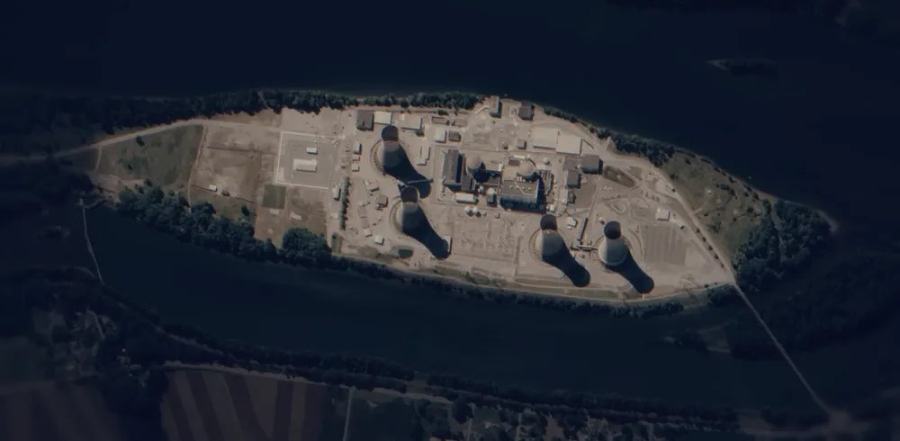
Several major tech firms have announced investments in various clean energy projects, including solar, wind, and even nuclear power. In Pennsylvania, Microsoft struck a deal to purchase electricity when the infamous Three Mile Island nuclear plant—which suffered a partial meltdown in 1979—is set to restart operations in 2027.

▲Three Mile Island nuclear power plant
However, these companies often offset emissions by purchasing renewable energy credits rather than fundamentally changing their energy mix. The problem is, fragile and fragmented power grids may not reliably support data center demands. Large-scale infrastructure upgrades would ultimately be paid for by consumers.
Amazon, Microsoft, and Google claim they are willing to cover the full cost of grid upgrades, including high-voltage transmission lines. But evidence suggests these expenses are passed on to customers.
In Virginia, Dominion Energy disclosed that to meet growing demand from data centers and electric vehicles, its power output will need to roughly double by 2039. This expansion is expected to cost up to $103 billion, potentially raising household electricity bills by 50%.
Despite this, some states continue aggressively courting data centers. In fiscal year 2023, Virginia offered nearly $1 billion in tax breaks for 56 data center projects.
The case of New Albany, Ohio is even more telling. In 2017, a mysterious company named Sidecat LLC promised to build two massive data centers on 300 acres, securing at least 15 years of 100% property tax abatement worth about $60 million. It was later revealed to be a subsidiary of Meta.
04. Conclusion: AI Construction Boom Continues—Who Bears the Silent Cost?
This AI-driven construction boom is reshaping global energy landscapes, environmental ecosystems, and community life. But as these giant data centers continue expanding, who is truly bearing the cost? Strain on power grids, water scarcity, and social costs from tax incentives—these invisible burdens may mostly fall on ordinary residents and consumers.
For residents like Donna and Carlos, choices are becoming increasingly difficult. The constant hum of data centers, along with competition for electricity and water, is forcing them to leave their homes. Donna believes many of her neighbors don’t yet grasp the severity of the issue. With resignation, she says: “It breaks my heart, but I can only fight for so long. After that, I’ll raise the white flag, pack my bags, and leave.”
Join TechFlow official community to stay tuned
Telegram:https://t.me/TechFlowDaily
X (Twitter):https://x.com/TechFlowPost
X (Twitter) EN:https://x.com/BlockFlow_News