Are data infrastructures ready for the era of crypto super apps?
TechFlow Selected TechFlow Selected
Are data infrastructures ready for the era of crypto super apps?
The moat is shifting toward "executable signals" and "underlying data capabilities," with long-tail assets and closed-loop transaction data representing a unique opportunity for crypto-native entrepreneurs.
 Navigating Web3 tides with focused insights
Author | Story @IOSG
TL;DR
-
Data Challenge: High-performance public chains are competing in sub-second block times. Consumer-side high concurrency, volatile traffic, and heterogeneous multi-chain demands increase data complexity, requiring infrastructure to shift toward real-time incremental processing + dynamic scaling. Traditional batch ETL pipelines suffer minute- to hour-level delays, making them unsuitable for real-time trading. Emerging solutions like The Graph, Nansen, and Pangea adopt streaming computation, reducing latency to real-time tracking levels.
-
Paradigm Shift in Data Competition: Last cycle focused on “understanding”; this cycle emphasizes “profitability”. Under Bonding Curve models, a one-minute delay can result in cost differences of several multiples. Tool evolution: from manual slippage settings → sniper bots → GMGN integrated terminals. On-chain execution capability is gradually becoming commoditized, shifting the competitive frontier to data itself: whoever captures signals faster can generate profits for users.
-
Expansion of Trading Data Dimensions: Memes are essentially financialized attention, driven by narrative, visibility, and propagation. Closed-loop integration of off-chain sentiment and on-chain data—narrative tracking and sentiment quantification—are now core to trading. "Subsurface data": fund flows, actor profiling, labeling of smart money/KOL addresses, revealing hidden games behind anonymous on-chain addresses. Next-gen trading terminals fuse on-chain and off-chain multidimensional signals at second-level granularity, improving entry and risk mitigation decisions.
-
AI-Driven Executable Signals: From Information to Returns. The new competitive goal: speed, automation, and generation of excess returns. LLM + multimodal AI can automatically extract decision signals and integrate copy trading with take-profit/stop-loss execution. Risks include hallucinations, short signal lifespan, execution latency, and risk control. Balancing speed and accuracy, reinforcement learning and simulation backtesting are critical.
-
The Survival Dilemma for Data Dashboards: Lightweight data aggregation/dashboard apps lack moats and face shrinking viability. Moving down: deepening high-performance infrastructure and integrated data research. Moving up: extending into application layers, directly owning user scenarios and increasing data engagement. Future landscape: either become Web3 utilities (data as infrastructure), or evolve into Crypto Bloomberg user platforms.
Moats are shifting toward “executable signals” and “core data capabilities.” Long-tail assets and closed-loop trading data represent unique opportunities for native crypto entrepreneurs. The 2–3 year opportunity window:
-
Upstream Infrastructure: Web2-grade processing power + Web3-native needs → Web3 Databricks/AWS.
-
Downstream Execution Platforms: AI Agent + multidimensional data + seamless execution → Crypto Bloomberg Terminal.
Special thanks to Hubble AI, Space & Time, OKX DEX, and other projects for supporting this report!
Introduction: Triple Resonance of Meme, High-Performance Blockchains, and AI
In the previous cycle, growth in on-chain trading relied heavily on infrastructure upgrades. In the current cycle, as infrastructure matures, super-apps like Pump.fun have emerged as new growth engines for the crypto industry. These asset issuance models, with standardized mechanisms and clever liquidity designs, create a raw, fair, and myth-making trading battleground. The replicable nature of such high-return wealth effects is profoundly reshaping user expectations and trading behaviors. Users no longer just need faster entry—they require the ability to collect, interpret, and act on multidimensional data within seconds. Existing data infrastructure can no longer meet these density and real-time demands.
This has led to higher demands on the trading environment: lower friction, faster confirmation, deeper liquidity. Trading activity is rapidly migrating to high-performance public chains and Layer 2 rollups like Solana and Base. These chains generate over ten times more transaction data than Ethereum did in the last cycle, posing severe performance challenges for existing data providers. With next-gen high-performance chains like Monad and MegaETH nearing launch, demand for on-chain data processing and storage will grow exponentially.
Meanwhile, rapid maturation of AI is accelerating intelligence democratization. GPT-5 already matches PhD-level cognition, and multimodal models like Gemini can easily interpret K-lines... With AI tools, complex trading signals are now accessible and executable even by ordinary users. As a result, traders increasingly rely on AI for decision-making—an evolution that hinges on multidimensional, high-fidelity data. AI is transitioning from an “assistant analysis tool” to a “trading decision hub,” amplifying requirements for data timeliness, explainability, and scalable processing.
Under the triple resonance of meme trading frenzy, expansion of high-performance blockchains, and AI commoditization, the ecosystem’s need for new data infrastructure has never been more urgent.
Meeting the Data Challenge of 100K TPS and Millisecond Block Times
With the rise of high-performance blockchains and rollups, the scale and speed of on-chain data have entered a new era.
As high-concurrency, low-latency architectures become standard, daily transaction volumes easily exceed tens of millions, with raw data reaching hundreds of GB per day. Take Solana: its average TPS over the past 30 days exceeds 1,200, with over 100 million daily transactions. On August 17, it hit a record high of 107,664 TPS. According to estimates, Solana's ledger data grows at 80–95 TB annually—equivalent to 210–260 GB per day.
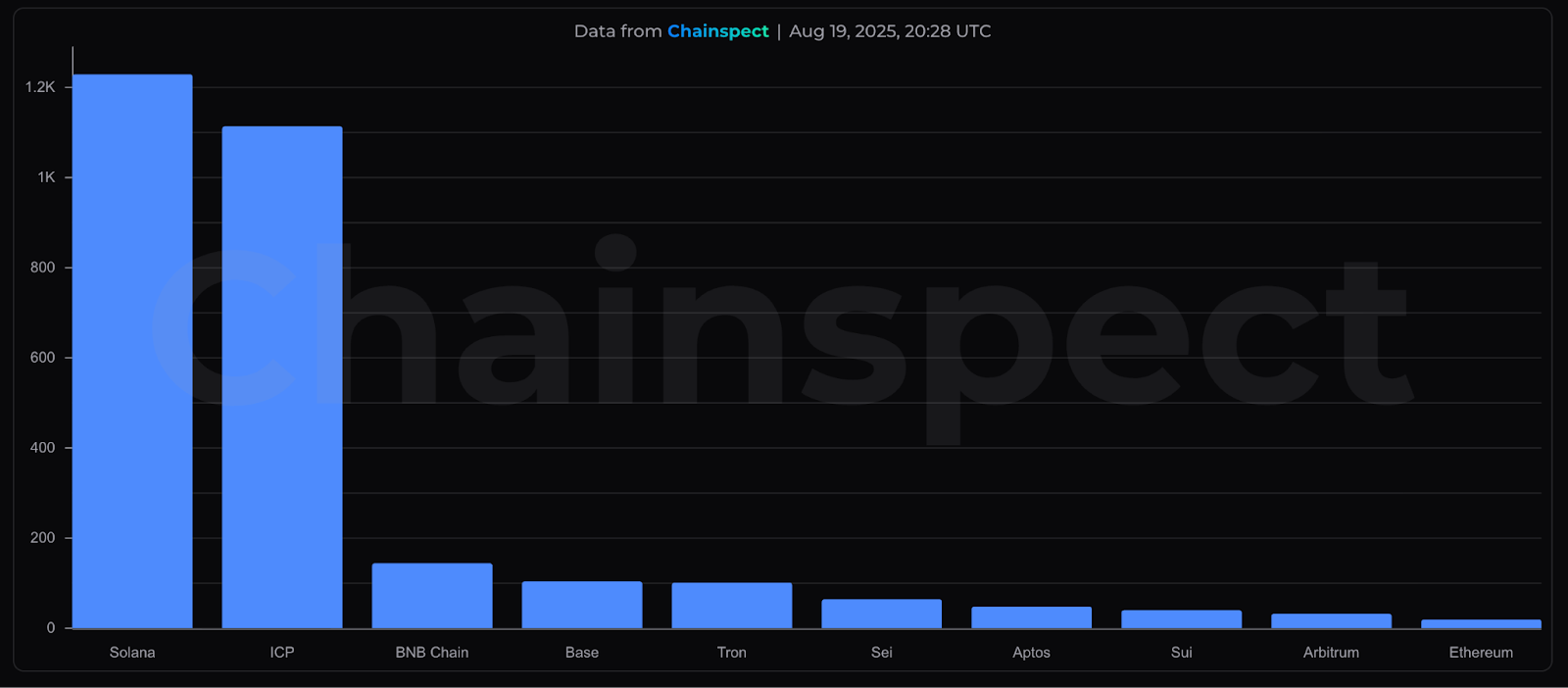
▲ Chainspect, 30-day Average TPS
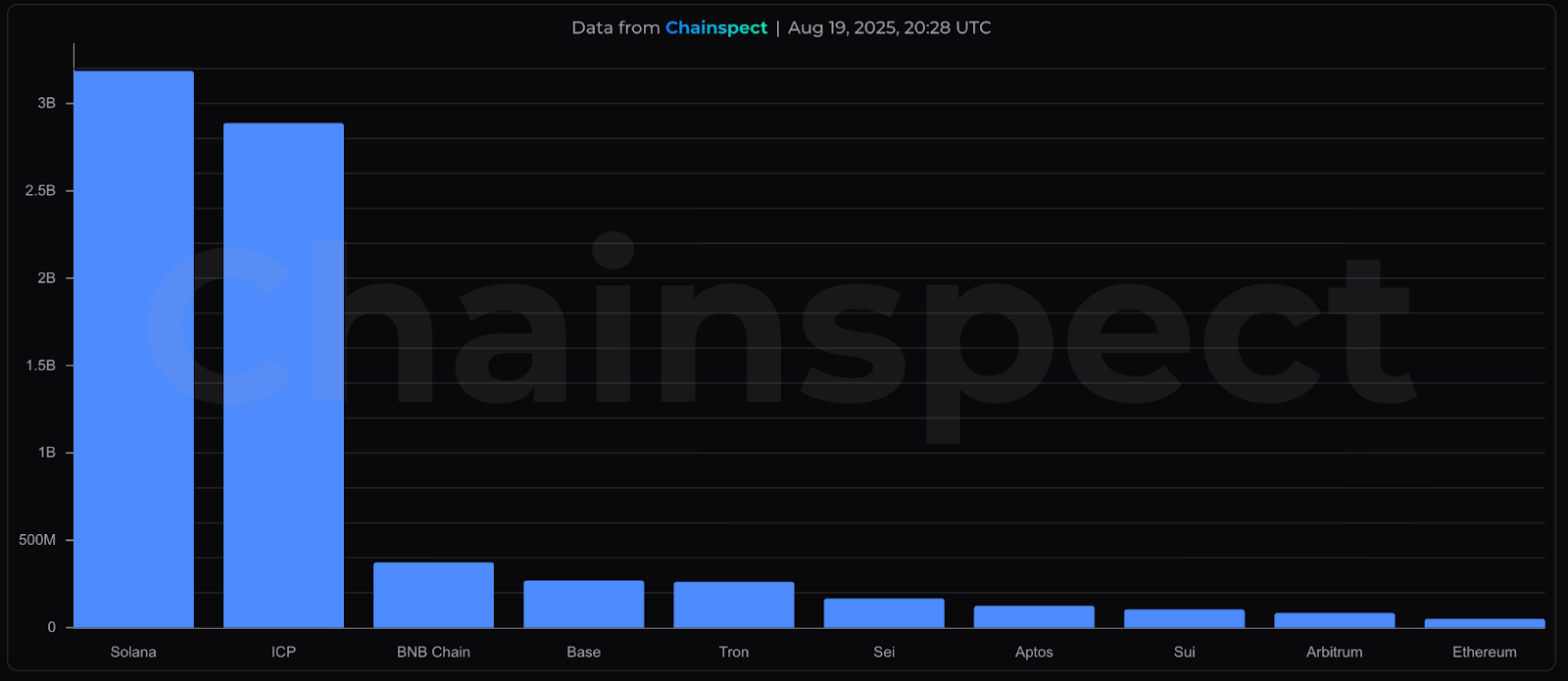
▲ Chainspect, 30-day Transaction Volume
Not only is throughput rising, but emerging chains now achieve millisecond-level block times. BNB Chain’s Maxwell upgrade reduced block time to 0.8s; Base Chain’s Flashblocks technology cuts it to 200ms. In the second half of this year, Solana plans to replace PoH with Alpenglow, targeting a 150ms block confirmation time. MegaETH aims for real-time block production at just 10ms. These consensus and technical breakthroughs greatly enhance transaction immediacy but place unprecedented demands on block data synchronization and decoding capabilities.
However, most downstream data infrastructures still rely on batch ETL pipelines, inevitably introducing data latency. For example, Dune typically experiences ~5-minute delays in displaying Solana contract interaction events, while protocol-layer aggregated data may take up to an hour. This means users’ transactions confirmed in 400ms may not appear in analytics tools for hundreds of times longer—an unacceptable lag for real-time trading applications.
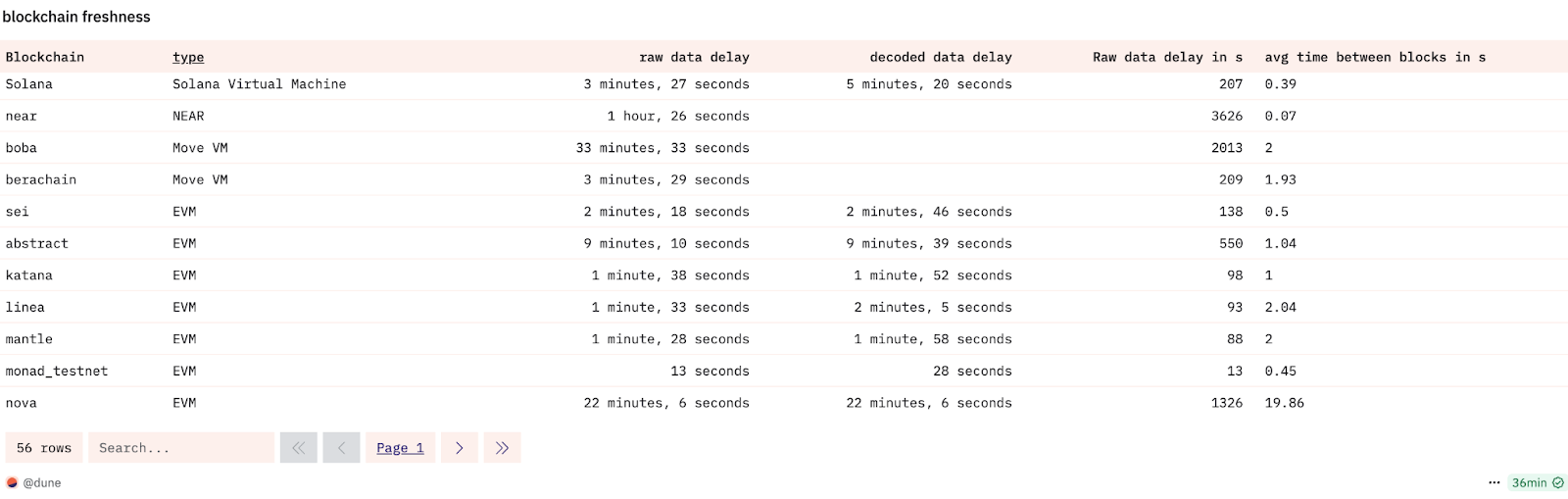
▲ Dune, Blockchain Freshness
To address supply-side data challenges, some platforms have shifted to streaming and real-time architectures. The Graph uses Substreams and Firehose to compress data latency to near real-time. Nansen achieves tens of times performance improvement on Smart Alerts and real-time dashboards by adopting streaming technologies like ClickHouse. Pangea aggregates compute, storage, and bandwidth from community nodes to deliver real-time streaming data with less than 100ms latency to B2B clients such as market makers, quantitative analysts, and central limit order books (CLOBs).
▲ Chainspect
Beyond sheer volume, on-chain transactions also exhibit significant traffic imbalance. Over the past year, Pumpfun’s weekly trading volume varied by nearly 30x between lowest and highest. In 2024, meme trading platform GMGN suffered six server crashes within four days, forcing it to migrate its underlying database from AWS Aurora to the open-source distributed SQL database TiDB. After migration, horizontal scalability and computational elasticity improved significantly, business agility increased by about 30%, greatly alleviating pressure during peak trading periods.
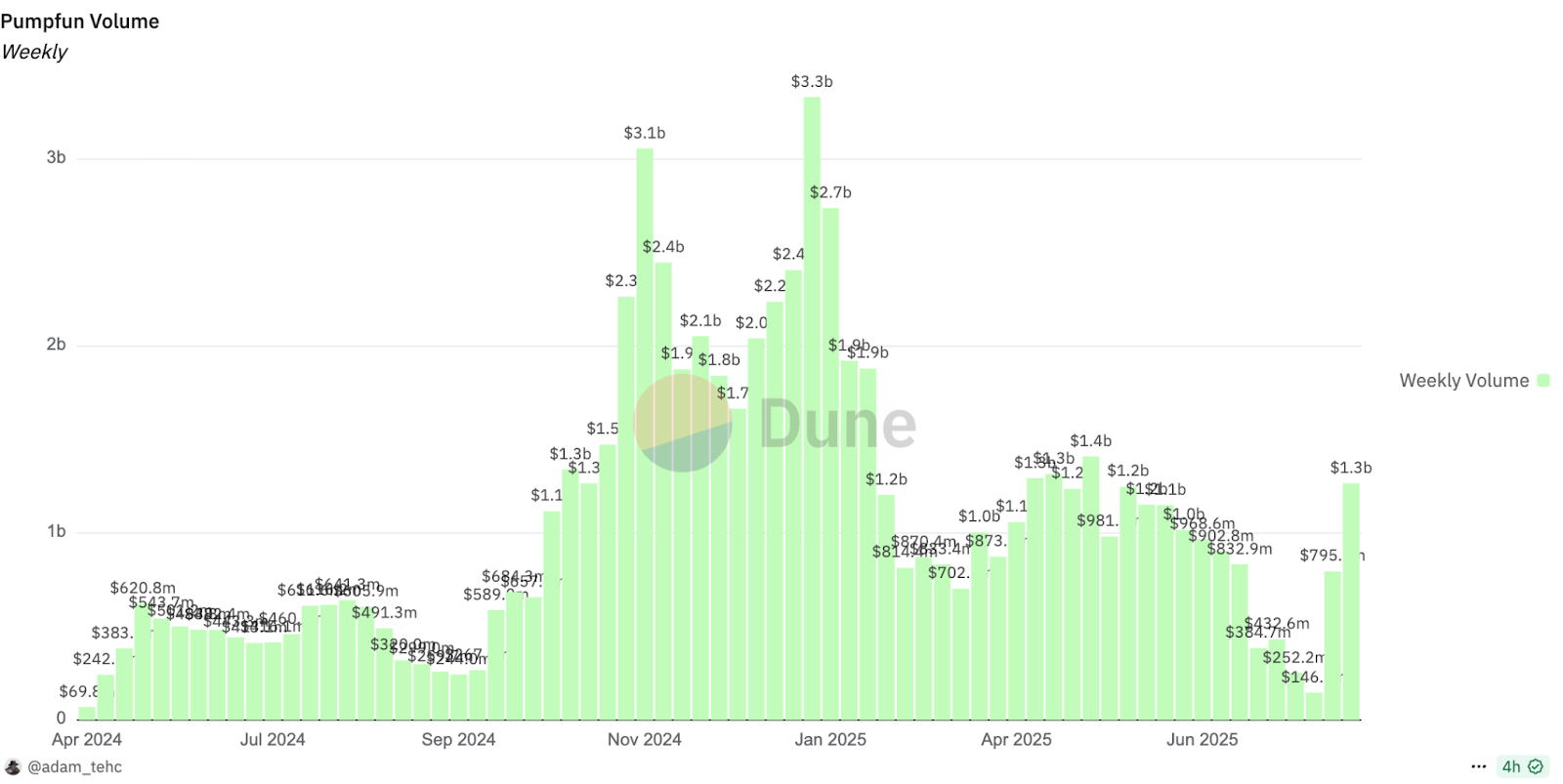
▲ Dune, Pumpfun Weekly Volume
▲ Odaily, TiDB Web3 Use Cases
The multi-chain ecosystem further compounds this complexity. Differences in log formats, event structures, and transaction fields across chains mean each new chain requires custom parsing logic—posing major tests to the flexibility and scalability of data infrastructure. Some data providers thus adopt a “customer-first” strategy: prioritizing chain integration based on where active trading occurs, balancing flexibility against scalability.
If data processing remains stuck in fixed-interval batch ETL modes amid the rise of high-performance chains, systems will face accumulating delays, decoding bottlenecks, and sluggish queries—unable to meet demands for real-time, granular, and interactive data consumption. Therefore, on-chain data infrastructure must evolve toward streaming incremental processing and real-time computing architectures, complemented by load-balancing mechanisms to handle cyclical concurrency spikes. This is not merely a natural technological progression but a critical requirement for stable real-time querying—and a key differentiator in the next generation of on-chain data platforms.
Speed Is Wealth: The Paradigm Shift in On-Chain Data Competition
The core mission of on-chain data has shifted from “visualization” to “executability.” In the last cycle, Dune was the standard tool for on-chain analysis, satisfying the need for “understanding” by enabling researchers and investors to piece together on-chain narratives using SQL and charts.
-
GameFi and DeFi players used Dune to track fund inflows/outflows, calculate yield farming returns, and exit before market turning points.
-
NFT traders analyzed volume trends, whale holdings, and distribution patterns via Dune to predict market热度.
But in this cycle, meme traders are the most active consumers. They’ve driven Pump.fun to generate cumulative revenue of $700 million, nearly double the total revenue of last cycle’s consumer leader Opensea.
In the meme space, market sensitivity to time is amplified to the extreme. Speed is no longer a luxury—it’s the decisive factor in profitability. In primary markets governed by Bonding Curves, speed equals cost. Token prices rise exponentially with buying demand; even a one-minute delay can multiply entry costs. According to Multicoin research, top-earning players in such games often pay 10% slippage to enter three blocks ahead of rivals. This wealth effect and the “rags-to-riches” mythos drive users to seek second-level K-charts, same-block execution engines, and all-in-one decision panels, competing fiercely on information gathering and order speed.
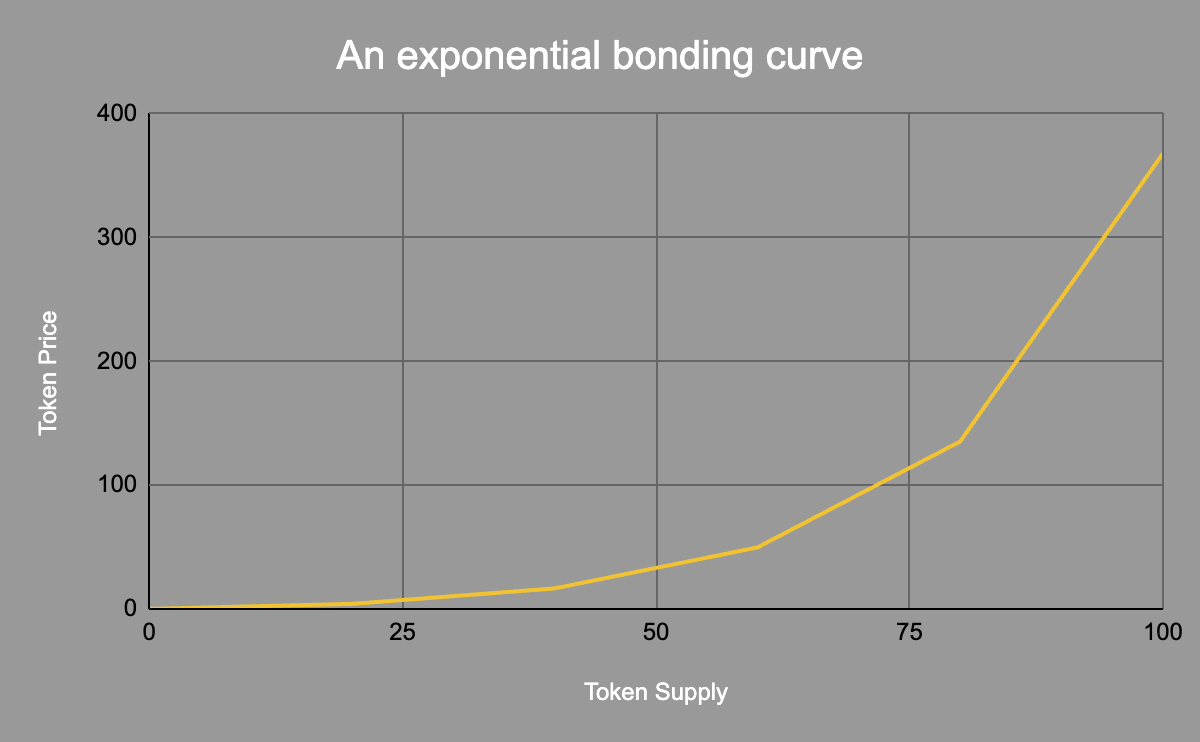
▲ Binance
In the Uniswap manual trading era, users had to set slippage and gas themselves, without front-end price visibility—making trades feel like lottery tickets. With BananaGun-style sniper bots, automated sniping and slippage tech leveled the playing field between retail and professional traders. By the PepeBoost era, bots not only pushed pool-launch alerts instantly but also shared early holder data. Today, with GMGN, we see an all-in-one terminal combining K-line data, multidimensional analytics, and execution—becoming the “Bloomberg Terminal” for meme trading.
As trading tools continue to evolve, execution barriers diminish, and the competitive frontier inevitably shifts to data itself: whoever captures signals faster and more accurately gains a trading edge and generates profits for users.
Dimensionality Is Advantage: Truth Beyond K-Lines
The essence of memecoins is the financialization of attention. Strong narratives break through circles, aggregate attention, and push up prices and market caps. For meme traders, real-time data matters, but to achieve big wins, three questions are more crucial: What is the token’s narrative, who is paying attention, and how can attention be amplified in the future? These forces leave only shadows on K-lines; their true drivers lie in multidimensional data—off-chain sentiment, on-chain addresses and holdings, and precise mapping between them.
On-Chain × Off-Chain: Closing the Loop from Attention to Trade
Users attract attention off-chain and trade on-chain. The closed-loop of these two datasets is becoming a core advantage in meme trading.
#Narrative Tracking and Propagation Chain Identification
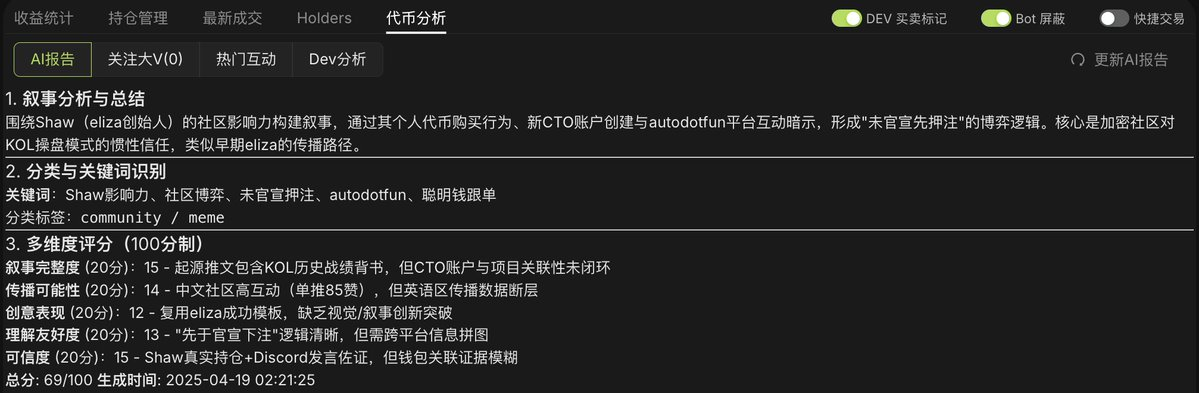
On social platforms like Twitter, tools like XHunt help meme traders analyze a project’s KOL follower list to identify backers and potential attention diffusion paths. 6551 DEX aggregates tweets, websites, comments, launch records, and KOL follows to generate AI reports that evolve with sentiment in real time, helping traders catch narratives precisely.
#Quantifying Sentiment Indicators
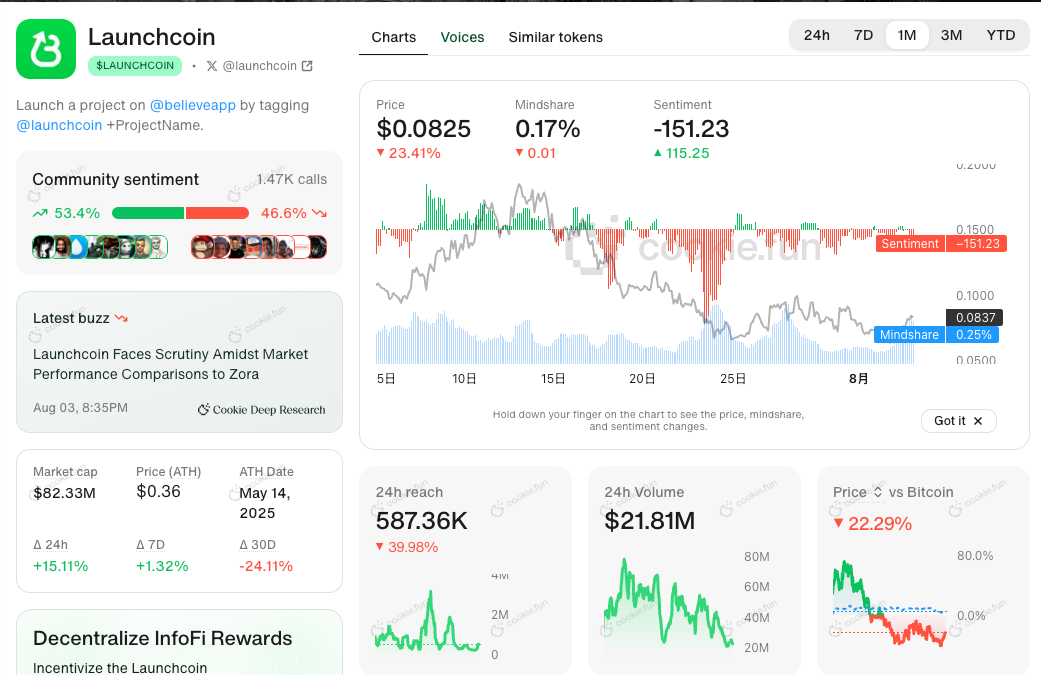
Infofi tools like Kaito and Cookie.fun aggregate and analyze content from Crypto Twitter, generating quantifiable metrics for Mindshare, Sentiment, and Influence. Cookie.fun, for instance, overlays these metrics directly onto price charts, transforming off-chain sentiment into readable “technical indicators.”
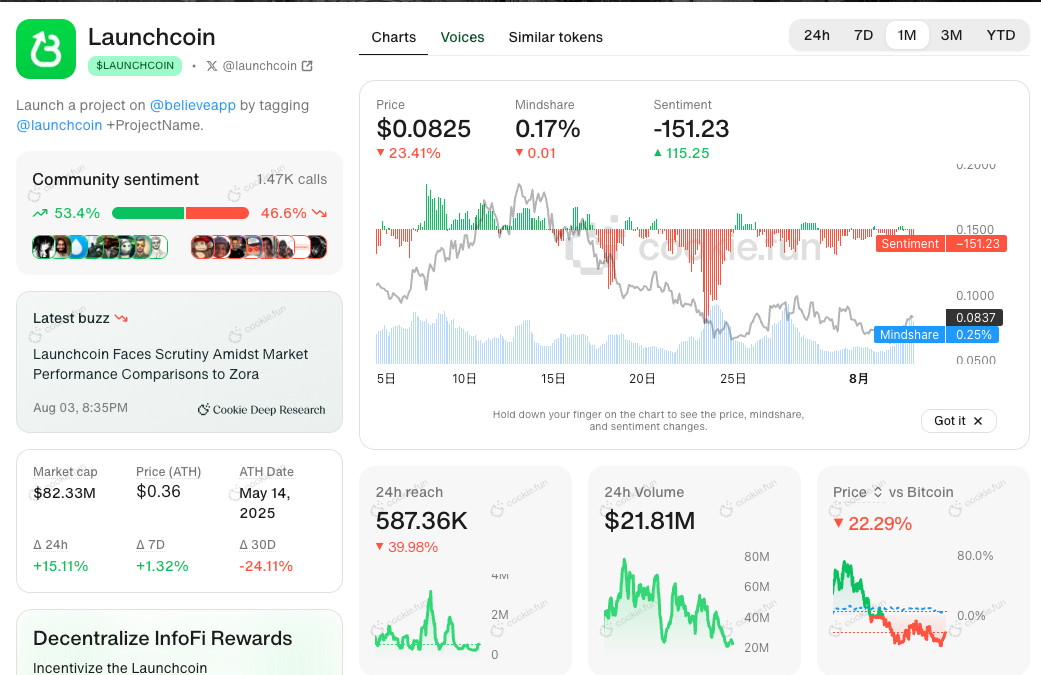
▲ Cookie.fun
#Equal Importance of On-Chain and Off-Chain
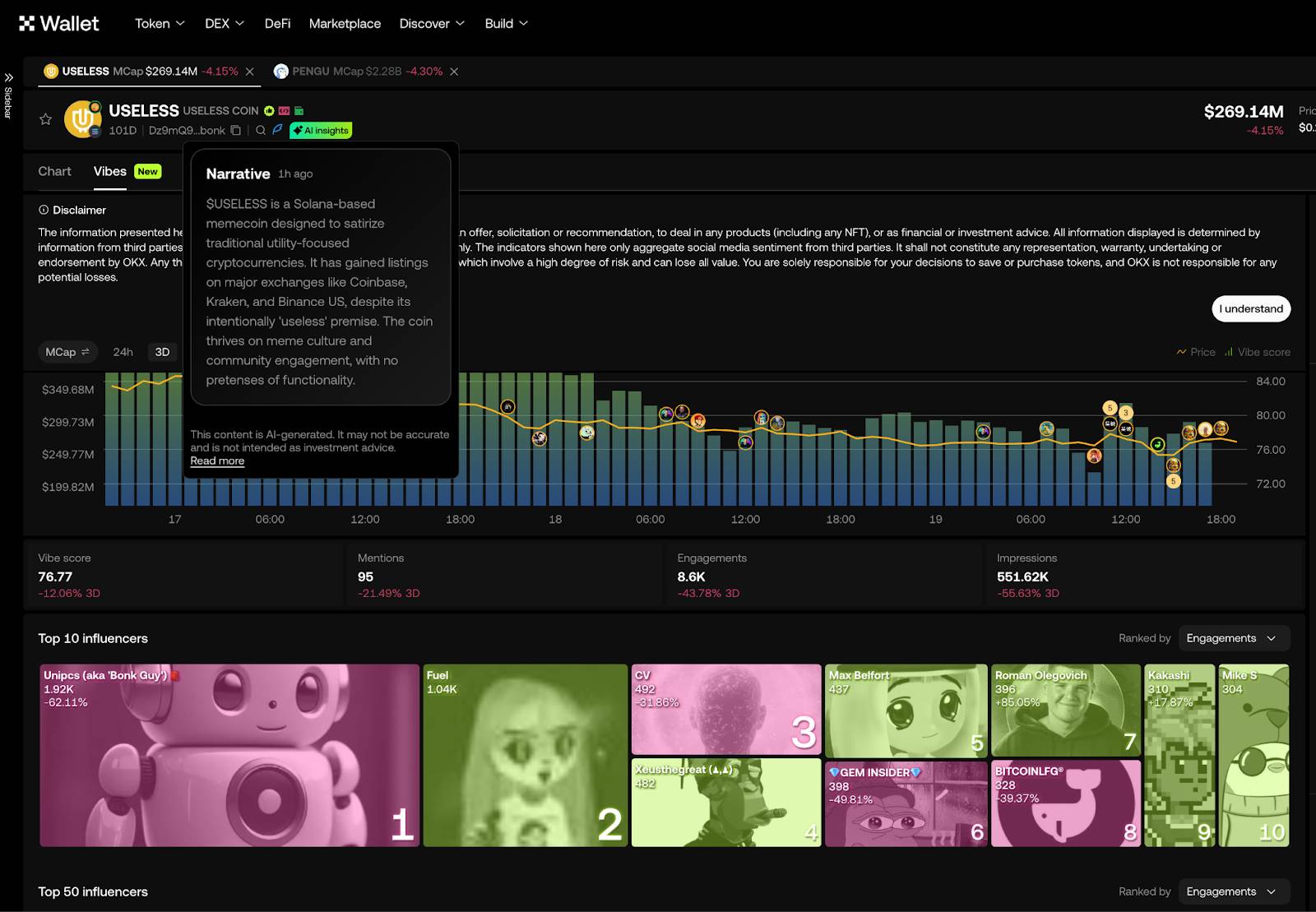
OKX DEX displays Vibes analysis alongside market data, aggregating KOL callout timestamps, key associated KOLs, Narrative Summary, and composite scores, drastically reducing off-chain information search time. Narrative Summary has become the most positively received AI feature among users.
Subsurface Data: Turning “Visible Ledgers” into “Usable Alpha”
In traditional finance, order flow data is held by large brokers; quant firms pay hundreds of millions annually to access it. In contrast, crypto’s transaction ledger is fully public—akin to “open-sourcing” expensive intelligence, creating a vast surface mine waiting to be exploited.
The value of subsurface data lies in extracting invisible intent from visible transactions. This includes fund flows and role identification—clues of whale accumulation/distribution, KOL burner wallets, concentrated vs. dispersed holdings, bundles, and anomalous transfers—as well as address profiling—tagging addresses as smart money, KOL/VC, developer, phishing, or insider trading accounts, then linking them to off-chain identities to connect on- and off-chain data.
These signals are often invisible to ordinary users but can significantly impact short-term market movements. By real-time parsing of address tags, holding patterns, and bundled transactions, trading assistants are uncovering underwater博弈 dynamics, helping traders avoid risks and capture alpha in second-level markets.
For example, GMGN, building on real-time on-chain trades and token contract data, integrates analyses of smart money, KOL/VC addresses, developer wallets, insider trading accounts, phishing addresses, and bundled transactions, mapping on-chain addresses to social media profiles, aligning fund flows, risk signals, and price behavior at second-level precision, enabling faster entry and risk assessment for users.
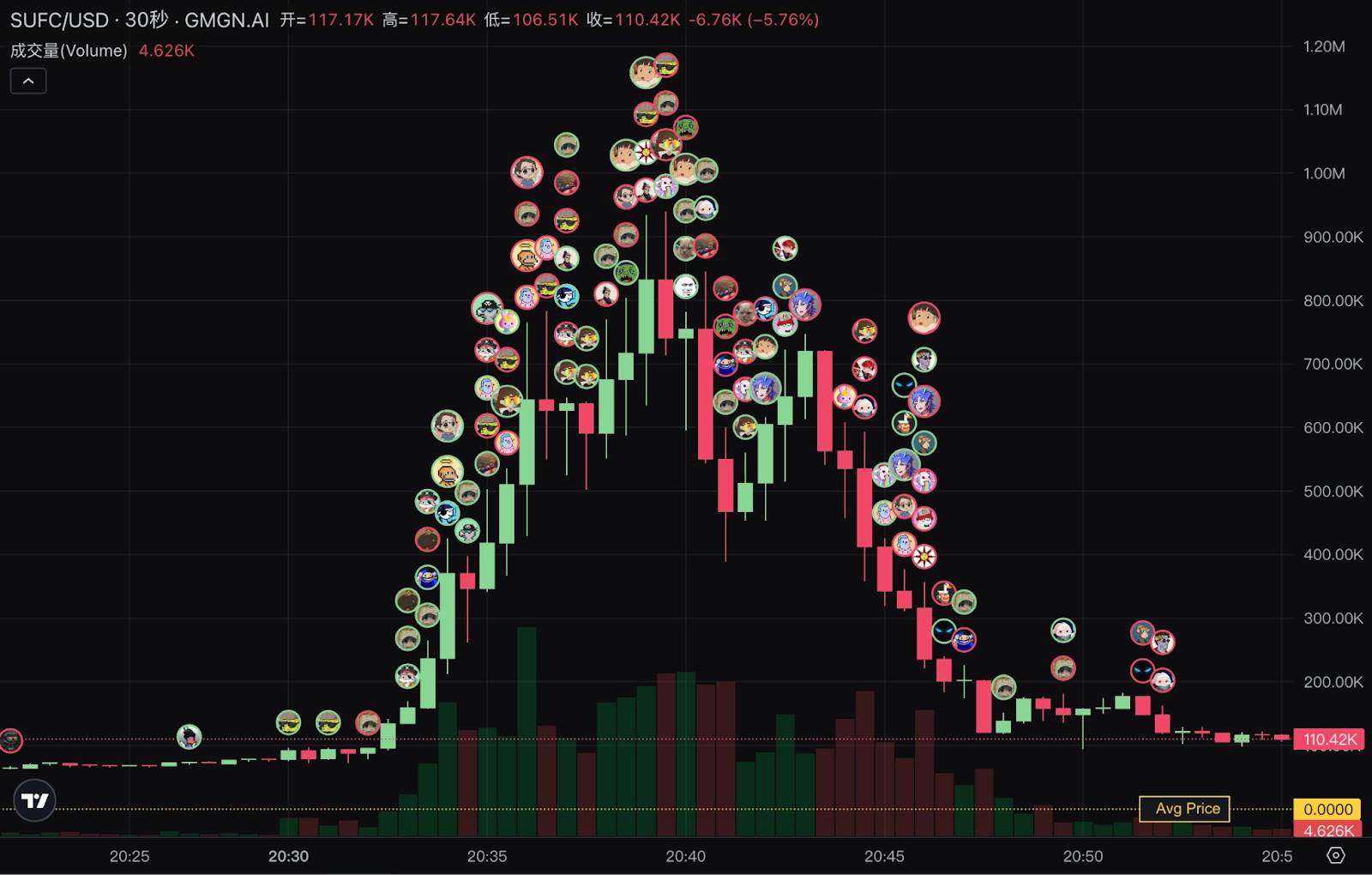
▲ GMGN
AI-Driven Executable Signals: From Information to Profit
“Next-gen AI won’t sell tools—it’ll sell returns.” — Sequoia Capital
This holds true in crypto trading. Once data speed and dimensionality are achieved, the next competitive frontier is transforming complex multidimensional data into executable trading signals. Evaluation criteria for data-driven decisions boil down to three: speed, automation, and excess return.
-
Speed: As AI capabilities advance, the strengths of natural language and multimodal LLMs come into play. They not only integrate and understand massive datasets but also establish semantic links across data, automatically extracting actionable insights. In high-intensity, low-depth on-chain environments, every signal has a short shelf life and limited capital capacity—speed directly impacts return potential.
-
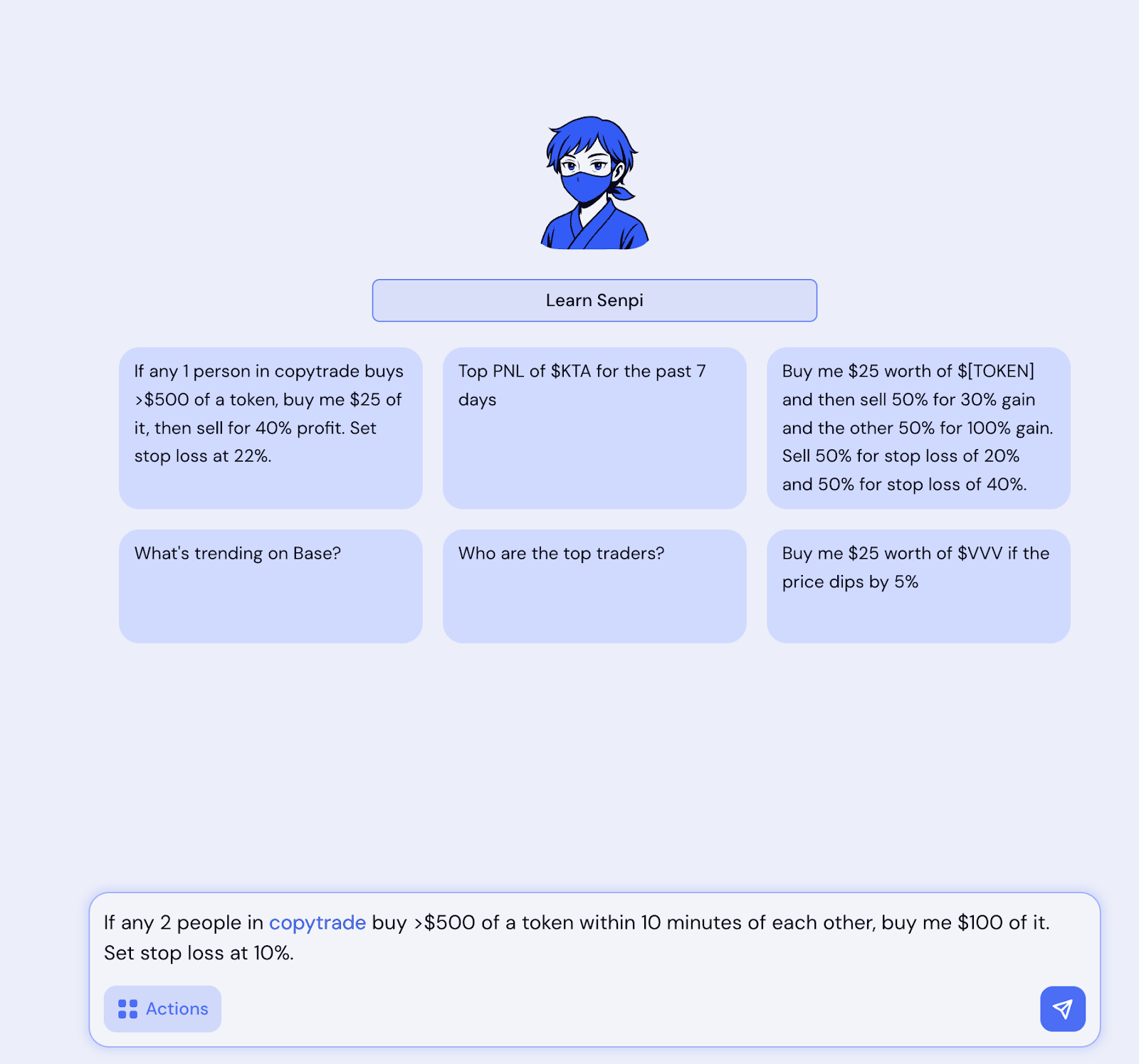
Automation: Humans can’t monitor markets 24/7, but AI can. For example, users can issue conditional buy orders with take-profit/stop-loss via Copy Trading on Senpi’s platform. This requires AI to continuously poll or monitor data in the background and autonomously execute trades upon detecting target signals.
-
Returns: Ultimately, any trading signal’s validity depends on its ability to consistently generate excess returns. AI must not only understand on-chain signals but also incorporate risk controls to maximize risk-adjusted returns in highly volatile environments—factoring in unique on-chain variables like slippage loss and execution latency.
This capability is reshaping data platforms’ business models: from selling “data access” to selling “return-generating signals.” The next-gen competition is no longer about data coverage, but signal executability—closing the final mile from “insight” to “execution.”
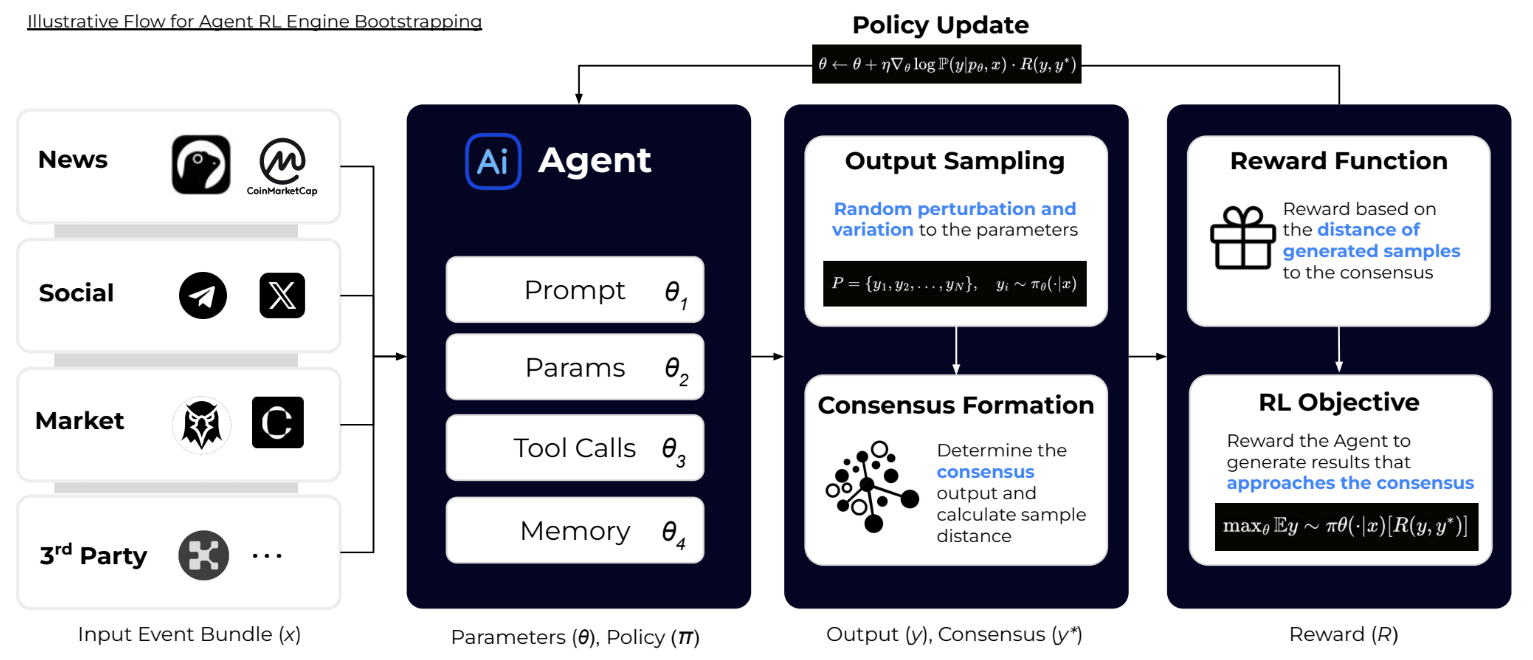
Some emerging projects are exploring this path. For instance, Truenorth, an AI-powered discovery engine, incorporates “decision execution rate” into its information effectiveness evaluation, using reinforcement learning to continuously optimize output, minimize noise, and help users build directly executable information flows aimed at order placement.
▲ Truenorth
Despite AI’s huge potential in generating executable signals, it faces multiple challenges.
-
Hallucinations: On-chain data is highly heterogeneous and noisy. LLMs may produce “hallucinations” or overfitting when parsing natural language queries or multimodal signals, affecting signal accuracy and returns. For example, AI often fails to locate the correct contract address for CT tickers among multiple identically named tokens. Similarly, discussions about AI on CT are frequently misattributed to Sleepless AI in many AI signal products.
-
Signal Lifespan: Trading environments change rapidly. Any delay erodes returns. AI must complete data extraction, inference, and execution in extremely short windows. Even simple Copy Trading strategies turn unprofitable if they fail to follow smart money.
-
Risk Control: In high-volatility scenarios, repeated failed on-chain executions or excessive slippage may not only prevent excess returns but could wipe out entire capital within minutes.
Therefore, finding the right balance between speed and accuracy, and leveraging reinforcement learning, transfer learning, and simulation backtesting to reduce error rates, will define AI’s competitive edge in this domain.
Up or Down? The Survival Choice for Data Dashboards
As AI gains the ability to generate executable signals and assist in order placement, lightweight middleware apps relying solely on data aggregation face existential threats. Whether assembling on-chain data into dashboards or layering execution logic atop aggregation (e.g., trading bots), these models fundamentally lack sustainable moats. Previously, such tools survived on convenience or user habits (e.g., checking token CTO status on DexScreener). But now, with identical data available across platforms, execution engines becoming commoditized, and AI capable of generating and triggering decisions from the same data, their competitiveness is rapidly eroding.
Going forward, efficient on-chain execution engines will mature, further lowering trading barriers. In this context, data providers must choose: go down, deepening faster data acquisition and processing infrastructure; or go up, extending into application layers to own user scenarios and consumption traffic. Mid-tier models that merely aggregate and lightly package data will see their survival space shrink continuously.
Going down means building infrastructure moats. Hubble AI realized that relying solely on Telegram bots offered no long-term advantage, so it pivoted upstream to data processing, aiming to build a “Crypto Databricks.” After maximizing Solana data processing speed, Hubble AI is evolving into an integrated data-research platform, positioning itself upstream to support data needs for U.S. “on-chain finance” narratives and AI agent applications.
Going up means expanding into user-facing applications and locking in end-users. Space and Time initially focused on sub-second SQL indexing and oracle delivery but recently began exploring consumer use cases, launching Dream.Space on Ethereum—a “vibe coding” product allowing users to write smart contracts or generate analytics dashboards using natural language. This pivot increases data service invocation frequency and builds direct user stickiness through product experience.
Thus, intermediaries surviving only on data API sales are losing ground. The future B2B2C data landscape will be dominated by two types: infrastructure companies controlling foundational pipelines, becoming the “utilities” of on-chain ecosystems; and platforms close to user decision-making, transforming data into application experiences.
Conclusion
Under the triple resonance of meme mania, explosive growth of high-performance blockchains, and AI commoditization, the on-chain data sector is undergoing structural transformation. Iterations in trading speed, data dimensionality, and executable signals have rendered “visible charts” insufficient as core advantages. True moats are shifting toward “executable signals that generate user profits” and “underlying data capabilities that power them.”
Over the next 2–3 years, the most attractive entrepreneurial opportunities in crypto data will emerge at the intersection of Web2-grade infrastructure maturity and Web3-native execution models. Data for major coins like BTC/ETH is highly standardized, resembling traditional financial futures, and is increasingly covered by traditional financial institutions and some Web2 fintech platforms.
In contrast, data for meme coins and long-tail on-chain assets exhibits high non-standardization and fragmentation—from community narratives and on-chain sentiment to cross-chain liquidity. Interpreting this requires combining on-chain address profiling, off-chain social signals, and even second-level execution. It is precisely this gap that creates a unique opportunity window for native crypto entrepreneurs to build closed-loop processing and trading systems around long-tail assets and meme data.
We are bullish on projects deeply committed to the following two directions:
-
Upstream Infrastructure—On-chain data companies with streaming pipelines matching Web2 giants in processing power, ultra-low latency indexing, and unified cross-chain parsing frameworks. These projects could become Web3 equivalents of Databricks/AWS, experiencing exponential transaction volume growth as users migrate on-chain, with B2B2C models offering long-term compounding value.
-
Downstream Execution Platforms—Applications integrating multidimensional data, AI agents, and seamless trading execution. By converting fragmented on- and off-chain signals into directly executable trades, these products have the potential to become natively crypto Bloomberg Terminals, monetizing not through data access fees but through excess returns and signal delivery.
We believe these two categories of players will dominate the next generation of the crypto data landscape and build sustainable competitive advantages.
Join TechFlow official community to stay tuned
Telegram:https://t.me/TechFlowDaily
X (Twitter):https://x.com/TechFlowPost
X (Twitter) EN:https://x.com/BlockFlow_News
 IOSG Ventures


![Axe Compute [NASDAQ: AGPU] completes corporate restructuring (formerly POAI), enterprise-grade decentralized GPU computing power Aethir officially enters the mainstream market](https://upload.techflowpost.com/upload/images/20251212/2025121221124297058230.png?x-oss-process=image/resize,p_50/quality,q_80)