In-depth Analysis of Binance Alpha's New Project Bluwhale
TechFlow Selected TechFlow Selected
In-depth Analysis of Binance Alpha's New Project Bluwhale
The Bluwhale token BLUAI will launch today on Binance Alpha and Binance Futures.
 Navigating Web3 tides with focused insights
By angelilu, Foresight News
A crypto trading competition centered around large AI models is now in full swing, drawing the crypto market's attention once again to the convergence of AI and Web3—just as a project called Bluwhale is about to launch its TGE. According to Binance’s official announcement, BLUAI, the native token of Bluwhale, will go live today (October 21, 2025) on Binance Alpha and Binance Futures.
Bluwhale is a decentralized AI personalization protocol within the Sui ecosystem, aiming to build an "Intelligence Layer" for Web3. By connecting AI agents and smart applications, it seeks to empower a consumer-driven, decentralized AI infrastructure. The team behind the project is led by Han Jin, a serial entrepreneur and Forbes 30 Under 30 honoree, and has received backing from institutional investors including SBI, Cardano, and Animoca Brands.
Bluwhale Architecture
Bluwhale addresses the current digital world’s “data monopoly dilemma.” Its proposed solution is a decentralized, open AI personalization protocol with the core goal of enabling users to truly own, control, and ultimately tokenize their digital profiles—transforming data from a passively harvested resource into an actively held user asset.
To achieve this, Bluwhale has designed several key conceptual products:
WhaleScore
The technical cornerstone of Bluwhale is its “decentralized user knowledge graph.” It employs a hybrid model that combines the flexibility of real-time data queries with the controllability of user sovereignty. Using AI technology, the architecture links on-chain wallet activity data with off-chain social identities voluntarily provided by users, forming comprehensive user profiles. Users “claim” their profiles by connecting wallets and verifying social media accounts, and can choose whether to share preferences and data with the DApp ecosystem to participate in value creation and earn rewards.
WhaleScore is central to Bluwhale’s productization. It is a comprehensive financial health index ranging from 0 to 1000, aggregating both on-chain (e.g., DeFi activity, NFT holdings) and off-chain (user-authorized) data to assess liquidity, spending, savings, yield, and diversification levels.
The Agentic Layer
Built upon WhaleScore, Bluwhale introduces the concept of the “Agentic Layer.” This goes beyond simple automation tools, offering instead personalized AI agents that act as dynamic financial coaches. These AI agents continuously learn from users’ wallet behaviors, spending patterns, and portfolios, proactively identifying inefficiencies such as idle funds or excessive risk exposure.
Furthermore, the Agentic Layer transforms raw data into specific, actionable recommendations. If a user’s WhaleScore drops due to imbalanced liquidity, their AI agent might suggest optimal asset rebalancing strategies. If they hold too many stablecoins and miss yield opportunities, the agent could recommend staking options or liquidity pools aligned with their risk profile. This marks a shift from passive data analysis to active, intelligent decision support, aiming to help users develop smarter financial habits over time.
Whale Tank
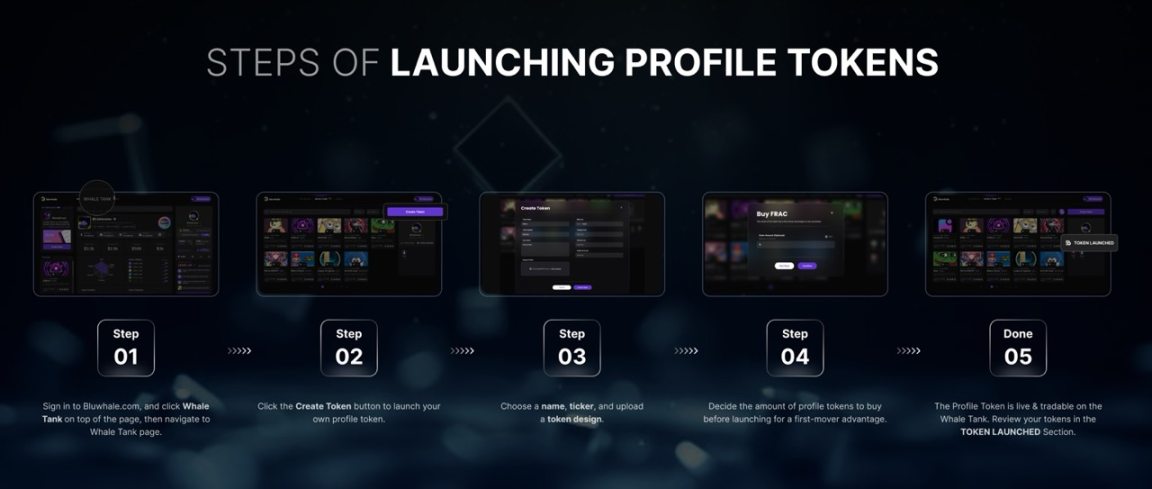
Whale Tank is a tool for issuing and trading profile tokens, allowing users to create and sell NFTs of their profile data, or purchase others’ profile tokens.
The Founder’s Journey
Behind every project stands a founder with a unique journey. The background of Bluwhale’s co-founder and CEO, Han Jin, offers deep insight into the project’s strategic direction. Born in China, raised in Germany, and ultimately graduating from UC Berkeley’s engineering program, Han Jin is a serial entrepreneur with global experience and Silicon Valley roots.

Prior to founding Bluwhale in 2022, Han Jin was best known as the co-founder and CEO of Lucid VR. Starting in 2015, he led the development of the LucidCam—one of the world’s first consumer-grade VR180 3D cameras. Lucid VR achieved notable success, with its product reaching major retail channels like Amazon and Best Buy, and winning multiple industry awards including the Edison Award. Yet beneath the accolades lay the harsh realities of hardware entrepreneurship. In interviews, Han Jin admitted that due to complex hardware requirements, long cycles of consumer VR market development, and heavy reliance on manufacturing, Lucid VR was one of the “most cash-intensive startups imaginable.”
This grueling experience in hardware likely played a pivotal role in shaping Bluwhale’s strategic direction. Han Jin’s past writings reveal a strong focus on business models and value creation, rather than technology alone. He has noted that many first-wave startups in emerging industries fail because they lack viable business models when customer demand remains unclear.
From this perspective, Bluwhale represents not just a pivot in domain, but a strategic evolution grounded in prior experience. It is almost the antithesis of Lucid VR’s business model:
-
From capital-heavy to asset-light: Shifting from a capital-intensive, low-margin hardware business to a software protocol with near-zero marginal costs and infinite scalability.
-
From application to platform: Moving from building a single consumer product to providing foundational infrastructure for other applications, thereby avoiding the massive uncertainty of direct consumer markets.
-
From traditional funding to Web3 economics: Transitioning from lengthy cycles of traditional venture capital to leveraging tokenomics for an endogenous business and funding model.
Thus, Bluwhale is not merely another new idea from Han Jin, but rather a systematic transformation of hard-earned lessons from a decade of entrepreneurship into a coherent solution.
Bluwhale’s Investor Lineup
A clear vision and technical architecture require solid financial backing, and Bluwhale’s fundraising history demonstrates strong market validation.
In March 2024, Bluwhale successfully raised $7 million in its seed round, led by SBI, with participation from Cardano and Animoca Brands. In January 2025, the project completed a strategic financing round, bringing its total funding to $100 million. This funding package included seed and subsequent equity rounds, a $75 million token purchase commitment, various grants, and node sales revenue. The round attracted a more diverse set of participants, including Cointelegraph, SwissBorg, DWF Labs, Master Ventures, and Hub71.
Ecosystem Token BLUAI and Points Token BLUP
In the Web3 world, a project’s economic model is central to its viability. The total supply of its ecosystem token BLUAI is fixed at 10 billion, with an initial circulating supply of 1.228 billion (12.28%) at TGE (Token Generation Event).
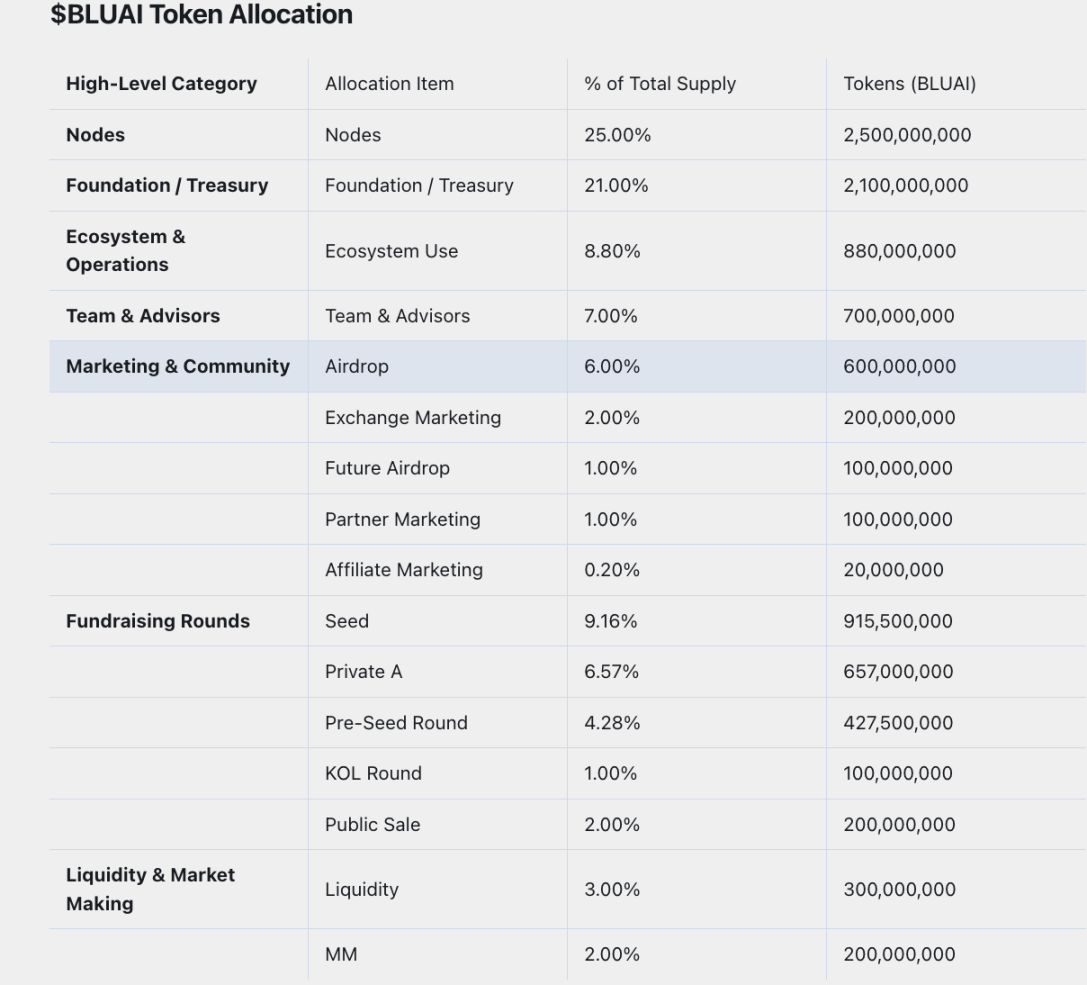
The token distribution is as follows: the largest portion (29.8%) is allocated to ecosystem and operations to support strategic expansion and community initiatives; 25% is reserved for node incentives to reward validators maintaining the network. The foundation and treasury hold 21% for R&D and long-term development; 23% is distributed to financing participants across funding rounds; 7% is allocated to the team and advisors; and the remaining 5% ensures initial liquidity and market-making in secondary markets.
Tokens allocated to the team and advisors are subject to a 12-month lock-up period, followed by linear vesting over 36 to 48 months—an encouraging signal that core team incentives are closely aligned with the project’s long-term success, helping mitigate risks of early insider selling.
Bluwhale also introduces a points token, BLUP (Bluwhale Points Token), positioned as the project’s official “community-first meme token,” used for internal access, reputation, and platform payments. Points accumulated in a Bluwhale account can be redeemed for BLUP, though these cannot later be exchanged for BLUAI airdrops.
The AI+Web3 Space Is Getting Crowded
Overall, Bluwhale is a noteworthy player in the AI+Web3 space. It possesses many ingredients for success: a serial entrepreneur tested by the market and enriched by experience; a vision that directly addresses Web2 pain points with a clear Web3 solution; a strong lineup of strategic investors; and a market launch strategy aligned with Binance.
However, the road ahead is not without challenges. The AI+Web3 narrative is heating up rapidly, and the field is becoming increasingly crowded. In on-chain analytics, established players like Nansen and Dune Analytics have already built strong moats. In decentralized identity (DID), protocols such as Lens Protocol and Farcaster are actively constructing social graphs. Meanwhile, specialized solutions like Formo and Holder are emerging in the Web3 CRM space. Bluwhale’s positioning spans all these areas, meaning it must prove unique value in each dimension.
Its ultimate success will depend on fulfilling the promises laid out in its whitepaper—driving mass adoption of DApps. Bluwhale must demonstrate that its “Intelligence Layer” and “Agentic Layer” are not just advanced data dashboards, but essential infrastructure that enables developers to build novel experiences and achieve more efficient growth. Whether WhaleScore becomes an industry-recognized value standard will be the key indicator of whether network effects can truly form.
Join TechFlow official community to stay tuned
Telegram:https://t.me/TechFlowDaily
X (Twitter):https://x.com/TechFlowPost
X (Twitter) EN:https://x.com/BlockFlow_News
 Foresight News