Ethereum at the Crossroads: Move Forward or Hold On?
TechFlow Selected TechFlow Selected
Ethereum at the Crossroads: Move Forward or Hold On?
This time, we won't talk about sentiment—only judgment.
 Navigating Web3 tides with focused insights
Author: Biteye
ETH/BTC hits a five-year low, old ecosystems are migrating, and new narratives have yet to emerge—Ethereum is stuck between technical upgrades and value dilution.
Ethical guardians still talk about ideals, while reality is liquidating faith.
This time, we’re not discussing sentiment—we’re focusing purely on judgment: Is ETH still worth holding? What are the bulls and bears betting on?
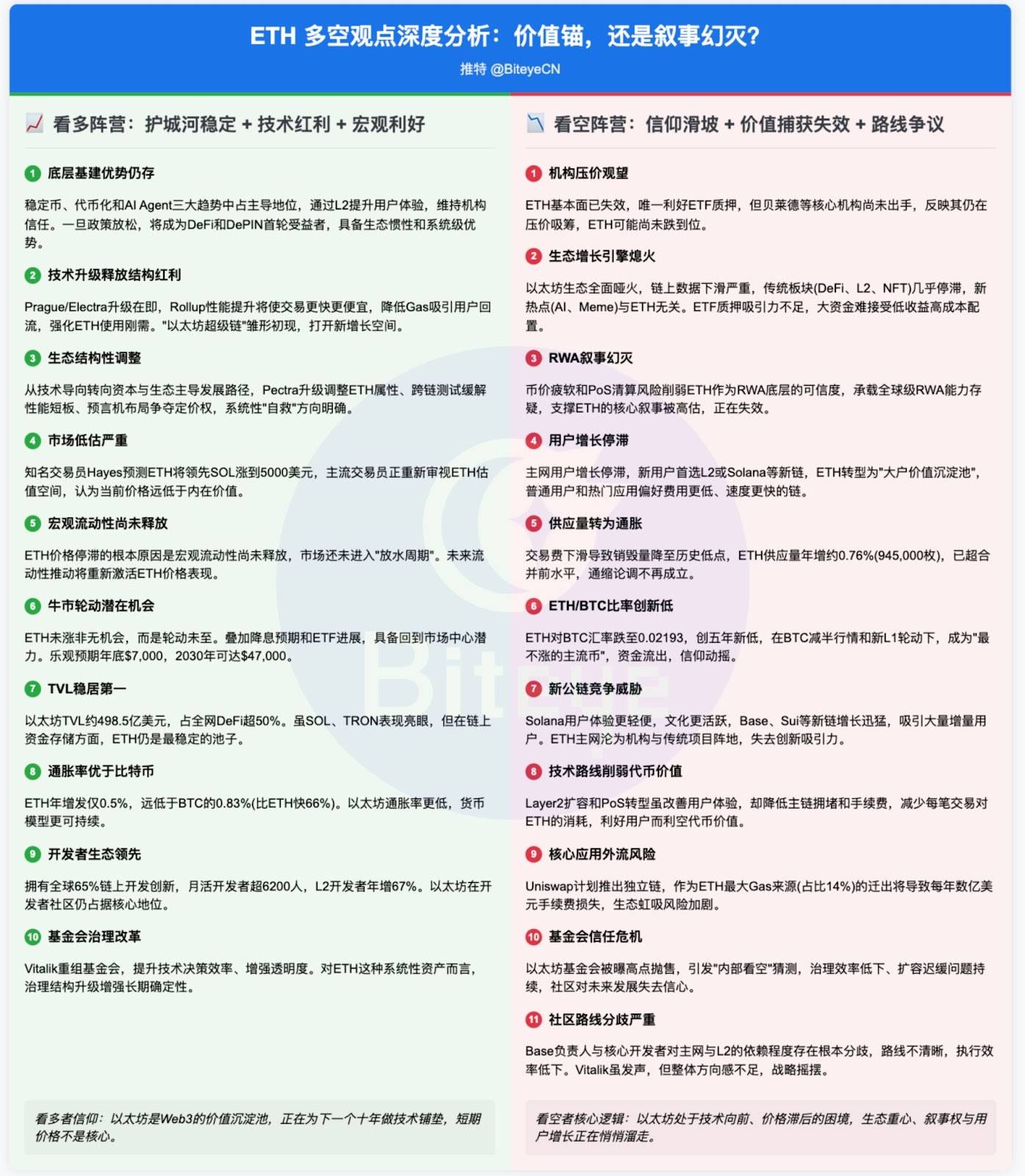
1. Bullish Case: Strong Moat + Tech Dividends + Macro Tailwinds
Despite its price stagnation, Ethereum’s long-term value continues to accumulate, according to bullish arguments. A solid ecosystem foundation, ongoing technical upgrades, and improving macro expectations provide three layers of support.
1. Ethereum remains the absolute core of foundational infrastructure: Bitwise CIO @Matt_Hougan pointed out that Ethereum leads in all three major trends—stablecoins, tokenization, and AI Agents. As long as Ethereum improves user experience via Layer 2 without losing institutional trust, the outlook is optimistic, leaning bullish. Saul Rejwan, managing partner at Masterkey, believes that once regulations ease, ETH will be among the first beneficiaries in DeFi and DePIN. @BTW0205 argues that although short-term sentiment is bearish, Ethereum still holds strong ecosystem inertia and systemic advantages. If it can reconstruct its value model and deliver new narratives, a comeback remains possible.
2. Ongoing tech upgrades unlock structural benefits: The upcoming Prague/Electra upgrade will boost Rollup performance, making Ethereum faster, cheaper, and more open. Lower gas fees could drive user return and strengthen demand for ETH usage. Bulls argue these structural improvements haven’t been priced in yet. @binji_x also sees early signs of an “Ethereum superchain,” potentially opening new growth avenues.
3. Signals of structural ecosystem shift: @feifan7686 suggests Ethereum is transitioning from a tech-driven to capital- and ecosystem-led development path. Upgrades like Pectra adjusting ETH’s properties, cross-chain testing alleviating performance bottlenecks, and oracle deployments competing for pricing power reflect a systemic “self-rescue” focused on capital structure and ecosystem influence. While not immediately reflected in price, the direction is clear—overall, this leans bullish.
4. Traders call out “undervalued ETH”: Prominent crypto analyst @rovercrc and former BitMEX CEO and well-known trader @CryptoHayes have both stated that ETH is undervalued by the market. Hayes even predicts ETH will outperform SOL and rise to $5,000 first. Though aggressive, such views signal that mainstream traders are re-evaluating ETH’s valuation potential.
5. Macro liquidity remains key driver: @0xVeryBigOrange argues that regardless of technical or ecosystem debates, the root cause of current price stagnation is one thing—macro liquidity hasn’t been released yet. It’s not that ETH is failing; the entire market hasn’t entered the “liquidity expansion cycle.”
6. Potential for bull market rotation: ETH hasn’t risen—not because it lacks opportunity, but because rotation hasn’t reached it yet. Combined with rate cut expectations and ETF developments, ETH has the potential to move back into the spotlight. DigitalCoinPrice estimates that in an optimistic scenario, ETH could reach $7,000 by year-end, and possibly climb to $47,000 by 2030.
7. TVL remains #1, on-chain capital still heavily allocated to ETH: Ethereum currently has a TVL of $49.85 billion, accounting for over half of total DeFi value. Although Solana and Tron perform strongly, when it comes to “on-chain savings,” ETH remains the most stable pool.
8. Lower inflation rate, supply model superior to BTC: ETH’s annual issuance is only 0.5%, significantly lower than BTC’s 0.83% (66% higher than ETH). This argument emphasizes that Ethereum’s inflation rate is much lower than Bitcoin’s, making its monetary model more sustainable.
9. Developer ecosystem leads in scale: Venture firm Electric Capital’s annual report shows that Ethereum hosts 65% of global on-chain developer innovation activity, with over 6,200 monthly active developers. L2 developer count grew 67% YoY. These figures confirm Ethereum’s central role in the developer community.
10. Foundation reform strengthens governance outlook: Vitalik announced a restructuring of the Ethereum Foundation to improve technical decision-making efficiency and transparency. For a systemic asset like ETH, governance upgrades enhance long-term predictability.
In summary, the bull thesis rests on this belief: Ethereum is Web3’s value reservoir, laying the technical groundwork for the next decade—short-term price is not the focus.
2. Bearish Case: Eroding Faith + Failed Value Capture + Roadmap Controversy
The bearish core argument: Times have changed. ETH lags behind competitors in price performance, structure, efficiency, and narrative. Its roadmap has failed to translate into token value, and its ecosystem is fragmenting.
1. From institutional view, ETH may not have bottomed yet: @jason_chen998 argues Ethereum’s fundamentals have deteriorated. The only remaining catalyst is staking ETFs, but major institutions like BlackRock haven’t moved in yet, suggesting they’re still accumulating at lower prices—implying ETH may not have hit bottom. Overall, bearish.
2. Ethereum has lost its growth engine: @Loki_Zeng believes Ethereum’s ecosystem completely stalled in Q1 2025, with severe declines in on-chain data. Traditional sectors (DeFi, L2, NFT) are nearly stagnant, and new trends (AI, Meme) are unrelated to ETH. Even the much-hyped staking ETF catalyst proved underwhelming, as large funds reject low returns paired with high costs. ETH lacks real growth momentum—bearish.
3. RWA narrative fading—Ethereum may not be optimal: @yuyue_chris questions Ethereum’s practical capability in RWA. Despite being seen as a “secure layer” for RWA assets, ETH’s weak price performance and PoS-related liquidation risks are undermining its credibility as RWA infrastructure. Doubts remain about Ethereum’s ability to host global-scale RWA—the narrative’s supportive effect is overestimated. Bearish.
4. On-chain growth slowing: @PANewsCN researcher @wsy2021111 noted in December 2024 that ETH mainnet user growth has stagnated over the past year. Most new users now prefer L2s or newer chains like Solana. In his view, Ethereum is becoming a “value reservoir for whales,” while retail users and trending apps favor faster, lower-fee chains. This highlights pressure on Ethereum’s user growth.
5. Supply entering inflationary phase: With network transaction fees declining, daily ETH burn has hit record lows. This sharply reduces the expected burn rate, resulting in a net annual supply increase of ~0.76%, or ~945,000 new ETH per year. Ethereum’s total supply has now exceeded pre-Merge levels.
6. ETH/BTC ratio hits five-year low: On March 31, analyst James Van Straten reported ETH/BTC fell to 0.02193, a five-year low. Amid BTC halving cycles and new L1 rotations, ETH has become the “least rising major coin,” with capital gradually exiting and faith eroding.
7. Rise of new public chains intensifies competition: Solana offers lighter UX and a more vibrant culture, attracting significant new users and developers. Chains like Base and Sui are growing actively, while Ethereum mainnet increasingly serves as a base for institutional and legacy projects, losing appeal to younger, innovative applications.
8. Technical roadmap questioned: Empowering users or weakening token value?: Investor John Pfeffer argues Ethereum’s current roadmap benefits users but harms token value. Layer 2 scaling and the PoS transition reduce mainnet congestion and fees—improving UX but decreasing ETH consumption per transaction.
9. Core app exodus: By end-2024, rumors spread that Uniswap plans to launch its own chain. As Uniswap contributes over 14% of ETH’s total gas fees, migration would cost Ethereum hundreds of millions in annual fees and eliminate a major burn source, exacerbating ecosystem drain.
10. Foundation accused of profit-taking, governance trust weakened: In late 2024, the Ethereum Foundation was exposed selling ETH at peak prices, fueling speculation of “insider bearishness.” Combined with inefficient governance and slow scaling progress, community confidence in future direction has waned.
11. Clear community divisions on roadmap: Jesse Pollak (Base lead) and core developer Dankrad Feist hold fundamentally different views on mainnet vs. L2 dependency. Strategic ambiguity and reduced execution efficiency persist. Vitalik has spoken, but overall direction is unclear and inconsistent.
In short, the bearish logic is this: Ethereum is trapped in a paradox—technically advancing, yet price-stagnant—while ecosystem focus, narrative leadership, and user growth quietly slip away.
3. So, What Should You Decide Now?
Based on the above bull and bear factors, we can analyze from the perspective of holder psychology and decision-making:
1. Long-term value-focused holders
If you believe ETH represents the foundational layer of future crypto—with the broadest developer base, strongest DeFi ecosystem, and continuously evolving tech—and that developers, capital, and structural narratives haven’t collapsed, then ETH remains the core chain for emerging narratives (DePIN, AI Agent, RWA). Holding—or even gradually accumulating—while waiting for the next cycle is a logical strategy.
2. Mid-to-short-term profit-oriented, risk-averse holders
Reducing ETH exposure moderately may better align with your strategy. After all, many bullish factors are likely to materialize only in the medium to long term. In the near term, ETH may continue to consolidate or weaken. The competitive pressures and value challenges cited by bears aren’t issues resolvable within one or two quarters.
Consider trimming position size while keeping a core holding for flexibility. Re-enter decisively once ETH’s trend clarifies, or engage in tactical trading to improve capital efficiency. A neutral approach could involve maintaining a base position (to avoid missing explosive moves) while allocating part of capital to other assets or swing trades to hedge opportunity cost.
3. Short-term performance seekers or those skeptical of Ethereum’s roadmap
Prudent caution is wise. Consider gradually exiting most positions during rallies, while closely monitoring key Ethereum metrics (e.g., on-chain activity). If fundamental improvements emerge or new narratives take shape, reallocate accordingly.
Risk Warning: The above is for informational purposes only, not investment advice.
Join TechFlow official community to stay tuned
Telegram:https://t.me/TechFlowDaily
X (Twitter):https://x.com/TechFlowPost
X (Twitter) EN:https://x.com/BlockFlow_News
 @BiteyeCN