








Behind Lnfi Network's TGE Delay: Waning BTC Ecosystem Hype and Capital
TechFlow Selected TechFlow Selected
Behind Lnfi Network's TGE Delay: Waning BTC Ecosystem Hype and Capital
The Dilemma of the BTC Ecosystem Community Amid Market Cycles, Technological Bottlenecks, and Lack of Trust
 Navigating Web3 tides with focused insights
By 0xLayman, ChainCatcher
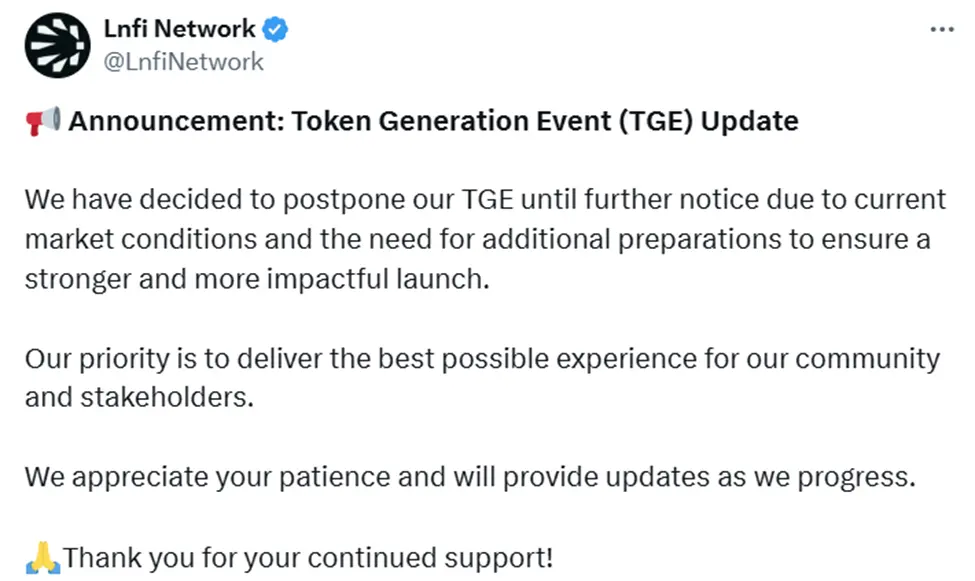
On March 24, 2025, Lnfi Network announced the postponement of its Token Generation Event (TGE), following a history of delayed core product launches.
In the current state of the BTC ecosystem, Lnfi Network's delay reflects the broader challenges faced by the entire ecosystem amid market volatility and industry fatigue.
A Crisis of Trust Behind the Delay
Lnfi Network (formerly NostrAssets) is a BTC Layer 2.5 solution aiming to bring Web3 and tokenization to the Lightning Network, enabling DeFi applications on Bitcoin.
However, this latest delay provided no clear timeline for resumption, details on additional development work required, or compensation plans for early supporters—only citing “unfavorable market conditions” as the reason.
Notably, on August 7, 2024, the team had already postponed the launch of its core products—LN Bridge and LN Exchange—using the same justification of “market downturn.”
In an environment where BTC ecosystem development has generally slowed and investor sentiment has grown increasingly cautious, repeated delays with vague explanations inevitably erode community trust. Even though the project previously secured seed funding from institutions such as HashKey Capital, UTXO Management, CMS Holdings, and Waterdrip Capital, it cannot silence growing concerns over the team’s execution capability and lack of transparent communication.
The Misalignment Between Vision and Reality
Although market conditions appeared to improve slightly by late March, the awkward position in which projects like Lnfi Network find themselves may be the deeper reason behind the TGE postponement.
During the latter phase of this bull cycle, market attention has largely shifted toward short-term speculative assets like memecoins, further weakening the appeal of the Bitcoin ecosystem and making long-term DeFi visions—such as those pursued by Lnfi Network—feel out of sync with prevailing market sentiment.
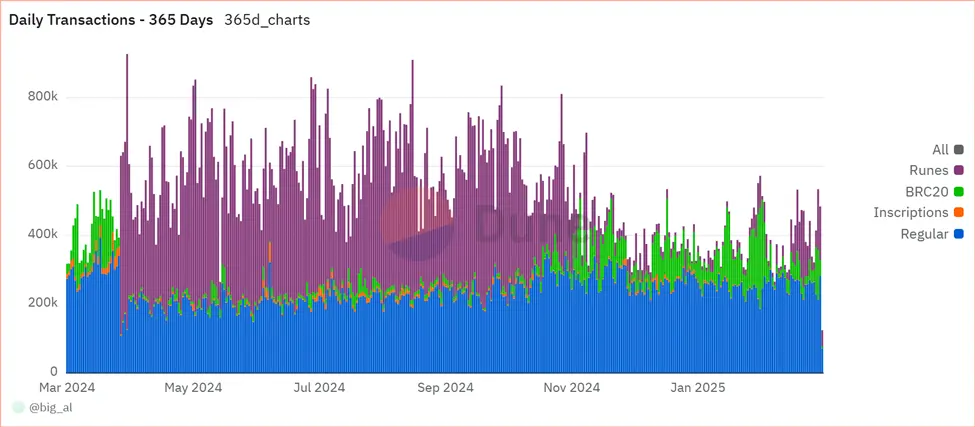
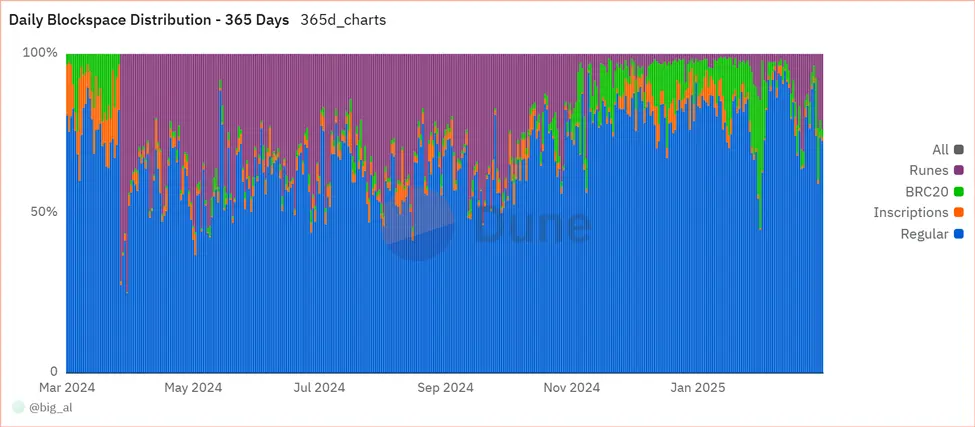
Data from public Dune dashboards shows that as of March 24, 2025, the daily transaction volume on the BTC ecosystem reached approximately 483,600. Of these, regular BTC transfers accounted for about 281,400 transactions (58.2%); Runes protocol transactions totaled around 156,800 (32.4%); BRC20 token transactions were about 44,600 (9.2%); and Inscriptions (NFT-like data entries) accounted for only 807 transactions (0.2%).
Compared to last year’s peak, when daily BTC ecosystem transactions exceeded one million (with Runes protocol alone surpassing 600,000 daily transactions), overall activity has declined sharply—down roughly 53% year-on-year.
In particular, Runes protocol transaction volume has dropped from a high of about 600,000 per day in 2024 to just 156,800 currently—a decline of over 70%. While BRC20 tokens experienced a temporary surge due to the memecoin craze, recent daily volumes have stabilized between 40,000 and 50,000 without significantly boosting overall ecosystem activity. Inscription-related transactions have nearly disappeared, accounting for less than 1% of total volume.
Overall, on-chain Bitcoin activity has reverted primarily to standard BTC transfers, indicating that after a brief wave of speculation driven by memecoins and new protocols, the market is returning to rationality—with a notable drop in speculative trading.
A Shared Struggle Across the Ecosystem
Lnfi Network’s struggles are not unique; its TGE delay mirrors the common challenges confronting the entire BTC ecosystem.
Despite high expectations for Layer 2 solutions to enhance Bitcoin’s scalability and functionality, the path to technical breakthroughs remains fraught with obstacles: some DeFi protocols add complexity, requiring trade-offs between security and usability; the Lightning Network faces issues of insufficient liquidity and centralization risks; while Layer 2 solutions improve scalability, they still struggle to achieve high throughput, low fees, secure bridging, and user-friendly experiences simultaneously.
BTC-based projects face not only technological bottlenecks and market fluctuations but also growing skepticism from users and communities. After years of market evolution, users have become more cautious toward new initiatives.
With increasing numbers of projects and frequent delays, even as institutional capital continues to flow in and push valuations higher, investor participation is slowing down. Rather than risking funds in high-risk BTC sidechains or DeFi ventures, many investors prefer holding Bitcoin directly to capture price appreciation with greater stability.
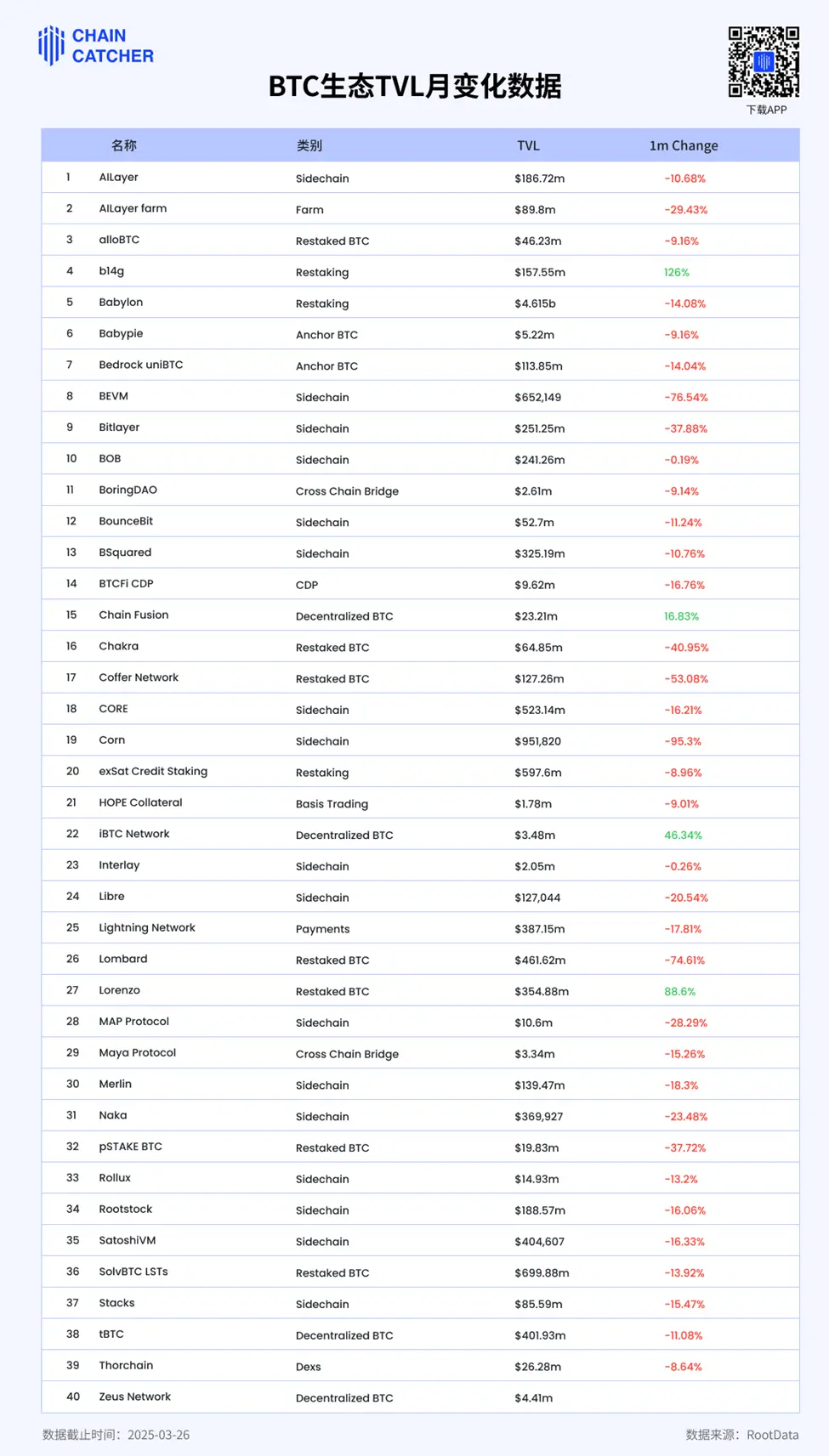
According to incomplete data compiled by ChainCatcher, the majority of BTC ecosystem projects have seen negative monthly TVL (Total Value Locked) growth, indicating poor capital inflows across the board during the observed period.
Even though the BTC ecosystem retains strong foundational consensus, without striking a balance between technological advancement and user trust, projects like Lnfi Network risk sinking further into obscurity amid ongoing market volatility and industry stagnation.
Join TechFlow official community to stay tuned
Telegram:https://t.me/TechFlowDaily
X (Twitter):https://x.com/TechFlowPost
X (Twitter) EN:https://x.com/BlockFlow_News
 ChainCatcher 链捕手






