








Opinion: The crypto narrative has entered a "post-performance era," where over-optimizing infrastructure performance is meaningless
TechFlow Selected TechFlow Selected
Opinion: The crypto narrative has entered a "post-performance era," where over-optimizing infrastructure performance is meaningless
Differentiation must come from other aspects: unique features and experiences.
 Navigating Web3 tides with focused insights
Author: Cem | Sovereign
Translation: TechFlow
Recently, the main discussion on crypto Twitter has centered around improving performance in general-purpose environments.
Base is pursuing its "Gigagas" goal by leveraging Reth and Ethereum’s blob upgrades.
Solana is approaching its vision of achieving 1 million TPS (transactions per second) through Firedancer and remarkable optimizations in its C-based network stack.
MegaEth completely removes gas limits with the help of a highly optimized sequencer.
As a crypto enthusiast, I have nothing to complain about. During DeFi Summer and the 2021 bull run, I paid hefty fees on Ethereum Mainnet—now I can enjoy low-cost transactions on Solana. And in the future, I’ll enjoy even cheaper and faster transactions across all these platforms.
Yet since first entering this space around 2017, I’ve been obsessed with making crypto mainstream. And recently, one question has lingered in my mind:
We are rapidly approaching the tipping point of over-optimization.
By the end of 2025, blockspace will be abundant, and performance will become commoditized. Once near-instantaneous and free transactions become the norm, speed alone won’t be enough to stand out. As developers, we need to shift our mindset.
The Post-Performance Era
We call it the “post-performance era” because the battle for performance has largely been won. Most platforms today can deliver fast and cheap transactions, so differentiation must come from elsewhere: unique features and experiences.
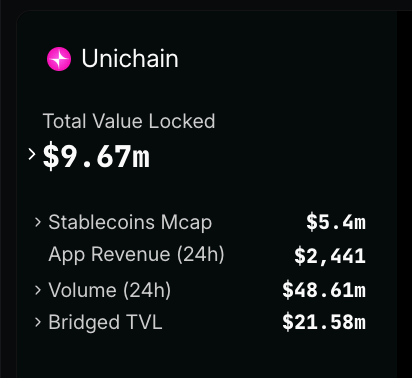
This is where full-stack customization comes into play. It's 2025—transactions are cheap and fast, yet most applications still look and feel the same. Meanwhile, the premium for launching yet another EVM-derived chain has vanished. Just look at Unichain—it failed to attract significant attention or liquidity:
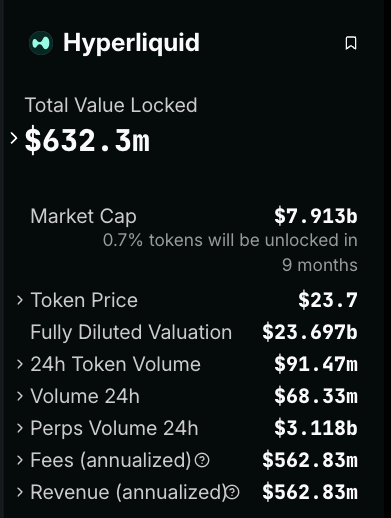
In contrast, this cycle’s winner—Hyperliquid—took a bold approach. It built its entire stack from scratch, optimizing specifically for its use case. Among its many interesting customizations, two stand out:
Priority Cancellations and Post-Only Orders
By enforcing transaction ordering within blocks based on type, Hyperliquid protects stale orders from being easily front-run by high-frequency traders. This reduces toxic order flow, makes market-making easier, and ultimately increases liquidity for all traders.
Vault-Based Copy Trading
Hyperliquid vaults allow anyone to automatically replicate a vault creator’s trades. Since vault logic runs as part of block production, no external keepers are required. Hyperliquidity vaults execute market-making strategies, allowing anyone to provide liquidity and share in the resulting PnL.
Combine these unique features with high performance, low latency, and a seamless user experience, and it’s clear why Hyperliquid has become the go-to DEX for derivatives.
The results speak for themselves:
The Real Bottleneck: Virtual Machines
A major reason most applications lack differentiation lies in virtual machines (VMs). Many of our tools are built around VMs—or derivatives of Ethereum and Solana clients—which in turn constrain customization.
In recent years, there's even been a trend pushing all rollups toward full EVM-equivalence, enabling them to natively run on the Ethereum Virtual Machine. That’s cool for us tech geeks—but is that really what the market needs?
I don’t think so. In fact, the more you differentiate on features that truly matter to users, the greater your chances of winning the market.
Isn’t Interoperability Key?
Yes, cross-chain communication remains essential—even within purpose-built blockchains. Standardized tools for shared liquidity and message passing are still critical.
That’s why open-source messaging libraries like @hyperlane and intent-based bridging frameworks like @RelayProtocol are poised for success. But beyond integrating these interoperability components into custom chains, developers should have full freedom to tailor their applications.
Responding to Market Demand
What the market demands are finely-tuned, purpose-built applications that offer seamless user experiences—not just another generic EVM fork. So build something truly customized, optimized for your specific use case.
Only then can we create applications that truly bring crypto into the mainstream.
Join TechFlow official community to stay tuned
Telegram:https://t.me/TechFlowDaily
X (Twitter):https://x.com/TechFlowPost
X (Twitter) EN:https://x.com/BlockFlow_News
 @cemozer_






