








Ethena: The Next-Generation Crypto Fed
TechFlow Selected TechFlow Selected
Ethena: The Next-Generation Crypto Fed
Ethena faces short-to-medium-term price pressure, but its core business holds long-term value.
 Navigating Web3 tides with focused insights
Author: 0xCousin
1. Who is Behind Ethena?
Ethena Team Members
The Ethena team has diverse and strong backgrounds, with deep expertise and practical experience in crypto, finance, and technology.
Founder G (Guy Young) previously worked at a $60 billion market-cap hedge fund and founded Ethena after the collapse of Luna. COO Elliot Parker was formerly a product manager at Paradigm and also worked at Deribit. Jane Liu, Head of Institutional Growth for Asia-Pacific, previously served as Investment Research Lead at Fundamental Labs and Head of Institutional Partnerships and Fund Relations at Lido Finance.
Ethena’s Funding Situation
According to Rootdata, Ethena has completed three funding rounds, raising a total of $119.5 million. The lead investors include Dragonfly, Maelstrom Capital, and Brevan Howard Digital.
Ethena has attracted attention and investment from numerous well-known institutions, not only providing substantial capital for Ethena's growth but also offering valuable industry resources. Ethena’s investor base includes exchanges (YZi Labs, OKX Ventures, HTX Ventures, Kraken Ventures, Gemini Frontier Fund, Deribit, etc.), market makers (GSR, Wintermute, Galaxy Digital, Amber Group, etc.), and traditional financial institutions (PayPal Ventures, Franklin Templeton, F-Prime Capital, etc.).
2. What is Ethena?
In one sentence: Ethena is a synthetic dollar (Synthetic Dollar) protocol that launched the dollar stablecoin USDe and the dollar savings asset sUSDe. The stability of USDe is backed by crypto assets combined with corresponding delta-neutral hedging positions (short futures).
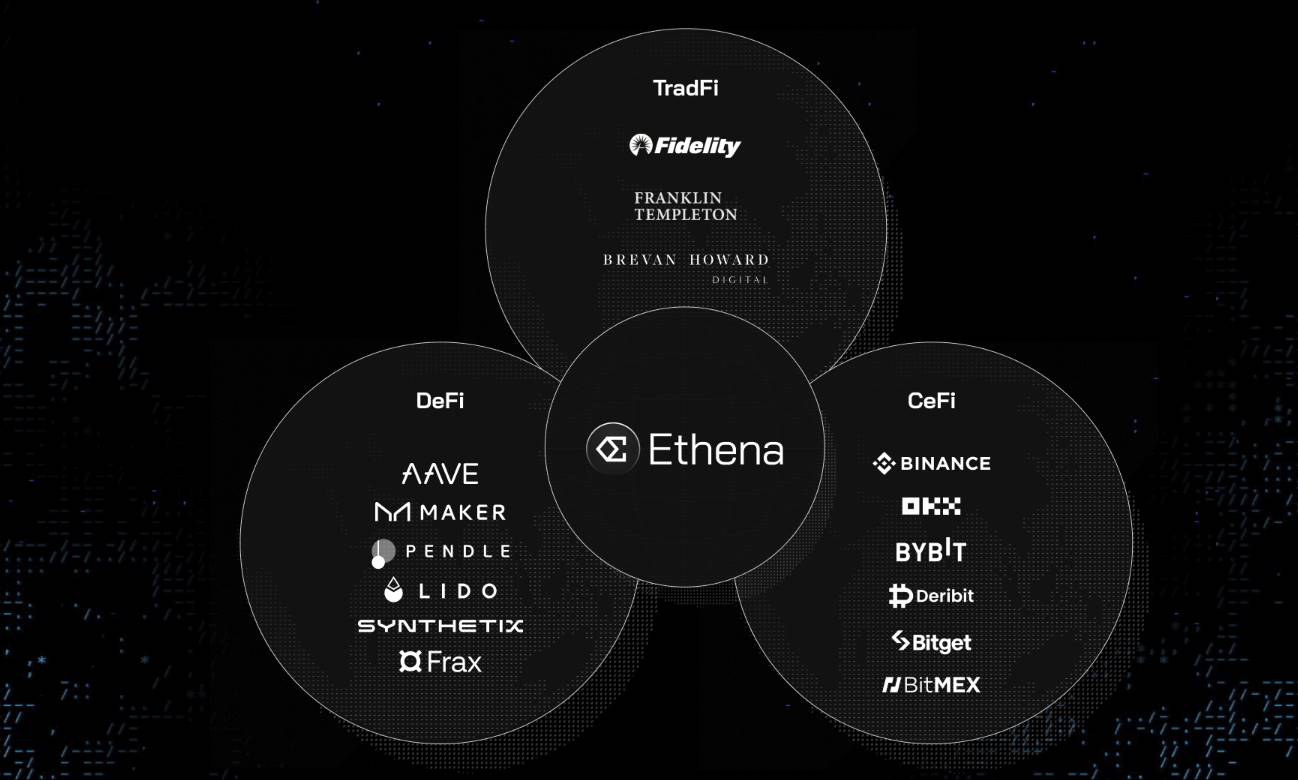
In terms of mission, Ethena aims to connect capital across CeFi, DeFi, and TradFi through its stablecoin USDe, while capturing interest rate differentials among these three sectors (exchanges, on-chain, traditional finance) to deliver higher yields to users. If USDe scales sufficiently, it may drive convergence of capital and interest rates across DeFi, CeFi, and TradFi.
Mechanism of Stablecoin USDe
Minting/Redemption Mechanism: Only two whitelisted, independent legal entities—Ethena GmbH and Ethena BVI Limited—are authorized to mint and redeem USDe. Minters must use BTC/ETH/ETH LSTs/USDT/USDC as collateral and interact with the USDe Mint and Redeem Contract. As shown below:
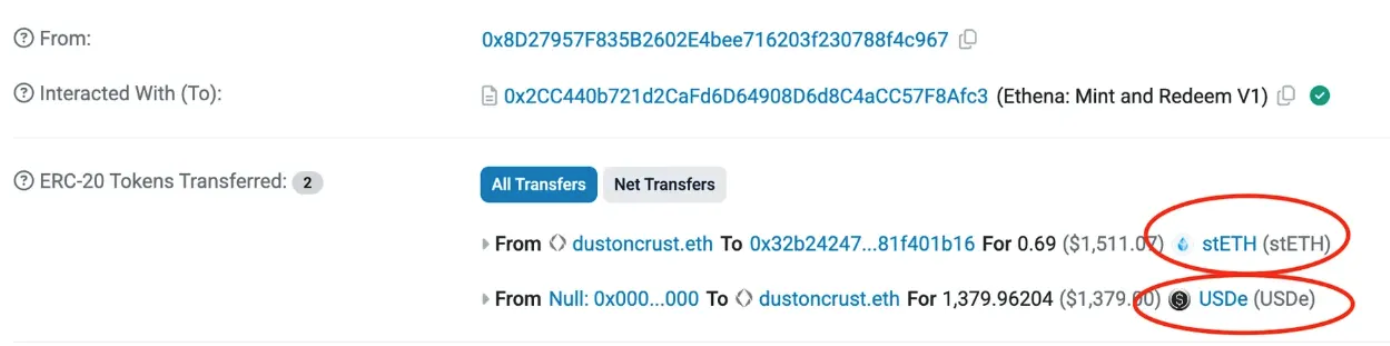
The first USDe mint transaction from Ethena Protocol's USDe Mint and Redeem Contract V1
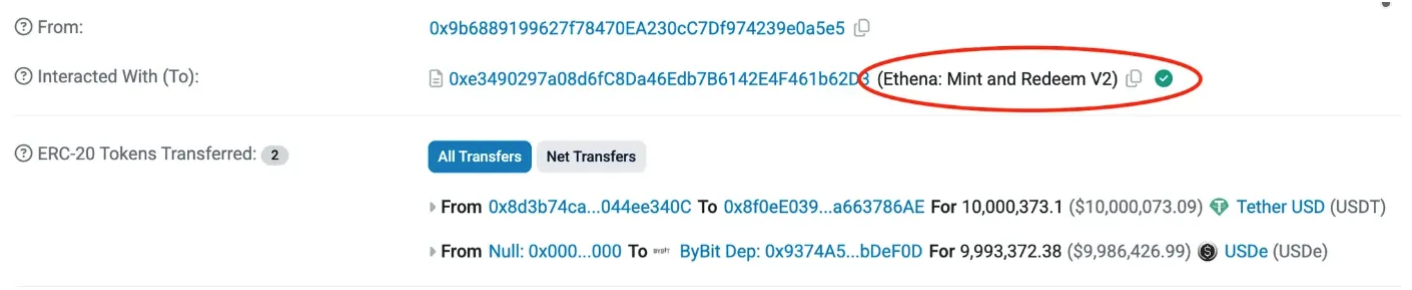
A recent USDe mint using Ethena Protocol's USDe Mint and Redeem Contract V2

This is a record of redeeming USDe for USDT
During minting or redemption, backing asset pricing is obtained from multiple sources and continuously validated, including CeFi exchanges, DeFi exchanges, OTC markets, and oracles such as Pyth and RedStone, ensuring accurate and fair valuation.
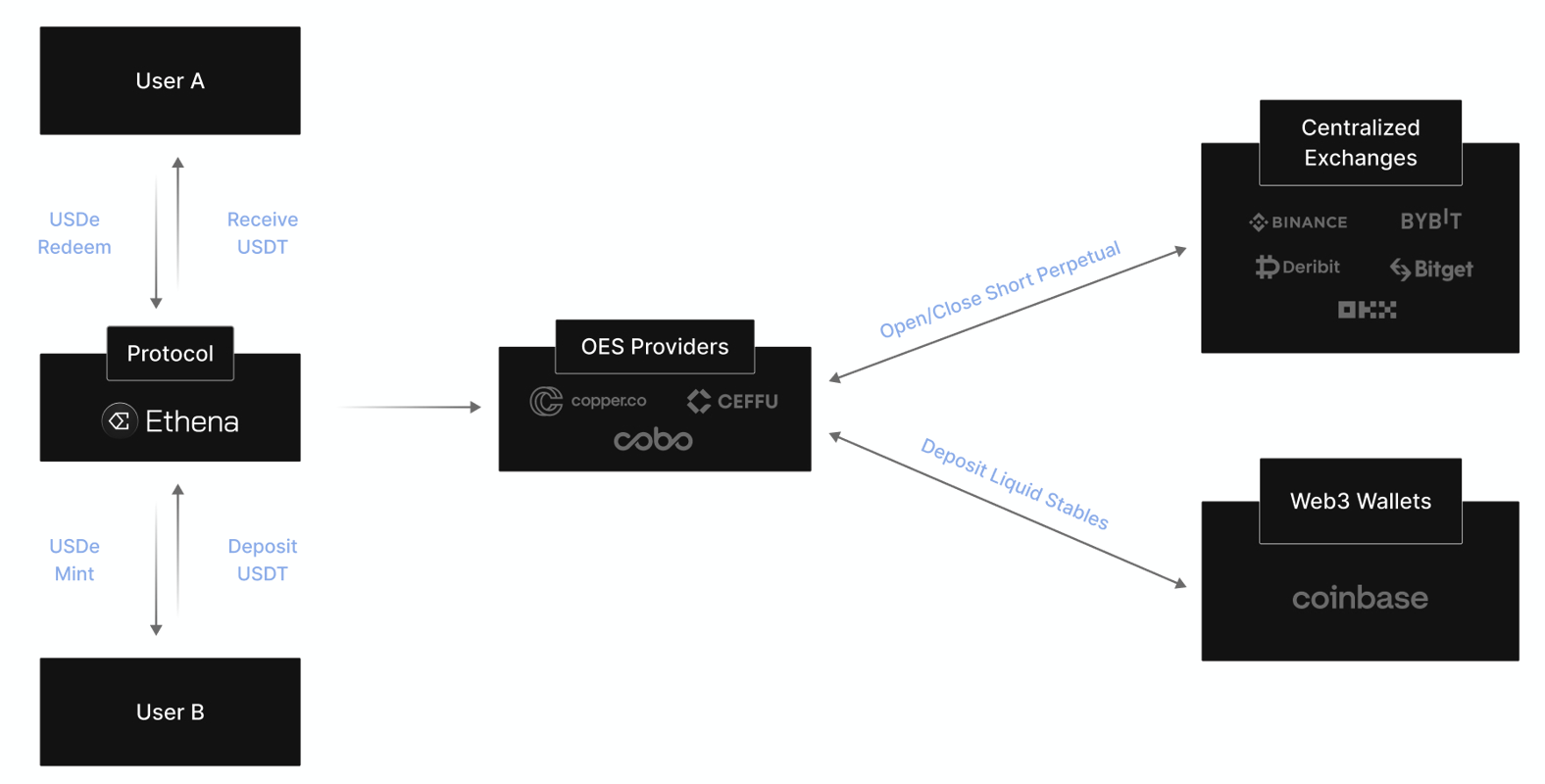
USDe Stability Mechanism: To ensure USDe’s stability, the key lies in hedging price volatility of the backing assets. Ethena implements an automated, programmatic delta-neutral strategy.
Yield Sources for sUSDe
The yield of sUSDe comes from how Ethena manages the collateral assets.
-
When Ethena receives collateral, it can hold them as stablecoins to earn fixed deposit interest;
-
It can also delegate via custodians to selected CEXs to establish short futures positions to hedge price fluctuations of backing assets, while earning funding rates;
-
If the backing asset is ETH, it can be staked to earn ETH staking APR.
These yields are distributed to users upon unstaking sUSDe and redeeming USDe, delivered as additional USDe returned.
Use Cases for Stablecoins (USDe/sUSDe/iUSDe)
In the DeFi space:
-
USDe/sUSDe serve as collateral on lending platforms like Aave and Spark;
-
USDe/sUSDe act as margin collateral on Perps DEXs;
-
USDe/sUSDe are used as collateral within other stablecoin protocols;
-
USDe/sUSDe function as underlying assets in interest rate swap protocols;
-
USDe serves as a quote currency (trading pair component) on Spot DEXs;
In the CeFi space:
-
USDe serves as a quote currency (trading pair component) on CEXs;
In the TradFi space:
-
iUSDe is Ethena’s stablecoin tailored for the TradFi market, allowing regulated traditional firms to subscribe. This enables traditional investment institutions to offer high crypto-market yields to their clients without directly engaging in crypto.
3. Ethena’s Innovations
Delta-Neutral Strategy to Hedge Backing Asset Price Volatility
Many stablecoin projects backed by crypto assets eventually become insolvent and depeg due to failing to hedge against price volatility of the backing assets. Ethena is the first project to implement an automated, algorithmic delta-hedging model, executing a programmatic delta-neutral hedge on backing assets to keep portfolio delta near zero. While Ethena’s early delta-hedging algorithm and execution model were a black box—posing potential long-term sustainability risks—this mechanism represents a major innovation. In the future, Ethena may transition to an open RFQ model, allowing various market makers to compete in executing hedging tasks.
Under normal conditions, USDe is redeemed at a 1:1 ratio to USDC. However, if the hedging mechanism fails or if futures positions incur funding rate losses, reducing reserve value, the redemption quote for USDe holders will be proportionally reduced and displayed with a 10-basis-point compensation fee.
Significantly Higher Capital Efficiency Than Most Stablecoin Projects
Centralized stablecoins like USDT and USDC, which are fiat-collateralized, face heavy regulatory oversight from traditional finance. Their collateral primarily consists of fiat currencies invested in U.S. Treasuries and bank deposits, leading to low capital efficiency and centralization risks.
Decentralized stablecoins like MakerDAO’s DAI typically require 120%-150% over-collateralization. Accounting for safety margins to avoid liquidation, actual collateral ratios may exceed 200%, resulting in low capital efficiency. Additionally, during extreme market volatility, users’ collateral may be liquidated, causing further losses.
In contrast, Ethena’s USDe approaches a 1:1 USD-to-USDe backing ratio, supported by delta-neutral hedging. This delivers high capital efficiency while maintaining stability.
More importantly, Ethena’s positioning allows other stablecoin projects to become partners. For example, Sky, Frax, and Usual have already integrated Ethena’s products into their own offerings.
OES Custody Model Ensures Asset Security
Ethena currently collaborates with multiple custodians including Copper, Ceffu, and Cobo. The partnership uses the OES (Off-Exchange Settlement) model, under which backing assets remain in on-chain wallets—eliminating exposure to CEX risks. It also mitigates custodial risk, as no single custodian can unilaterally control the assets. For example, when Cooper is the custodian, assets are stored in an off-exchange vault where Ethena, Cooper, and the vault each hold a private key, requiring two signatures for transactions. Alternatively, assets may be held in bankruptcy-remote trusts.
Integrating Traditional Finance to Scale Up USDe
Ethena connects capital across CeFi, DeFi, and TradFi via USDe, capturing yield differentials across these domains to generate higher returns for users.
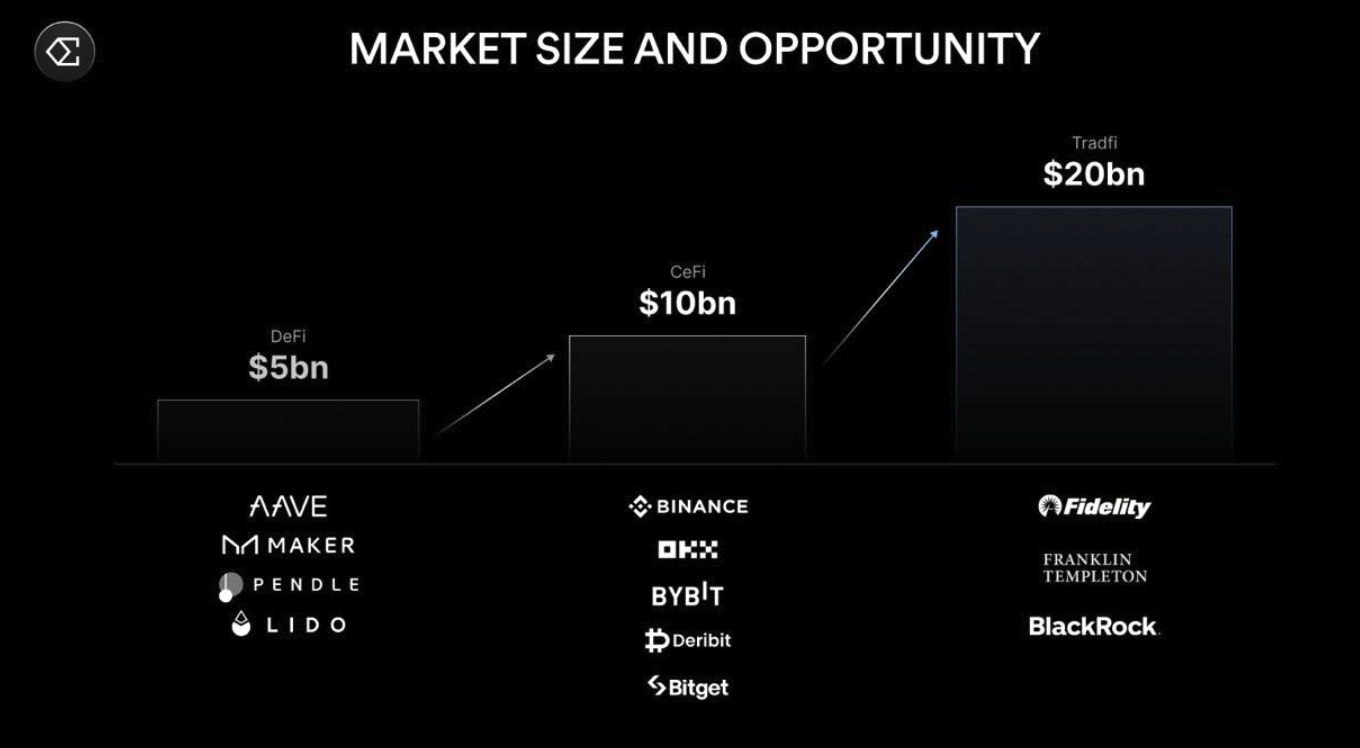
TradFi generally lacks high-yield products, yet the market for low-yield fixed-income instruments is massive. In crypto, leveraged trading demand creates persistent demand for dollars (stablecoins), often generating “risk-free” high-yield opportunities.
Ethena acts as a bridge, integrating traditional finance to scale USDe. When Fed rates are low (or during rate-cut cycles), crypto activity increases, and perpetual contract funding rates rise. Ethena’s short futures positions used for delta hedging then earn higher funding income. Thus, when traditional finance yields are low, Ethena users can achieve higher returns.
This dynamic makes iUSDe attractive for traditional finance clients seeking yield in low-rate environments. This likely contributed to strategic investments in Ethena last December by Franklin Templeton and F-Prime Capital, Fidelity Investments’ venture arm. Additionally, USDtb—a product co-launched by Ethena and BlackRock’s BUIDL—could channel significant TradFi capital into Ethena and subsequently into the broader crypto market.
4. Current Project Status
USDe has become the third-largest USD-pegged stablecoin. As of March 7, 2025, USDe’s circulating supply exceeded $5.5 billion, ranking behind only USDT and USDC. Its transfer volume ranks fourth, behind USDT, USDC, and DAI. However, active addresses remain low at just 1,612, indicating limited retail adoption. Ethena’s revenue growth is rapid—it is the second-fastest crypto startup to reach $100 million in revenue, trailing only Pump.fun.
Ethena has become a foundational pillar for many DeFi protocols. Over 50% of Pendle’s TVL is attributed to Ethena; about 25% of Sky’s revenue comes from Ethena; approximately 30% of Morpho’s yield stems from leveraging Ethena assets; Ethena is Aave’s fastest-growing new asset; most EVM-based perps DEXs have integrated USDe as collateral.
Ethena is building an ecosystem around USDe. According to public information from Ethena’s official site, two projects—decentralized exchange Ethereal and on-chain trading protocol Derive (supporting options, perpetuals, and spot trading)—are set to launch in Q1 2025. On external partnerships, Ethena is progressing steadily, having co-launched USDtb with BlackRock and partnered with World Liberty Financial, a DeFi project linked to the Trump family.
Ethena also faces certain risks:
Core yield for USDe is unstable—As discussed, USDe has three yield sources: (1) deposit interest from backing stablecoins, (2) funding rate income from short futures positions, and (3) ETH staking APR from ETH in backing assets. Among these, futures funding rates may turn persistently negative during bear markets, potentially eroding USDe’s yield.
CEX ADL mechanisms could disrupt delta-neutral strategy—Because CEXs employ automatic deleveraging (ADL) mechanisms, these may interfere with Ethena’s delta-neutral strategy during specific market events.
Partners may introduce liquidity risk—Bybit is the exchange with the highest USDe adoption, once holding nearly $700 million worth of USDe. Additionally, Mantle—a Layer2 closely tied to Bybit (founded by BitDAO, which merged with the Mantle ecosystem)—hosts the second-largest supply of USDe. Recently, Bybit suffered a hack, triggering over $120 million in USDe redemptions. Currently, Ethena holds $1.9 billion in liquid stables as backing assets, sufficient to cover such sudden redemption surges. However, we cannot rule out future scenarios involving redemption volumes exceeding available liquid reserves, creating short-term liquidity risks.
5. Investment Value of Ethena (ENA)
ENA currently has a FDV of $5.6B and a circulating market cap of $2B. Ethena has raised funds in three rounds: $6M, $14M, and $100M. The second round valued the project at $300M, meaning the current token price still offers over 18x return.
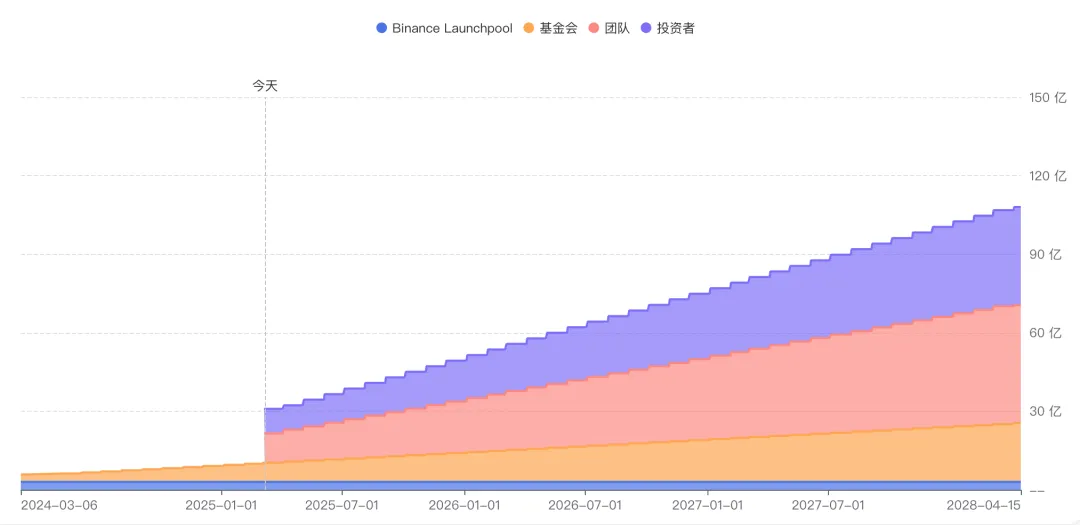
Prior to May 5, 2025, circulating tokens mainly consist of a 2% Binance Launchpool allocation, along with linearly unlocking shares from the foundation and team. In April, some OTC-purchased shares will begin unlocking at a cost basis of ~$0.25. Starting May 5, monthly institutional unlocks will add over 78 million ENA per month.
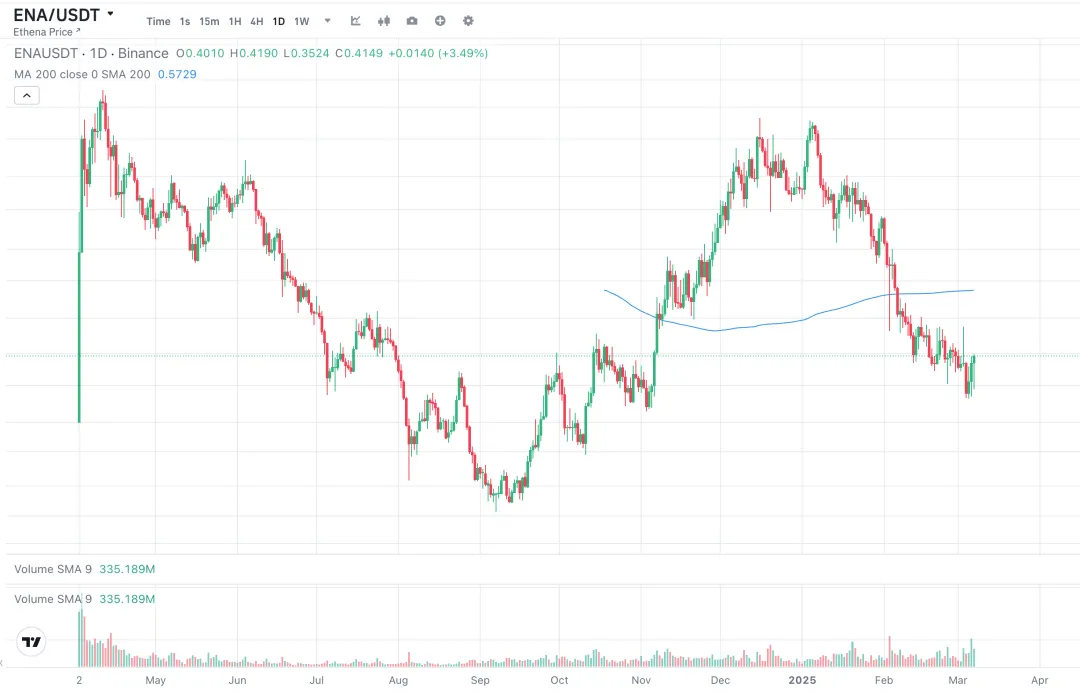
Recently, the overall crypto market has corrected, and ENA has performed weakly. BTC has pulled back 25% from its peak, ETH nearly 50%, and ENA about 70%. The upcoming token unlocks—often viewed as bearish—may already be largely priced into the current valuation.
In summary, ENA faces short- to medium-term price pressure, but the core business holds long-term value.
Join TechFlow official community to stay tuned
Telegram:https://t.me/TechFlowDaily
X (Twitter):https://x.com/TechFlowPost
X (Twitter) EN:https://x.com/BlockFlow_News
 @iobc_capital






