
Estimating Pump.fun's Revenue: Official income of $68 per token launched, users bear 70% of profits or pay fees
TechFlow Selected TechFlow Selected
Estimating Pump.fun's Revenue: Official income of $68 per token launched, users bear 70% of profits or pay fees
Behind the players who contributed substantial fees and interaction volume, who is the biggest winner of Pump.fun?
 Navigating Web3 tides with focused insights
By Frank, PANews
Pump.fun has recently sparked a public controversy. The U.S. law firm Burwick Law has filed a lawsuit on behalf of investors who incurred losses on the platform, targeting both Pump.fun and fraudulent project teams. Burwick Law stated this announcement came after months of collaboration with investors and urged more victims to submit their information. Combined with recent discussions on social media revealing that only 55,000 addresses on Pump.fun have earned over $10,000 in profits, founder Alon was compelled to respond, disputing the accuracy of these figures. It seems that behind the massive transaction fees and user activity contributed by players, the question of who truly benefits the most from Pump.fun has become a topic of greater public interest.
A Free Casino or a Breeding Ground for Schemers?
Following news of Burwick Law's legal action against Pump.fun, many crypto KOLs joined the discussion. Noted on-chain investigator ZachXBT commented: "Fallen gamblers voluntarily choose to gamble in micro-cap MEME tokens—they are not genuine victims or investors."
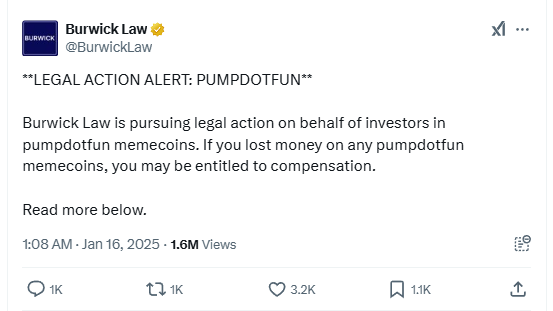
In response, Burwick Law shared the view of its partner Max Burwick: "Just like a casino, regulated gambling is defined by rules and immutable statistics. Imagine if you went to a casino and the dealer could execute a 'rug pull' during a card game—would you make the same argument here?"
In fact, the views expressed by ZachXBT and Max Burwick broadly represent two prevailing public stances regarding the lawsuit against Pump.fun. One camp argues that trading on Pump.fun is entirely voluntary, and filing lawsuits reflects poor sportsmanship; moreover, they claim the platform’s mechanism actually reduces fraud risks commonly found in other MEME projects. The opposing side contends that Pump.fun collects substantial fees while allowing certain addresses to manipulate markets and failing to moderate content, thus warranting legal action.
Of course, whether Pump.fun has violated any regulations, and whether this lawsuit will result in a victory for investors or devolve into a farce, remains unknown at this stage.
How Many Winners Are There on Pump.fun?
Beyond this, how many users on Pump.fun are actually profitable? And who are the biggest beneficiaries? These questions may hold greater significance for ordinary users. PANews conducted an analysis based on long-term data from Pump.fun.
As early as January 11, social media buzzed over data showing only 55,000 addresses (0.408%) on Pump.fun had earned more than $10,000 in profit. In response, Pump.fun founder Alon specifically disputed the accuracy of this statistic. He cited three reasons: 1) It excludes purchases tied to Raydium integrations, where most profits are realized post-listing. 2) Unrealized gains are not accounted for. 3) Of the over 13 million traders, many are bots and AI agents. Approximately 30% of wallets executed only one transaction, making it highly unlikely they belong to real human users.
Here, Alon was referring to the "Pump.Fun Alpha Wallets" dataset created by @adam_tehc on Dune. It should be clarified that Alon did not accuse @adam_tehc’s data of being inaccurate, but rather incomplete—insufficient to fully reflect user profitability on Pump.fun.
In our subsequent analysis, PANews partially references several Dune dashboards created by @adam_tehc, using only basic statistical metrics such as total address count, trading volume, and cumulative earnings. Additionally, due to the lack of direct profit-and-loss data for individual users, our analysis relies on available confirmed data through estimation and inference methods. While not perfectly precise, we aim to shed light on certain aspects of the ecosystem.
Given the variety of data types involved, here are some foundational statistics (as of January 16):
Cumulative revenue of Pump.fun: $416,810,737 ($416.8 million)
Total tokens issued on Pump.fun: 6,096,526 (6.1 million)
Total number of user addresses on Pump.fun: 14,130,923 (14.13 million)
Pump.fun revenue over the past 30 days: $105,182,383 ($105.2 million—an inflated figure primarily due to income aggregation from other DEXs performed by Pump.fun in January)
Estimated total trading volume: $36,030,577,862 ($36 billion, covering April 22, 2024, to January 6, 2025). Note: As cumulative revenue stood at approximately $9.65 million on April 22, back-calculating from a 1% fee rate suggests prior trading volume of about $965 million. Thus, estimated total trading volume reaches ~$37 billion.
Average graduation rate of tokens: 1.42%
The above data comes from @adam_tehc's Pump.Fun datasets on Dune.
Number of transactions on Pump.fun in the past 30 days: 113,540,000 (113.5 million)
Active addresses on Pump.fun in the past 30 days: 7,795,520 (7.8 million)
The above data comes from Solana Explorer's Pump.fun Program data.
In addition, PANews randomly sampled 5,252 transactions across seven nearly full tokens on Pump.fun on January 16 and analyzed trading behaviors, identifying 36 bot addresses and 909 real users.
Official Earns $68 per Token Issued
Based on the above statistics, PANews derived the following analytical results:
Token-related data:
Using total issuance and revenue figures, we find the platform earns an average of $68 in fees per token issued.
Dividing total trading volume by total tokens issued yields an average trading volume of approximately $6,074 per token.
User-related data:
Dividing total revenue by total number of users gives an average contribution of $29.49 in fees per user.
Using the past 30 days’ total revenue and total transaction count, we calculate that each transaction generates about $0.92 in revenue. Given the 1% fee rate, this implies an average transaction size of ~$92.63 over the past month.
From the past 30 days’ data, we derive that each user made an average of 14.56 transactions and contributed $13.49 in fees. Extrapolating to lifetime contributions ($29.49 per user), we estimate the average address conducts around 31.8 transactions.
To summarize: On average, each address executes 31.8 trades, with an average trade size of $92.63.
Combining this with token-level data, we calculate that each token generates about 65.5 transactions on average, meaning each user participates in roughly 5.5 trades per token. The average number of unique addresses interacting with each token is approximately 11.79.
Does the Platform Take 70% of User Profits?
Next, let’s model an idealized scenario. Assume every user has an equal chance of purchasing a graduating token, and upon listing on Raydium, all users can sell at exactly double their purchase price. Each successful buy matches the average transaction size. For simplicity, imagine a hypothetical “average user” whose behavior aligns precisely with all calculated averages.
From previous calculations, we know the token graduation rate on Pump.fun is 1.42%. Therefore, the “average user” wins approximately 1.42% of the time. With an average transaction size of $92.63 and a total of 31.8 trades conducted, this user would successfully buy a graduating token 0.45 times (31.8 × 1.42%). Selling at double value yields a profit of $41.88.
During this process, the user pays $29.49 in platform fees. This calculation includes only fees—not losses from trading decisions. We assume perfect luck: even when failing to acquire a graduating token, the user breaks even on all internal market trades without loss.
Under this extreme best-case scenario (excluding trading losses), the average user earns ~$41.88 in profit while paying $29.49 in fees. That means Pump.fun captures roughly **70% of the user’s profit** in fees alone.
If this calculation approximates reality, it becomes easier to understand why so many investors are directing criticism toward Pump.fun’s team.
Of course, actual conditions may deviate from this model. For instance, post-Raydium listing returns might exceed 100%. However, this is unlikely—most tokens quickly drop to zero after launch. For example, on January 17, 48,631 new tokens were created on Pump.fun within 24 hours, with 697 graduating. Among newly listed tokens on Raydium during the same period, only 214 maintained a market cap above $81,000 (graduation threshold) and recorded over 100 transactions—just 30% retention of graduation status.
Ultimately, the methodology used here involves estimation and extrapolation and cannot fully represent reality. Nevertheless, from a macro perspective, one conclusion stands clear: regardless of specifics, the Pump.fun team remains the single largest beneficiary of this MEME frenzy. Releasing official, transparent data would provide users with clearer insights and better context—and ultimately speak louder than speculation.
Join TechFlow official community to stay tuned
Telegram:https://t.me/TechFlowDaily
X (Twitter):https://x.com/TechFlowPost
X (Twitter) EN:https://x.com/BlockFlow_News
 PANews