








From 32 GitHub Stars to a $32 Million Market Cap: A Quick Overview of $QUDE, Solana's Promising AI Framework
TechFlow Selected TechFlow Selected
From 32 GitHub Stars to a $32 Million Market Cap: A Quick Overview of $QUDE, Solana's Promising AI Framework
QudeAI is an open-source framework designed for creating, deploying, and interacting with AI agents on the Solana network.
 Navigating Web3 tides with focused insights
Author: Deep Value Memetics
Translation: TechFlow
$QUDE: The "Pioneer" of a New-Generation Framework?
New Token Overview | $QUDE (FDV $30M) | @Qudeai
DVM Viewpoint: $QUDE is an open-source, low-code platform and modular framework built on Solana ($SOL), focused on simplifying the creation, deployment, and interaction of on-chain AI agents. It primarily addresses the complexities involved in developing scalable, secure, and data-analytical AI applications within decentralized environments. As a new project, $QUDE has shown impressive traction on GitHub, accumulating 32 stars and 7 forks within two weeks. We believe this technology holds uniqueness within the Solana ecosystem, currently facing almost no direct competitors. In the short term, its valuation may fluctuate between $50M–$100M; should adoption accelerate, its valuation could gradually approach that of more mature frameworks.
Project Overview | Modular, Scalable Agent Framework and Its DAO
QudeAI is an open-source framework specifically designed for creating, deploying, and interacting with AI agents on the Solana network.
Using this framework, users can develop agents capable of performing tasks such as blockchain queries and market analysis, while QudeAI acts as a "co-pilot" during development, offering guidance and collaborative support.
The framework is known for its modular and scalable design, enabling seamless integration between AI and blockchain technologies.
In addition, the QudeAI framework is tied to a decentralized autonomous organization (DAO). The DAO aggregates the market cap of all agents deployed through the framework. Developers may choose to contribute a portion of their token supply to the DAO in exchange for additional benefits, such as agent verification and increased visibility.
How Does the Project Work? | CLI-Based Agent Creation, RESTful API Interaction, OpenAI-Powered AI Engine, and Firebase-Solana Data Management
-
Agent Creation & Deployment: Users define the behavior and functionality of AI agents via a command-line interface (CLI). The QudeAI framework guides users throughout the process, enabling rapid design and development. Agents can then be deployed onto the Solana blockchain using CLI commands.
-
Agent Interaction: Users can interact with agents either through the CLI tool or via RESTful API. The RESTful API supports GET and POST requests, allowing users to query blockchain data or execute commands using natural language.
-
AI Engine: QudeAI leverages OpenAI's API to power agent interactions. Users can flexibly configure agent behavior patterns and response logic to meet diverse task requirements.
-
Data Management: Metadata and real-time data updates are supported by Firebase, while blockchain data is managed via Bitquery API and stored on the Solana network, ensuring transparency and immutability.
Core Technologies Used | Solana, Node.js Backend, OpenAI AI, Firebase Data Management, and Bitquery Analytics
-
Blockchain: Built on the Solana blockchain, providing high-speed, low-cost transactions while ensuring data transparency and immutability.
-
Backend: API routing is built using Node.js and Express framework, combined with Firebase for data persistence, and offers convenient interaction via RESTful API.
-
Artificial Intelligence: Utilizes OpenAI's GPT models to support natural language interaction and behavioral configuration of agents.
-
Database: Firebase stores agent metadata and user interaction logs, with real-time data updates.
-
API Integration: Bitquery provides blockchain data analytics services; QudeAPI connects public AI agents to extend functionality.
-
Development Tools: TypeScript is used to improve development efficiency, and CLI tools are provided for easy management of agent lifecycles.
-
Middlewares: Ensure secure communication and request coordination between system modules.
What Key Problems Does the Project Solve?
QudeAI’s core objective is to address pain points in the convergence of AI and blockchain technology, delivering simpler and more efficient solutions for developers and users:
-
Simplifies Complexity: Significantly lowers the technical barrier to developing and managing AI agents that interact with blockchains, allowing developers to focus on core agent functionalities.
-
Improves Accessibility: As an open-source project, QudeAI provides a developer-friendly platform that enables broader access to AI and blockchain technologies.
-
Enhances Performance and Scalability: Combines efficient data processing with blockchain technology to support large-scale deployments and fast response times.
-
Ensures Transparency and Security: Leverages blockchain immutability to safeguard data integrity, while Firebase provides secure storage solutions.
Founders and Vision
Currently, the identity of QudeAI's founders remains undisclosed. However, the project’s core vision is to revolutionize the way AI and blockchain technologies interact by providing user-friendly tools that simplify the creation and management of agents. QudeAI aims to promote widespread adoption of AI and blockchain technologies, empowering more developers to easily build intelligent decentralized applications.
Comparison with Native Solana Frameworks
ARC’s Rig Framework (@arcdotfun) and QUDE (@Qudeai) target different application domains.
$ARC’s Rig Framework is a Rust-based framework focused on building high-performance AI agents. Its primary goal is to optimize the performance and workflows of AI applications, addressing challenges such as AI model integration, token management, and concurrent processing. By offering a suite of practical tools, it helps developers enhance agent efficiency in real-world scenarios.
In contrast, $QUDE focuses on deep integration between AI and blockchain, providing a platform where developers can directly create and run AI agents on blockchain networks. It enables on-chain intelligent interaction through QLLM (QudeAI Language and Logic Module) and fosters community collaboration via QCM (QudeAI Community Module), making agent development more open and accessible.
The key distinction lies in focus: $ARC’s Rig Framework emphasizes performance optimization and workflow management for AI agents in Rust environments, whereas $QUDE is dedicated to advancing the development and application of AI agents within blockchain ecosystems.
References
-
Contract Address (CA):
3MyaQBG7y3SHLQZa282Jh2xtB2TZKHGzNp1CuZ4Cpump
-
Official Website: https://qude.ai
-
GitHub: https://github.com/qudeai
-
Developer Documentation: https://docs.qude.ai
-
Telegram Community: https://t.me/qudeai
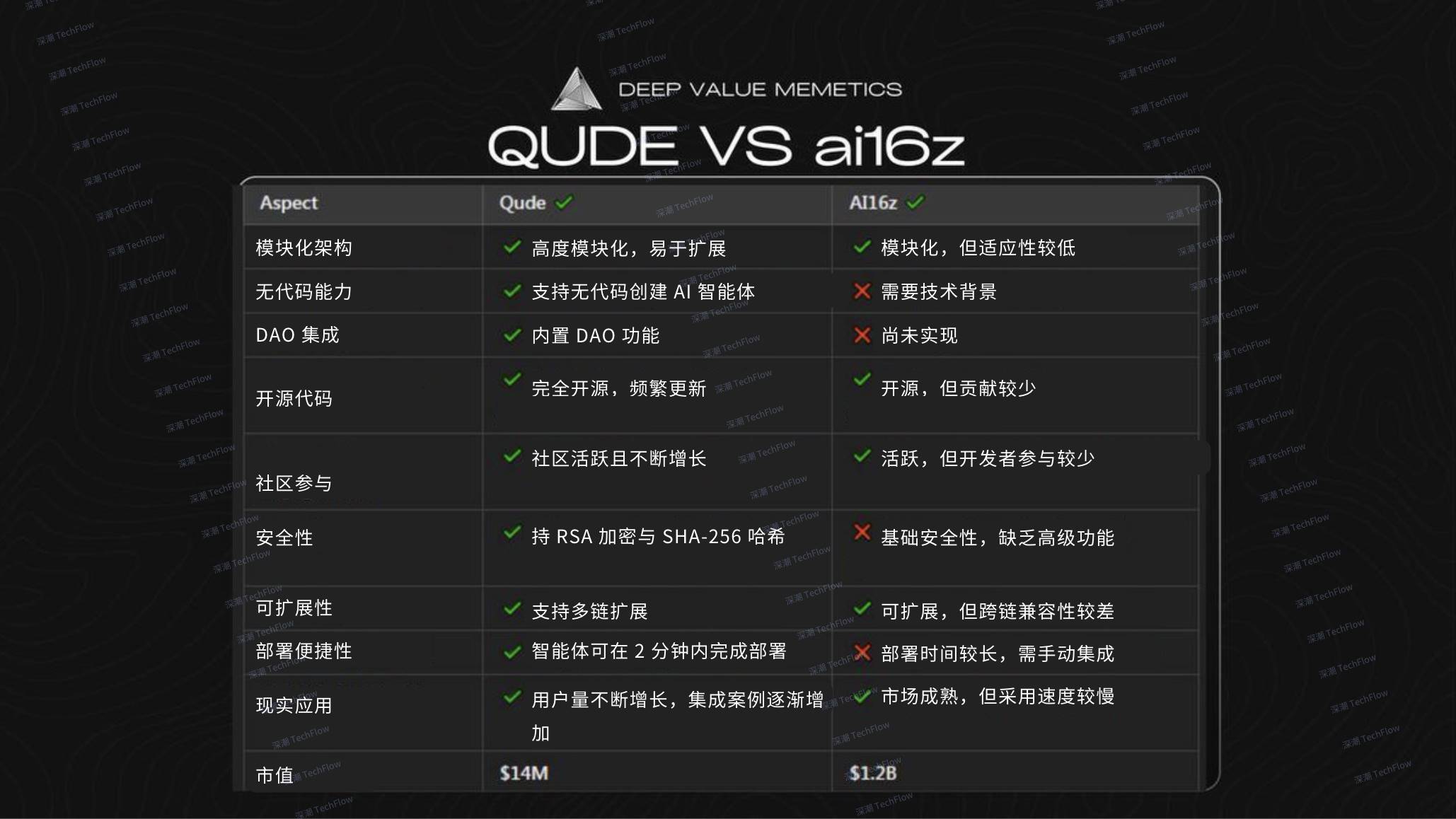
Original image from Deep Value Memetics, translated by TechFlow
Join TechFlow official community to stay tuned
Telegram:https://t.me/TechFlowDaily
X (Twitter):https://x.com/TechFlowPost
X (Twitter) EN:https://x.com/BlockFlow_News
 @DV_Memetics







