Public Chain Lego: Connecting Layer 1 and Layer 0 Blockchains to Reshape the Market Landscape
TechFlow Selected TechFlow Selected
Public Chain Lego: Connecting Layer 1 and Layer 0 Blockchains to Reshape the Market Landscape
What's behind Cosmos' new consensus engine, Supernova Core? Do public blockchains like Cosmos still stand a chance?
 Navigating Web3 tides with focused insights
By Arain, ChainCatcher
In previous cycles, whenever Ethereum encountered a "performance" bottleneck, so-called "Ethereum killers" would emerge. These refer to Layer 1 blockchains that position themselves as competitors to Ethereum's proposed Layer 2 solutions.
However, since Ethereum completed its Cancun upgrade this year, the narrative around Ethereum Layer 2 has surpassed that of Layer 1 and even replaced it as the dominant storyline. On one hand, the competitive landscape among Layer 1 chains remains unchanged—by market cap, ETH, BNB, and Solana form a triad (excluding BTC), with ETH dominating. On the other hand, a key question arises: why have we seen almost no new "Ethereum killers" emerging in this cycle?
Interestingly, Ethereum itself appears to be陷入困境 with Layer 2. Token Terminal data shows that ETH Layer 1 revenue has plummeted nearly 99% since March 2024. Meanwhile, in August this year, Multicoin Capital criticized Ethereum’s Layer 2 ecosystem on Bankless, prompting researchers from the Ethereum Foundation to clarify in an AMA that Ethereum is still actively exploring Layer 1 development rather than relying entirely on Layer 2.
Problems previously masked by the prosperity of Layer 2 are now surfacing.
The Public Chain Wars: A History of Fragmentation
Layer 1 and Layer 2 represent different levels within blockchain networks. Layer 1 refers to the mainchain—a standalone, autonomous chain where transactions are executed and confirmed directly, providing foundational infrastructure for the network and enabling direct interaction with users. Notable public chains such as Bitcoin and Ethereum reside at this level.
Layer 2 consists of off-chain scaling solutions built atop Layer 1 blockchains like Ethereum, designed to improve scalability. Prominent projects in this space include Arbitrum and Optimism.
It can be said that Layer 1 precedes Layer 2. As technology advances and market understanding evolves, the blockchain ecosystem has expanded to include Layer 0 and Layer 3. Layer 0 refers to the underlying infrastructure capable of supporting multiple Layer 1 blockchains, while Layer 3 represents application layers built on blockchains, including games, wallets, and other dApps.
The war among public chains originated in Layer 1. To overcome Bitcoin's limitations, numerous alternative public chains began flourishing. Bitcoin was originally designed as a trustless peer-to-peer electronic cash system—also a Layer 1 chain—prioritizing security and decentralization. To preserve these two attributes, Bitcoin isn't suitable for hosting extensive applications or development, resulting in poor scalability.
Security, decentralization, and scalability constitute the core elements of the "Blockchain Trilemma," a theory introduced by Ethereum founder Vitalik Buterin, which posits that a blockchain network cannot simultaneously achieve all three properties.
In 2015, Ethereum officially launched. Around the same time, other public chains emerged sequentially, including Cardano and Polkadot. Ethereum became the first widely recognized public chain with a Turing-complete programming language, addressing Bitcoin’s lack of extensibility.
Historically speaking, however, this expansion was limited. Each time Ethereum adoption increased, network congestion followed. To avoid risks of "centralization creep" in the protocol, Ethereum developers were reluctant to raise throughput limits. Thus, Ethereum also fell into the trap of the trilemma. The most tangible consequence during such periods is that using Ethereum becomes extremely expensive or slow—an operational disaster for app builders and users alike—but this also created opportunities for competitors.
According to incomplete statistics, in 2018 alone, over 100 new public chains launched globally, ushering in an era of "thousands of chains rising together." EOS, TRON, Tezos, and Cardano raised $400 million, $200 million, $227 million, and $117 million respectively through fundraising events, becoming standout projects in the market.
These chains were once dubbed "Ethereum killers" by the market. Today, some have been reclassified—some under Layer 0, others under Layer 2.
From 2020 to 2021, competition among public chains intensified—not only did their numbers grow, but already-launched chains began fighting for market share. This battle is evident in developer activity metrics:
-
Solana saw a 223% increase in developer activity in 2021. With its proprietary consensus mechanism, it stood out as a high-performance non-EVM blockchain emphasizing extreme cost-effectiveness, allowing rapid growth of applications on its network. Even today, this Layer 1 chain remains highly competitive.
-
NEAR experienced 100% growth in developer activity during the same period. Its Nightshade technology aims for faster transaction speeds, lower costs, and higher throughput. Through Aurora, it achieves EVM compatibility, meaning developers can easily port their smart contracts from Ethereum to NEAR.
-
Avalanche saw 46% growth in developer activity. This Layer 1 chain comprises three parallel public chains, with the C-Chain handling smart contract development, deployment, and interaction—and being EVM-compatible. Validators secure the network via proof-of-stake, enabling fast and low-cost transaction processing. Note: Avalanche is currently classified as a Layer 0 project.
-
Polygon (MATIC) recorded a 350% surge in developer activity. Technically a sidechain, Polygon was initially categorized as Layer 1 due to its user experience closely resembling that of Layer 1 chains. Thanks to its excellent performance-to-cost ratio, it attracted massive developer interest. Its network classification has since evolved, and it is now considered a Layer 2 solution.
By late 2021, as markets entered a phase of sharp volatility and deleveraging, some public chains gradually fell behind, leading to the current market structure.
According to Token Terminal data, in terms of market cap, only four public chains hold weights above 1%: BTC, ETH, BNB, and Solana, accounting for approximately 70.23%, 16.92%, 4.84%, and 3.84% respectively.
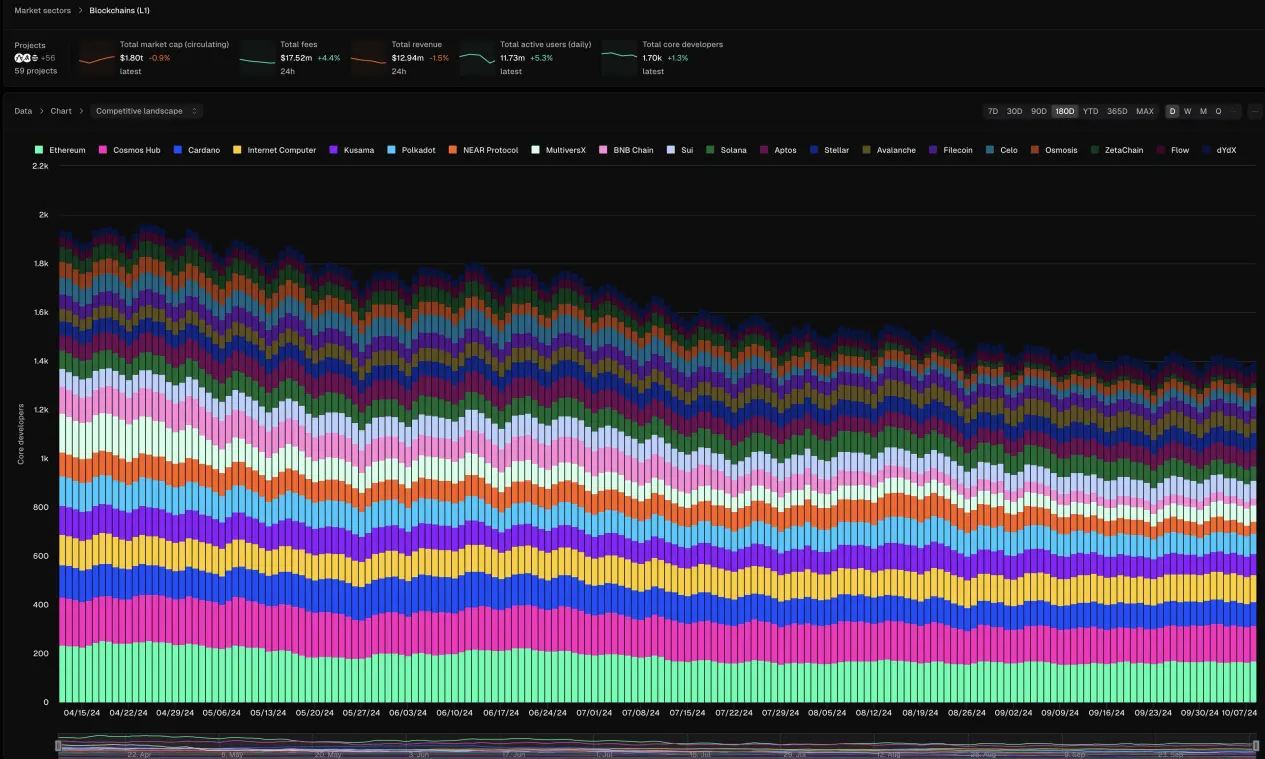
In terms of core developer count, only Ethereum, Cosmos, Internet Computer, and OP Mainnet exceed 100 active core developers. Following them are Cardano, Kusama, and Polkadot, each approaching 100 core developers. A larger developer base often indicates greater project potential, as public chains compete for developer resources through incentives and vision—more developers mean more products and users.
From the above data, it's clear that the top two players dominate the market share. However, the mismatch between market cap rankings and developer counts suggests there are undervalued public chains in the market.
The Overlooked Chains: Cosmos’ Dilemma
Before discussing these sidelined chains, let’s summarize the development models and competitive dynamics of mainstream public chains. Using prominent projects as examples, currently recognized mainstream chains fall into several categories:
1. Multi-chain Architectures:
-
Ethereum (ETH): The pioneer smart contract platform, leading in security, innovation, and user base. However, it suffers from scalability issues, high fees, and outdated architecture. Currently classified as Layer 1 + Layer 2.
-
Polkadot (DOT): Features advanced architecture backed by Gavin Wood, but its fee model pressures developers, and its ecosystem is still nascent. Now classified as Layer 0.
-
Cosmos: Offers advanced architecture and freedom, but suffers from loose organizational structure and high development barriers, with its ecosystem still in early stages. Classified as Layer 0.
-
Avalanche (AVAX): Well-funded, with integrated architecture and comprehensive ecosystem, but lacks interoperability between subnets and insufficient consensus on new features during bear markets. Classified as Layer 0.
-
Polygon: Well-funded, broad strategic positioning, and forward-thinking concepts, but overall network clarity is lacking and new features lack consensus in bear markets. Now classified as Layer 2.
2. Single-chain Architectures:
-
Solana: Innovates with parallel execution and minimized network communication overhead, but faces challenges regarding decentralization and node performance strain. A Layer 1 network.
-
Aptos: Uses optimistic execution and is developer-friendly, but efficiency gains are limited if all transactions are interdependent. A Layer 1 network.
-
Sui: Similar to Aptos, but requires transactions to declare dependencies upfront. A Layer 1 network.
-
Fuel: Focused on modularity, solely handling execution layer while abandoning consensus and DA layers. Still in early stage. A Layer 2 network.
3. Specialized Architectures:
-
Near: Highlights sharding, but ecosystem growth is slow and system complexity is high. A Layer 1 network.
-
Ar: A novel paradigm based on storage, though questions remain about security, decentralization, and market acceptance. A Layer 0 network.
-
BSC: High traffic, ample funding, and vibrant ecosystem, but weak technological innovation. A Layer 1 network.
In the eyes of many industry practitioners, fierce competition may force many projects to adopt conservative strategies over the long term due to resource drain, shifting narratives, or fading trends. Some even abandon past achievements, failing to align with market demands, ultimately wasting sustained investment and development efforts. Cosmos’ current awkward position exemplifies how certain chains have become marginalized amid competition.
As a pioneer in cryptocurrency and blockchain development, Cosmos envisioned a “super city cluster” concept and pioneered the idea of “application-specific chains.” Through the Inter-Blockchain Communication (IBC) protocol, it enables secure and efficient exchange of information and value across different blockchains, profoundly influencing modular blockchain theory and the concept of blockchain sovereignty.
During Ethereum’s congestion and fee spikes in 2017, Cosmos was seen as a scalable alternative and gained significant attention. During the 2017–2018 bull market, Cosmos’ token ATOM ranked among the top 20 cryptocurrencies by market cap.
The number of Cosmos Zones is a key metric for measuring the health of the Cosmos ecosystem. Zones can be understood as application chains—standalone blockchains built using the Cosmos SDK. These Zones communicate via IBC, enabling secure interactions between Zones and the Hub (the central node of the Cosmos ecosystem) and facilitating cross-chain asset transfers. According to the Cosmos explorer, there are currently 91 zones, with 84 actively running—indicating success in ecosystem building.
Today, however, Cosmos’ market cap has slipped outside the top 50. Over time, its unique technical approach has become partially replaceable: Rollup solutions on Ethereum and Celestia now offer developers similar customization options as Cosmos application chains, along with more mature communities and deeper liquidity pools.
The Cosmos ecosystem stands at a crossroads.
Complementary Strengths: 'Blockchain LEGO' Revives Dormant Star Chains
Blockchain network layers are not fixed. Today, Cosmos is increasingly recognized as a Layer 0 blockchain, meaning it should no longer be judged by Layer 1 standards.
Layer 0 aims to create a more flexible foundational architecture, enabling developers to launch dedicated blockchains independently, potentially offering more effective solutions to scalability and interoperability challenges.
The core components of Cosmos include the Cosmos SDK, IBC protocol, and Tendermint consensus engine:
-
The Cosmos SDK is an open-source framework, toolkit, and template library that significantly reduces the difficulty of developing blockchains and related applications;
-
The IBC protocol allows different blockchains to exchange information and interoperate, enabling various chains within the Cosmos ecosystem to form a connected network. Additionally, blockchains built with the Cosmos SDK can
-
The Tendermint consensus engine provides an efficient and reliable consensus mechanism, enabling nodes in the blockchain network to reach agreement quickly and fairly; ·
Among these, the Cosmos SDK plays a crucial role in helping developers rapidly build blockchains from scratch. Importantly, Cosmos provides developers with consensus mechanisms and application development tools (SDK), rather than traditional execution engines like the EVM. This gives developers greater freedom to customize the runtime environment and transaction types of their application chains—even creating fully independent blockchains. In fact, even projects outside the Cosmos ecosystem can use this SDK, and any project built with it can exchange tokens and value with other chains in Cosmos via the IBC protocol, thereby forming a “link” with the broader Cosmos ecosystem.
This functions like a “traffic gateway.” But today, this “gateway” faces challenges. In reality, the Cosmos SDK relies on the CometBFT consensus algorithm, which was originally designed not for high-performance public chains but primarily for fault tolerance. This consensus algorithm is based on the 1990s-era Practical Byzantine Fault Tolerance (pBFT), making it somewhat “outdated” in today’s competitive public chain environment. Industry insiders report that several high-performance chains initially considered using the Cosmos SDK but found it inadequate in practice and ultimately switched to alternatives.
The shortcomings of the Cosmos SDK include the following aspects:
1. Limited scalability and performance. As the number of validators increases, CometBFT performs poorly under high transaction throughput;
2. Inefficient P2P network design. This causes significant slowdowns in block proposal and voting communications in large networks with fewer validators;
3. Tight coupling between transaction ordering and state management within the consensus engine, limiting both performance and flexibility;
4. EVM compatibility issues. Lack of seamless EVM integration effectively excludes developers who wish to use Ethereum tools or tap into the Ethereum community;
5. Validator scalability limits. Communication and signature aggregation bottlenecks prevent Cosmos blockchains from efficiently scaling beyond 150 active validators, constraining decentralization and network security;
6. Database performance bottlenecks, particularly affecting high-performance applications and transaction processing speed.
Continuing to use CometBFT restricts scalability, performance, and integration diversity, creating operational hurdles for many blockchain teams building on Cosmos, potentially undermining the long-term growth of the Cosmos ecosystem. To overcome these limitations, Cosmos is pursuing solutions. In the recently announced SDK v2, Cosmos declared support for a new consensus engine called Supernova Core.
Supernova Core is a Cosmos SDK-compatible consensus framework designed to directly replace CometBFT. It has already effectively addressed the current issues with the Cosmos SDK:
1. Utilizes Boneh–Lynn–Shacham (BLS) signature aggregation, enabling high performance even with over 150 validators;
2. Implements a hierarchical network architecture instead of P2P design, reducing latency and ensuring efficient communication, thus improving overall performance;
3. Based on HotStuff consensus. Compared to traditional pBFT implementations, it achieves up to 3x higher throughput while enhancing fault tolerance;
4. Fully EVM-compatible, enabling seamless deployment experiences. Developers in the Cosmos ecosystem can now leverage Ethereum tools and infrastructure;
5. Decouples transaction ordering from state processing. This architecture allows EVM execution to operate independently of consensus and scale separately, optimizing performance. In the future, this could provide greater flexibility, enabling decentralized Layer 2 solutions with superior performance and enhanced security.
Meter Builds the Blueprint for Blockchain LEGO
Supernova Core is a solution developed by Meter, a Layer 1 blockchain, to address the challenges faced by the Cosmos SDK. Founded in 2018, Meter is a decentralized Ethereum scaling solution that integrates the advantages of PoW and PoS. It processes transactions via proof-of-stake based on the HotStuff consensus, resisting MEV and front-running, aiming to become a highly decentralized and high-performance Ethereum sidechain.
Meter founder Xiao Han Zhu stated that since 2021, the Meter team has been exploring cross-chain bridges and launching various projects, striving to advance the evolution and performance of the “blockchain LEGO” concept. Notably, the core code of Supernova Core—the consensus engine now adopted by Cosmos—has already been implemented and continuously running on Meter’s mainnet for four years, achieving peak daily transaction volumes of 8 million. During periods of high network load, when AWS randomly shut down about 20% of community validator nodes running on resource-limited virtual machines, Supernova Core still ensured network integrity and performance, demonstrating its robustness, security, and efficiency.
Going forward, Supernova Core will target improvements such as parallel EVM execution and optimized database I/O to further boost throughput, efficiency, and performance, enhancing user experience.
Representing Layer 0 and Layer 1 respectively, the collaboration between Cosmos and Meter sets an exemplary model for the “blockchain LEGO” vision. This partnership reveals that Cosmos remains a vibrant Layer 0 ecosystem. Once integrated with Meter’s Supernova Core, the Cosmos SDK could offer greater convenience to ecosystem participants, attracting more new developers to join the Cosmos ecosystem.
For Meter, this collaborative case serves as a powerful demonstration, helping the market recognize Meter’s proven technical capabilities. It could drive Supernova Core to become the preferred solution for building scalable, efficient, and high-performance blockchains, promoting wider adoption and collaboration across the blockchain community and making high-performance blockchain development more accessible.
Meter encourages industry participants to adopt Supernova Core, whether building new Layer 1 chains or enhancing Layer 2 solutions.
Notably, in enhancing Layer 2 solutions, Supernova Core can address current centralization issues. Beyond debating Layer 1 vs. Layer 2 roadmaps, the Ethereum community is increasingly concerned about the insufficient decentralization of existing Layer 2s—centralized sequencers pose risks of malicious behavior, transaction insertion, and MEV, potentially creating a darker forest than Ethereum itself. Current Layer 2s, enjoying substantial revenue from sequencers, show little willingness to decentralize. Supernova Core offers a framework for decentralized Layer 2s without compromising their income, ensuring sustainable long-term development.
The Supernova Core testnet is set to launch by year-end—worth watching closely. Making high-performance Layer 1 and decentralized Layer 2 development less daunting will no longer just be a slogan.
Although current market attention focuses heavily on Layer 2, it's undeniable that Layer 2 projects largely play a game of attracting liquidity, lacking novel value creation. Future trends will still call for several technically strong Layer 1 chains to lead the market, and Layer 0—the foundation upon which Layer 1s are launched—will provide the necessary breeding ground.
As long-term market participants, we must keep our gaze on the fundamentals—deeper technologies at Layer 1, and even Layer 0. That’s where the future lies.
Join TechFlow official community to stay tuned
Telegram:https://t.me/TechFlowDaily
X (Twitter):https://x.com/TechFlowPost
X (Twitter) EN:https://x.com/BlockFlow_News
 ChainCatcher 链捕手