Pantera Capital's 2025 Crypto Outlook: Cryptocurrency Will Truly Go Mainstream, with Stablecoins Remaining a Key Focus
TechFlow Selected TechFlow Selected
Pantera Capital's 2025 Crypto Outlook: Cryptocurrency Will Truly Go Mainstream, with Stablecoins Remaining a Key Focus
Analyzing future trends from multiple dimensions.
 Navigating Web3 tides with focused insights
Authors: Dan Morehead, Paul Veradittakit, Franklin Bi, Jeff Lewis, Erik Lowe, Mason Nystrom
Translation: TechFlow
This article presents Pantera Capital's outlook on the development of crypto in 2025. It is a compilation consisting of four pieces that analyze future trends from multiple dimensions—blockchain’s path toward mainstream adoption, three key trends for 2025, how crypto will reinforce the dominance of the U.S. dollar, and how RWAs (real-world assets) will drive convergence within DeFi protocols.
TechFlow has translated the full text below.
A Hundredfold Growth Opportunity in Blockchain: The Path to Mainstream Adoption
Author: Franklin Bi, General Partner
How can cryptocurrency truly go mainstream?
Once we look past the noise and speculation, this is the only question worth asking. As investors, our job is to identify the path to widespread crypto adoption—because that’s exactly where the next hundredfold investment opportunity lies.
Yet top-tier venture investors aren’t prophets. They focus on the present, with exceptional clarity about reality. One thing is certain: 2025 will be a turning point for the crypto industry.
Imagine if Jeff Bezos had been jailed for selling books online—what would the internet look like today? What if Steve Jobs had been sanctioned for launching the App Store, or Jensen Huang forced to build Nvidia abroad after having his bank accounts frozen? This is precisely the kind of challenge the blockchain industry has faced over recent years.
But 2025 will mark a pivotal milestone in blockchain history—the first real chance for entrepreneurs, regulators, and policymakers to clear away barriers preventing mainstream adoption.
Faced with this increasingly clear path forward, we must ask ourselves: What opportunities lie ahead on this journey? Which areas might generate hundredfold—or even thousandfold—returns?
Just as “Social/Local/Mobile” (SoLoMo) unlocked the potential of the internet in the 2010s, beginning in 2025, the convergence of three major trends will drive mass adoption of blockchain:
-
Gateways: Connecting traditional financial systems to blockchain;
-
Developers: Lowering barriers so more people can easily build blockchain-based applications;
-
Applications: Creating meaningful blockchain apps that seamlessly integrate into daily life.
Gateways: Bridging Traditional Finance and Blockchain
Looking back at Wall Street’s evolution—from electronic trading introduced in the 1970s to today’s digital payments—a 50-year technological transformation reveals one fundamental truth: All financial assets eventually flow to wherever they can move most freely, trade most efficiently, and create the greatest value.
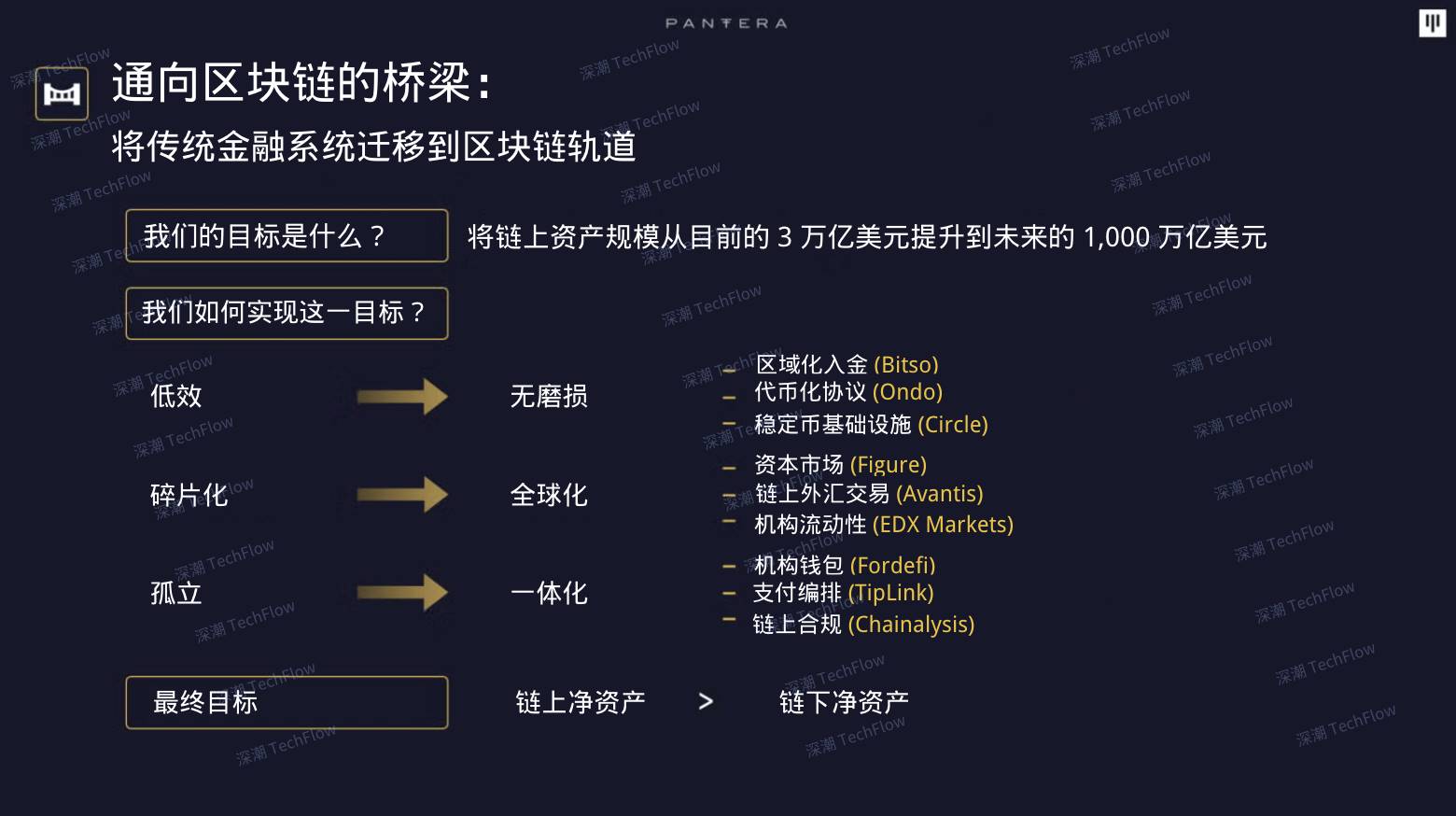
Today, blockchain networks already carry $3 trillion in crypto assets (such as Bitcoin and Ethereum), along with tokenized versions of real-world assets (like tokenized dollars and government bonds). Yet globally, households, governments, and corporations hold over $100 trillion in financial assets. This means blockchain still has room to grow by a factor of roughly 300x within finance alone.
Where are we now? We’re not even at the starting line—participants are still warming up. Global balance sheets have only just begun migrating onto blockchains. To make this happen, we need robust gateways connecting traditional finance to the blockchain world.
We need platforms capable of efficiently bringing new users and existing assets on-chain. For example, Latin America’s Bitso already uses blockchain technology to process over 10% of U.S.-Mexico remittance transactions. Platforms like Ondo are competing directly with financial giants such as Franklin Templeton and BlackRock, aiming to bring over $20 trillion in U.S. Treasuries onto blockchains.
Cryptocurrency: A New Era for Global Capital Markets
Cryptocurrency is enabling the formation of the first truly global capital market, powered by real-time settlement and borderless liquidity. But to realize this vision, global markets require matching global trading infrastructure. Exchanges like Figure and Avantis are aggregating supply and demand worldwide, transforming foreign exchange (FX), credit, and securities markets.
We also need products compatible with existing traditional financial systems—not just parallel crypto-native ecosystems. These could be advanced custody wallets like those offered by Fordefi for institutions, or simple payment solutions like TipLink, easy enough for seniors to use.
What will it look like when crypto fully goes mainstream? We believe there will come a day when people’s wealth on-chain exceeds their off-chain holdings. Once assets move on-chain, they become instantly transferable globally, tradable at low cost without intermediaries, and accessible to global markets to maximize value. That moment will be an irreversible inflection point.
Original image by Franklin Bi, translated by TechFlow
Developers: The Core Engine of the Blockchain Ecosystem
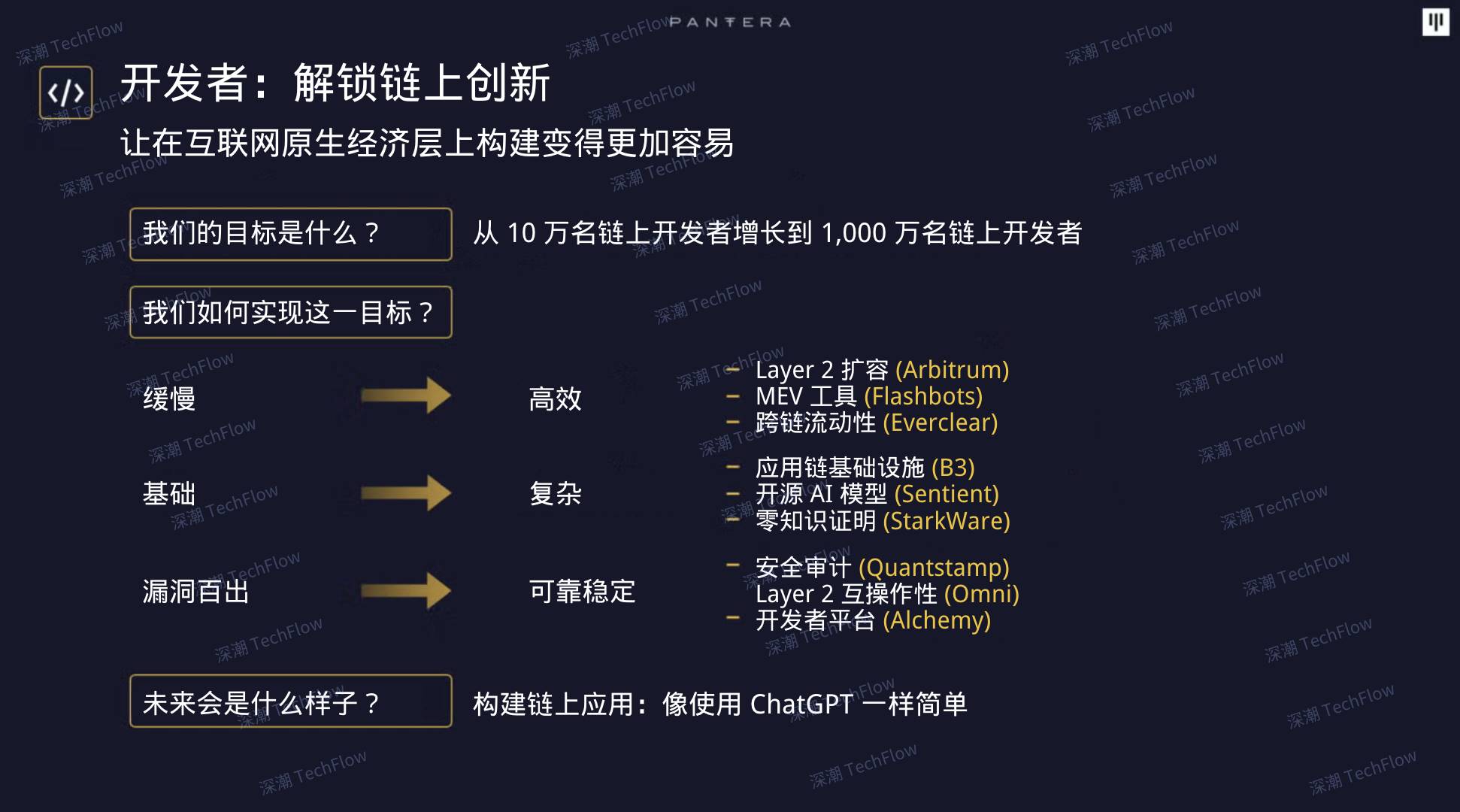
Currently, around 100,000 developers are active in blockchain globally—fewer than half the number employed at a single large tech company in Silicon Valley. To achieve mainstream adoption, we need to scale this number to 10 million: a 100x increase.
The full potential of blockchain technology depends on better development tools. Just as advances in mobile development unlocked the power of Apple’s App Store, simplifying blockchain app development will allow creators to build more useful products.
By 2025, blockchain development will undergo significant breakthroughs. A key advancement will be making blockchains themselves more developer-friendly. Take Arbitrum’s Optimistic Rollup scaling solution—it brought the crypto industry into a “broadband era.” The upcoming Arbitrum Stylus upgrade may have an even greater impact, allowing developers to write smart contracts using mainstream programming languages like C, C++, and Rust, potentially attracting over 10 million additional developers to blockchain.
Zero-knowledge (ZK) technology was once considered too complex for practical use. But with new toolkits like StarkWare’s developer suite, ZK implementation has become much simpler. Today, zk-proofs are being used in tools like Freedom Tool and Rarimo’s blockchain voting system, deployed in Russia, Georgia, and Iran to enhance democratic participation.
Tools and infrastructure supporting blockchain development play a critical role in advancing the technology. Platforms like Alchemy simplify development workflows, enabling large-scale building and deployment of on-chain applications. From DeFi protocols to on-chain games, Alchemy has helped numerous projects succeed. As the ecosystem evolves, these platforms must continue iterating to help developers push the boundaries of what’s possible on-chain.
Looking ahead to 2025, the multichain (multichain) ecosystem will accelerate further. In response to growing complexity, specialized blockchains are emerging, each offering unique advantages in computing power, execution efficiency, or decentralization. Infrastructure tailored for specific domains—such as gaming or trading—is also taking shape, exemplified by B3. With rapid growth in chains, Layer 2s, and application-specific chains (appchains), cross-chain liquidity solutions (like Everclear) and interoperability protocols (like Omni) will become essential, removing technical hurdles so developers can focus on innovation.
Just as web development evolved from hand-coded HTML to no-code tools, blockchain development is undergoing a similar transformation. In the future, building on-chain applications may be as simple as conversing with ChatGPT. This evolution will attract more talent and propel the blockchain ecosystem into a new phase.
Original image by Franklin Bi, translated by TechFlow
Applications: Transitioning from "Wall Street" to "Main Street"
How many people are already living on-chain today?
Estimates suggest about 80 million people globally are active on-chain. This growth has largely stemmed from crypto’s appeal as “Wall Street 2.0”—a new venue for fundraising, speculation, and transfers. But to expand from 80 million to 8 billion—to include everyone on Earth—crypto must transition from “Wall Street” to “Main Street,” becoming part of everyday life.
2025 could be the pivotal year for mainstream crypto adoption—the long-awaited “FarmVille moment” for blockchain. FarmVille was Facebook’s first breakout social game, driving exponential user growth and transforming Facebook from a photo-sharing site into a global social network.
Today, crypto is accelerating toward its own “FarmVille moment.” More on-chain features are being integrated into new games and social apps. For instance, game studio InfiniGods is bringing in many first-time on-chain users. Their mobile casual game *King of Destiny* has been downloaded over 2 million times in the past year, introducing players who normally prefer *Candy Crush* to the on-chain world—rather than sending them to Coinbase.
On-chain gaming, social activities, and collectibles already account for about 50% of current active independent wallets. As more users engage in on-chain commerce, blockchain’s influence will extend far beyond finance into broader aspects of daily life.
A new class of “productive” applications is leading a new industrial revolution. The era dominated by traditional corporations is gradually giving way to the rise of “industrial networks.” These networks, known as DePIN (Decentralized Physical Infrastructure Networks), address underserved needs in areas like wireless connectivity, hyper-local data, and human capital, using on-chain coordination and market-driven mechanisms. For example, Hivemapper, a decentralized mapping network, has mapped over 30% of roads worldwide using data from more than 150,000 contributors—surpassing Google Maps in both timeliness and accuracy.
More importantly, these “productive” applications are creating real revenue streams. We expect annualized revenue in the DePIN sector to exceed $500 million in 2025, up from $500 million in 2024. This industrial-grade cash flow enables sustainable business models based on real-world utility, injecting strong momentum to attract capital into the on-chain economy.
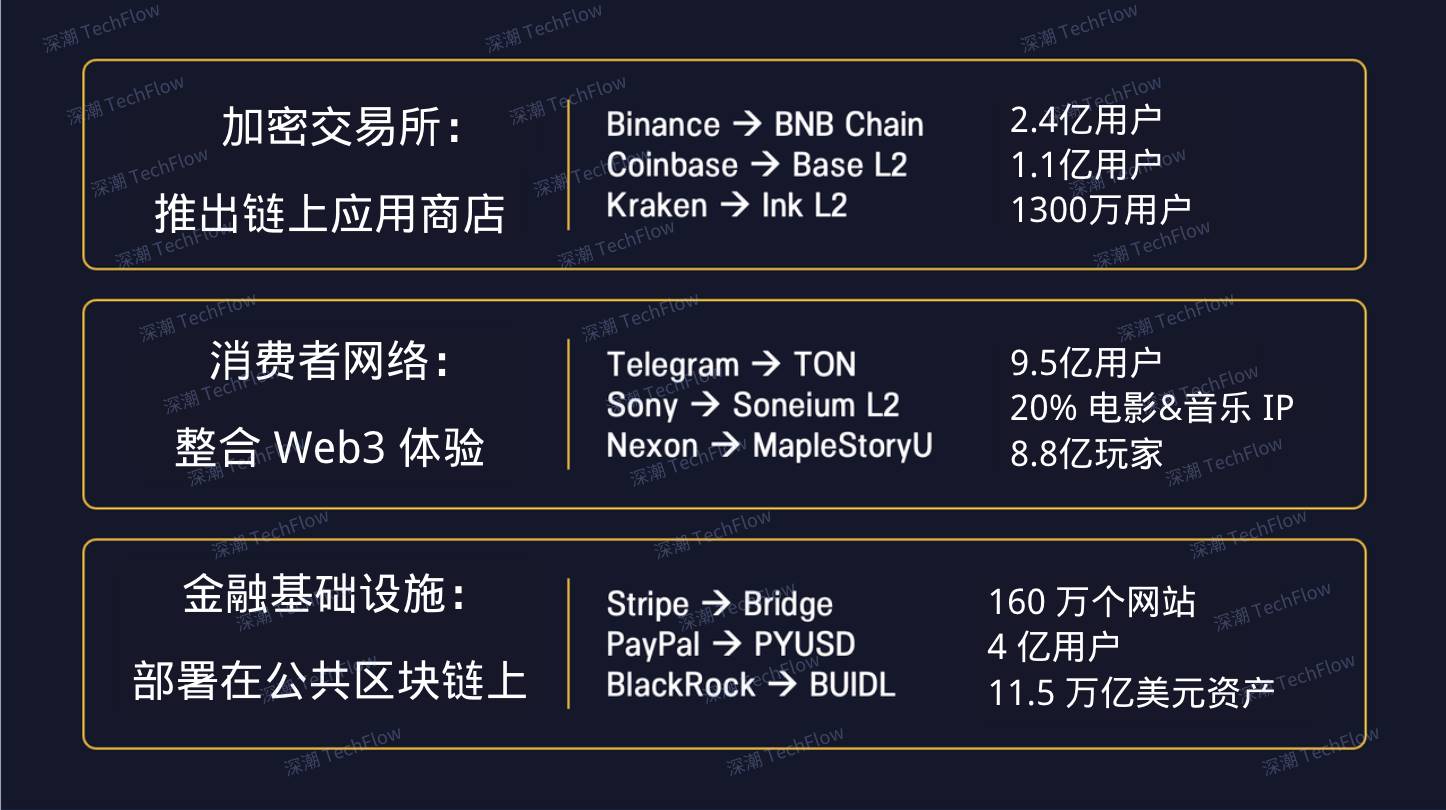
How do we get these applications in front of all 8 billion people? In 2025, we’ll see entirely new distribution models capable of reaching hundreds of millions of consumers at scale. Crypto exchanges like Coinbase, Kraken, and Binance are launching their own blockchains to help users enter the on-chain world more easily. Platforms like Telegram and Sony are integrating Web3 features into their massive user bases, expanding the on-chain user population.
Meanwhile, game companies are adding on-chain functionality to classic titles (like *MapleStory*), potentially converting millions of players into on-chain users. Financial institutions like PayPal and BlackRock are rolling out on-chain financial and payment solutions, making it easier for mainstream users to access and use blockchain technology.
Original image by Franklin Bi, translated by TechFlow
In 2025, the convergence of these trends will usher the on-chain economy into a crucial turning point. When ordinary people have a reason to spend 60 minutes per week on-chain, “onchain” will become as routine as “online.” Instead of waiting for a single “killer app,” imagine a diverse ecosystem—just as we switch between different apps on the internet today, people will spend time on-chain for entertainment, socializing, earning income, and more. When that happens, the on-chain economy will truly become woven into everyday life.
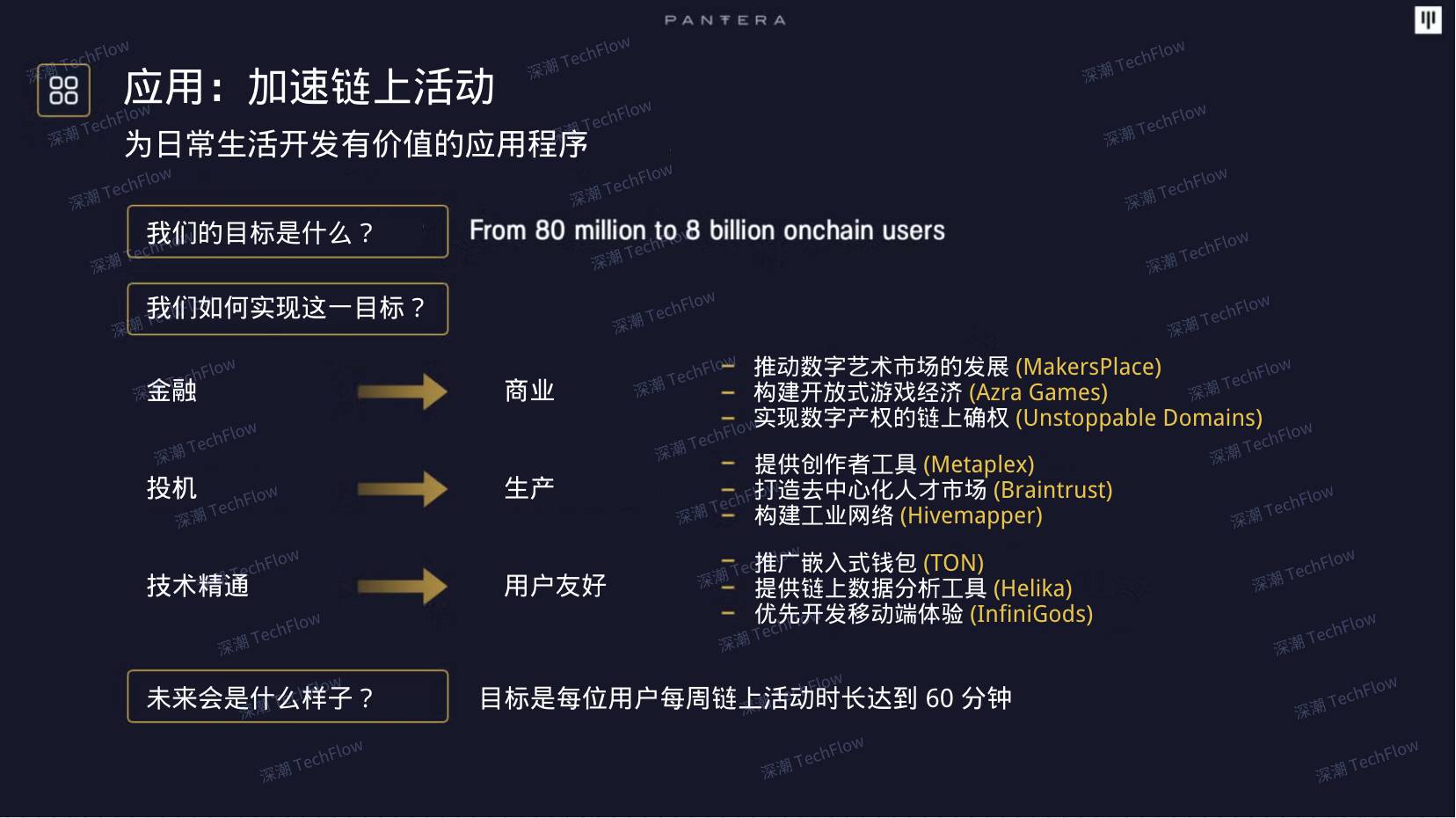
Original image by Franklin Bi, translated by TechFlow
Looking Ahead: Accelerating Blockchain’s Integration into Mainstream Life
The coming year will mark the beginning of blockchain deeply integrating into daily life, just as the internet once did. The shift from “Wall Street” to “Main Street” isn’t just happening—it’s accelerating rapidly. This transformation is driven by continuous innovation in entertainment, commerce, and practical applications.
To advance this shift, we must invest more in accessible entry points to blockchain, better technology and development tools, and applications that solve real-world problems. 2025 remains full of immense potential, and mainstream crypto adoption is becoming increasingly tangible. As the saying goes: “The best way to predict the future is to create it.”
Crypto Predictions for 2025
Author: Paul Veradittakit, Managing Partner
This year, I invited fellow Pantera investors to contribute predictions. I’ve grouped them into two categories: rising trends and emerging ideas.
Rising Trends:
-
On-chain real-world assets (RWAs)—excluding stablecoins—will represent 30% of total value locked (TVL), up from 15% today.
In 2024, on-chain RWAs grew over 60%, reaching $13.7 billion. About 70% of this consists of private credit, with most of the remainder in Treasuries and commodities. Capital inflows into these categories are accelerating, and 2025 may see even more sophisticated RWA products emerge.
First, the rapid growth of private credit stems from improving blockchain infrastructure. Figure dominates this space, adding nearly $4 billion in on-chain assets in 2024 alone. As more firms enter, private credit becomes an easier on-ramp into the crypto ecosystem.
Second, trillions of dollars in off-chain Treasuries and commodities remain untapped. Currently, only $2.7 billion in Treasuries are on-chain. Unlike stablecoins, Treasuries generate yield directly (while stablecoin yields are captured by issuers), making them more attractive. For example, BlackRock’s BUIDL Treasury fund holds only $500 million on-chain, compared to tens of billions in off-chain government bonds. Now, DeFi infrastructure fully supports RWA integration—Treasuries and stablecoins alike can be used in liquidity pools, lending markets, and perpetuals—greatly lowering adoption barriers. Commodities are following a similar trajectory.
Currently, on-chain RWAs are limited to basic products. However, as infrastructure for minting and managing RWA protocols improves, operators gain deeper understanding of risks and mitigation strategies. Specialized firms now offer wallet management, minting mechanisms, Sybil attack detection, and crypto-native banking services. These advancements make it feasible to bring more complex financial instruments—stocks, ETFs, bonds—on-chain. These trends are expected to accelerate RWA adoption in 2025, deepening blockchain’s role in finance.
-
Bitcoin-Fi: The Rise of Bitcoin Finance
Last year, my prediction for Bitcoin-Fi was optimistic but didn’t reach 1–2% of total Bitcoin TVL. This year, several factors may drive faster growth: native Bitcoin financial protocols without bridges (e.g., Babylon), higher yields, rising Bitcoin prices, and strong demand for newer Bitcoin assets (runes, Ordinals, BRC20). By 2025, we expect 1% of Bitcoin to participate in Bitcoin-Fi—an important breakthrough for Bitcoin in finance.
-
Fintech Companies: Becoming the Mainstream Gateway to Crypto
Platforms like TON, Venmo, PayPal, and WhatsApp are becoming powerful drivers of crypto adoption due to their neutrality. They provide access to crypto interactions without pushing specific apps or protocols, serving as simplified onboarding channels. Each serves distinct user bases: TON reaches 950 million Telegram users; Venmo and PayPal serve 500 million payment users each; WhatsApp boasts 2.95 billion monthly active users.
For example, Felix runs on WhatsApp, letting users send instant transfers via messages, with funds withdrawable digitally or in cash at partner locations (like 7-Eleven). Technically, Felix uses Bitso on the Stellar network with stablecoins. Users can now buy crypto on MetaMask using Venmo. Stripe acquired stablecoin firm Bridge, while Robinhood bought crypto exchange Bitstamp.
Whether intentional or through third-party integrations, these fintech firms are gradually becoming mainstream gateways to crypto. As they scale, they may rival smaller centralized exchanges in terms of crypto holdings.
4. Unichain: The Highest-Volume L2 Network
Uniswap currently has ~$6.5B in total value locked (TVL), processing 50,000–80,000 transactions daily, with daily volume between $1B and $4B. Arbitrum sees ~$1.4B in daily volume (one-third from Uniswap); Base sees ~$1.5B (one-quarter from Uniswap).
If Unichain captures half of Uniswap’s transaction volume, it will easily surpass today’s largest L2s to become the highest-volume network. This demonstrates Unichain’s potential and marks further maturation of the DeFi ecosystem.
5. NFT Renaissance: From Tool to Diverse Applications
NFTs were originally designed as a tool within blockchain technology, not an end in themselves. Today, NFT use cases span on-chain gaming, AI (for ownership of trading models), identity verification, and consumer applications.
For example, Blackbird is a restaurant rewards app that integrates NFTs into customer identification, seamlessly blending Web3 with food service. Leveraging blockchain’s openness, liquidity, and identifiability, Blackbird provides restaurants with consumer behavior data while easily enabling subscriptions, memberships, and discounts.
Sofamon created Web3 emojis as NFTs called “wearables,” unlocking the financial potential of the emoji market. They also recognize the importance of on-chain intellectual property (IP), partnering with top KOLs and K-pop stars to combat digital counterfeiting. For instance, Story Protocol recently raised $80 million at a $2.25 billion valuation to tokenize global IP, restoring originality as the core of creative exploration. Luxury watchmaker IWC launched a membership NFT, granting holders access to exclusive communities and events.
NFTs’ flexibility allows use in identity, transaction records, asset ownership, and membership management, while also representing and assessing asset value. This versatility creates monetization opportunities and may fuel speculative market growth. As the technology matures, NFT applications will continue expanding.
6. Restaking Protocols: A Step Toward Mainnet Launch
In 2025, restaking protocols like EigenLayer, Symbiotic, and Karak will launch on mainnet. These protocols offer returns to operators via AVS (Actively Validated Services) and slashing mechanisms. Though restaking hype cooled over the past year, its potential remains significant.
Restaking’s influence grows as more networks adopt it. Even indirect reliance on a specific restaking protocol brings benefits. This dynamic allows certain protocols to maintain high valuations even as relevance shifts. We expect restaking to remain a multi-billion-dollar market, with more applications transitioning to appchains that either adopt restaking or build atop it.
Emerging Ideas:
7. zkTLS: A New Technology Bringing Off-Chain Data On-Chain
zkTLS (zero-knowledge Transport Layer Security) is a new zero-knowledge proof-based technology for verifying the authenticity of Web2 data. While not yet fully realized, its implementation this year could introduce entirely new data types to blockchain.
For example, zkTLS can prove data genuinely originated from a specific website—something no current technology can do reliably. Combining trusted execution environments (TEEs) and multiparty computation (MPC), zkTLS may evolve to support partial data privacy.
Though still conceptual, we expect companies to begin investing in zkTLS development and integration into on-chain services. It could serve as a verifiable oracle for non-financial data or a secure data feed for broader blockchain support.
8. Regulatory Support: A Shift in U.S. Crypto Policy
The U.S. regulatory environment shows its first signs of pro-crypto sentiment. In the recent election, 278 pro-crypto House candidates were elected, compared to 122 anti-crypto candidates. Additionally, SEC Chair Gary Gensler, long seen as hostile to crypto, announced he will step down in January. Reports indicate Trump plans to nominate Paul Atkins as the new SEC Chair. Atkins served as an SEC Commissioner from 2002–2008, has publicly supported the crypto industry, and advises the Chamber of Digital Commerce, which advocates for crypto adoption.
Trump has also appointed tech investor and former Yammer CEO and PayPal COO David Sacks as the newly created “AI & Crypto Czar.” In the announcement, Trump stated: “He will develop a legal framework providing the clarity the crypto industry has long sought.”
These changes spark optimism about the future of U.S. crypto regulation. We hope to see fewer SEC lawsuits, clearer definitions of crypto as an asset class, and improved tax policies.
Crypto: The Unexpected Ally Against De-Dollarization
Authors: Jeff Lewis (Hedge Fund Product Manager) and Erik Lowe (Content Lead)
In recent years, global “de-dollarization” has gained momentum. Countries and institutions are reducing reliance on the U.S. dollar in international trade and finance, raising concerns about the dollar’s long-term dominance.
A common metric for dollar dominance is its share of global foreign exchange reserves. Since 2000, this share has steadily declined by 13 percentage points.
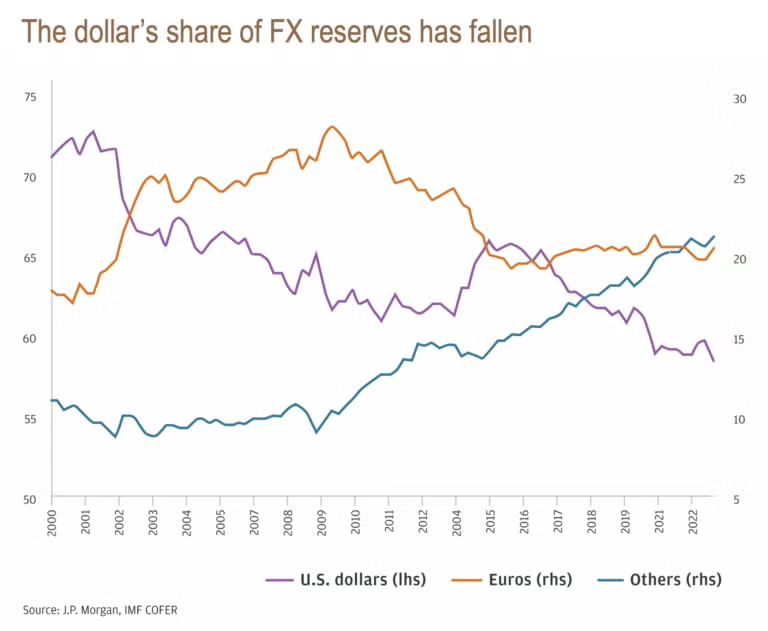
However, we believe this trend is about to reverse—and the force driving this change is blockchain technology and tokenization, technologies once thought to undermine the dollar. Ironically, they are now becoming the dollar’s strongest allies.
As Elon Musk said: “The most ironic outcomes are often the most likely.”
Enhanced Dollar: How Blockchain Strengthens Dollar Dominance
Public blockchains inject new vitality into fiat currencies, enabling them to reach 5 billion smartphone users globally and facilitate seamless cross-border payments. Surging demand for tokenized fiat (i.e., stablecoins) has created a $200 billion market—where U.S. dollar-backed stablecoins dominate overwhelmingly.
A report by Castle Island and Brevan Howard shows nearly 100% of stablecoins are backed by U.S. dollars. This indicates blockchain technology isn’t weakening the dollar—in fact, through efficiency and globalization, it’s reinforcing the dollar’s central role in global finance.
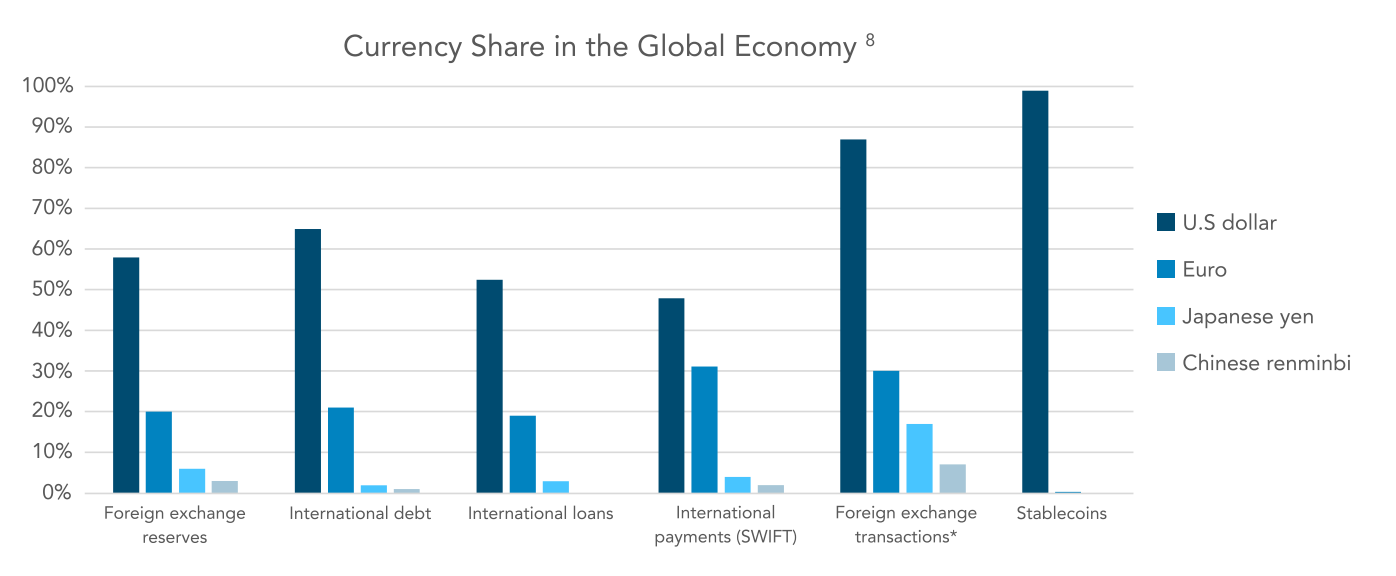
Source: Castle Island and Brevan Howard Report
Among the top 20 fiat-backed stablecoins, 16 include “USD” in their names.
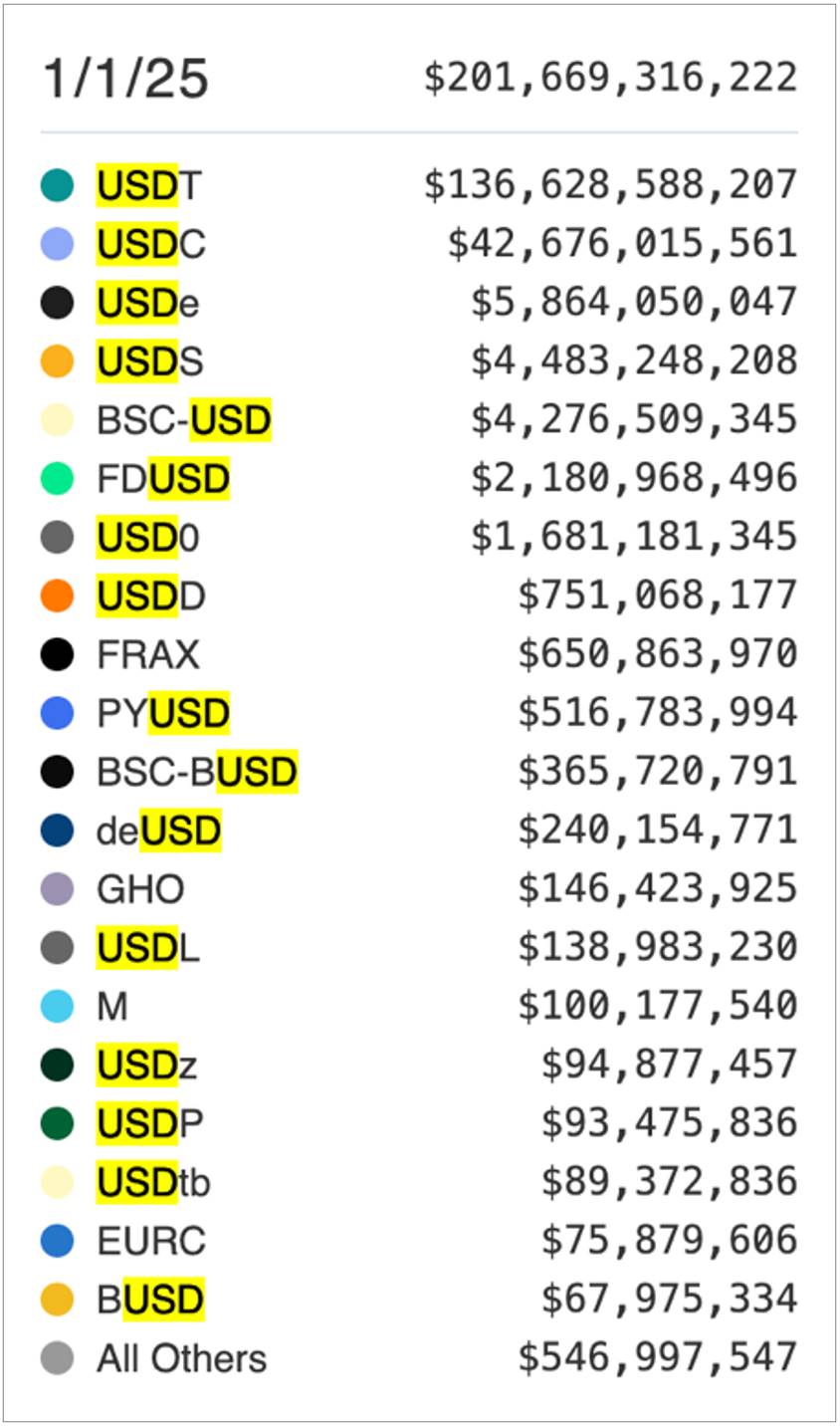
Source: rwa.xyz
Despite 16 years of development, public perception of blockchain hasn’t changed much. Early Bitcoin supporters hoped it would challenge the dollar’s global dominance. Over time, however, Bitcoin evolved into “digital gold”—a store of value rather than a medium of exchange. In this role, its threat to the dollar has significantly diminished.
Meanwhile, the rapid rise of stablecoins and RWAs is fulfilling Bitcoin’s original promise—providing a stable, yield-generating medium of exchange on blockchain. Rather than undermining the dollar, this development amplifies the dollar’s global reach through blockchain technology.
The Rise of Stablecoins in Emerging Markets
In emerging markets, dollar-backed stablecoins have become practical financial tools, offering alternatives for those holding cash or relying on fragile banking systems. In countries facing currency depreciation or economic instability, merchants and residents often prefer the stability of digital dollars.
A report by Castle Island and Brevan Howard surveyed existing crypto users in Nigeria, Indonesia, Turkey, Brazil, and India, revealing stablecoins’ vital role:
-
Savings Demand: 47% of respondents primarily use stablecoins to save in USD—only slightly less than the 50% using them for crypto/NFT trading.
-
Currency Conversion: 69% have converted local currency to stablecoins unrelated to trading activity, indicating broad demand beyond payments and savings.
-
Future Expectations: 72% expect to increase stablecoin usage, reflecting the tool’s potential in emerging markets.
From individual savers to multinational corporations, when economic actors favor the safest, most liquid financial tools, dollar-backed stablecoins increasingly displace local currencies. This phenomenon shows stablecoins not only provide real-world blockchain use cases but also strengthen the dollar’s position in the global economy.
Stablecoin Legislation in 2025: A Smart Move in America’s Interest
With legislative progress underway, it’s widely expected that the Trump administration will push forward stablecoin-focused regulations. Patrick McHenry’s stablecoin bill, initially proposed in 2023, was recently referred to the House by Representative Maxine Waters. Stablecoin legislation has long been seen as the first step toward clear U.S. crypto regulation. We believe substantial progress will occur by 2025, especially as policymakers recognize stablecoins’ strategic role in expanding the dollar’s global footprint.
Widespread stablecoin adoption aligns with U.S. national interests. It increases the share of dollar-denominated global transactions and creates demand for U.S. Treasuries as collateral. For a country with $37 trillion in outstanding debt, stablecoins and crypto offer an innovative distribution channel.
Stablecoins vs. CBDCs: A Fundamental Technical Distinction
It’s crucial to distinguish fiat-backed stablecoins from central bank digital currencies (CBDCs)—technologies that appear similar but are fundamentally different.
A report published by J.P. Morgan in October 2025 notes that new technologies promoting payment sovereignty are potential drivers of de-dollarization. It cites projects like mBridge, a joint digital currency initiative by multiple central banks, as possible alternatives to dollar-based transactions.
While the rise of foreign CBDCs does pressure dollar dominance, we believe the rapid growth of dollar-backed stablecoins effectively counters this trend. In our view, stablecoins built on decentralized, permissionless blockchains will be more widely adopted due to stronger privacy, censorship resistance, and cross-platform interoperability.
Stablecoins and Tokenized Treasuries: Fueling Demand for U.S. Debt
According to U.S. Treasury data, about $120 billion in stablecoin collateral is directly invested in U.S. Treasuries, significantly boosting demand for short-term debt. Beyond stablecoins, direct tokenization of Treasuries is gaining traction. Digitizing Treasuries via blockchain enhances liquidity and offers investors easier trading options.
Companies like BlackRock (via Securitize), Franklin Templeton, Hashnote, and Pantera-backed Ondo lead this ~$4 billion market. This trend shows blockchain’s potential not only in payments but also in digitizing traditional financial assets.
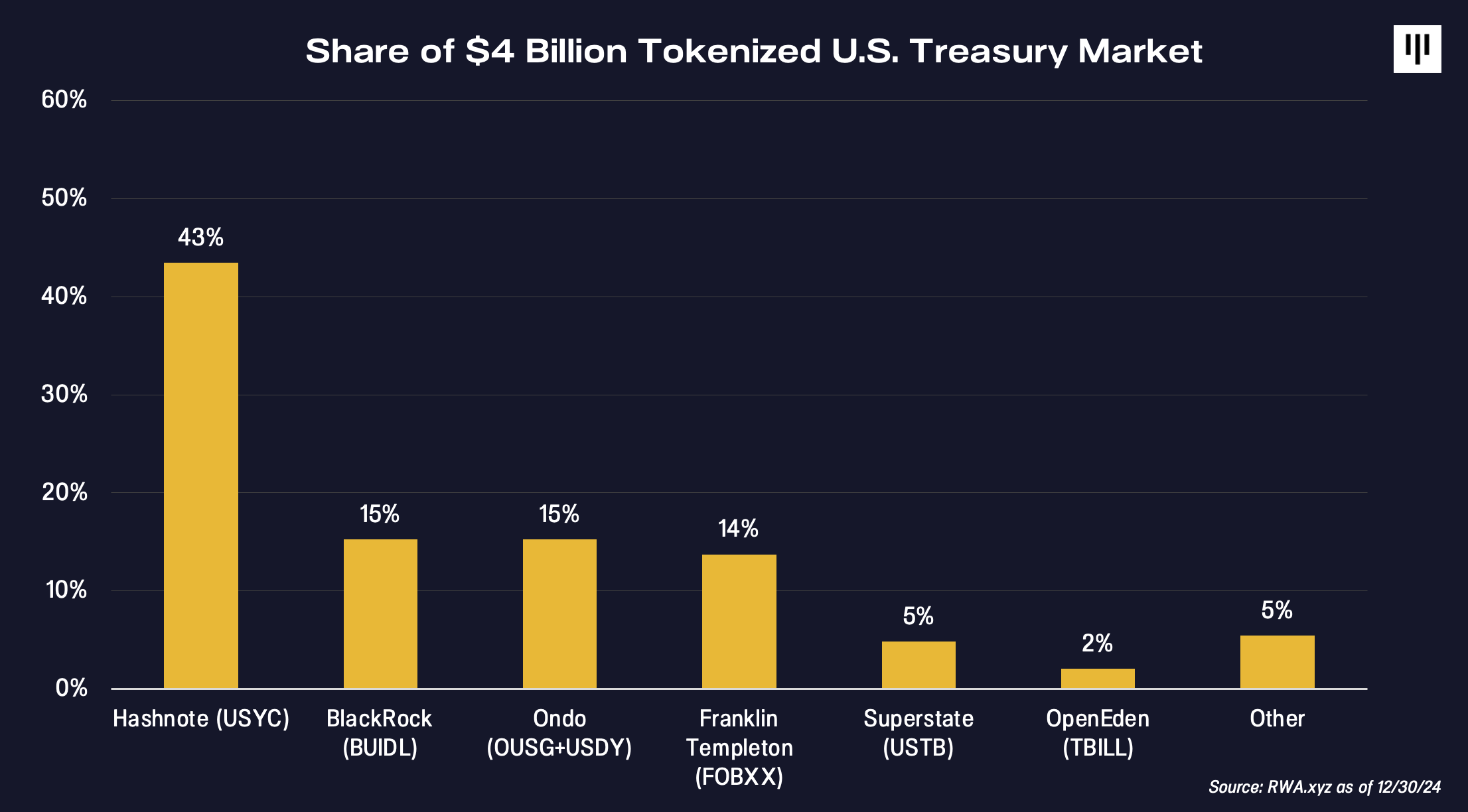
Ondo has launched two core products in the on-chain asset space, designed to offer investors simpler, more efficient access:
-
USDY (U.S. Dollar Yield Token): A tokenized note backed by short-term U.S. Treasuries and bank deposits. Designed for non-U.S. investors, it offers stable, high-quality yield while simplifying access to dollar-denominated assets.
-
OUSG (Ondo Short-Term U.S. Government Bond Fund): Provides liquid exposure to short-term U.S. Treasuries, allowing qualified investors to mint and redeem instantly. This flexibility enables more efficient portfolio management.
Products like USDY offer overseas investors a simpler, more accessible way to gain exposure to U.S. dollars and Treasuries compared to traditional channels.
A New Era of Dollar Dominance: Empowered by Blockchain
Blockchain technology isn’t eroding the dollar’s global supremacy—in fact, it’s strengthening it through digital infrastructure. Even amid geopolitical and technological pressures toward de-dollarization, the ability to tokenize and mobilize dollar assets globally makes them irreplaceable.
J.P. Morgan identifies three structural pillars behind dollar dominance:
-
Deep capital markets
-
Rule of law
-
Institutional transparency
These advantages remain unmatched in today’s global financial system. Stablecoins extend these strengths into a digital, borderless context.
In fact, the U.S. dollar is blockchain’s biggest beneficiary. Blockchain’s “killer app” may well be the dollar itself—showing that technology doesn’t just disrupt power structures, but can reinforce them. As regulatory frameworks mature and demand for tokenized assets surges, the on-chain migration of dollar assets will further cement the dollar’s role as the cornerstone of global finance. Whether under Democratic or Republican leadership, U.S. regulators will support any force that increases demand for U.S. Treasuries—making regulatory progress almost inevitable.
Three Key Trends in DeFi: The On-Chain Migration of Real-World Assets
Author: Mason Nystrom, Junior Partner
With improved user experience and maturing protocols, DeFi is growing rapidly, attracting increasing users and capital. In this post, I explore three key trends shaping DeFi. Below is a brief overview of one of them:
The RWA Flywheel: From Endogenous to Exogenous Growth
Since 2022, high interest rates have driven significant migration of real-world assets (RWAs) onto blockchains. Asset managers like BlackRock recognize clear advantages to on-chain RWAs:
-
Programmable Financial Assets: Automated operations via smart contracts.
-
Lower Cost Structure: Reduced issuance and maintenance costs.
-
Greater Accessibility: Enables broader investor access to high-quality assets.
These benefits resemble those of stablecoins, delivering roughly 10x efficiency gains over traditional finance.
According to RWA.xyz and DefiLlama, RWAs currently represent 21%-22% of assets on Ethereum. Most consist of AAA-rated U.S. Treasury bills, whose growth has benefited from high rates. Yet even if macroeconomic conditions shift, the trend of tokenizing assets is now entrenched in Wall Street, paving the way for more RWAs to go on-chain.
As traditional assets migrate on-chain, they trigger a compounding flywheel effect, accelerating the convergence and replacement of traditional finance with DeFi protocols.
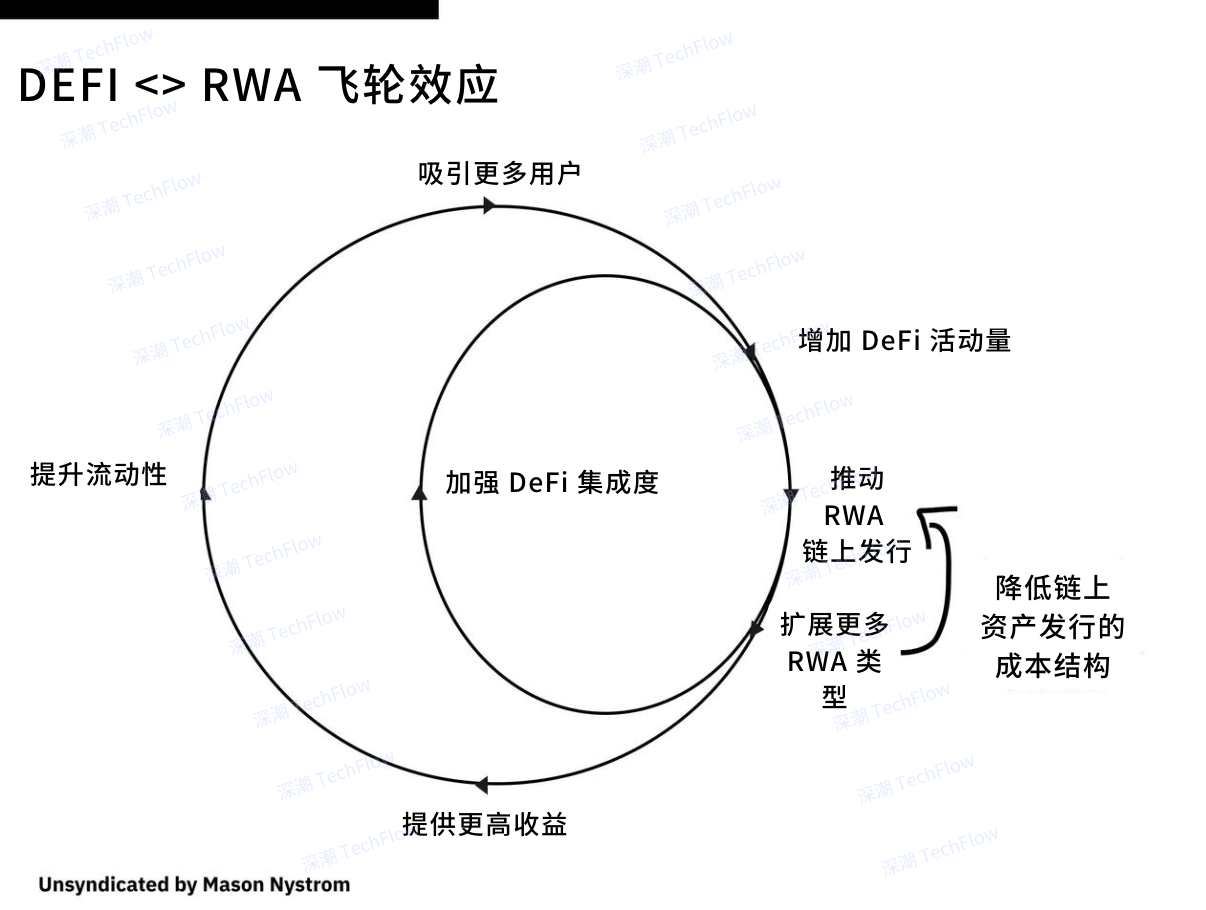
Original image by Mason Nystrom, translated by TechFlow
Why does this matter? Growth in the crypto market stems from two key sources: endogenous capital and exogenous capital.
Currently, most DeFi funding is endogenous—capital circulating within the DeFi ecosystem, capable of self-reinforcing growth through on-chain activity. Still, DeFi’s history has been cyclical: bull markets, corrections, then renewal. Over time, new financial primitives (e.g., lending protocols, AMMs) have expanded DeFi’s overall size.
For example, on-chain lending protocols (Maker, Compound, Aave) enabled leverage using crypto collateral, expanding DeFi’s utility. Decentralized exchanges—especially automated market makers (AMMs)—increased tradable tokens and boosted liquidity. Yet endogenous growth has limits. While speculative on-chain activity (endogenous capital) has established crypto as a legitimate asset class, the next wave of DeFi growth requires exogenous capital—traditional off-chain financial capital.
Real-world assets (RWAs) offer vast potential here. RWAs—commodities, equities, private credit, FX—represent enormous pools of exogenous capital, helping DeFi break free from internal capital loops. Just as stablecoin growth relied on real-world use cases (cross-border payments, savings), other DeFi activities (trading, lending) need similar injections of external capital.
Looking ahead, DeFi aims to migrate all financial activity onto blockchains. We expect expansion along two parallel paths: endogenous growth through increased on-chain activity, and exogenous growth through on-chain migration of real-world assets.
“BUY THE RUMOR, BUY THE NEWS”: The Bitcoin ETF Success Story
A year ago, in our November blockchain letter, we published an article titled “Upcoming Bitcoin ETF: BUY THE RUMOR, BUY THE NEWS.”
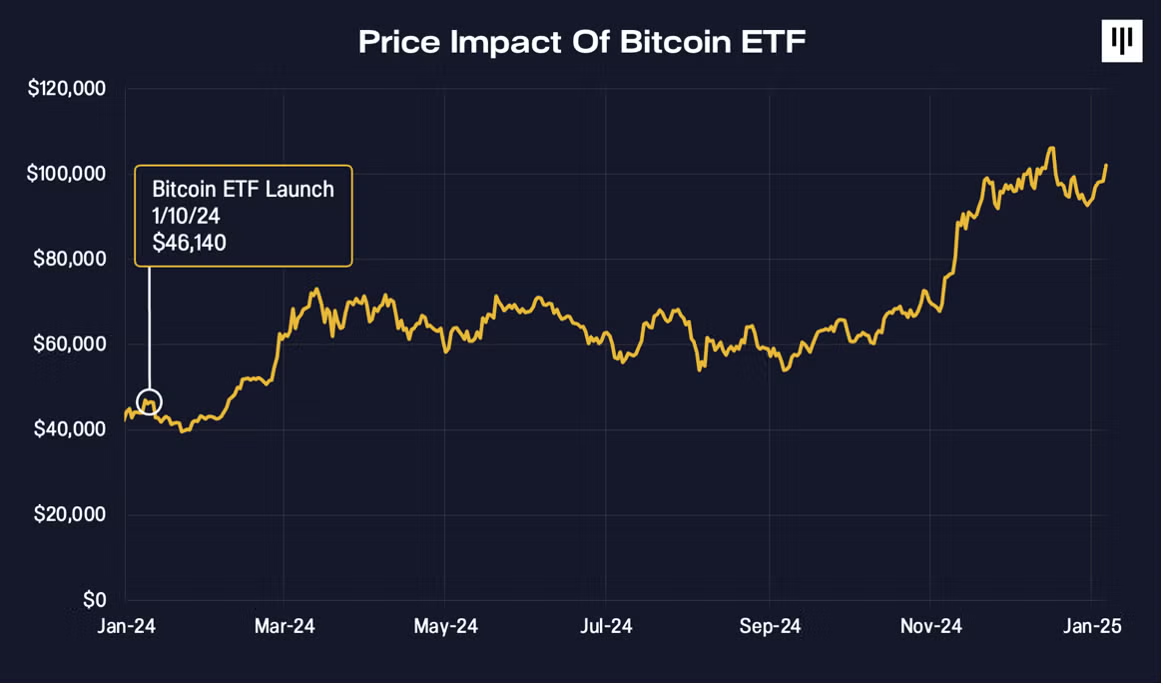
We argued: Although “BUY THE RUMOR, SELL THE NEWS” is a classic Wall Street playbook, it might not apply to the launch of spot Bitcoin ETFs. This prediction proved correct.
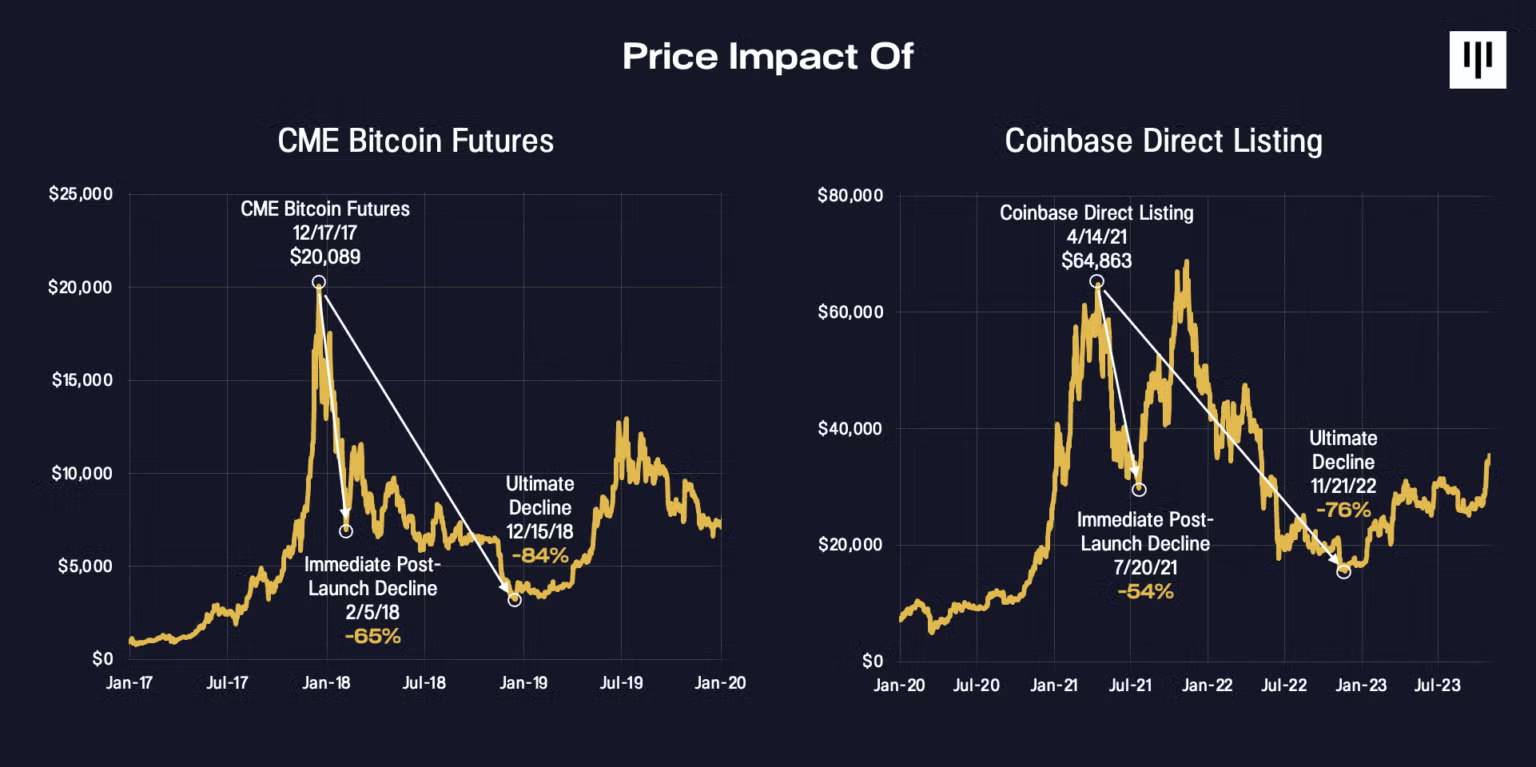
Since the Bitcoin ETF launch, Bitcoin’s price has risen 103%.
BlackRock’s Bitcoin ETF surpassed the assets of its 20-year-old gold ETF just 11 months after launch. This achievement is considered “the most successful ETF launch in history,” reaching $50 billion five times faster than the second-fastest ETF.
Next month, I’ll explore why the impact of the U.S. election hasn’t yet been fully understood by markets or reflected in Bitcoin’s price. I believe the U.S. election will become another textbook case of “buy the rumor, buy the news.”
Join TechFlow official community to stay tuned
Telegram:https://t.me/TechFlowDaily
X (Twitter):https://x.com/TechFlowPost
X (Twitter) EN:https://x.com/BlockFlow_News
 Pantera Capital