Popular comic, guiding you to quickly understand Hyperliquid's auction mechanism
TechFlow Selected TechFlow Selected
Popular comic, guiding you to quickly understand Hyperliquid's auction mechanism
Hyperliquid's auction mechanism determines the price at which new tokens are listed on the spot exchange.
 Navigating Web3 tides with focused insights
Author: nairolf
Translation: TechFlow
"Friend, what is Hyperliquid's bidding mechanism?"
Below is a (super) simple explanation of the HIP-1 proposal introduced by @HyperliquidX.
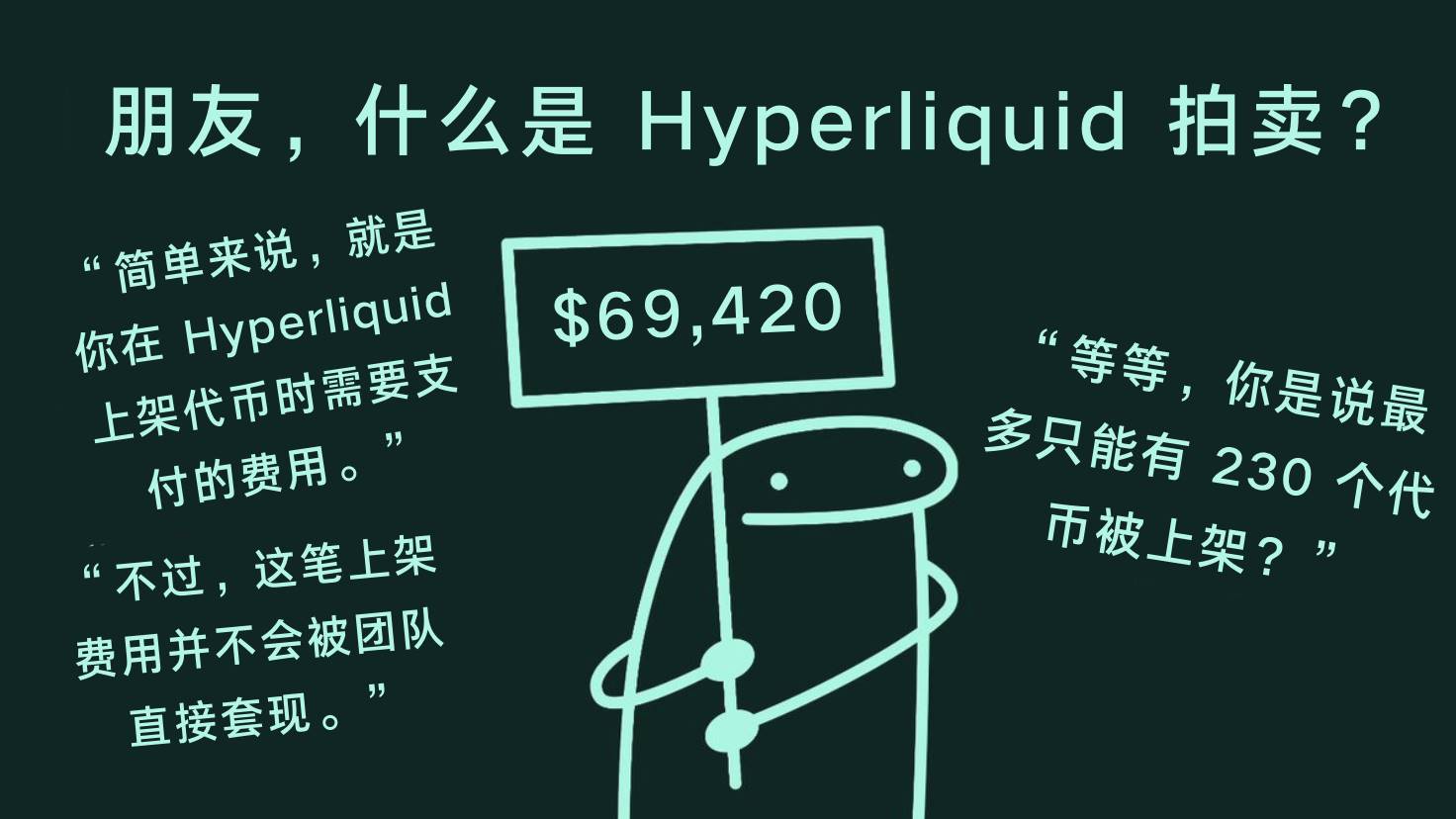
"What is this?"
HIP-1 is a standard for fungible tokens with limited supply.
It defines the rules for how tokens are listed on Hyperliquid. Tokens are sold via Dutch auctions, each lasting 31 hours, with the starting price set at double the final price of the previous auction.
"Not following?"
Hyperliquid is an L1 blockchain that comes with its own exchange.
It supports various perpetual contracts, allowing users to go long or short on nearly any token with leverage.
Additionally, it has a spot trading zone similar to Binance or Coinbase—but fully decentralized. Hopefully, that helps clarify things.
"Got it. But how does it work?"
Because Hyperliquid is decentralized, it needs a fair mechanism to determine which tokens get listed—rather than letting a single team or individual decide arbitrarily. This differs from centralized exchanges, where listings are often determined by fees or internal selection.

"How exactly does it operate?"
Hyperliquid uses an auction mechanism for token listings.
In simple terms, a new "listing right" is auctioned off every 31 hours. The auction starts at double the final price of the previous "listing right," and the price gradually decreases over time until someone purchases it.
"Give me an example."
Suppose you want your "XYZ" token listed on Hyperliquid.
Contacting the team directly to request a listing won't work. Instead, you must purchase a "listing right" by participating in the auction.

"So how much does it cost?"
The first step is checking the final price of the last "listing right"—say, $69,420.
The next auction will start at double that amount: $138,840.
This price will gradually decline over time until someone decides to buy. Then, every 31 hours, the auction process repeats.
"So I can list my token?"
Exactly. Anyone can participate in the auction. As long as you're willing to pay the current price, you can acquire a "listing right" and list your token on Hyperliquid.
The 31-hour interval ensures that too many tokens aren't listed at once, preserving platform scarcity and the uniqueness of each listing.

Summary
Hyperliquid’s auction mechanism determines the price at which new tokens are listed on its spot exchange.
Each auction is constrained by time and price—occurring every 31 hours, starting at double the prior auction’s final price, then declining continuously until purchased.
Join TechFlow official community to stay tuned
Telegram:https://t.me/TechFlowDaily
X (Twitter):https://x.com/TechFlowPost
X (Twitter) EN:https://x.com/BlockFlow_News
 @0xNairolf