









Will the Rise of "Strategic Reserves" Reshape Sovereign Nations' and Corporations' Balance Sheets with Bitcoin?
TechFlow Selected TechFlow Selected
Will the Rise of "Strategic Reserves" Reshape Sovereign Nations' and Corporations' Balance Sheets with Bitcoin?
Gold, as a global strategic reserve asset, has a history spanning thousands of years, while 15-year-old Bitcoin is mounting a new challenge.
 Navigating Web3 tides with focused insights
Author: Yuliya
What does it mean to hold 1 million BTC as a strategic reserve asset?
According to data from the World Gold Council, as of the third quarter of 2024, the U.S. Federal Reserve's gold reserves reached 8,133.46 tons (approximately $530 billion), ranking first globally. The current market value of 1 million BTC is close to $100 billion—about 19% of U.S. gold reserves—making it a highly significant scale.
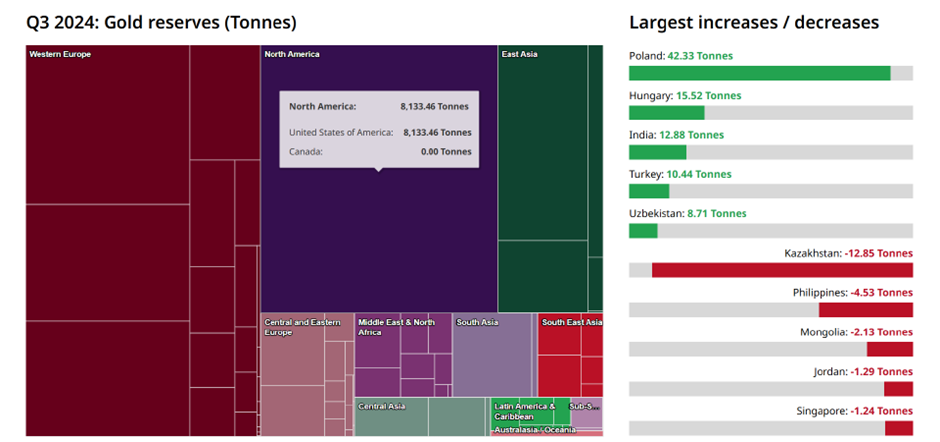
Source: World Gold Council
As Trump and an increasing number of institutions, corporations, and sovereign nations begin considering establishing "Bitcoin strategic reserves," is Bitcoin approaching its "Fort Knox moment"? Could it become a key component of the global reserve asset system, just like gold?
The next decade may prove pivotal in answering this question.
What Does “Strategic Reserve Asset” Mean?
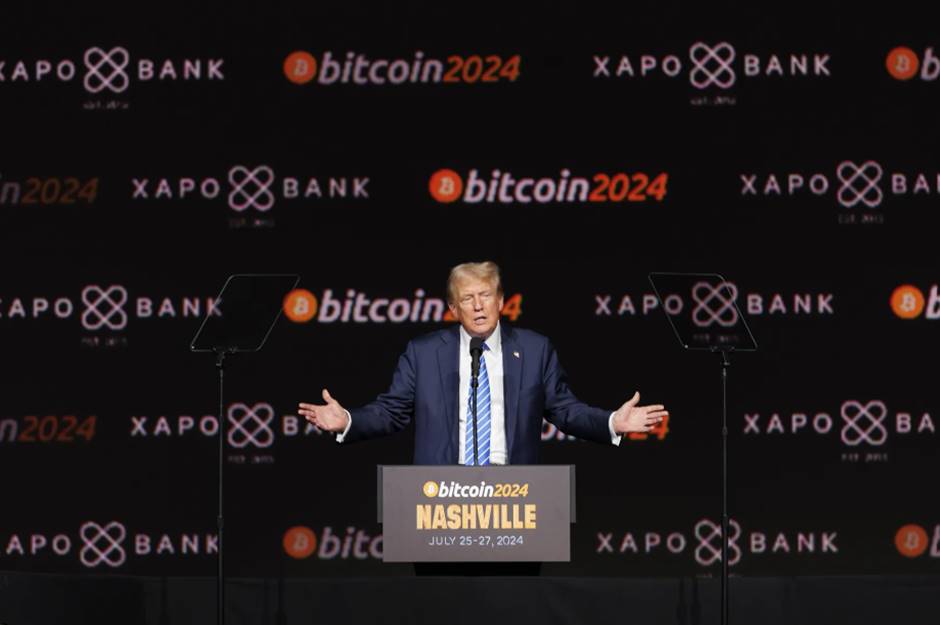
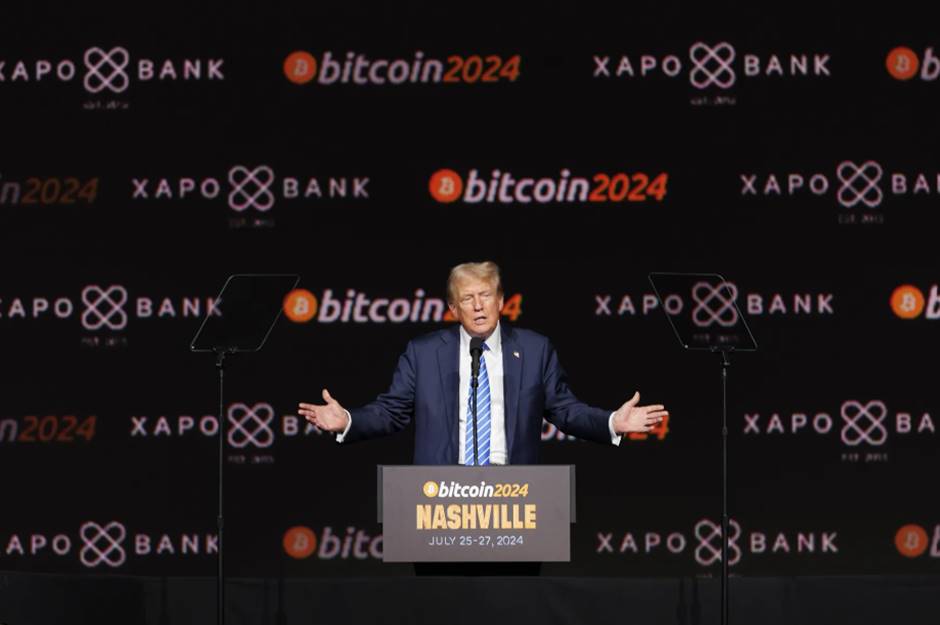
At the Bitcoin2024 conference in July 2024, Trump explicitly pledged that any bitcoin held or acquired by the government would be “never sold,” reaffirming his vision for a “strategic Bitcoin reserve.”
Following Trump’s election victory and recent appointments of crypto-friendly officials—including the U.S. Treasury Secretary, SEC Chair, and White House Crypto Czar—the idea of including Bitcoin in U.S. strategic reserves has moved closer to reality.
What Exactly Is a “Strategic Reserve Asset”?
At its core, a “strategic reserve asset” refers to key assets held by national or regional governments to manage economic volatility, financial crises, or geopolitical risks, thereby safeguarding financial stability, economic security, and international competitiveness. Such assets typically possess high value and broad acceptance, safety and stability, and liquidity.
At the corporate level, strategic reserve assets help ensure financial stability, enhance risk resilience, and support long-term growth strategies. Especially during times of economic turmoil, they often serve as the primary defense against systemic risks.
Traditional Strategic Reserve Assets Include:
-
Gold: Widely recognized as a stable store of value due to its scarcity and inflation resistance;
-
Foreign exchange reserves: Primarily reserve currencies such as the U.S. dollar, serving as essential tools for international trade and payments;
-
Special Drawing Rights (SDR): Allocated by the International Monetary Fund (IMF) to supplement member countries’ official reserves;
Evidently, assets qualifying as “strategic reserves” must simultaneously offer value stability, global recognition, and ease of circulation. As an emerging digital asset, Bitcoin is gradually meeting these criteria and increasingly seen as a potential alternative to gold.
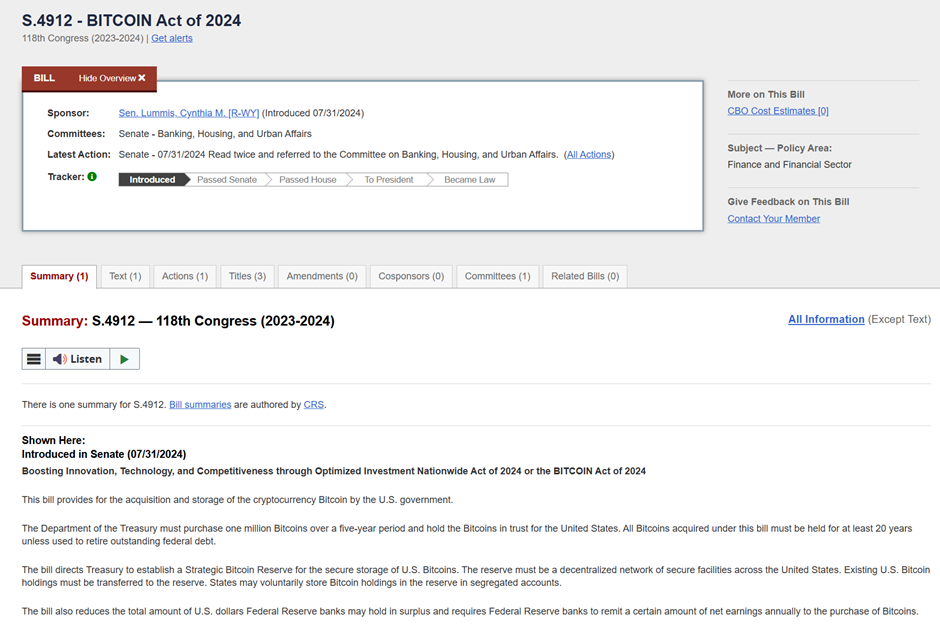
Notably, beyond Trump’s public commitment, on July 31, 2024, U.S. Senator Cynthia Lummis introduced the “U.S. Bitcoin Strategic Reserve Act” (BITCOIN Act of 2024) to Congress. The bill mandates that the U.S. Treasury purchase 1 million BTC within five years and hold them for at least 20 years—unless used to repay outstanding federal debt—and proposes requiring the Federal Reserve to allocate a portion of its annual net earnings toward purchasing Bitcoin.
The plan aims to ensure the U.S. government maintains a substantial Bitcoin holding over the next two decades, providing a long-term financial hedge. The bill has been submitted to the Senate Committee on Banking, Housing, and Urban Affairs and requires committee discussion, votes, passage by both chambers, and final approval by President Trump to become law.
Why Bitcoin, Beyond Gold and Foreign Exchange?
From an asset allocation perspective, larger gold reserves are not inherently better.
A primary concern is that physical gold generates no interest or yield, nor does it offer notable liquidity returns. This lies at the heart of Warren Buffett’s longstanding skepticism: “Gold doesn’t pay interest, so it lacks compounding power.”
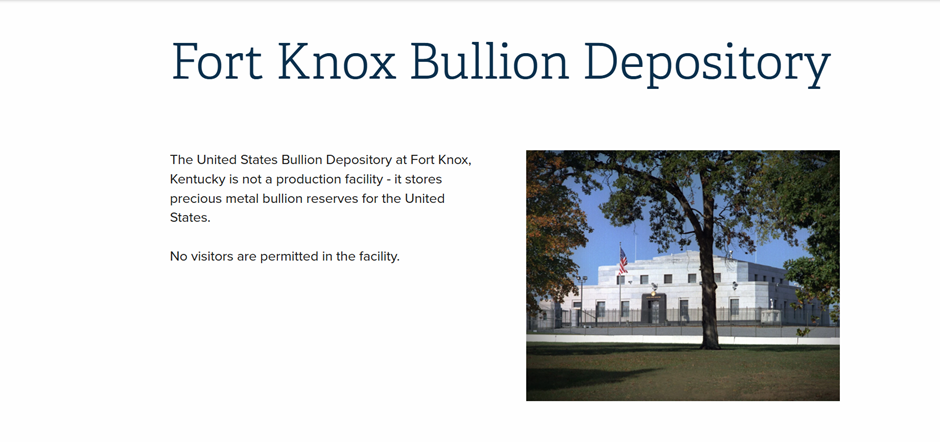
More critically, maintaining gold reserves incurs substantial storage and security costs. For most countries, managing and securing gold reserves represents a significant fiscal burden. Take the Federal Reserve’s iconic gold vault at Fort Knox—its security investment is staggering:
Located deep within Kentucky’s strategic interior, the facility features underground construction, thick reinforced concrete walls, round-the-clock surveillance systems, and permanent military deployment numbering in the thousands. Thus, gold reserves have evolved from a security necessity into a continuous, capital-intensive fiscal expense.
In contrast, Bitcoin’s storage cost is nearly negligible. It requires no physical space or expensive protective infrastructure. With secure wallets, multi-signature technology, and decentralized network verification, efficient storage and management are easily achieved.
At the national level, Bitcoin storage expenditures are primarily limited to technology and network maintenance—far lower than the physical protection costs of gold. This means that even without generating direct returns, Bitcoin’s holding costs are significantly more favorable, leaving greater room for net asset growth.
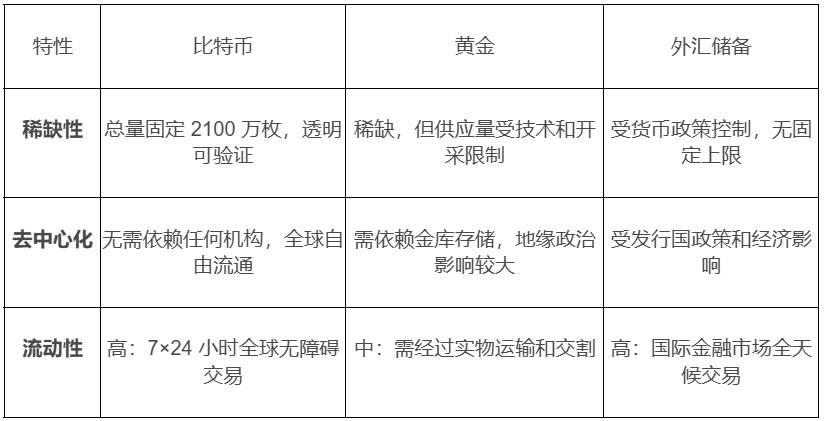
Moreover, physical gold transactions involve complex processes such as delivery, storage, and transportation, with settlement cycles lasting days or even weeks. Gold markets are also constrained by the time and geographic limitations of traditional finance. Bitcoin, however, enables 7×24-hour trading across global exchanges.
Beyond gold, foreign exchange reserves (such as euros or yen)—being fiat currencies issued by other nations—are subject to both the issuing country’s economic health and geopolitical risks. Bitcoin, by contrast, avoids monetary policy manipulation and excessive issuance-driven devaluation through its built-in scarcity. It allows any holder—individuals, institutions, or sovereign states—to freely store, transfer, and trade it worldwide.
This decentralized nature shields Bitcoin from political and economic interference, ensuring its value-preserving function remains stable even during global upheavals.

Corporations, Institutions, and Sovereign Nations Are Becoming BTC “Pixiu”
With a total market cap of $2 trillion, Bitcoin—with its advantages of non-physical storage, global liquidity, high transparency, and inflation resistance—is steadily rising as a potential reserve instrument. An increasing number of companies, institutions, and sovereign nations are exploring integrating Bitcoin into their strategic reserve portfolios.
The U.S. Government: One of the World’s Largest Bitcoin Holders
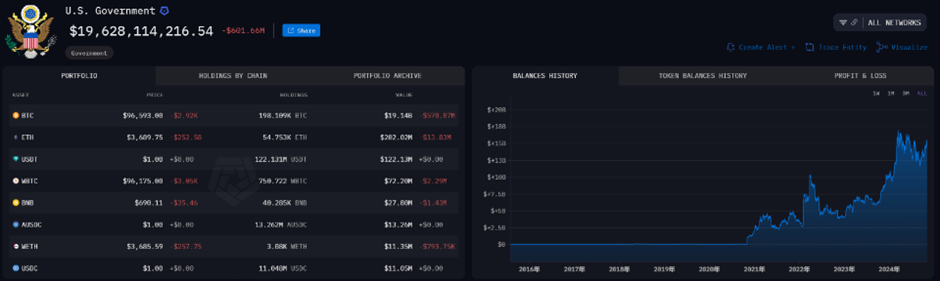
Surprisingly, the U.S. government is already one of the world’s largest Bitcoin holders. Over the years, through law enforcement actions, it has seized vast amounts of Bitcoin from cybercriminals, money laundering networks, and dark web markets. It currently holds approximately 200,000 BTC, valued at nearly $20 billion.
As the most crypto-supportive U.S. president in modern history (based on public statements), whether Trump will integrate Bitcoin into the federal reserve system over the next four years remains to be seen. However, it is foreseeable that the government’s Bitcoin holdings may shift away from frequent sales toward a strategy focused on long-term strategic value.
El Salvador: Buying 1 BTC Daily
El Salvador, the first country globally to adopt Bitcoin as legal tender, passed relevant legislation on September 7, 2021. It launched the Chivo wallet, depositing $30 worth of Bitcoin for every user who downloaded it, embedding Bitcoin into its national economy and demonstrating a firm “Bitcoinization” strategy.
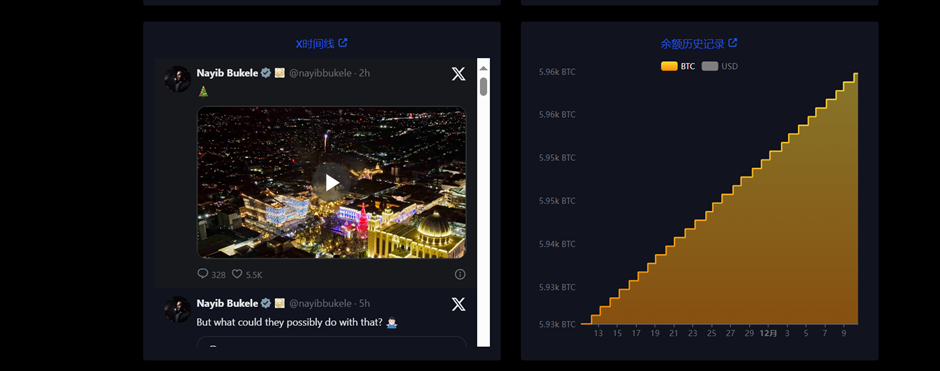
Whenever the crypto market experiences sharp volatility, President Nayib Bukele promptly announces new Bitcoin purchases via social media, boosting market confidence. Currently, El Salvador continues buying 1 BTC per day. Thanks to this consistent accumulation, by December 10, its BTC holdings reached 5,959.77 BTC, valued at approximately $577 million.
While this position is modest in global terms, for a small economy, its unwavering Bitcoin strategy carries strong symbolic significance, offering a unique experimental model for other nations.
MicroStrategy: All-In on Bitcoin
Beyond sovereign states, publicly traded company MicroStrategy stands as a benchmark in Bitcoin accumulation—its aggressive “buy, buy, buy” strategy is well known, and its holdings surpass those of any sovereign nation at the public level.
MicroStrategy’s first major Bitcoin purchase dates back to August 11, 2020, when it invested $250 million to acquire 21,454 BTC at an average price of around $11,652 per coin. Since then, it has continued accumulating. Its latest purchase occurred on December 9, investing approximately $2.1 billion to buy 21,550 BTC at an average price of $98,783 per coin.
As of December 8, 2024, MicroStrategy has cumulatively invested about $25.6 billion to acquire 423,650 BTC, at an average cost of $60,324 per BTC. At the current price of $97,000, its unrealized gains amount to approximately $15.5 billion.
Tesla: A Long-Term “Hodler” of Bitcoin
On December 20, 2020, shortly after MicroStrategy’s Michael Saylor urged other CEOs to follow suit, Elon Musk first expressed interest in buying Bitcoin. In late January 2021, he changed his Twitter bio to #Bitcoin, and Tesla announced in February 2021 that it had purchased $1.5 billion worth of Bitcoin.
In Q1 2021, Tesla sold 10% of its Bitcoin holdings. Musk explained this was to “test liquidity and verify Bitcoin’s feasibility as a cash equivalent on the balance sheet.”
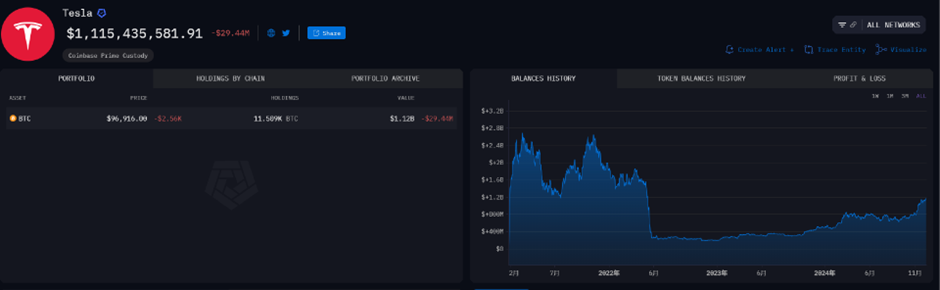
According to Arkham data, as of publication, Tesla holds 11,509 BTC, with a market value of approximately $1.1 billion.
Other Countries and Major Enterprises/Institutions: Bitcoin Reserves Going Mainstream
Bitcoin’s strategic value is expanding from the national level to enterprises and institutions. National-level initiatives shape policy environments, while corporations drive adoption. Bitcoin is no longer merely a safe-haven asset but a key strategic component of corporate balance sheets.
Recently, tech giants such as Microsoft and Amazon have received active investor proposals urging them to include Bitcoin on their balance sheets.
Michael Saylor, founder of MicroStrategy, has advised Microsoft’s board on Bitcoin investment, arguing it would significantly enhance enterprise value and generate long-term shareholder returns.
Meanwhile, the conservative think tank Center for National Policy recommends Amazon allocate 1% of its total assets to Bitcoin to boost shareholder value and hedge against fiat currency depreciation.
Incorporating Bitcoin onto corporate balance sheets offers several advantages:
-
Inflation Resistance: Bitcoin’s hard cap of 21 million coins grants it strong inflation-resistant properties, helping companies preserve asset value amid global monetary easing;
-
Portfolio Diversification: As a new asset class, Bitcoin enriches corporate asset allocation, reduces dependence on single assets, and enhances financial resilience;
-
Enhanced Brand Image and Market Position: Holding Bitcoin signals a company’s embrace of innovative technologies and future economic models, strengthening competitiveness and projecting a forward-thinking brand identity;
However, when adding BTC to their balance sheets, companies must address two critical challenges: securely custodizing large holdings and efficiently executing OTC (over-the-counter) trades to avoid market impact. These needs have driven rapid growth in professional custody and OTC services tailored to meet institutional requirements for digital asset management.
Notably, as the market evolves, the digital asset service ecosystem continues to mature. In custody, many platforms now employ isolated wallet designs and bankruptcy remoteness mechanisms, along with insurance coverage against various risks. For example, Hong Kong-licensed exchange OSL has partnered with insurers like Canopius to extend protection to cybersecurity breaches, technical failures, and other threats. On the OTC front, licensed compliant platforms are leveraging integration with traditional banking systems to provide institutional investors with more standardized and efficient trading environments.
Bitcoin in the Next Decade: Speculative Asset or Global Strategic Reserve?
Bitcoin has evolved from a fringe asset into a rising star among global strategic reserves. From sovereign nations to mainstream institutions and traditional enterprises, more and more players are redefining its role. Its scarcity, decentralization, and high transparency have earned it the nickname “digital gold.”
Despite ongoing debates about price volatility, Bitcoin’s adoption is advancing irresistibly. If Trump’s vision of a “strategic reserve asset” becomes reality, Bitcoin could rival—or even surpass—gold in strategic importance:
While gold possesses physical scarcity, its distribution and trading rely on complex logistics and regulatory frameworks. Bitcoin, powered by blockchain technology, eliminates the need for physical storage and transportation, enabling borderless, instant transfers—making it better suited as a national or institutional reserve asset capable of fulfilling broader strategic roles. This advantage is also driving professional service providers like OSL to continuously improve infrastructure, offering institutional clients end-to-end solutions from custody to trading.
Over the next decade, Bitcoin’s potential as a global strategic reserve asset will be fully realized, with applications expanding further. From national-level “long-term hodling” to corporate “buy-and-hold” strategies, Bitcoin’s influence continues to grow. Global leaders and industry giants like MicroStrategy, Microsoft, and Amazon have become its strongest advocates, greatly enhancing global recognition of cryptocurrencies.
“The boat has already sailed past countless mountains.” Whether or not Bitcoin becomes a strategic reserve asset for the U.S. or others in the next four years, it has already secured a crucial victory in the journey of adoption. As more institutions embrace Bitcoin, the development of professional digital asset financial infrastructure will play an increasingly vital role in the years ahead.
Join TechFlow official community to stay tuned
Telegram:https://t.me/TechFlowDaily
X (Twitter):https://x.com/TechFlowPost
X (Twitter) EN:https://x.com/BlockFlow_News
 PANews






