New Transformation in the Global Financial Order: U.S. Strategic Bitcoin Reserves
TechFlow Selected TechFlow Selected
New Transformation in the Global Financial Order: U.S. Strategic Bitcoin Reserves
Overall, Trump's strategic Bitcoin reserve EO is definitely positive for the long term.
 Navigating Web3 tides with focused insights
Author: 0xCousin
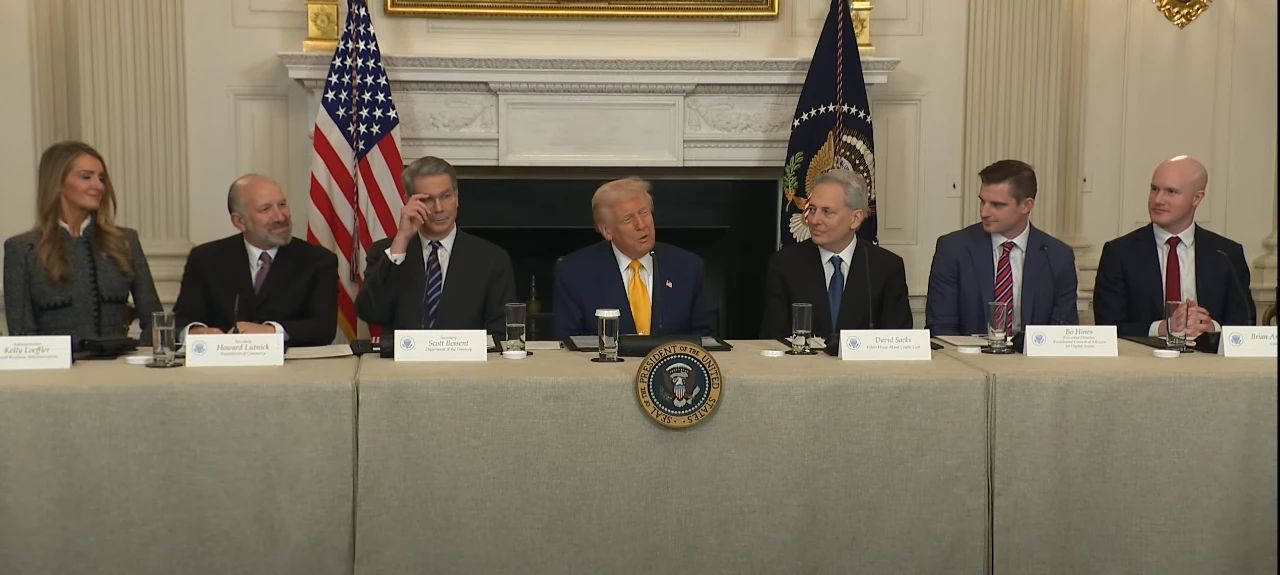
On March 6, 2025, U.S. President Trump signed an executive order titled "Establishing a Strategic Bitcoin Reserve and American Digital Assets Reserve." The next day, the White House hosted a crypto summit.
This marks another major milestone for the cryptocurrency industry.
Bitcoin Goes Mainstream: A New Chapter in America’s Strategic Reserves
Let’s examine this move from the perspective of the U.S. government. The purpose of establishing a strategic Bitcoin reserve is to strengthen and consolidate America’s dominant position in the global financial system.
The executive order makes it clear: “The U.S. government currently holds a significant amount of BTC, but has not yet developed policies to harness its strategic value within the global financial system. Just as managing national ownership and control over other resources serves the national interest, we must leverage—not restrict—the potential of digital assets to promote national prosperity.”
The United States has a history of creating strategic reserves. For example:
Strategic Gold Reserves—In the 19th century, the U.S. adopted the gold standard, with the dollar’s value backed by gold reserves. In 1933, President Roosevelt issued Executive Order 6102, banning private ownership of gold and mandating its seizure into Federal Reserve banks. In 1934, the U.S. passed the Gold Reserve Act, transferring gold holdings to the Treasury Department. In 1944, through the Bretton Woods Agreement, the U.S. committed to exchange gold at $35 per ounce, making the dollar the world's primary reserve currency. This system lasted until 1971, when President Nixon ended the dollar’s convertibility into gold, effectively collapsing the Bretton Woods system and ending the gold standard.
Strategic Petroleum Reserve (SPR)—In 1974, the U.S. reached an agreement with Saudi Arabia and OPEC nations that oil trade must be conducted in U.S. dollars, cementing the dollar’s role as the global foreign exchange reserve. In 1975, Congress passed the Energy Policy and Conservation Act, establishing the SPR. At its peak, the SPR held nearly 700 million barrels; by 2024, reserves had declined to 350 million barrels. On June 9, 2024, the U.S.-Saudi petrodollar agreement officially expired, and Saudi Arabia announced it would not renew the deal.
There are also less impactful strategic reserves, such as uranium, rare earth elements, silver, and grain.
Less than a year after the end of the petrodollar era, the U.S. is now establishing a strategic Bitcoin reserve.This indicates that the consensus around Bitcoin as “digital gold” has become very strong.
Strategic Rationale Behind the U.S. Strategic Bitcoin Reserve
1. Consolidating Dollar Financial Hegemony
For decades, the U.S. dollar has dominated the global financial system as the primary currency for international trade and financial transactions. However, shifts in the global economic landscape, the rise of emerging economies, and changing geopolitical dynamics have increasingly challenged the dollar’s supremacy.
Bitcoin, as a decentralized digital currency, offers unique advantages in global circulation—its transactions bypass traditional financial institutions and government controls, enabling fast, borderless transfers unaffected by geopolitical barriers.
By strengthening the link between the dollar and Bitcoin/crypto, and by taking the lead in establishing a Bitcoin strategic reserve, the U.S. can secure a dominant position in the crypto space, integrate the crypto market into the dollar-based settlement system, and thus reinforce the dollar’s central role in global finance. This would represent a powerful reaffirmation of U.S. financial hegemony in the new financial era.
As Trump stated during the White House Crypto Summit, establishing a Bitcoin reserve is equivalent to building a “virtual Fort Knox” (Fort Knox being the U.S. facility that stores national gold reserves). He also noted that congressional lawmakers are advancing legislation on dollar-backed stablecoins and clearer regulation of digital asset markets, and he willensure the long-term stability of the dollar’s status.
The die is cast, the momentum set. While this may be the first time such intentions have been publicly declared at the highest level of policy design, American companies have already secured key positions in the crypto sector: in asset issuance—though concerns remain about the inability of RWA tokenization to achieve trustlessness, Franklin Templeton has emerged as the largest traditional financial institution issuing U.S. Treasury RWAs; in asset securitization—the spot Bitcoin ETFs led by traditional firms like BlackRock have surpassed $100 billion in total assets under management; in asset trading and custody—Coinbase, a Nasdaq-listed company, serves as the primary custodian for these ETFs.
What’s still missing is a clear regulatory framework to shield the crypto industry from arbitrary crackdowns like those seen under the Biden administration, and from overlapping, uncoordinated, and ambiguous oversight by multiple government agencies.
2. A Tool Against Inflation
Theoretically, establishing a strategic Bitcoin reserve could help hedge against inflation to some extent.
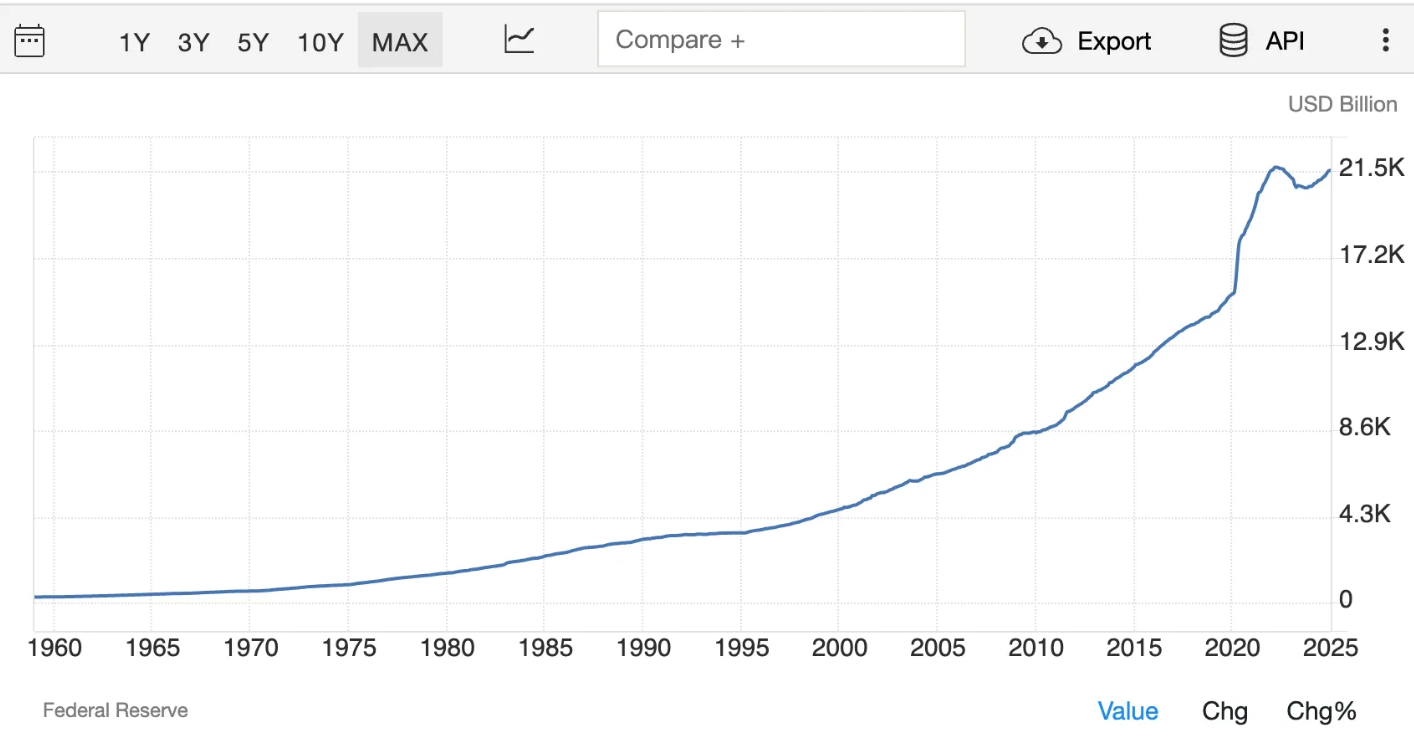
According to World Bank data, the U.S. M2 money supply since 1960 is shown in the chart below:
U.S. national debt over time:
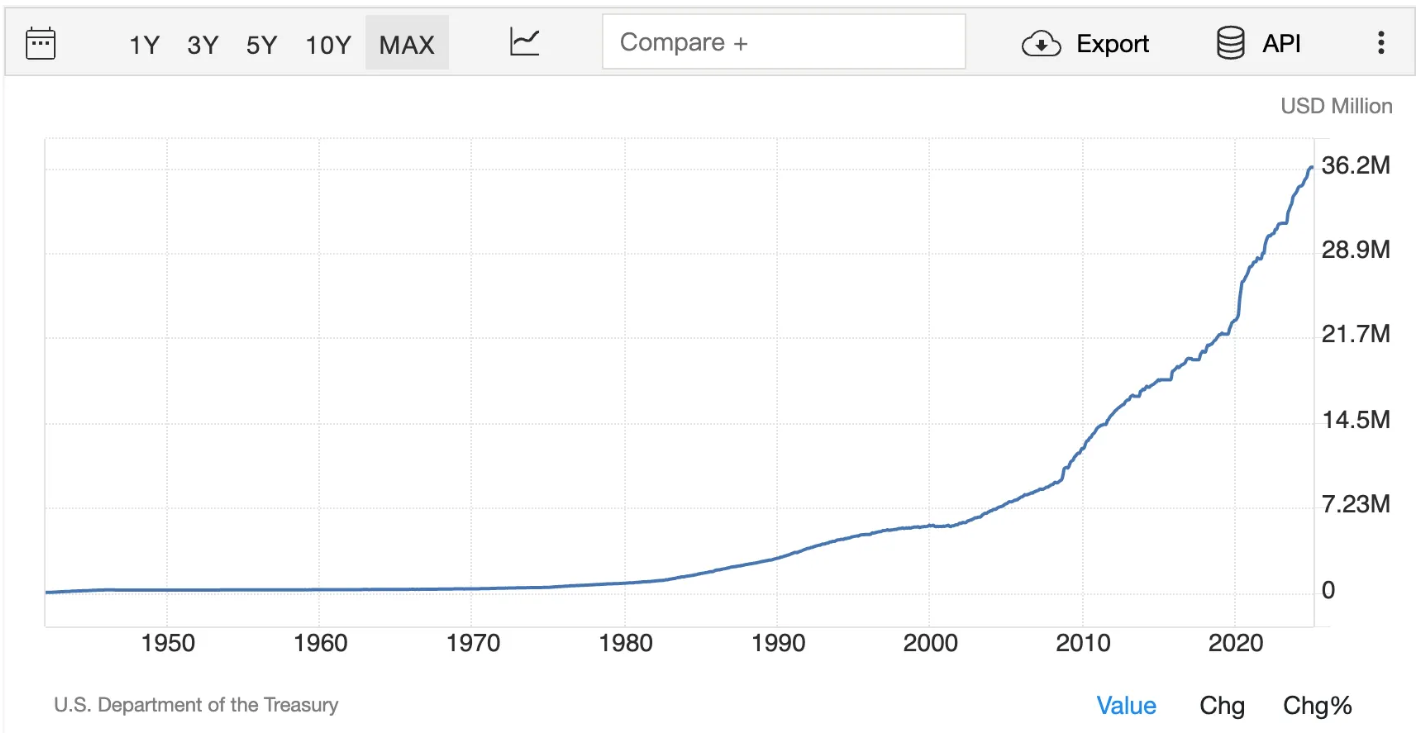
The total U.S. federal government debt has exceeded $36 trillion, reaching a record high. Moreover, the ratio of federal debt to GDP has continued to rise in recent years, reflecting that debt growth outpaces economic growth. Due to the expanding debt burden and current high interest rates, U.S. federal interest payments reached approximately $882 billion in 2024—a significant fiscal strain.
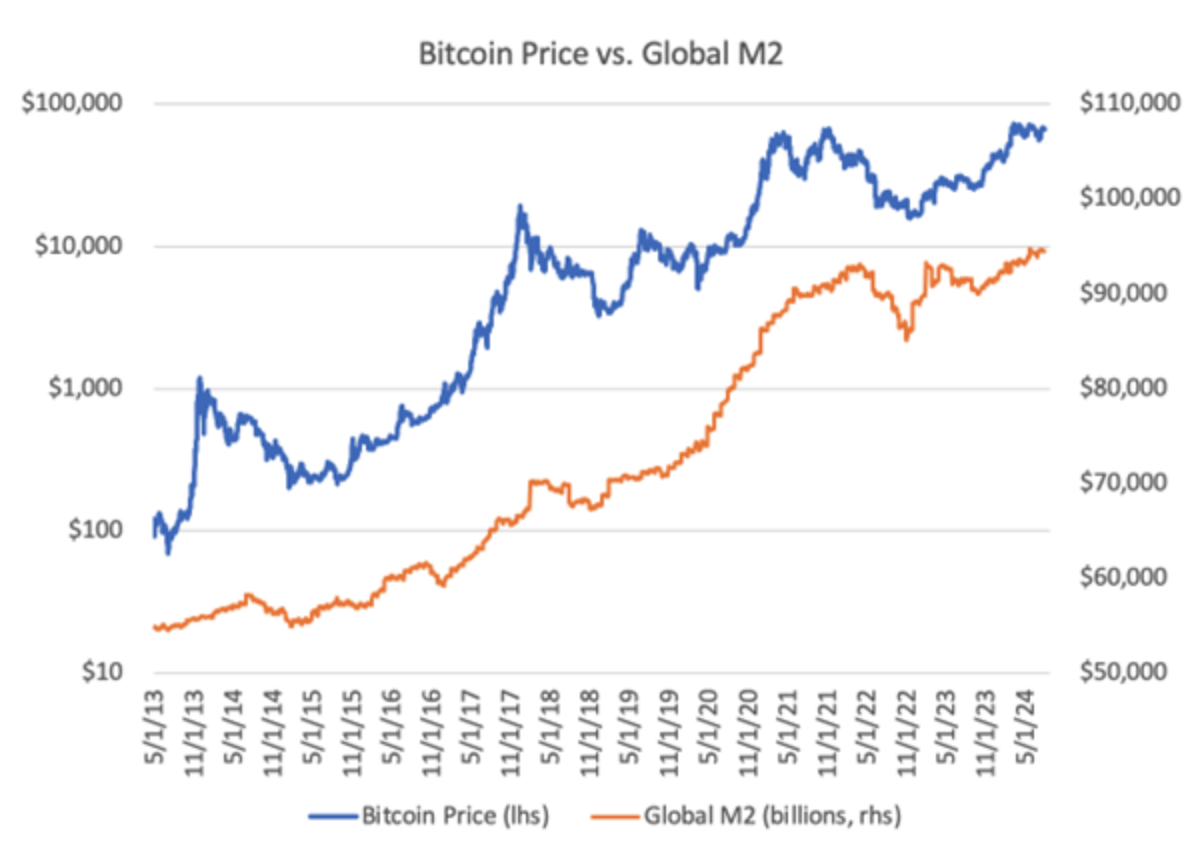
Bitcoin, as “digital gold,” may serve as a potential tool to combat inflation and address national debt issues. Governments worldwide often print more money to stimulate the economy, leading to currency devaluation and inflation. With its fixed supply cap, Bitcoin is widely viewed as an ideal asset for hedging against inflation.
Motivations behind the U.S. government’s decision to establish a strategic Bitcoin reserve are multifaceted. Beyond consolidating dollar dominance and fighting inflation, there are additional drivers: from the standpoint of financial innovation, Bitcoin and blockchain technology offer new opportunities for the financial sector; from global financial competition, as noted in the executive order, “the nation that establishes a strategic Bitcoin reserve first will gain a strategic advantage”; and from the perspective of domestic political interests, Trump is fulfilling a campaign promise, and the influence of the crypto-related interest groups within this Trump administration has significantly increased, shaping government decisions.
Profound Impacts on the Crypto Market
Trump’s executive order falls short of market expectations
The executive order includes several key provisions:
1. The Secretary of the Treasury shall establish an office responsible for managing and controlling the custodial account of the “Strategic Bitcoin Reserve” (SBR), funded by BTC seized by the Treasury in criminal or civil cases. BTC deposited into the SBR shall not be sold.
2. The Treasury shall establish another office to manage and control the custodial account of the “United States Digital Assets Reserve,” funded by all digital assets held by the Treasury other than BTC. The Treasury shall develop a strategy for the responsible management of this reserve (no prohibition on selling).
3. The Secretary of the Treasury and the Secretary of Commerce shall devise strategies to acquire additional government BTC without increasing the budget or imposing additional costs on U.S. taxpayers. (“Figure it out yourselves...”)
The U.S. government currently holds approximately 200,000 BTC, seized through criminal and civil proceedings. Trump directed the Treasury and Commerce secretaries to create a plan to “increase Bitcoin reserve holdings without costing taxpayers anything.”
The approach outlined in this executive order falls short of market expectations, mainly because the community had been excited by another federal-level bill—Senator Cynthia Lummis’s proposed “Bitcoin Act,” which called for the U.S. Treasury to purchase 1 million BTC within five years and hold them for 20 years—but this proposal has been rejected.
Federal-level crypto-related bills currently under consideration have neutral market impact
In the U.S., there is a distinction between presidential executive orders (EO) and congressional legislation (Congressional Legislation). Unfortunately, no major federal-level Bitcoin-related bills have successfully passed into law recently. Currently, three crypto-related bills are progressing at the federal level:
-
H.R.148: Keep Your Coins Act of 2025
-
S394: GENIUS Act of 2025
-
HRes111: Expressing support for blockchain technology and digital assets.
Among these, HRes111 is largely symbolic with little substance and is likely to fail. The Keep Your Coins Act (H.R.148) aims to protect individuals’ rights to self-custody their crypto assets. The GENIUS (Guiding and Establishing National Innovation in U.S. Stablecoins) Act is a regulatory framework for dollar-backed stablecoins, setting licensing and reserve requirements for issuers.
Trump indicated at the White House crypto summit that he hopes the dollar stablecoin innovation bill (GENIUS Act) will reach his desk for signature before the August recess. However, the community has limited enthusiasm for this bill, as it lacks clear tangible benefits.
State-level Strategic Bitcoin Reserve bills may offer more promise
Beyond federal legislation, several state governments are actively pushing forward legislative efforts on Strategic Bitcoin Reserve Acts, including Arizona, Texas, New Hampshire, and Oklahoma. Five states—including Montana, North Dakota, South Dakota, Pennsylvania, and Wyoming—have already rejected such proposals.
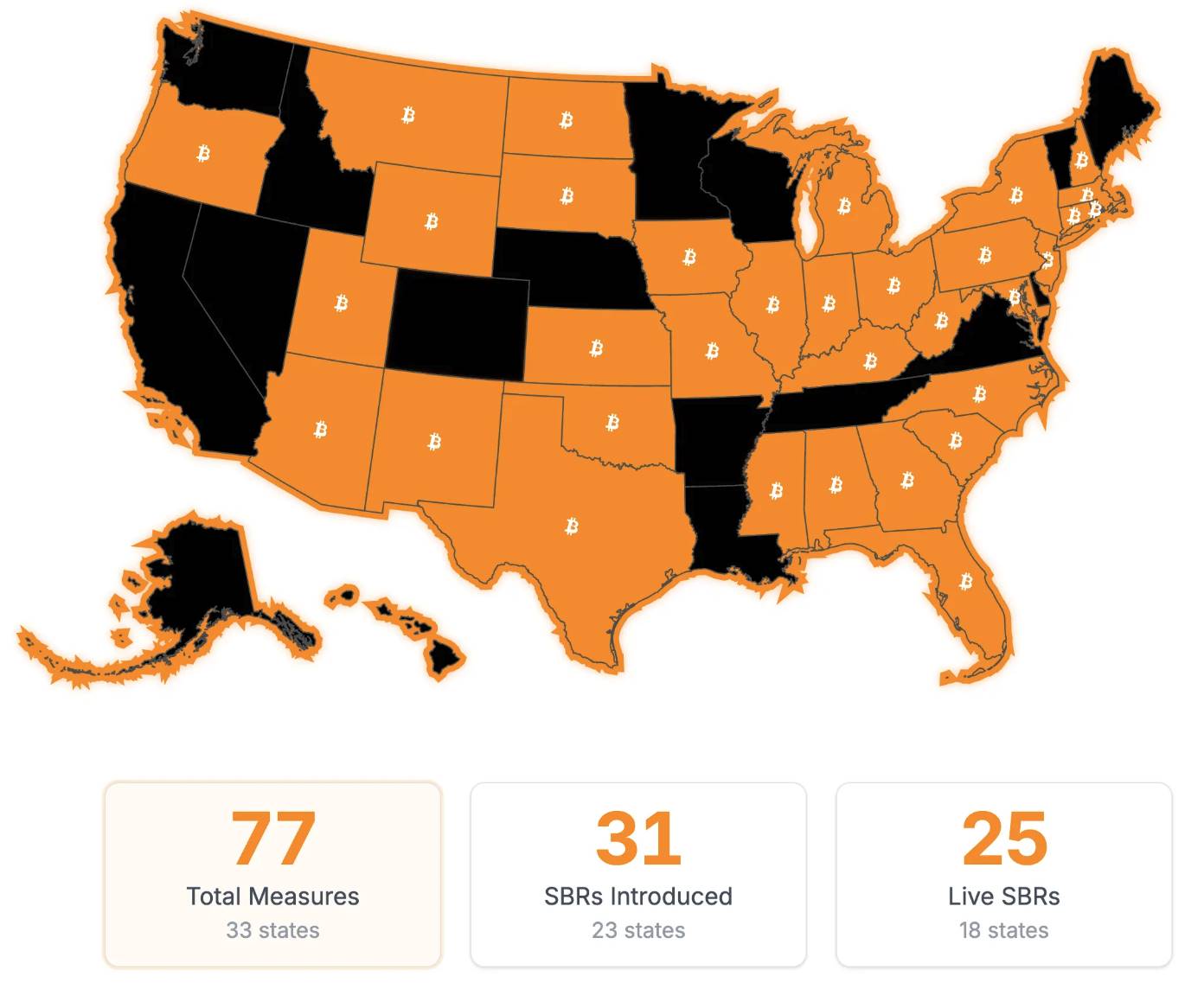
The legislative process for a Strategic Bitcoin Reserve Act at the state level generally involves: drafting and submission by a state legislator or committee to the state legislature; followed by votes in both the state House and Senate; and finally, if passed by both chambers, submission to the governor for signature.
The image below shows the ongoing legislative process for the Strategic Bitcoin Reserve Act in Arizona:
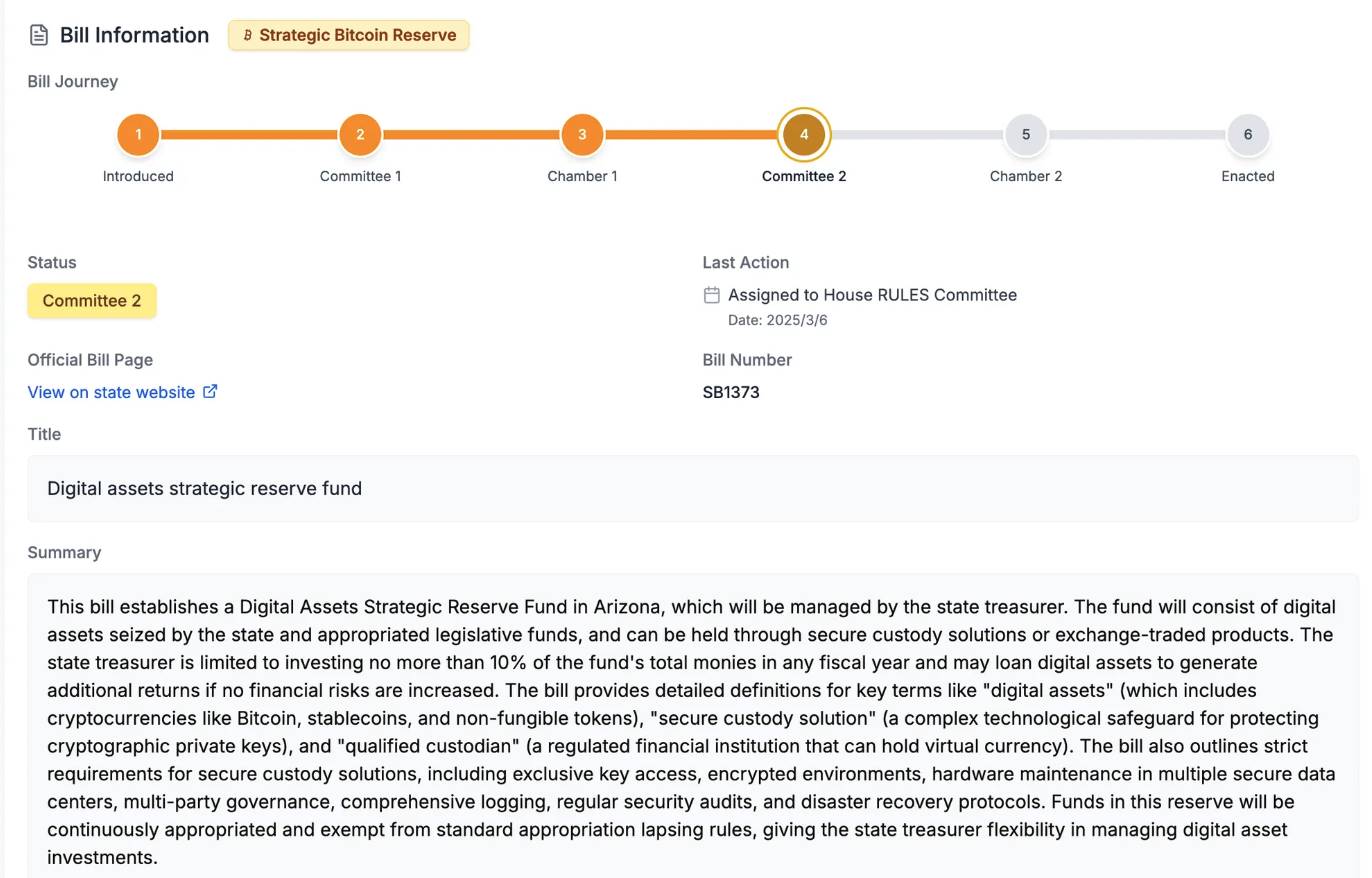
The content of each state’s Strategic Bitcoin Reserve Act varies. For example, Oklahoma proposes allowing the state government to invest up to 10% of public funds in Bitcoin or any digital asset with a market capitalization exceeding $500 billion; Kentucky proposes investing up to 10% of surplus cash in cryptocurrencies with a market cap above $750 billion and regulated stablecoins.
Overall, Trump’s Strategic Bitcoin Reserve EO (Executive Order) is undoubtedly a long-term positive.
Policy-wise, as long as the executive order remains stable and unchanged, the regulatory environment will remain favorable for at least the next few years.
Funding-wise, while there is no federal plan to acquire a million BTC, successful state-level proposals could bring real capital investment.
Market supply-demand dynamics: On the supply side, BTC seized by the U.S. government and deposited into the Strategic Bitcoin Reserve cannot be sold, reducing sell-side pressure in the market;
On the demand side, the U.S. government’s decision to establish a strategic Bitcoin reserve may spark greater investor interest in Bitcoin, including from traditional financial institutions and large corporations. This could alleviate concerns about entering the crypto space and might even inspire other nations to establish their own strategic Bitcoin reserves.
Conclusion
In the words of Michael Saylor: History will remember the moment the U.S. established its Strategic Bitcoin Reserve—as a turning point in the financial and geopolitical landscape of the 21st century.
Join TechFlow official community to stay tuned
Telegram:https://t.me/TechFlowDaily
X (Twitter):https://x.com/TechFlowPost
X (Twitter) EN:https://x.com/BlockFlow_News
 @iobc_capital