








BTC Strategic Reserves and Artificial Intelligence Fill the Halving Gap
TechFlow Selected TechFlow Selected
BTC Strategic Reserves and Artificial Intelligence Fill the Halving Gap
Most miners who have shifted to artificial intelligence are still mining Bitcoin.
 Navigating Web3 tides with focused insights
Author: Prathik Desai
Translation: Block unicorn
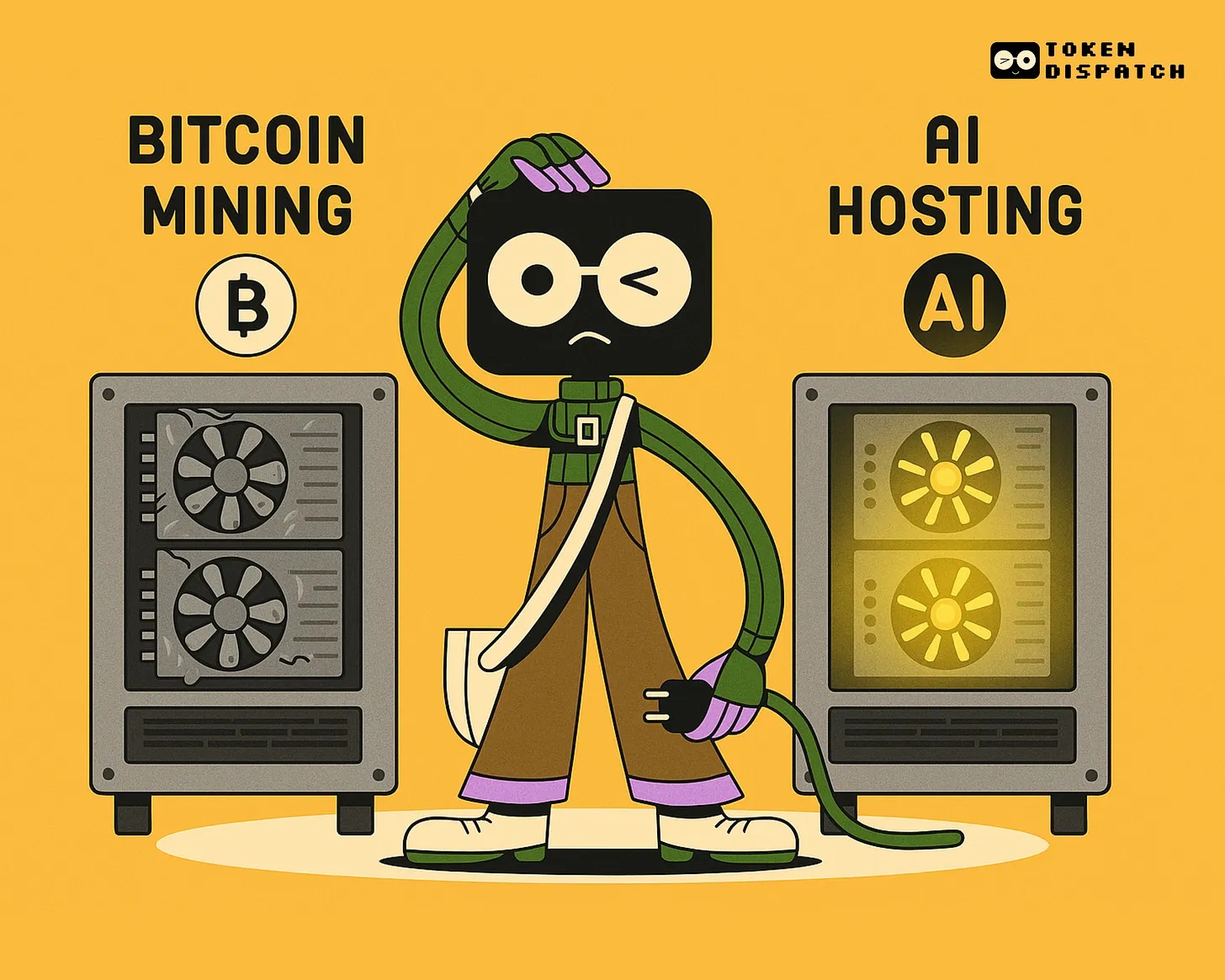
In April 2024, Bitcoin's fourth halving quietly reset the rules of the game for miners. Block rewards dropped from 6.25 BTC to 3.125 BTC per block. Initially, the market took little notice—prices barely fluctuated. But for miners already operating on thin margins, the math became significantly harder overnight.
It meant they had to exert the same effort for half the reward.
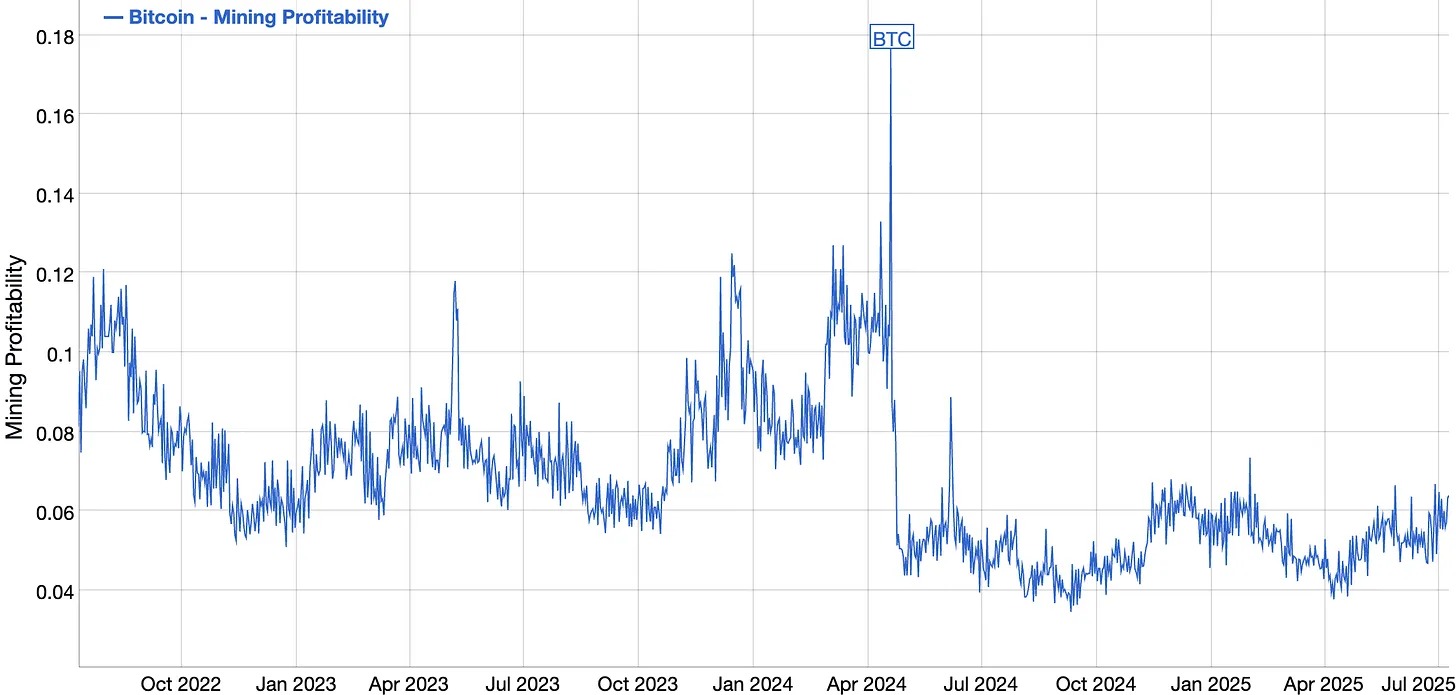
Maintaining the old model meant covering energy costs and upgrading equipment. Some tried, but most saw their revenues shrink. Mining profitability fell from an average of about $0.08 per day (per terahash/second) to $0.055 per day (per terahash/second).
Everyone knew the halving was coming. Most prepared for business transformation by ceasing to sell the Bitcoin they mined. With unchanged costs and lower income, profit margins shrank. Instead, they began accumulating Bitcoin, betting on its long-term appreciation.
They didn’t stop there. Michael Saylor’s Strategy (then MicroStrategy) had already set a precedent with its aggressive Bitcoin accumulation strategy.
Marathon Digital, already the largest miner by treasury size, has added over 30,000 BTC to its balance sheet in just over a year since the halving. The company mined at least 8,900 BTC and purchased over 21,000 BTC on the open market.
Riot held every satoshi it mined (approximately 5,000 BTC) during the 12 months following the halving and bought another 5,000+ BTC during that period. Even Hut 8, which produces relatively fewer coins, has added over 1,000 BTC since the halving, selling almost none of its accumulated holdings.
Hive recovered from the wave of Ethereum’s shift to proof-of-stake (PoS), growing its Bitcoin reserves by more than 25% since the halving before selling part of its stash to fund expansion. Core Scientific, once bankrupt with empty wallets, has acquired over 900 BTC since the halving—700 of them in a single quarter—an extraordinary shift for a miner that previously sold every coin just to survive.
These are not normal operations for Bitcoin miners—they are desperate attempts to evolve.
One thing is clear: hoarding Bitcoin is no longer a temporary measure. It signals confidence in Bitcoin’s price appreciation, but it also reveals something else.
Building a Bitcoin treasury helps support long-term price growth. But asset appreciation doesn’t equal revenue—it can’t pay day-to-day operational expenses.
After the halving, margins tightened further. The cost of mining Bitcoin became higher than ever. Many realized the old model—mine, sell, repeat—was no longer sustainable. Some miners discovered they already had the foundation to pivot: facilities built for high-power machines. They began repurposing their infrastructure for AI computing.
Core Scientific made the first high-profile move. In June 2024, it signed a 12-year, $3.5 billion GPU infrastructure hosting agreement with AI cloud provider CoreWeave. One of the largest AI hosting deals ever, this contract gave Core a long-term revenue stream largely independent of Bitcoin prices—and sparked a quiet race across the mining sector.
Riot followed a similar path. In January 2025, Riot paused expansion of its 600-megawatt Bitcoin mine in Corsicana and began marketing the site to hyperscale data centers and AI firms. The company shifted focus from increasing hashpower to securing AI tenants. Designed for massive scale, the Corsicana facility has access to 1 gigawatt of power and vast land. Riot now sees greater value in leasing the space to AI operators rather than installing more ASICs.
Hut 8 took a different route. It spun off its entire mining division into a separate entity called American Bitcoin, retaining 80% ownership. This allowed the parent company to focus on data center infrastructure and AI services. In September 2024, Hut 8 launched Highrise, its GPU-as-a-service arm, starting with a thousand Nvidia H100s under a five-year contract with a cloud client. Earlier this year, it announced plans for a 300-megawatt high-performance computing campus in Louisiana.
Hive leveraged its legacy from years of GPU mining prior to Ethereum’s merge. It repurposed over 4,000 older GPUs for cloud computing and later deployed H100 and H200 clusters in Quebec. By early 2025, Hive’s AI business reached a $20 million annualized revenue run rate, aiming for $100 million the following year. It sold some Bitcoin in 2024 but retained most of what it mined that year.
Even Marathon, one of Bitcoin’s staunchest advocates, adjusted course. In September 2024, it appointed two AI industry veterans to its board. The company developed immersion-cooling systems specifically designed for AI inference workloads. In early 2025, it began exploring data center colocation services for AI clients. As of May 2025, the company held over 49,000 BTC and had sold almost none of its post-halving mining output.
Iris Energy went all-in on AI. It sold all its mined Bitcoin to aggressively expand its data centers. By mid-2025, it had deployed over 4,000 GPUs and was building facilities in Texas and British Columbia capable of supporting up to 20,000 GPUs. Though still cash-strapped, its infrastructure is rapidly advancing.
Some miners view Bitcoin as a strategic reserve. Others see it as liquid inventory to fund growth. Either way, they’re attempting to extend the same assets—cheap land, stranded energy, grid access, and specialized cooling systems—into areas far more valuable than mining alone.
Mining alone is no longer enough to ensure survival.
Electricity prices haven’t changed. Hashrate continues to climb. The miners surviving today are those adding optionality—some becoming service providers, others cloud computing vendors, many still experimenting to find their path.
Currently, most miners still mine Bitcoin. But that’s no longer their entire business. It’s now just one of several revenue streams, potentially joined by AI hosting, GPU leasing, energy brokerage, or even sovereign-scale computing infrastructure.
It’s too early to judge whether the pivot to AI will succeed—the data is still too limited. While high-performance computing (HPC) hasn’t scaled across the board yet, the per-megawatt margins in AI computing are significantly higher than mining, offering a crucial advantage.
For some, signs of progress are already visible.
Iris Energy’s AI services revenue grew from negligible to $2.2 million by June 2025. That relatively new segment achieved a profit-to-revenue ratio of 98%, compared to 75% for its mining operations.
Yet this isn’t a foolproof strategy. Building AI infrastructure is expensive. It requires more than just power—networking, redundancy, cooling, and a steady pipeline of customers to fill racks. Not every miner will succeed. Some will overbuild, some will miss market turns, and some will remain entirely dependent on Bitcoin years from now.
The industry is no longer monolithic.
They started by stacking blocks. Then they began stacking Bitcoin. Now, they’re stacking GPUs. Yet Bitcoin mining hasn’t stopped.
Most miners who pivoted to AI are still mining Bitcoin.
Last month, Bitcoin’s hashrate hit an all-time high, far surpassing levels at the time of the halving. This indicates rising mining difficulty and cost, as miners must deploy more computational resources to solve blocks and earn rewards.
Under these conditions, it becomes economically unviable for enterprises to sell mined Bitcoin at low margins. Unless Bitcoin’s price rises substantially or transaction fees spike, only the most efficient operations will remain profitable.
Improving efficiency may mean lowering power and compute costs. It might even mean holding Bitcoin and only selling when prices are well above post-halving averages. This explains why most miners are turning to AI—to achieve better returns on investment.
Join TechFlow official community to stay tuned
Telegram:https://t.me/TechFlowDaily
X (Twitter):https://x.com/TechFlowPost
X (Twitter) EN:https://x.com/BlockFlow_News


