








Strategic Reserves and Power Plays: The Crypto Order in the Trump Era (Continued)
TechFlow Selected TechFlow Selected
Strategic Reserves and Power Plays: The Crypto Order in the Trump Era (Continued)
Value should be code pulsing on the blockchain, not a signature line on a White House executive order.
 Navigating Web3 tides with focused insights
Author: Zeke, Researcher at YBB Capital
Preface
On March 6, local U.S. time, President Donald Trump signed an executive order formally establishing a U.S. Strategic Bitcoin Reserve. Subsequently, David Sacks, the White House's cryptocurrency policy chief, clarified details on social media platform X: approximately 200,000 bitcoins currently held by the federal government—acquired exclusively through criminal or civil forfeiture procedures—will be fully allocated to this strategic reserve. He explicitly stated that these assets will be “neither sold nor replenished via market purchases.”
In my previous article published on March 4, I speculated about potential developments regarding the strategic reserve. Interestingly, current events have largely aligned with those predictions. Trump did not include altcoins such as SOL and XRP in the reserve as previously suggested, nor has he injected new fiscal funds into the BTC reserve. Instead, only the existing seized bitcoins were transferred into the reserve. What surprised me, however, was how swiftly this policy was implemented—Trump didn’t hold onto this "trump card" for long. With its swift deployment, market speculation about government-driven bitcoin buying vanished overnight, leading BTC to correct down to around $77,000. Now, from any perspective, it seems Trump has few remaining cards to play. But one must ask: can the strategic vision of this so-called "Crypto President," who has navigated both business and politics for decades, truly be so limited?
I. Gold, Oil, or BTC?
The collapse of Bretton Woods, cracks in petrodollar dominance, and the rise of Bitcoin—each shift reflects the dollar’s adaptive evolution through changing anchors across eras.
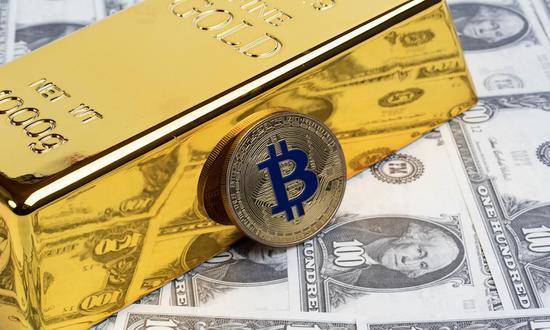
The 1944 Bretton Woods Agreement established the dollar as the global monetary system’s ultimate anchor, pegged to gold at $35 per ounce. This arrangement relied on a core logic: physical scarcity of gold underpinned dollar credibility, while the dollar’s network effects amplified gold’s liquidity. However, the Triffin Dilemma exposed a fatal flaw—the expansion of global trade required dollar outflows (U.S. deficits), yet maintaining dollar confidence depended on U.S. surpluses and sufficient gold reserves. In 1971, Nixon severed the dollar’s link to gold, freeing American hegemony from the constraints of gold. History proved that any monetary system rigidly tied to tangible resources ultimately collapses due to the irreconcilable conflict between resource scarcity and economic growth. The end of the gold-backed dollar forced the U.S. to seek a more flexible foundation.
The 1973 oil crisis offered Nixon a solution. Oil’s critical role in modern industry was undeniable. A year later, under Nixon’s directive, newly appointed Treasury Secretary William Simon and his deputy Gerry Parsky rushed to Saudi Arabia, the world’s largest oil producer. They struck the "Undeniable Agreement": the U.S. pledged comprehensive military protection and security guarantees; in return, Saudi Arabia agreed to price all oil exports in dollars and reinvest surplus petrodollars into U.S. Treasury bonds. By exchanging military backing for acceptance of the dollar as the sole pricing currency for oil transactions among oil-producing nations, the U.S. ushered in Version 2.0—the petrodollar replaced gold as the new anchor of dollar credibility. The petrodollar system formed a closed loop: "oil trade → dollar recycling → treasury purchases." Wall Street then packaged these recycled petrodollars into derivatives (reaching $610 trillion in 2023), diluting credit risk through "debt monetization."

The essence of this cycle is America collecting global "seigniorage" via oil trade. Yet today, with U.S. fiscal deficits soaring (7% of GDP) and national debt surpassing $36 trillion, the entire system has devolved into a Ponzi-like cycle of rolling over old debts with new ones. As de-dollarization in oil trading expands, this loop risks unraveling from anchor erosion. So what comes next? Who will fill the void left by oil over the coming half-century?
Trump now holds two powerful tools: Nvidia and Bitcoin. Within the high-end AI narrative, Nvidia plays a role akin to the "digital Middle East"—everyone needs computing power, but only we can supply it. Unfortunately, a certain Eastern nation has demonstrated that AI compute demand can also follow a decentralized, small-scale model. At least before the full arrival of the AI Agent era, equating computing power with digital oil remains premature. (Or put differently, some countries may achieve energy self-sufficiency.)
Now consider the second tool: Bitcoin. The idea of adopting Bitcoin as a strategic reserve originated with Senator Lummis’ bill introduced last year to Congress. Her argument centered on the declining purchasing power of the dollar contrasted against Bitcoin’s average annual growth rate of 55%, positioning it as an inflation-resistant store of value potentially replacing gold. Trump himself once said: “Give them a little crypto check. Give them some Bitcoin, and erase our $35 trillion.” Whether anchoring the dollar or repaying national debt, I’ve consistently opposed such notions in past writings. First, as noted above, the failure of Bretton Woods teaches us that Bitcoin—with its hard cap of 21 million coins—is even scarcer than gold. The U.S. cannot afford to repeat the Triffin Dilemma. Second, volatility and insufficient reserves render it impractical: the current 200,000 BTC holding is valued below $20 billion—just 0.056% of U.S. debt. To effectively anchor the dollar would require owning at least 30% of Bitcoin’s circulating supply (~6 million BTC), or artificially inflating its price dozens of times over while ensuring long-term stability—both highly unrealistic. Third, pegging the dollar to Bitcoin would clearly accelerate dollar marginalization. How could Bitcoin generate a global tax base? That remains an open question.
Given how the strategic reserve has unfolded so far, the Trump administration clearly lacks better short-term entry points. But playing this card so quickly compels me to reconsider: do they hold a bigger hand?
Building upon speculations from my prior article:
1. Bitcoin’s scarcity does not imply all cryptocurrencies are scarce—many public chain tokens feature deflationary mechanisms. Today, the dollar rests on oil beneath and gold above. Could the "Digital Fort Knox" consist of a hybrid composition—BTC as gold, ETH or SOL as oil? As large-scale adoption of an "encryption capital" advances, could an American-style crypto loop emerge? Projects like Usual and Tether, along with multiple stablecoin initiatives, continue promoting dollar-based settlements, with their structural mechanics or profit sources deeply linked to U.S. Treasuries. Isn't there a faint resemblance to the petrodollar system?
2. A no-buy, no-sell stance makes sense for now—but if that’s the full extent of the strategy, why announce it so early? Trump isn’t naive, nor is his crypto team. Rumors now swirl within the industry that a U.S. sovereign fund (still in proposal stage) will purchase cryptocurrencies. Personally, I believe this sovereign fund is actually his ace card.
3. Previously, I thought narrowly—that Trump merely offered empty promises to crypto interests for political gain. But looking at present trends, we should think bigger. It may only be a matter of time before other major nations follow suit with strategic reserves. Among them, BTC will likely be most readily accepted, while SOL—and possibly even XRP—may surpass ETH in status as adoption grows.
4. The largest unit in the crypto struggle is no longer individual blockchains. Trump has recently shown clear intent to consolidate dominant CEXs, major public chains, and various giant projects. But how exactly will consolidation occur? And how will resisters fight back?
5. Wall Street widely believes Trump is engineering an artificial recession to pressure the Fed into cutting rates. Just as markets begin recovering, another blow arrives—from Trump and Musk (Department of Government Efficiency). Is Trump also deliberately suppressing the crypto market, turning top-tier expectations into illusions? On this point, I’m less convinced. First, the AI bubble in U.S. equities is real—not comparable to the 2000 dot-com bubble, but undoubtedly overheated. Second, the Trump-Musk duo’s aggressive moves inevitably provoke backlash, making leftist counterattacks inevitable. The so-called recession is thus a collective outcome.
For points 1, 3, and 5, I can only offer speculative extrapolation. But for points 2 and 4, I believe further elaboration is possible.
II. Sovereign Fund
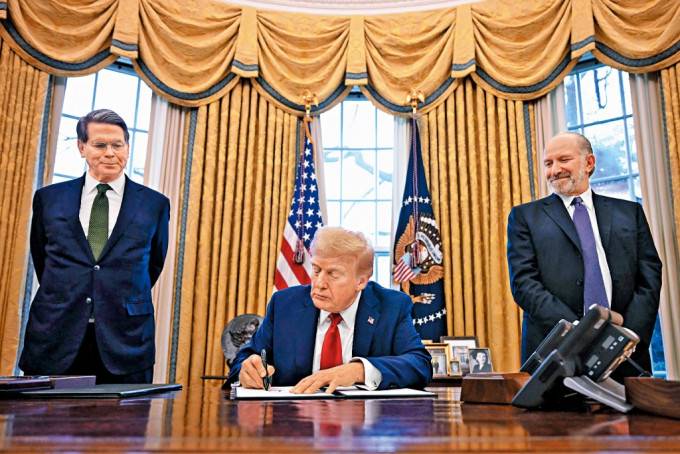
On February 3 this year, Trump signed an executive order directing the establishment of a U.S. sovereign wealth fund within one year. The order requires the Department of Commerce and Treasury to submit a detailed plan within 90 days, covering funding mechanisms, investment strategies, capital structure, and governance models. The fund aims to finance infrastructure, supply chains, and strategic industries.
About 50 countries and regions globally operate sovereign funds—China’s CIC and Huatai rank second and third worldwide. Depending on national contexts, investment styles vary: Middle Eastern funds focus on strategic sectors, Norway emphasizes equity investments, while China targets private equity, real estate, and Belt and Road projects. Four primary benefits of sovereign funds include: 1) smoothing economic fluctuations (hedging commodity price risks, optimizing foreign exchange management); 2) driving structural transformation (e.g., Gulf states fostering tourism and tech); 3) enhancing global financial influence; and 4) protecting society and building welfare systems.
The background behind America’s proposed fund stems largely from the TikTok dispute. Publicly, Trump claims he wants to buy back Americans’ favorite internet company. Privately, it serves as a vehicle for fiscal relief, deficit reduction, and infrastructure upgrades. More personally, it represents a power upgrade—an opportunity for Trump to leverage his business acumen for national profit from the White House. If conditions allow, this fund could naturally become the primary source of capital for the crypto strategic reserve. This isn’t mere conjecture: Howard Lutnick, Trump’s nominee for Commerce Secretary and key architect of the fund, formerly served as CEO of Cantor Fitzgerald—one of Tether’s custodians, responsible for related reserve assets. Lutnick is also a known Bitcoin supporter. His leadership in shaping the sovereign fund paves the way for Trump’s crypto allies and associated interest networks. Moreover, most sovereign funds register in offshore financial centers like the Cayman Islands or Luxembourg, leveraging local laws to avoid disclosure requirements and enabling opaque operations. For example, Saudi Arabia’s Public Investment Fund (PIF) holds 320,000 BTC through offshore shell companies, entirely outside sovereign balance sheet oversight. The shortcomings of Trump’s 2016–2020 term might finally be rectified during this presidency.
Funding sources boil down to four options: earn, sell, borrow, or print. Given America’s current situation, the first two are most plausible—Trump intends to use tariff revenues to capitalize the fund, or alternatively, monetize the federal government’s $5.7 trillion in existing assets. Ultimately, the specific method matters less than understanding the potential scale. Should this materialize, three core implications stand out: 1) government buying becomes reality; 2) U.S.-aligned crypto projects will dominate—or even constitute the sole Alpha—in future crypto markets; 3) survival of top-tier projects may hinge on whether they accept sovereign capital investment.
III. Surrender?
Binance made two significant moves this month: first, partnering with UAE royalty through a $2 billion investment from sovereign fund MGX. Reports suggest U.S. officials also approached Binance for talks. The Wall Street Journal went so far as to claim CZ may have exchanged equity with the Trump family for clemency. Second, BSC has been seamlessly integrated into its own CEX, allowing users to use stablecoins for frictionless on-chain transactions within the exchange. These actions signal that traditional finance and geopolitical forces are systematically absorbing crypto. Furthermore, embracing centralization appears increasingly the only viable path forward for public chains. Cryptocurrencies are being partitioned—public chains must either align with power or remain dependent on CEX traffic valves to grow.
Ethereum remains aloof, choosing neither path. Its exchange rate against BTC continues setting new lows, and criticism toward the Ethereum Foundation and Vitalik has persisted throughout the past year. Yet from my perspective, Ethereum’s survival—and potential resistance—is crucial for the integrity of crypto. Today, only two paths exist: surrender or resist.
Those who surrender share temporary prosperity with the elite, gaining fleeting peace. But today cede five cities, tomorrow ten—how much Web3 remains when decentralization keeps bleeding to centralization? Eventually, all seven kingdoms fall to Qin. Ethereum may have a peculiar autocrat, but it remains the only blockchain truly deserving of the term "decentralized ecosystem." Yes, even today. I am not a diehard Ethereum supporter, but I refuse to see it become crypto’s Handan—a hollow relic of lost ideals. Value should reside in code pulsing across blocks, not in a signature on a White House executive order.
Join TechFlow official community to stay tuned
Telegram:https://t.me/TechFlowDaily
X (Twitter):https://x.com/TechFlowPost
X (Twitter) EN:https://x.com/BlockFlow_News
 @YBBCapital


