Mantle Deep Research Report: From Fundamentals to Ecosystem
TechFlow Selected TechFlow Selected
Mantle Deep Research Report: From Fundamentals to Ecosystem
Since its mainnet launch in July 2023, Mantle has become the fourth-largest L2 by TVL and is backed by an exceptionally large treasury of over $2.6 billion.
 Navigating Web3 tides with focused insights
Authored by: Klein Labs + Web3Labs
1. Overview of Mantle
1.1 Project Introduction
Overview
The public blockchain sector has always been the main battlefield of Web3. Since the inception of Ethereum, numerous challengers have emerged. Building upon Ethereum's foundation, a divergence in Layer 2 (L2) approaches arose, culminating today in an era of vibrant L2 competition. We are increasingly realizing that technological innovation and high performance alone are insufficient. A public chain is akin to a digital kingdom, requiring a thriving ecosystem and broad consensus among developers and users to continuously generate "taxation" revenue.
Mantle has emerged as a dark horse in this fiercely competitive landscape. Since its mainnet launch in July 2023, within just over a year it has become the fourth-largest L2 by Total Value Locked (TVL), backed by a massive treasury of $2.6 billion. It now stands among the top-tier L2s with momentum toward becoming a leading public blockchain. How did Mantle achieve this rapid ascent, and what future developments lie ahead? We explore these questions in depth below.
Key Development Milestones
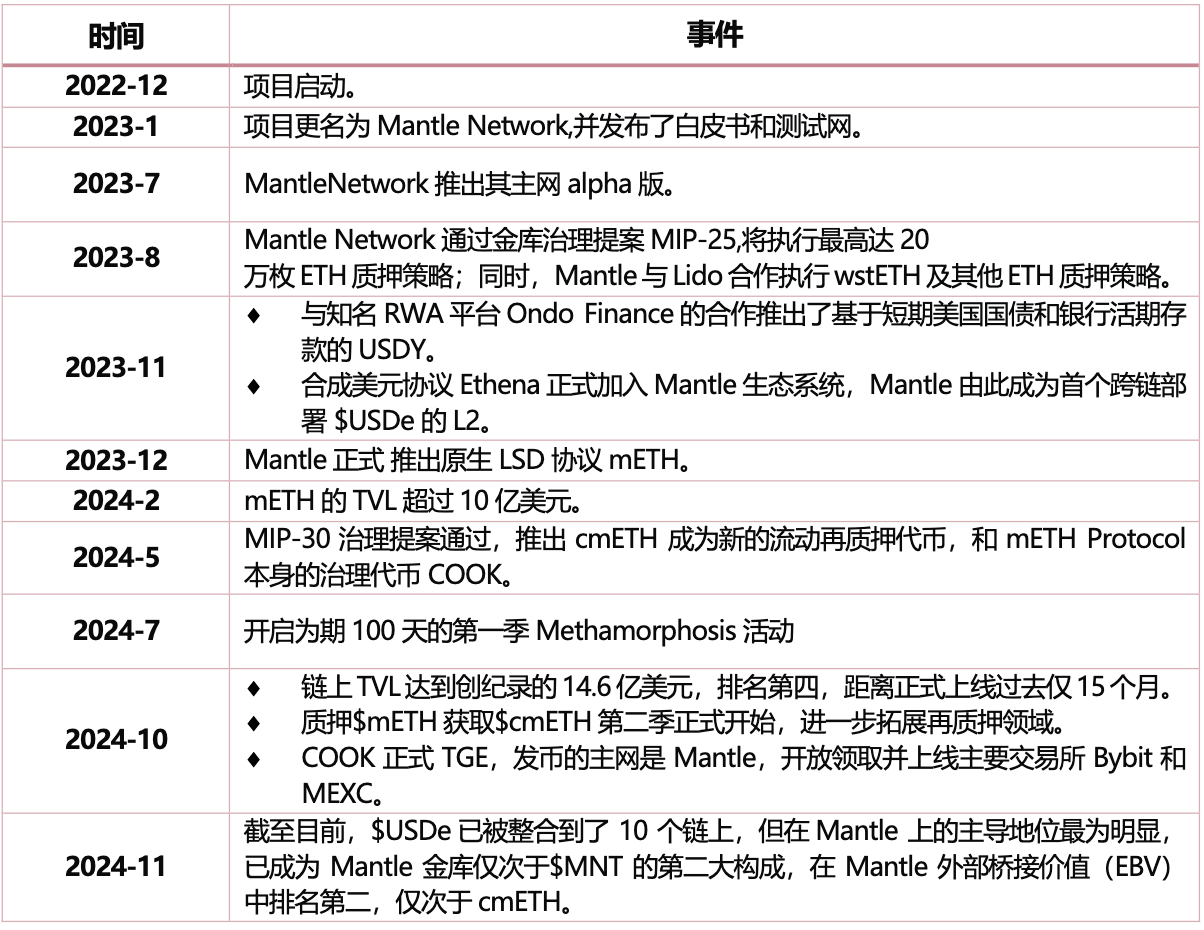
1.2 Token Economics
The $MNT token serves as both the governance and utility token for the Mantle ecosystem, with a total supply of 6.219 billion. As a governance token, each $MNT carries voting rights within Mantle’s decentralized governance system. As a utility token, $MNT can be used to pay gas fees on the Mantle network and is also the primary asset distributed through rewards programs—this sets Mantle apart from many other L2s. By consuming $MNT as gas, Mantle strengthens the token’s intrinsic value accrual mechanism.
According to the official $MNT initial distribution snapshot provided on July 7, 2023, the allocation is as follows:
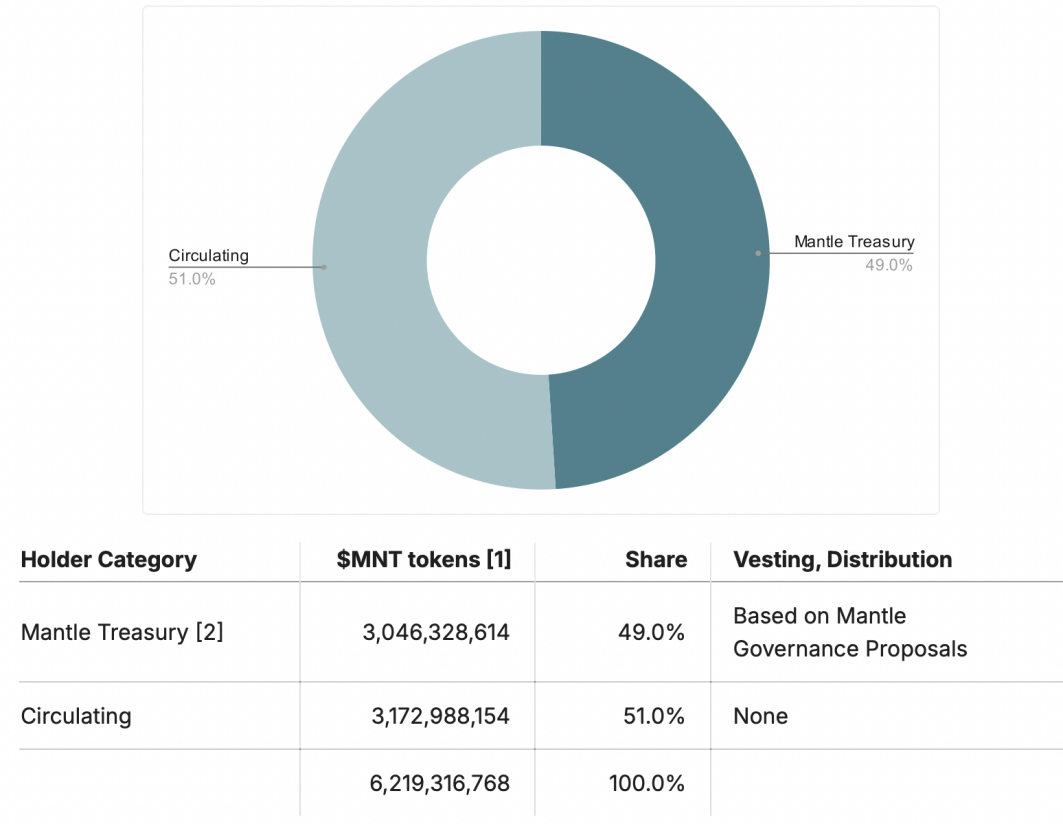
Source: Mantle
As shown in the chart, nearly half of all $MNT tokens are held in the Mantle Treasury, which are non-circulating. The release of these treasury tokens must follow formal governance procedures, including strict budgeting, fundraising, and disbursement protocols. After the initial allocation, additional sources of $MNT for the treasury include periodic third-party donations and gas fee revenues collected from the Mantle mainnet.
The core budget of Mantle represents the primary expenditure channel for $MNT, funding areas such as labor costs, general administrative expenses, marketing, ecosystem and builder programs, and infrastructure and security.
In September 2024, MIP-31 was passed, outlining a new plan for Mantle’s second budget cycle (covering July 2024 to June 2025). Key allocations include R&D and growth ($15 million USDx and $20 million MNT) and marketing ($12 million USDx and $20 million MNT). In practice, Mantle has already partnered with various marketing and research entities—including prominent media and research organizations like Bankless, Unchained Podcast, Delphi Digital, and Messari—as well as influential thought leaders who have covered Mantle extensively.
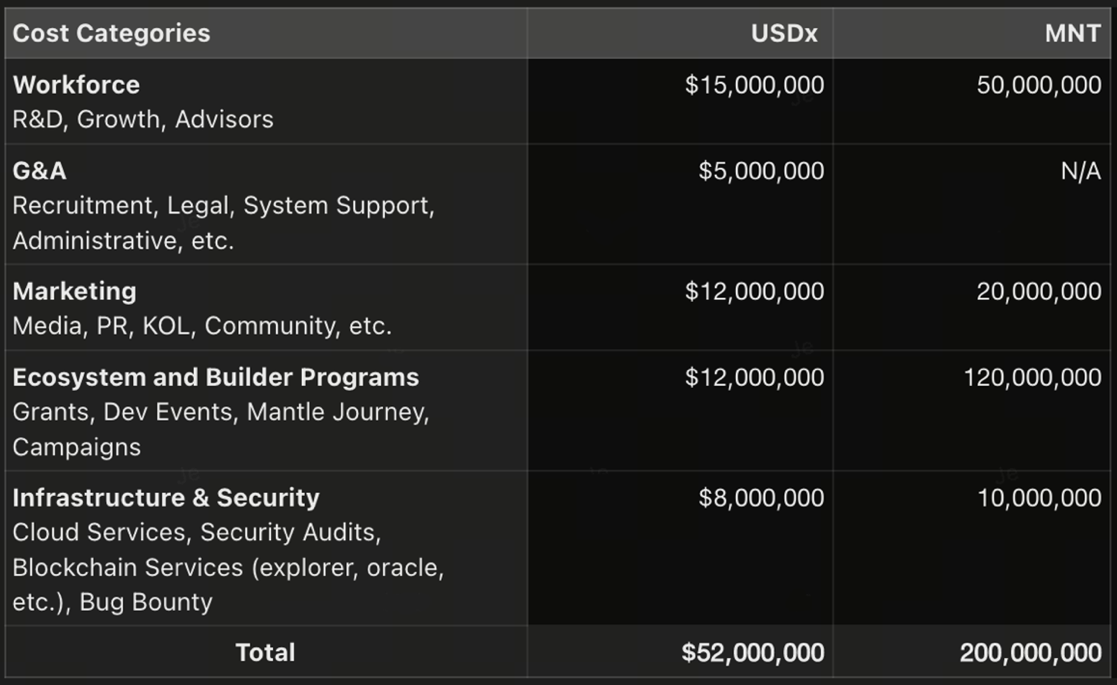
Mantle Budget Composition, Source: Mantle
1.3 Data Snapshot
Project-related Metrics
We now examine multiple data points to understand Mantle’s growth trajectory over the past year. Mantle launched its mainnet on July 17, 2023. Following a stabilization period, explosive growth began in early 2024.
In terms of TVL, at the beginning of February 2024, Mantle’s on-chain TVL had just surpassed $400 million. It then surged rapidly, peaking near $1.5 billion in April 2024—an increase of over 300% in four months. At the time of writing, Mantle’s latest TVL stands at $1.38 billion, ranking fourth among all L2s. As a foundational metric for evaluating L2 development, TVL reflects user participation, market confidence, and overall ecosystem health. Rapidly growing TVL signals increasing trust and adoption, and demonstrates Mantle’s ability to provide deeper liquidity.
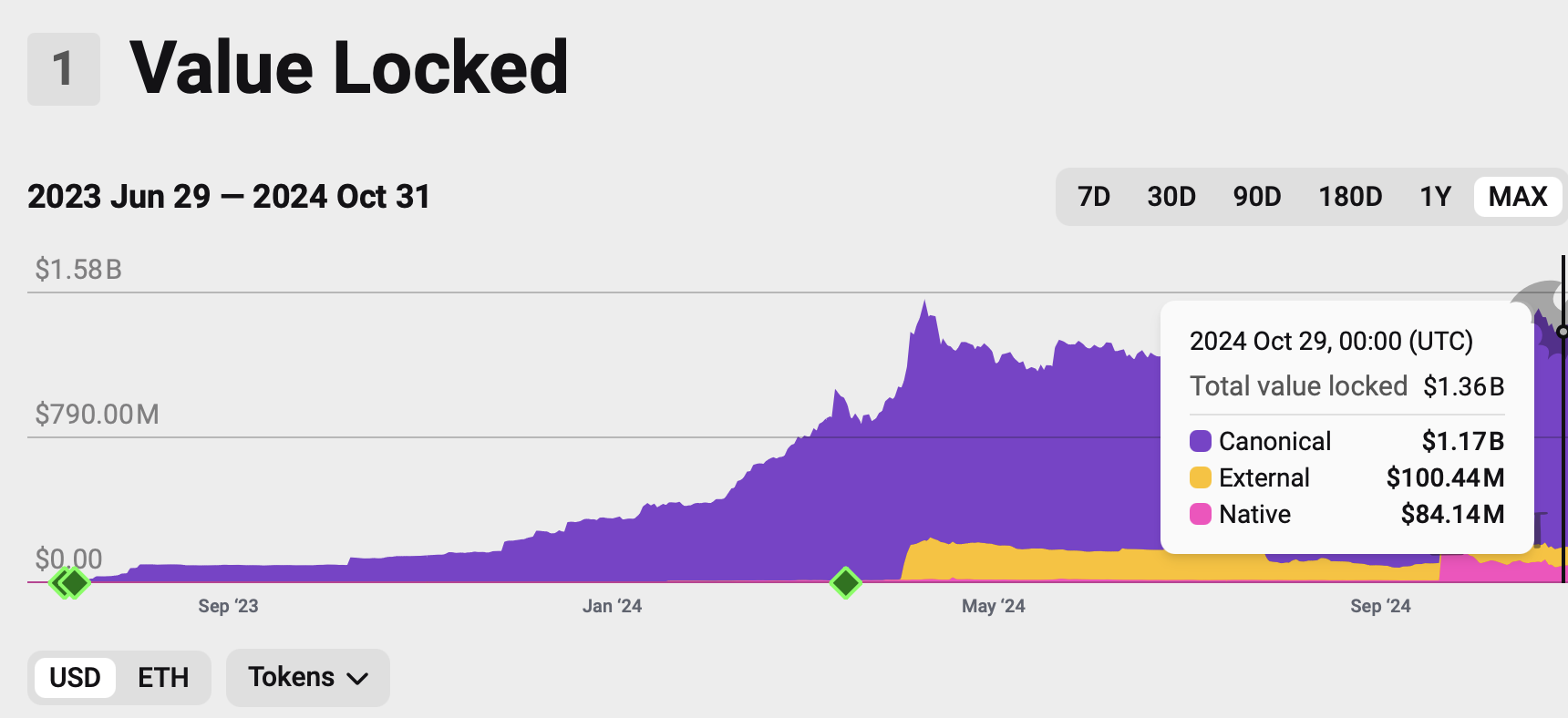
Mantle TVL, Source: l2beat, 2024/10/31
Looking at In-dApps TVL via DeFiLlama’s dashboard offers a clearer view of Mantle’s ecosystem composition. It is evident that core contributions come from DeFi domains such as DEXs, lending, and restaking, with DEX TVL showing particularly strong growth. This highlights DeFi as a central focus area for Mantle.
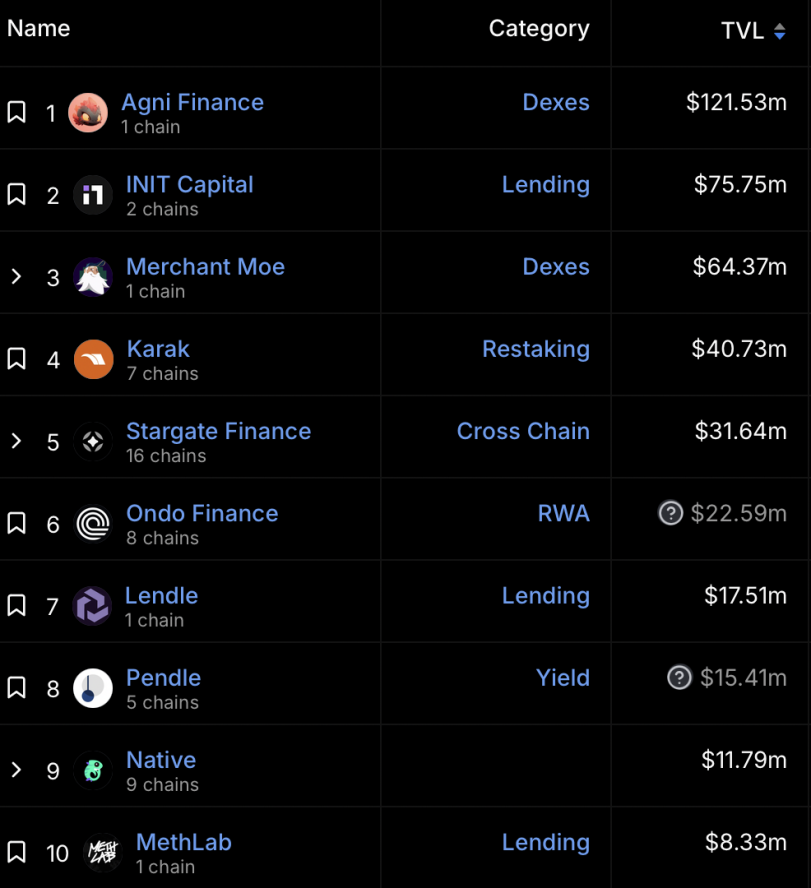
TVL of Projects in Mantle Ecosystem, Source: DeFiLlama, 2024/10/24
Beyond TVL fundamentals, let us assess Mantle’s on-chain activity. With the proliferation of new L2s—akin to building highways with little traffic due to lack of demand—most face a common issue: absence of compelling applications. Therefore, metrics like user count and transaction volume offer more meaningful insights into actual ecosystem vitality. Mantle’s growth data reveals exceptional user engagement.
In user numbers, Mantle had approximately 330,000 users in December 2023. By October 15, 2024, this number exceeded 4.42 million—a 13x increase in under a year—indicating substantial inflow into the Mantle ecosystem.
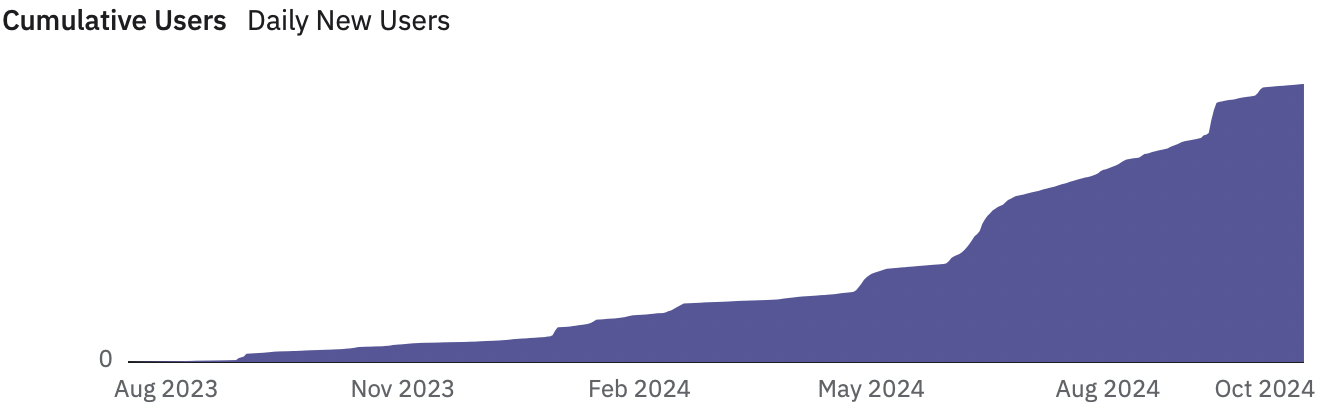
Mantle User Data, Source: Dune, 2024/10/24
Regarding daily activity, Mantle’s monthly active users saw a sharp rise by the end of April 2024 and have since remained at a higher baseline. Current monthly active users hover around 40,000—nearly triple the level seen in September 2023.
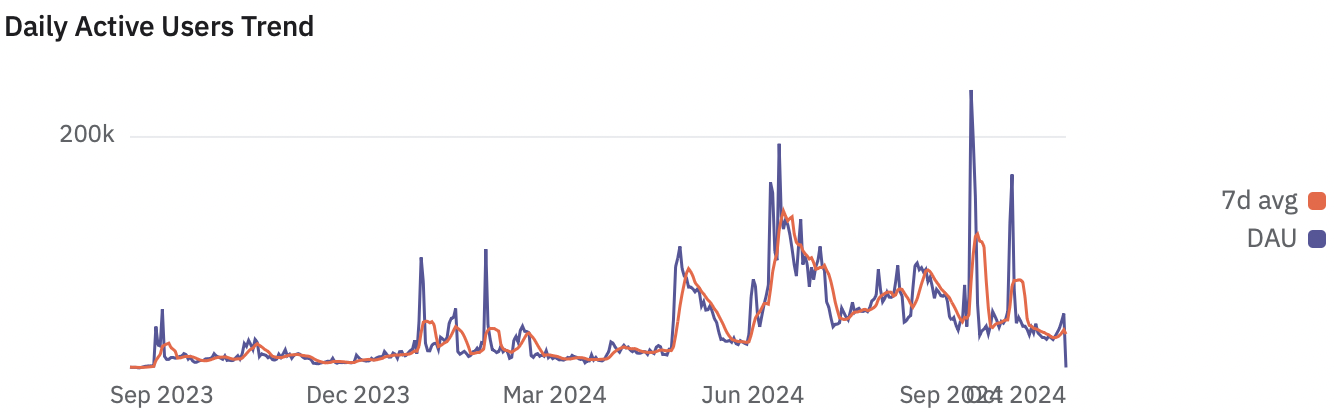
Mantle Daily Activity Data, Source: Dune, 2024/10/24
In transaction volume, as of October 23, 2024, Mantle has recorded over 150 million total transactions, with daily peaks exceeding 2.2 million. This indicates robust on-chain activity. Higher transaction volumes directly translate to increased network fee revenue, reflecting stronger self-sustainability capabilities.
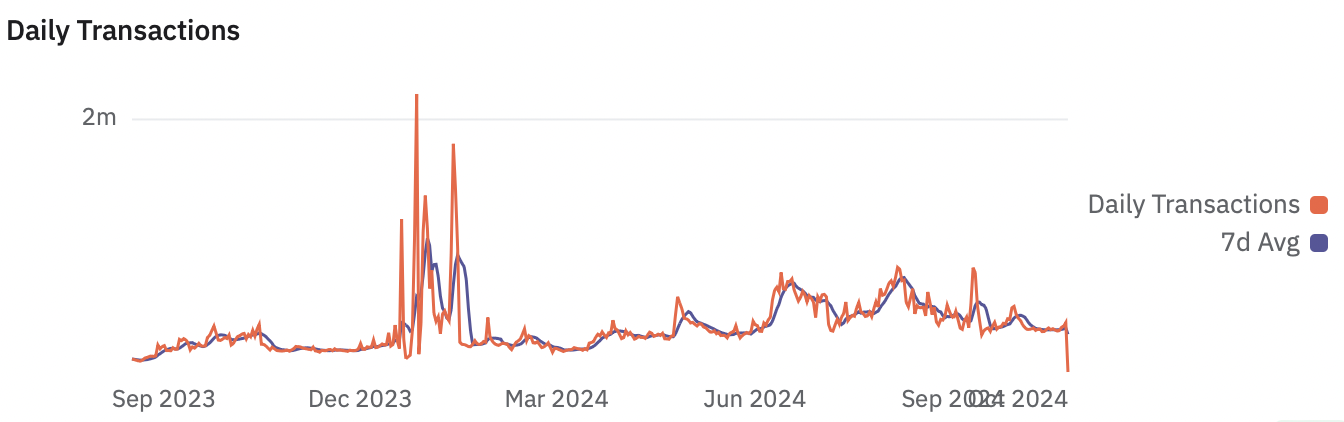
Mantle Transaction Data, Source: Dune, 2024/10/24
Social Media Metrics
As of October 24, 2024, Mantle has amassed over 800,000 followers on X (formerly Twitter), while maintaining highly active communities on Telegram and Discord with over 200,000 members participating in discussions, AMAs, and project updates. Currently, Mantle’s Discord community has attracted nearly 440,000 members, with over 10,000 online daily—one of the most popular channels in the space. Twitter engagement remains consistently high.
Additionally, Mantle has hosted over 120 AMAs across official and ecosystem social channels, led by KOLs and project team members. Initiatives such as “Mantle Ecowaves” and “Mantle Showcase Radio” have played significant roles in driving user engagement and adoption. Mantle has also held over 50 offline events globally, further expanding its presence.
1.4 Technical Architecture
L2 rollups are primarily categorized into two types: Optimistic Rollups (OP) and Zero-Knowledge Rollups (ZK). Mantle Network implements its L2 scaling solution based on OP Rollup technology while independently developing a modular Data Availability (DA) layer.
Modular Design Significantly Reduces Transaction Costs
To understand modular blockchains, one must first grasp monolithic blockchains. Taking Ethereum as an example, a mature monolithic blockchain typically consists of four layers: Execution Layer, Settlement Layer, Data Availability Layer (DA), and Consensus Layer—each serving distinct functions. Mantle’s modular design separates these four critical functions across different layers instead of consolidating them into a single network layer, as most traditional blockchains do. These functions are:
-
Transaction Execution: Conducted on Mantle’s EVM-compatible execution and settlement layer. Mantle’s sequencer generates blocks on the L2 execution layer and submits state root data to the underlying blockchain (Ethereum).
-
Consensus & Settlement: Handled by the Ethereum L1 network.
-
Data Availability: Mantle independently developed a DA layer leveraging Eigen DA, allowing it to submit only essential state roots to Ethereum mainnet, reducing the amount of calldata required compared to standard OP rollups.
-
Data Retrieval: Other nodes retrieve transaction data from Mantle’s DA via DTL services for verification and confirmation.
In current blockchain architectures, OP rollups incur high calldata fees by submitting full transaction data to Ethereum’s DA layer. As transaction volume grows, this cost accounts for 80–95% of total fees, severely limiting rollup cost efficiency. Mantle’s proprietary modular DA layer successfully mitigates this burden. Furthermore, modularity enables easier integration of emerging technologies.
Decentralized Sequencers Eliminate Centralization Risks
The sequencer is a core component in L2 solutions responsible for collecting and ordering transactions, computing states, and generating blocks—critical for network security. In traditional rollup designs, sequencers are often centralized nodes vulnerable to failure, manipulation, or censorship. Mantle replaces this model with a permissionless cluster of sequencers, delivering key benefits:
-
Enhanced network availability by eliminating single points of failure, ensuring continuous operation.
-
Improved consensus reliability by preventing sequencer manipulation or censorship, ensuring fair and transparent transaction processing.
-
Stronger incentive alignment through reward mechanisms that encourage compliant behavior, supporting long-term sustainability. In contrast, centralized sequencers suffer from public goods dilemmas.
1.5 Competitive Landscape
Ethereum’s congestion created the backdrop for one of the grandest narratives in crypto. In his article “The Three Transitions,” Vitalik Buterin outlined three major technical shifts Ethereum must undergo: transition to L2 scaling (with everyone moving to rollups), wallet security (adoption of smart contract wallets), and privacy (enabling private fund transfers). Vitalik emphasized that without L2 development, Ethereum would fail due to prohibitively high transaction costs.
It is precisely within this context that the L2 sector is flourishing. According to L2Beat, there are currently 110 operational L2 or L3 scaling solutions. Yet only a few have gained mainstream traction, accumulating significant TVL and user bases. As of October 24, 2024, total TVL across L2 solutions reached $37.62 billion—tripling over the previous year—demonstrating strong momentum and growing user demand.
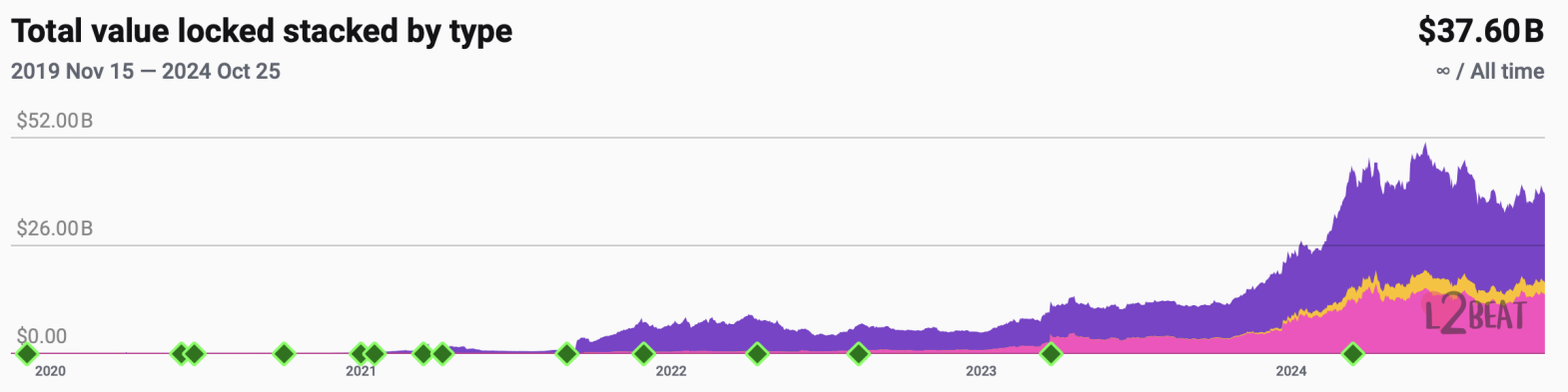
Source: l2beat, 2024/10/25
Mantle vs. Mainstream L2s
In terms of TVL, the top three are Arbitrum, Base, and Optimism, collectively holding over 73% of the market share. Mantle entered later but quickly rose to become the fourth-largest L2 just one year after launch.
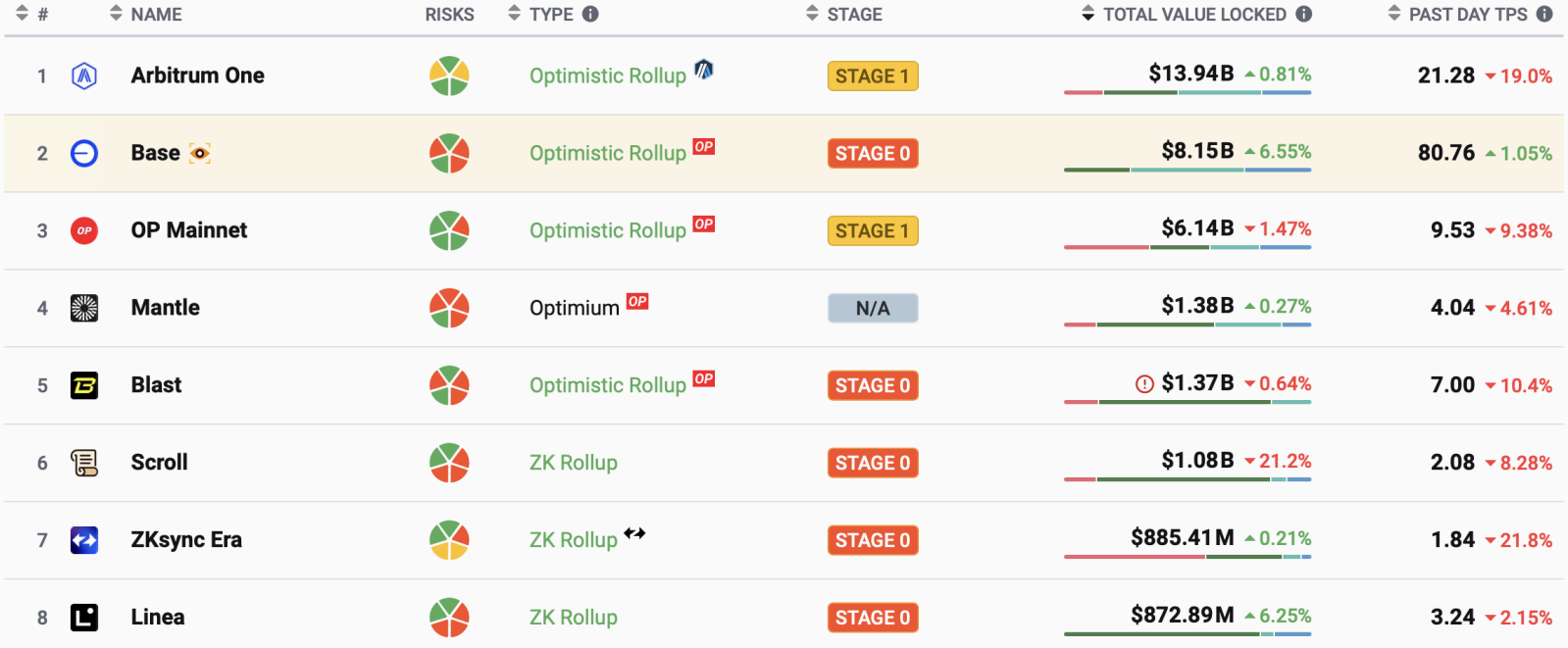
L2 TVL Rankings, Source: L2beat, 2024/10/31
In Fully Diluted Valuation (FDV), Mantle ranks behind only Optimism and Arbitrum at $3.58 billion. Regarding Market Cap / FDV ratio, Mantle leads at 54.1%, indicating relatively lower future sell-side pressure compared to peers.
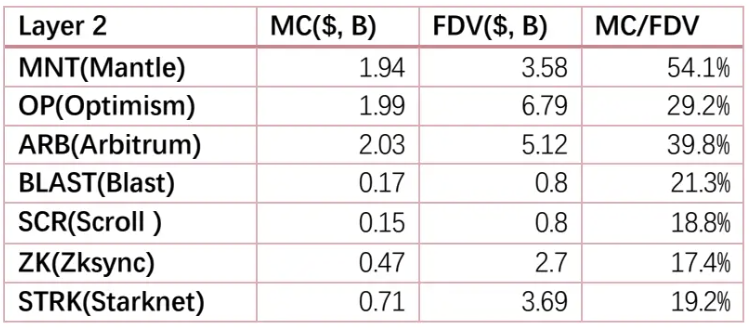
Source: CoinMarketCap, 2024/10/26, compiled by Klein Labs
In revenue and profitability, Base surpassed Arbitrum in March 2024 to become the most profitable L2, while Mantle maintains a solid position within the top five.
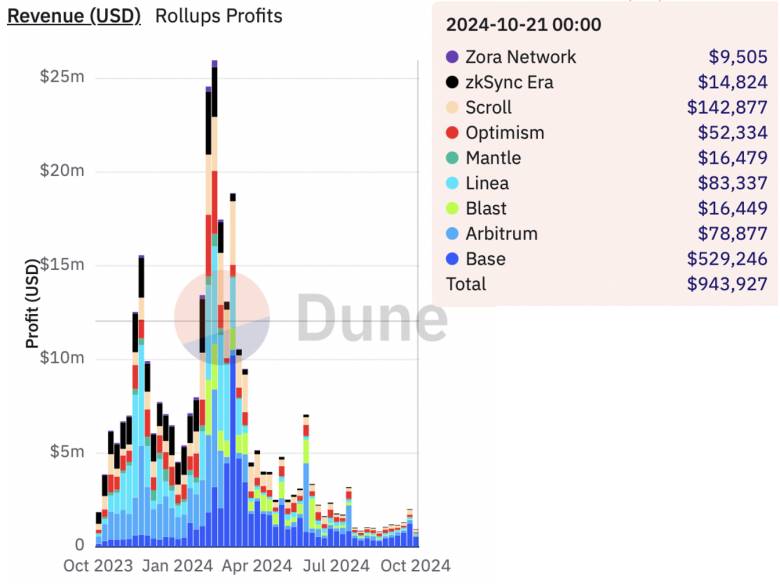

Source: Dune, 2024/10/26
Mantle vs. Exchange-Backed Chains
Mantle’s early supporters include Bybit, the third-largest cryptocurrency exchange, giving it unique advantages. This section compares Mantle with other exchange-backed L2 projects.
When discussing exchange-supported blockchains, notable examples include Binance’s BNB Chain and opBNB, Coinbase’s Base, OKX’s X Layer, and recently, Kraken announced plans on October 24 to launch its L2 network Ink, expected to go live on mainnet in early 2025.
Before diving into these L2s, consider their parent exchanges. According to CoinMarketCap rankings, Binance, Coinbase, and Bybit rank among the top three crypto exchanges, with OKX and Kraken placing fourth and sixth respectively. Among the top six exchanges, five now support at least one blockchain—reflecting a strategic shift in the industry.
Exchanges entering the blockchain space represent not just service expansion but a broader movement from off-chain (CEX) to on-chain (DeFi) ecosystems. This trend encourages large-scale migration of users and assets from centralized platforms to decentralized finance, advancing decentralization. Both exchanges and blockchains share fundamental similarities—they facilitate issuance and trading of new assets to generate revenue. Exchanges bring valuable expertise in asset management and industry connections, offering competitive advantages to their affiliated chains.
1.5.2.1 BNB Chain
BNB Chain (formerly Binance Chain) was launched in 2019 when the utility token BNB migrated from Ethereum to its own chain. Originally named BSC, it operates as an L1. Despite being an L1, its strong ties to Binance warrant inclusion here.
BNB Chain currently holds $4.7 billion in TVL. Leveraging Binance’s exchange backing and financial resources, it has established DeFi as a dominant sector, highlighted by PancakeSwap.
Binance’s technical and financial support is undoubtedly a major advantage for BNB Chain. However, its close relationship with the exchange raises concerns about decentralization. For instance, during a 2022 hack, Binance requested validators to pause transactions on BNB Chain to contain the situation. Such centralized actions reveal limited validator diversity and suggest most nodes are directly or indirectly controlled by Binance.
How such exchange-backed chains can leverage institutional resources while gradually achieving independent on-chain governance—true to Web3’s decentralization ethos—remains a key challenge.
In Q2 2023, BNB Chain also launched opBNB, an EVM-compatible L2 scalability solution built on OP Stack. As per DeFiLlama, opBNB currently holds $21.6 million TVL, still in early stages.
1.5.2.2 Base
Base is an Ethereum L2 public chain incubated by Coinbase. Due to regulatory oversight from the SEC, Base cannot easily issue a native token, depriving it of a natural token-based incentive mechanism available to other L2s.
Despite this limitation, Base achieved remarkable success within a year of launch, experiencing two explosive growth phases in TVL—in April and September—surpassing $2.4 billion. Innovative projects like Friendtech have emerged on Base.
The top five contributors to Base’s TVL are all DeFi projects. Notably, Aerodrome Finance alone contributes $1.3 billion—accounting for nearly 54% of Base’s total TVL. Launched on August 28, 2023, Aerodrome is an automated market maker (AMM)-based DEX.
1.5.2.3 Cronos zkEVM
Cronos is a blockchain launched in November 2021 by Crypto.com (ranked 13th), an Ethereum-compatible L1. However, its TVL has remained stagnant since launch. Subsequently, Cronos Labs collaborated with Matter Labs to develop Cronos zkEVM, a ZK-based L2, which went live on mainnet in August 2024.
Cronos zkEVM currently maintains a stable TVL of around $17 million—still small relative to leading chains.
1.5.2.4 X Layer
X Layer is a zk-rollup L2 jointly launched in April by OKX and Polygon Labs. It uses OKB as its native gas token. Future plans include technical optimizations such as sequencer decentralization. X Layer currently holds $9.3 million in TVL.
In TVL comparison, Base leads, followed by Mantle in second place, with Cronos zkEVM and X Layer remaining relatively smaller in scale.
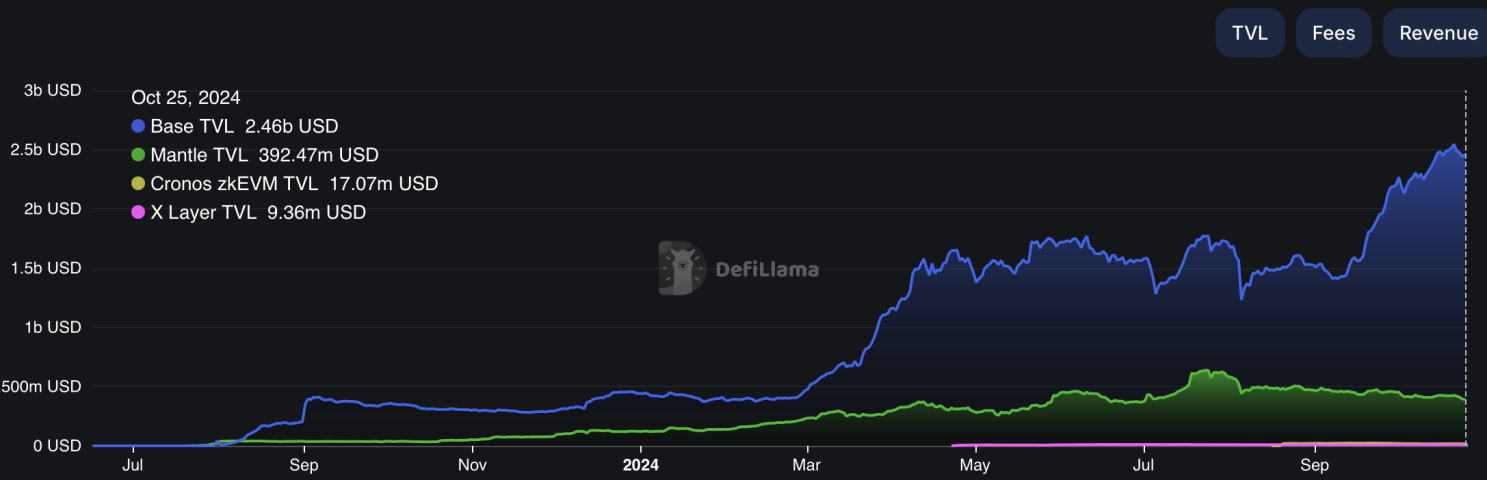
Source: DeFiLlama, 2024/10/26
1.6 Preliminary Value Assessment
Cross-comparison with other Layer 2 networks allows for intuitive assessment of ecosystem vibrancy and valuation levels, enabling better evaluation of a network’s growth potential.
One crucial distinction: unlike other L2s using ETH as gas, Mantle uses $MNT as its native gas token. This factor must be considered in comparative analysis. Key metrics evaluated include:
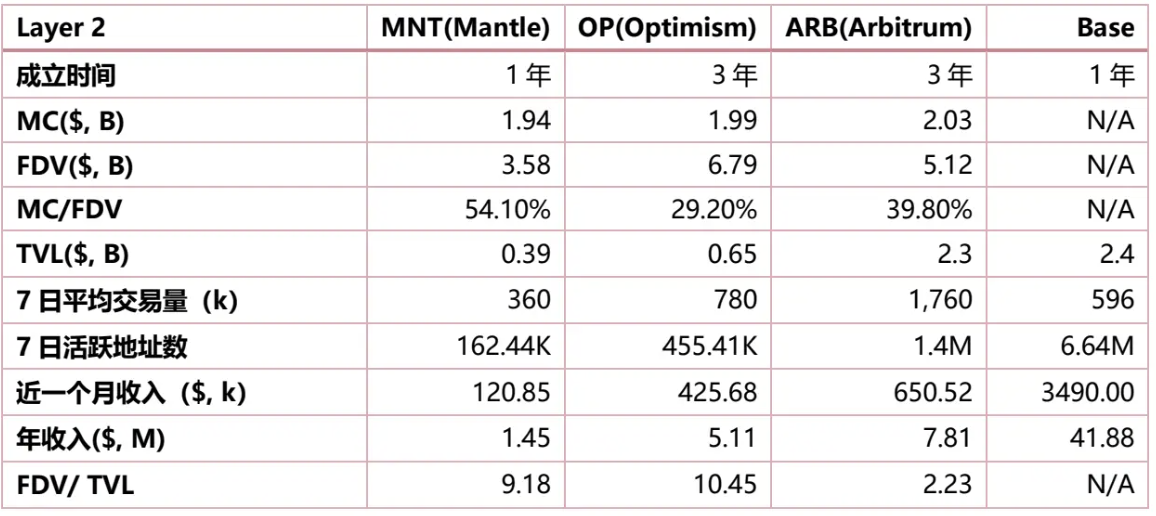
Data Comparison, Source: Dune, DeFiLlama, Klein Labs compilation, 2024/10/26
Compared to other OP Rollup-based L2s, Mantle’s ecosystem remains relatively early-stage. However, over 50% of its native token $MNT is already in circulation, suggesting lower future selling pressure than competing chains. Moreover, achieving such high levels in TVL and on-chain revenue within such a short timeframe strongly suggests that as Mantle’s ecosystem matures and expands, its competitive standing in the L2 arena will continue to rise to new heights.
2. Mantle’s Ecosystem
As Vitalik noted, a blockchain’s ecosystem is its killer feature. A rich and diverse ecosystem attracts new users and encourages existing ones to engage in more frequent and varied interactions. While macro market cycles certainly contributed positively to Mantle’s growth, the expanding breadth and depth of its ecosystem have been equally—if not more—important drivers.
According to recent data, over 240 dApps have launched on Mantle, including 89 in DeFi, 96 in infrastructure, and 20 in GameFi. DeFi and infrastructure dominate, underscoring DeFi’s role as foundational infrastructure fueling Mantle’s growth.
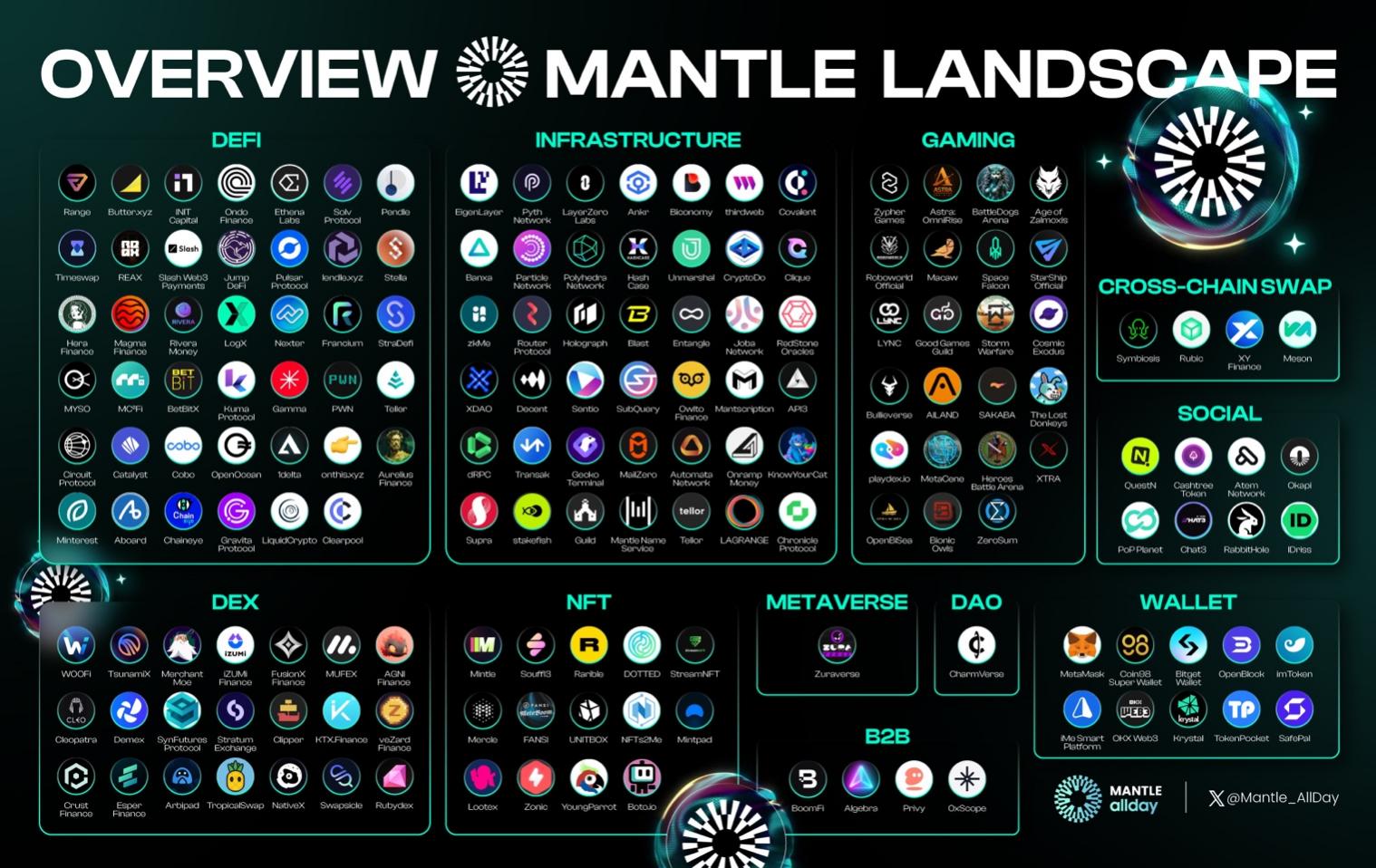
Source: Mantle, 2024/10/24
We now analyze representative projects across major categories:
2.1 DeFi Sector
DeFi forms the bedrock of any public chain. The maturity of DeFi infrastructure significantly influences the overall ecosystem’s growth potential and ceiling. Of Mantle’s 89 DeFi projects, 36 are DEXs, with others spanning lending and re-staking. Below are highlights:
2.1.1 Agni Finance
Project Overview: Founded in 2023, Agni Finance is Mantle’s native AMM-based DEX and currently ranks #1 in TVL on Mantle ($121 million), with cumulative trading volume reaching $3.92 billion. It supports six tokens and 20 trading pairs, with METH/WETH being the most active. According to CoinGecko, Agni’s latest 24-hour trading volume is $4.36M.
Agni Finance experienced a doubling in TVL in July 2024 and has since stabilized above $100 million—doubling Q2 figures.
X: @Agnidex
2.1.2 INIT Capital
Project Overview: Launched in 2023, INIT Capital is a platform enabling seamless interaction between dApps and users, offering permissionless access to unified liquidity pools and efficient yield management. As DeFi liquidity infrastructure, INIT supports activities including lending and yield strategies. It is now live on both Mantle and Blast. At the time of writing, INIT Capital manages $110 million in market size, with over $24 million lent out.
In late February 2024, INIT Capital announced a $3.1 million seed round co-led by Electric Capital and Mirana Ventures.
X: @InitCapital_
2.1.3 Merchant Moe
Project Overview: Merchant Moe is a DEX launched in 2024, a product of Trader Joe, specifically designed and built for the Mantle ecosystem and community. It went live on mainnet in January 2024, alongside the $MOE token. It currently offers 14 tokens and 22 trading pairs, with METH/USDT being the most traded pair.
Per MIP-28, Merchant Moe receives liquidity support from the Mantle Treasury. It also secured seed investment from Mantle EcoFund.
X: @MerchantMoe_xyz
2.1.4 Ondo Finance
Project Overview: Ondo Finance focuses on the Real World Assets (RWA) sector, primarily tokenizing high-quality assets such as U.S. Treasuries and money market funds within compliant frameworks, enabling blockchain-based investment and trading. Ondo has driven the RWA sector’s TVL growth sixfold over the past year and is a leading force in the space. Ondo Finance’s TVL has grown rapidly since April and currently ranks third in the RWA sector, enjoying first-mover advantages with promising future prospects. Supporting eight chains, Ondo ranks third in TVL on Mantle—outperforming Aptos, Arbitrum, and Sui.
X: @OndoFinance
2.2 Wrapped Assets
Technically part of DeFi, wrapped assets deserve separate analysis due to Mantle’s notable achievements and strategic emphasis in this domain.
On October 23, Bybit launched cmETH and announced plans to introduce COOK, the governance token for mETH, sparking widespread attention. Before analyzing cmETH and COOK, understanding mETH is essential.
2.2.1 mETH
mETH is a permissionless, non-custodial liquid staking derivative (LSD) protocol where users stake ETH to receive mETH (1:1). Currently, mETH secures over 480,000 ETH through 15,025 validator nodes.
As Mantle’s native LSD protocol, mETH launched on December 4, 2023, and achieved rapid growth, reaching $1.22 billion TVL in under a year—now ranking as the fourth-largest Ethereum LSD product.
Contextually, Ethereum completed its transition from PoW to PoS in June 2023. At that time, Lido Finance already dominated the LSD market with $13 billion TVL, followed by competitors like Rocket Pool (rETH), making the LSD space highly competitive. Clearly, mETH lacked first-mover advantage when first discussed in Mantle’s governance forums.
However, after extensive community governance discussions and technical preparation, the open-access ETH liquid staking protocol officially launched on December 8, 2023 (initially called Mantle LSP). Thanks to strong performance, mETH quickly distinguished itself as a rising contender in the crowded LSD landscape.
According to DeFiLlama, within one week of launch, Mantle LSP’s TVL surpassed $100 million, rising steadily to peak near $2.2 billion in March 2024. It now stabilizes above $1.2 billion, securing its place as the fourth-largest Ethereum LSD. Official data shows mETH has over 8,000 holders on Ethereum and 26,000 on Mantle—highlighting impressive user adoption and activity.
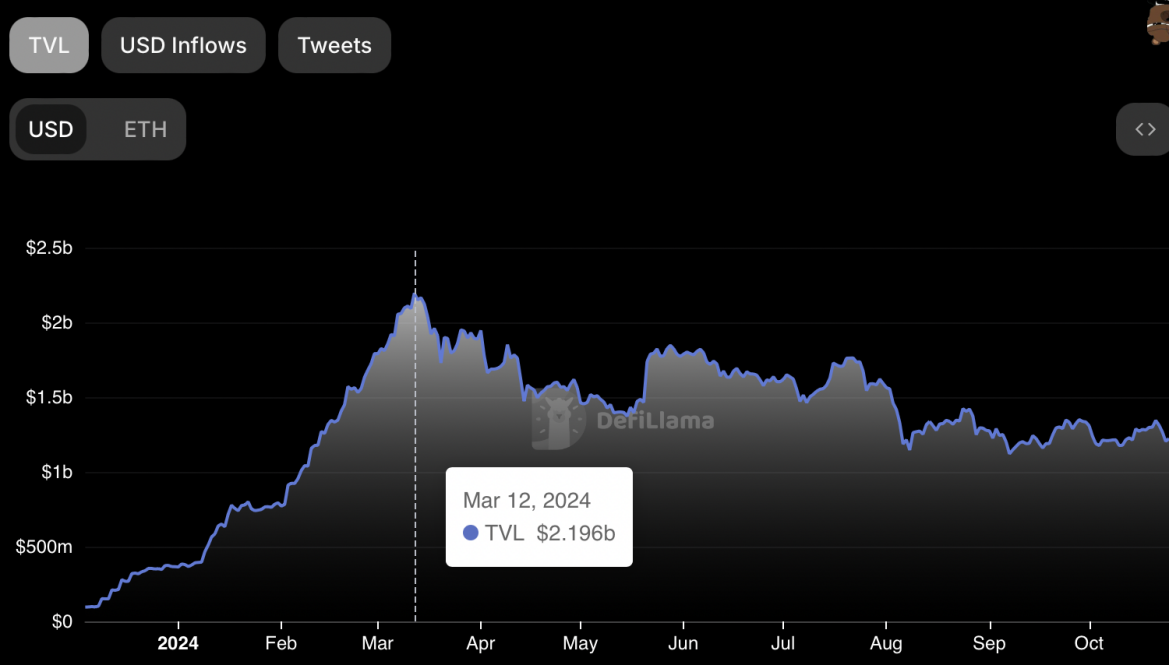
Source: DeFiLlama, 2024/10/25
mETH holders can use the token across various DeFi platforms for liquidity provision, yield farming, and other financial activities without unstaking ETH. Examples include:
-
Trading: Bybit offers mETH/USDT and mETH/ETH pairs; NativeX provides mETH/WETH and other swap options.
-
Lending: INIT Capital allows depositing/borrowing positions using ETH; Timeswap accepts ETH as collateral; MYSO Finance offers zero-fee swaps and customizable no-liquidation loans.
-
Liquidity: Merchant Moe hosts multiple liquidity pools; Butter.xyz enables adding liquidity to any available token, including ETH and MNT.
This represents mETH’s unique strength: backed by Mantle’s rich and mature ecosystem, it unlocks diverse liquidity scenarios, greater yield opportunities, and stronger demand for mETH—creating a healthy flywheel effect that fuels sustained growth and prosperity.
2.2.2 cmETH
In late May 2024, six months after mETH’s official release, governance proposal MIP-30 passed, introducing cmETH as a new Liquid Restaking Token (LRT). Specifically, mETH functions as a liquid staking token (users stake ETH to get mETH); cmETH acts as a liquid restaking token (users stake mETH to receive cmETH 1:1).
Like mETH, cmETH will be highly composable within the Mantle ecosystem—including integrations with EigenLayer, Symbiotic, Karak, and Zircuit—allowing users to retain mETH benefits while exploring additional yield opportunities via L2s and decentralized apps and protocols. Compared to mETH, cmETH offers broader earning potential beyond base staking yields, including points from restaking protocols (airdrop expectations) and AVS rewards.
In short, cmETH is a higher-risk, higher-reward alternative suited for users seeking enhanced returns within acceptable risk parameters. Additionally, MIP-30 previewed the upcoming launch of $COOK as the governance token for mETH.
Worth noting is Mantle’s high-profile Methamorphosis Season One campaign launched in July 2024. Over 100 days, mETH leveraged its ecosystem strengths, announcing 23 partnerships with major projects like EigenLayer, Symbiotic, Karak, Zircuit, and Pendle. Users holding mETH could earn Power by completing tasks—their Power balance redeemable for future $COOK tokens.
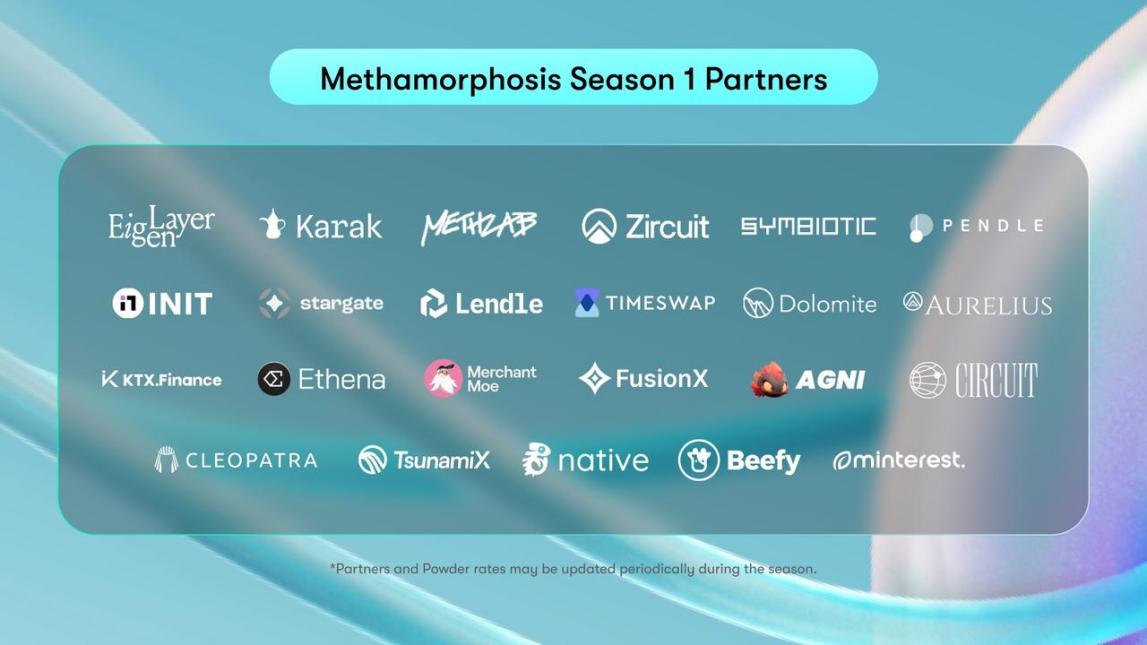
Source: Mantle
Although Season One concluded, on October 23, mETH announced the imminent launch of Methamorphosis Season Two—undoubtedly setting the stage for another wave of explosive growth across the Mantle ecosystem.
2.2.3 FBTC
Mantle’s wrapped assets extend beyond ETH. Within its ecosystem, FBTC—co-developed with Antalpha—represents another vital form of liquid asset. While WBTC previously succeeded in bringing BTC to Ethereum, it occasionally faces trust issues. FBTC presents a superior alternative.
FBTC is a multi-chain Bitcoin asset pegged 1:1 to BTC, offering cross-chain bridging and trading functionality between Ethereum and Mantle networks—enhancing Bitcoin’s accessibility and utility. By integrating FBTC, Mantle enriches the variety of on-chain liquid assets and offers users new cross-chain trading options, improving overall user experience.
Together with products like mETH, FBTC forms Mantle’s multidimensional strategy in liquidity and cross-chain domains, positioning it as a formidable player in L2 and cross-chain liquidity.
2.3 Gaming
Grant Zhang leads Mantle’s gaming vertical. With extensive experience in the gaming industry, Zhang previously led publishing teams for titles like *League of Legends* and *Game of Thrones*, contributing to games downloaded over 500 million times.
Mantle’s approach to gaming differs significantly from most ecosystems, primarily due to its team composition. While other ecosystems often rely on top investors to drive game development, Mantle’s gaming team comprises seasoned game publishing and operations experts. This enables Mantle to offer more substantive support to game partners—including tokenomics design, economic modeling, game publishing, fundraising, and user acquisition.
Despite possessing the largest treasury in Web3, Mantle exercises extreme selectivity in choosing supported games. Unlike ecosystems attempting to flood the market with hundreds of games, Mantle has formed deep collaborations with only about 7–8 games, providing them with substantial backing. Consequently, selected games receive far more impactful support.
Below are key gaming projects:
2.2.1 Catizen
Catizen is a cat-themed mini-game built on Telegram’s mini-app platform, where players earn rewards by swiping to care for virtual cats. According to a tweet by Telegram CEO Pavel Durov, as of July 30, 2024, Catizen had over 26 million players—just over four months after launching on March 19, 2024.
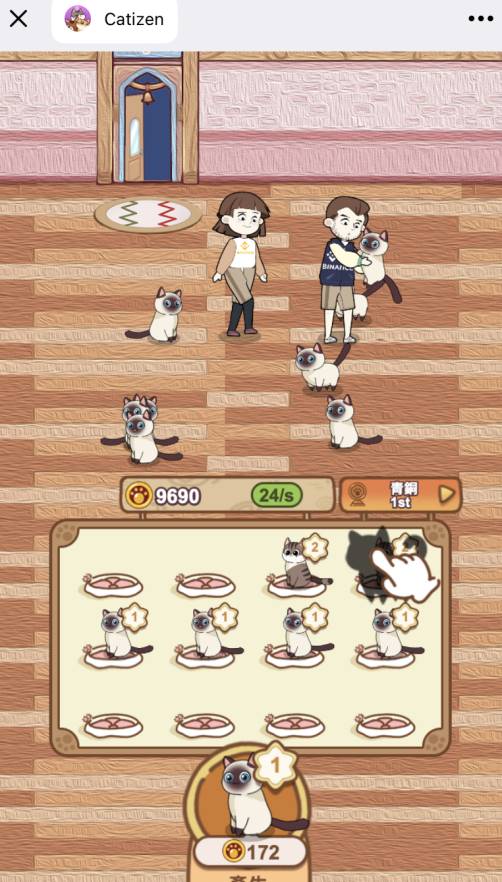
Catizen Example, Source: Catizen
In April 2024, Catizen established a strategic partnership with Mantle. However, Mantle’s collaboration with Catizen and its publisher Pluto Studio dates back to August 2023. From game design and token economics to user acquisition and cooperation with TON, Mantle provided comprehensive support. Catizen chose Mantle because of its unique team structure, capable of delivering professional, practical assistance that meaningfully drives project success—something other ecosystems struggle to match.
For Mantle, hyper-casual games like Catizen and Tap-to-Earn are just the beginning. These games excel at attracting users and funneling Telegram’s vast user base into mini-games. Going forward, Mantle plans to grow alongside the Telegram mini-game ecosystem, releasing more suitable games at each evolutionary stage.
At publication, Catizen has over 600,000 users on Mantle Blockchain. CATI leads Mantle’s Natively Minted Value ranking at $76.63 million.
X: @CatizenAI
2.2.2 MetaCene
MetaCene is a large-scale multiplayer online role-playing game (MMORPG) incorporating Web3 elements. It integrates NFTs, blockchain mechanics, and AI technology with classic gameplay features like PvP battles and land management. MetaCene was founded by Qunzhao (Alan) Tan, an experienced game developer.
As a major MMORPG, MetaCene demands complex design in cost structures, rules, and economic models. Mantle’s ecosystem includes Game7, Hyperplay, Yeeha, and Community Gaming—teams that provide holistic support in user acquisition, engagement, wallet infrastructure, onboarding, and security—delivering tangible value to MetaCene.
Notably, the founder of a leading professional guild praised MetaCene after deep gameplay, highlighting its balanced design and international player base—indirect validation of its playability.
At publication, MetaCene has over 510,000 users, with daily active users briefly exceeding 360,000.
X: @MetaCeneGame
2.2.3 Funton.ai
Funton.ai joined the Mantle ecosystem in October 2024. As a leading modular multi-game platform in the TON ecosystem, Funton.ai aims to build a decentralized GameFi ecosystem combining AI and gaming, offering one-click game creation. As of July 2024, it had over 350,000 monthly active users. Its collaboration with Mantle helps attract hundreds of millions of Telegram users into the Mantle ecosystem. Funton.ai also customized Flappy MNT for Mantle—users connecting wallets containing $MNT can earn $MNT + FUN Points by playing.
Recently, Funton.ai conducted $FUN token airdrops in partnership with Gate.io and OKX Wallet, expanding its market influence and user base. It has also joined accelerator programs run by Web3Labs and KuCoin Labs, gaining recognition from mainstream Web3 institutions.
X: @funton_ai
2.4 Other Ecosystem Initiatives
Mantle has consistently invested heavily in ecosystem development, setting benchmarks for other chains. Below are key initiatives:
2.4.1 EcoFund
Mantle EcoFund is a $200 million ecosystem fund sourced from the Mantle Treasury, aimed at accelerating developer and dApp adoption on Mantle. It prioritizes investing in teams building high-quality, innovative projects within the Mantle ecosystem and may increase allocations to promising ventures.
As per the official website, EcoFund has supported over 13 projects, including INIT Capital, Catizen, and Merchant Moe—all now cornerstone projects in the Mantle ecosystem.
2.4.2 Mantle Grants
To further stimulate ecosystem vitality, Mantle launched two incentive programs:
Mantle Scouts Program: Launched in April 2024, it empowered 16 industry leaders to distribute $1 million worth of $MNT grants to high-potential projects within the ecosystem. The program provides mentorship, network access, and funding to accelerate project success on Mantle.
Public Grants: Offers grants up to $20,000 in $MNT to early-stage projects, fostering a vibrant developer community.
2.4.3 Game7
Given gaming’s strategic importance, Mantle partnered with Game7 to launch a game accelerator program. Built on Mantle’s infrastructure, Game7 provides developers with essential tools such as NFT markets, cross-chain bridges, and game DAOs—offering superior user experiences and ecosystem connectivity. Together, they aim to advance permissionless, interoperable gaming worlds.
2.4.4 Sozu Haus
In developer outreach, Mantle has sponsored and hosted 26 global hackathons, along with numerous technical workshops and online AMAs. Over 900 hackathon projects have been submitted. Mantle also organized six exclusive Sozu Haus events (a mini-accelerator and maker residency program) and participated in major global crypto conferences to attract top founders and developers.
2.4.5 Other Ecosystem Partners
Beyond its internal ecosystem, Mantle actively collaborates with external partners. These alliances expand Mantle’s reach in capital support, user traffic, development resources, market credibility, industry endorsement, and developer education—providing critical technical and liquidity resources.
Mirana Ventures continues to provide funding and strategic support to the Mantle ecosystem. Ranked among RootData’s Top 100 Investment Firms in 2023, Mirana manages tens of millions in assets and has incubated multiple successful projects. Notable investments include TON, Morpho, Zircuit, and Story Protocol. Additionally, Mantle is EigenLayer’s sole technical partner.
In developer community building, Moledao supports Mantle. Dedicated to empowering early-stage Web3 projects and developers, Moledao connects talent through公益 courses, hackathons, and offline events. It has helped Mantle engage numerous outstanding blockchain projects and developers. As a developer hub, Moledao continuously supplies technical innovation and talent, accelerating Mantle’s ecosystem construction.
2.4.6 Ecosystem Incentives
Mantle’s massive treasury—nearly $3 billion, the second-largest globally—is its greatest source of confidence. Interest generated from treasury-held PoS assets can be directly redistributed to users—for example, restaking rewards via EigenLayer can serve as ecosystem incentives. This mechanism tangibly boosts user engagement. Through ecosystem participation or staking, users not only support network growth but also earn a share of treasury returns—making the entire ecosystem more dynamic and sustainable.
3. Key Takeaways
In just over a year, Mantle has demonstrated strong competitiveness in the L2 space through outstanding growth metrics. For current users, with deeper ecosystem integration and the arrival of cmETH and COOK, Mantle’s growth trajectory remains robust. Given this foreseeable momentum, our key perspectives are:
-
Strong Backing from Bybit: Mantle’s close relationship with Bybit means high-potential projects within its ecosystem may gain listing opportunities on Bybit and exposure to a wider investor audience. For dApp development teams, this represents an attractive resource and visibility channel.
-
World’s Largest Treasury Support: Mantle’s ~$3 billion treasury provides unparalleled backing for projects built on its network—the strongest foundation for ecosystem growth. Mantle is building a highly incentivized center for financial and consumer-oriented on-chain applications, where interest income from the treasury can fund additional user subsidies.
-
Technical Architecture Advantages: Mantle’s modular design delivers significant scalability and cost optimization benefits, making it more flexible and open to innovation.
-
Fourth-Largest Ethereum LSD Product: The top four TVL contributors on Mantle are all DeFi projects. Achieving liquidity convergence—a core goal of DeFi—is critical. Mantle is deeply committed to solving liquidity fragmentation and has made major bets in liquid staking. Thanks to advanced architecture and strong ecosystem empowerment, mETH became the fourth-largest Ethereum LSD in record time.
-
Vibrant Gaming Ecosystem: To date, Mantle’s gaming vertical has launched seven flagship titles, with Catizen and MetaCene excelling in their respective niches. Mantle plans to gradually release all planned games over the coming quarters, driving further ecosystem expansion.
-
Comprehensive Support for Developers and Founders: The Web3 industry needs more innovation and real-world application cases. Mantle runs diverse developer incentive programs—from the Sozu Haus hacker residency to the $200 million EcoFund—to identify and nurture top developer talent. For talented, creative, and passionate builders, Mantle is an ideal growth platform.
Mantle, as a cost-effective and forward-looking Layer 2 project, possesses the potential to lead on-chain transactions and application development, offering an ideal environment for DeFi and decentralized applications. We should not only recognize Mantle’s promise as an L2 but evaluate it within the broader public blockchain landscape—its performance, ecosystem, and TVL already surpass most Layer 1s. Considering its short history, powerful treasury, and consistent track record of “doing the right things,” we have every reason to expect exciting innovations from Mantle in the Web3 world.
Could the next paradigm-shifting breakthrough happen on Mantle?
Join TechFlow official community to stay tuned
Telegram:https://t.me/TechFlowDaily
X (Twitter):https://x.com/TechFlowPost
X (Twitter) EN:https://x.com/BlockFlow_News
 @kleinlabsxyz