Interview with Bybit Spot Lead: Bybit's Deep Integration with Mantle, RWA Plus Institutional Adoption Pave the Dual-Engine Growth Path
TechFlow Selected TechFlow Selected
Interview with Bybit Spot Lead: Bybit's Deep Integration with Mantle, RWA Plus Institutional Adoption Pave the Dual-Engine Growth Path
It is certain that MNT will always be an important partner in Bybit's core ecosystem.
 Navigating Web3 tides with focused insights
Compiled & Translated: TechFlow
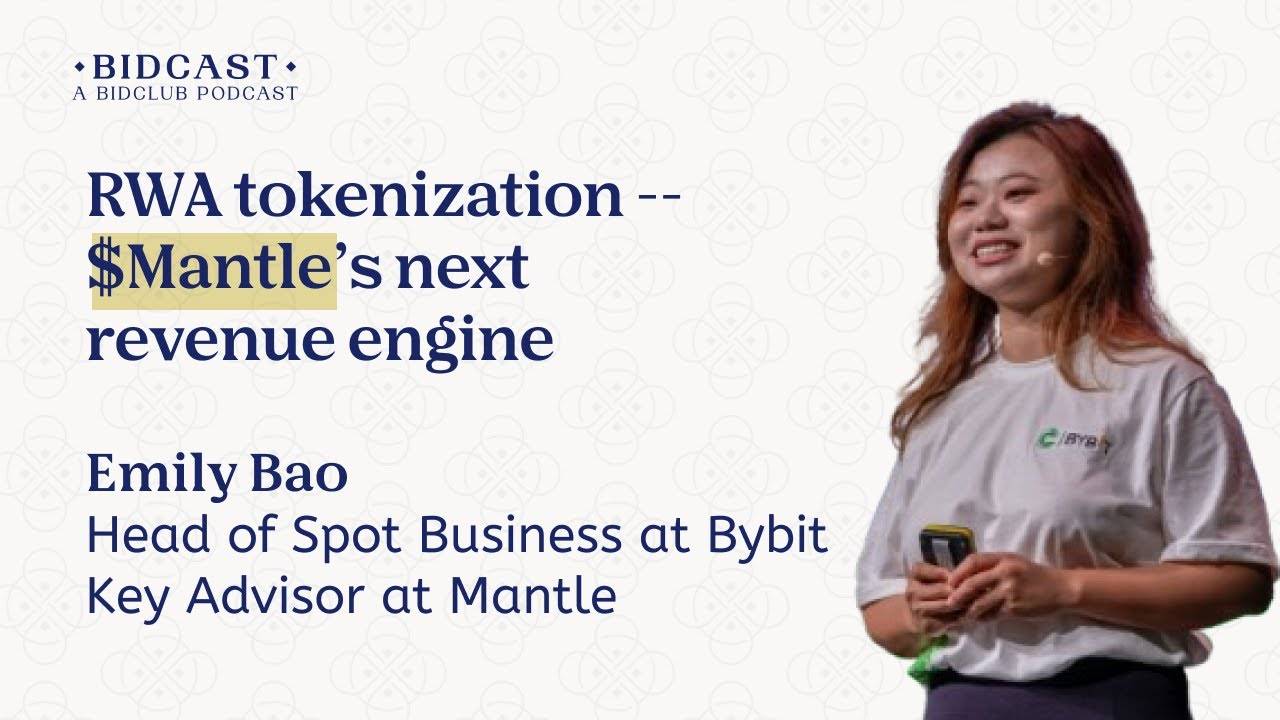
Guest: Emily Bao, Head of Spot Trading
Host: Jason Kam
Original Title: What will happen to $MNT with a closer Bybit tie-up? - Emily Bao (Key advisor at Mantle)
Podcast Source: BidCast
Release Date: September 19, 2025
Key Takeaways
Bybit's $4 billion annual revenue, Mantle's $5 billion treasury, and RWA-driven strategies shaping fund-scale crypto initiatives.
Highlights Summary
-
As a centralized exchange, our core business is asset management and trading services. Therefore, our mission is to identify high-quality assets early and bring them onto the platform to deliver the best trading experience.
-
Mantle and Bybit remain two separate entities. Mantle is not Bybit’s exclusive chain, but rather a key ecosystem partner within Bybit’s core network.
-
I believe the most anticipated feature is the MNT fee discount. After September 23, users will be able to pay trading fees with MNT tokens and receive a discount.
-
We can't predict every future change precisely, but one thing is certain: MNT will always remain a key partner in Bybit’s core ecosystem.
-
Centralized exchanges still play an indispensable role in today’s crypto ecosystem. They aggregate the largest number of crypto traders and provide industry-leading liquidity.
-
Bybit’s daily trading volume is around $30 billion, with approximately $25 billion from derivatives and $5 billion from spot trading. At a commission rate of 3 to 4 basis points, this translates to roughly $4 billion in annual revenue—an accurate benchmark for estimating our financials.
-
We’ve already started engaging with RWA issuers across different regions. While current partnerships are limited, several projects are in active discussion, and prospects look very promising. You may soon see real RWA assets launched on the Mantle chain.
-
We’re negotiating with a major fund management company based in the U.S. and Europe. We're also talking with listed companies in Asia and the U.S. that want to tokenize their stocks and list them on crypto exchanges.
-
MNT is tradable not only on Bybit but also on other platforms such as centralized exchanges and Hyperliquid spot exchange. We collaborate with market makers to ensure sufficient token liquidity across these platforms.
-
Many people ask if there’s a way to buy MNT at a lower price. We plan to launch a discounted purchase product for Mantle by the end of September (with a vesting period). It will be available to all retail users, VIPs, and institutional clients.
-
Daily active users (DAU), or active wallet addresses, are a crucial metric for measuring user engagement and activity on the Mantle chain.
-
We hope Mantle can enter capital markets—not as Bybit’s platform token, but as the core Layer 2 ecosystem governance token, MNT.
Transitioning from BIT to MNT Token
Jason:
Bybit launched the BIT token back in 2021, and now it's gradually transitioning to the MNT token. With the series of announcements you released in August and September, how have you been reconnecting the MNT token with Bybit’s ecosystem? Can you walk us through your thought process?
Emily:
I'm glad you brought up the BIT token. In fact, I joined Bybit after participating in the BIT token sale—I've held BIT for four years now, and I've been working with Bybit for three. My involvement with Mantle isn’t new; I’ve been following its development closely for a long time. I think this transition reflects what we’ve observed in the current market cycle: increasing synergy between centralized exchanges (CEX) and decentralized finance (DeFi). This isn’t about opposition, but growing collaboration.
This trend was already visible during the last cycle’s “DeFi Summer,” and in this cycle, DeFi has matured further while attracting many new users into crypto. These new users often begin their journey through DeFi applications, just like in the previous cycle. Meanwhile, centralized exchanges are actively embracing decentralized applications. As a CEX, our core business revolves around asset management and trading services. Therefore, our mission is to identify high-quality assets early and bring them onto the platform to deliver the best trading experience. This is both our responsibility and one of the goals we aim to contribute to the industry. That’s why we believe Mantle’s technological strengths make it a natural fit as a core ecosystem token for Bybit. Over the past few years, we’ve migrated Bit Dao and Bit Token to Layer 2 infrastructure and have seen Mantle evolve into an efficient and sustainable Layer 2 blockchain.
In addition, we’ve launched mEth and FBTC tokens and introduced the UR Bank product on Mantle. Many decentralized assets and applications on Mantle are now deeply integrated with Bybit. Furthermore, MNT, as the governance token of the Mantle Network, already offers multiple utility functions and benefits to holders on the Bybit platform. Through the partnership between Bybit and Mantle, we aim to realize the vision of “two forces creating the future.” We plan to further leverage the Mantle Network and MNT token to empower Bybit users, enhance liquidity, and offer more accessible products and services. We also hope to attract more CEX users and traders to explore the innovation opportunities in DeFi and public on-chain networks.
The Future of MNT and Prospects for Collaboration with Bybit
Jason:
I remember during the BIT token era, Bybit would allocate part of its income or referral profits into the BIT treasury—sometimes millions per day, right? But that mechanism seems to have stopped with the transition to MNT. Now that MNT and Bybit’s ecosystems are becoming increasingly intertwined, will this practice berestarted?
Emily:
We currently don’t plan to restart that mechanism. Frankly, Mantle’s treasury is already one of the largest in the industry. We now have ample resources and capacity to drive more meaningful initiatives. To clarify, Mantle and Bybit remain two independent entities. Mantle is not Bybit’s exclusive chain, but a key ecosystem partner within Bybit’s core network.
Jason:
So Bybit now has many ways to empower MNT holders, right? For example,staking MNT can earn rewards similar to BNB airdrops, or using it as collateral. Beyond that, some features have already been announced. Among the upcoming Mantle and Bybit collaborations, which ones do you think are the most exciting?
Emily:
Besides those, I think the most anticipated feature is the MNT fee discount. As we’ve announced, this program is expected to officially launch on September 23. From that date onward, users will be able to pay trading fees with MNT tokens and enjoy a discount.
Jason:
Will those fees be burned? Or what exactly is the mechanism?
Emily:
We’ve received many user inquiries about fee burning or buyback mechanisms. In fact, this ties into the tokenomics upgrade of MNT—we need to plan strategically for the long term and may consider adjustments in the future.
Jason:
So currently, starting September 23, users paying trading fees via MNT will get a discount. And these MNT tokens will go into the treasury, similar to the previous BIT treasury model, correct?
Emily:
Exactly. However, we plan to further utilize the MNT treasury and other Mantle treasury resources to support the growth of the Mantle Network ecosystem. Funds in the treasury will be used to drive more innovative projects and application rollouts.
Jason:
Overall, even though MNT and Bybit are separate entities, their connection is clearly getting tighter. Soas an MNT holder, how can they feel confident that the benefits they currently enjoy won’t be reduced in the future?
For example, with BIT, when Bybit stopped sharing trading fees, BIT holders’ value capture was affected.How can people be sure thatMNT's benefits will remain protected going forward?
Emily:
That’s a great question. First, I believe nothing is permanent—the entire industry and ecosystem keep evolving. Benefits aren’t simply “taken away,” but rather upgraded or adjusted to adapt to market changes. We aim to provide users with more new benefits and features. Of course, we can’t predict every future change precisely, but one thing is certain: MNT will always remain a key partner in Bybit’s core ecosystem.
Jason:
I’d like to discuss Bybit’s revenue. From what I understand, Bybit’s daily trading volume is around $30 billion, with $25 billion from derivatives and $5 billion from spot trading. If we apply a fee rate of 0.03% to 0.04%, annualrevenue would be roughly $4 billion, correct?
Emily:
Your calculation is correct—this does serve as a solid reference point for forecasting our financials.
Jason:
There’s been a lot of discussion around recycling Bybit’s revenue back into the Mantle ecosystem for value capture. What’s your take on this idea?
Emily:
To be honest, I think the greater significance of the Bybit-Mantle partnership lies in Bybit’s market advantages. Currently, we’ve attracted the most active crypto traders in the industry and enjoy strong support from top-tier liquidity providers. These resources will powerfully support the development of the Mantle network and drive further ecosystem growth.
Bridging Centralized Exchanges (CEX) and Decentralized Finance (DeFi)
Jason:
Currently, Bybit trades aren’t settled on the Mantle chain, right? Transactions still happen on the centralized exchange.
Emily:
That’s correct. However, certain specific assets have already begun settling on the Mantle chain. As we advance our roadmap, we’ll place greater emphasis on real-world asset (RWA) applications and better serving institutional clients. This aligns with Mantle’s core positioning and our key direction for future development.
Here, liquidity is the key issue. While it might sound complex, from my perspective, centralized exchanges still play an indispensable role in today’s crypto ecosystem. They aggregate the most crypto traders and offer industry-leading liquidity. Yet, CEXs are private, while blockchain networks are public—all asset access and transactions occur transparently on-chain. This creates a gap between native on-chain assets and the private liquidity of centralized exchanges.
I believe Mantle occupies a unique position to bridge this gap—finding ways to match top-tier liquidity with on-chain assets and real-world assets, or supporting what will matter most in the industry over the next 10 to 20 years.
Growth Initiatives and Opportunities in Real-World Assets (RWA)
Jason:
I understand that new asset types like real-world assets (RWA) are better suited for on-chain trading rather than in the private environment of a centralized exchange. It seems Bybit is attempting an integration where users feel like they’re trading on a CEX, but the transaction actually settles on-chain. Does this mean the link between the two has already been established?
Emily:
Additionally, we’re continuously upgrading Mantle’s technical architecture to improve speed and security, making settlement and usage easier for institutional users.
Jason:
I have another question,regarding Bybit’s ~$4 billion in revenue. If we use this figure as a reference, what percentage of users do you expect will choose to pay trading fees with MNT instead of cash?
Emily:
A conservative estimate would be 20% to 30% of VIP traders opting for MNT. I believe most VIP users will find this feature appealing. A more aggressive forecast could be 50% to 60% adoption among VIPs.
Jason:
And VIPs account for about 80% of total trading volume, right?
Emily:
Slightly less, but including institutional clients, it’s around 80%.
Jason:
So somewhere between 70% and 80%, meaning perhaps 15% to 20% of trading volume could be settled in MNT.
Emily:
About right—based on actual spot trading data, regular users make up about 20%, while VIPs and institutions combined account for 80%.
Jason:
Is the ratio similar for derivatives trading?
Emily:
Slightly different, but generally close.
Jason:
So assuming 75% of trading volume comes from VIPs and institutions, and 25% of those VIPs choose to settle with MNT. If they enjoy a 30% to 40% fee discount,then ultimately 15% to 20% of trading volume might be settled via MNT.Does this imply significant token burn for MNT?
Emily:
Yes.
Jason:
This feature launches on September 23, right? But regarding the collected MNT, have you decided how to handle it?
Emily:
Yes, we are using part of the MNT in the treasury to fund and subsidize developers building innovative applications on the Mantle chain. We’re also collaborating with key partners, such as mainstream DeFi protocols, encouraging them to integrate Mantle into their projects. These partnership programs will also utilize MNT from the treasury.
Jason:
But if I calculate correctly, around $500 million worth of MNT could be consumed annually. You can’t possibly distribute that much in subsidies every year, right? Only a portion will likely be distributed.
Emily:
Yes, we’re also exploring additional use cases for MNT beyond native crypto ecosystem applications. For example, users may eventually use MNT to pay for Bybit Card or Bybit Pay services. While these features aren’t fully launched yet, we expect some initial functionality to go live by the end of September, further expanding MNT’s utility.
Jason:
Regarding value capture for MNT, there are two possible approaches: Bybit using cash to buy back MNT, or using fee revenue to burn MNT. What conditions are needed to implement either approach?
Emily:
We are indeed considering a tokenomics upgrade for MNT while evaluating these factors comprehensively. However, I believe it’s even more important to drive MNT’s growth beyond the Bybit ecosystem. Mantle is an independent blockchain network, and we aim to attract more assets and projects to join. For MNT holders, this means more investment opportunities—such as participating in DeFi activities or projects on Mantle. In the future, we might even see funds or equities directly purchasable with MNT.
Jason:
There’s a lot of speculation externally around fee sharing, buybacks, and burning. Ben surely understands the valuation gap between Mantle’s token and other Layer 1 or Layer 2 tokens. Do you think closing this valuation gap is his top priority? Will these proposals and tokenomics upgrades push us in that direction?
Emily:
I believe MNT is highly important to Bybit users. Although MNT isn’t Bybit’s native platform token, it enjoys deep synergies with Bybit. I see MNT becoming a key growth driver for Bybit, but we must use MNT carefully—ensuring proposed solutions benefit Bybit users while supporting builders and holders within the MNT ecosystem.
Jason:
Do you think they have a timeline in mind? Will these plans be implemented in Q4 or Q1?
Emily:
Ben is very focused on timelines. He wants everything completed as quickly as possible. People often ask why Bybit executes so effectively—the reason is Ben pushes for rapid progress on everything.
Jason:
Regarding growth initiatives, you’re advancing multiple fronts simultaneously—work on DeFi and RWA, as well as standalone banking efforts. Which set of opportunities excites you most in terms of driving MNT’s value and ecosystem growth? Are there any developments particularly worth anticipating in the near future?
Emily:
I’m personally very bullish on the RWA initiative. This isn’t a new concept—back in 2017, we were already discussing Security Token Offerings (STOs). Then stablecoins emerged, like Tether’s USDT, which transformed the crypto market. Crypto assets could now settle in USDT, driving widespread adoption.
In past cycles, we shifted from STO narratives to RWA. My first DeFi RWA project was Centrifuge, which experimented with tokenizing real-world assets. By purchasing these tokens, users seemed to gain partial ownership of real estate. Other experimental RWA projects followed. I believe RWA is back in focus this cycle. One catalyst was the approval of Bitcoin and Ethereum ETFs earlier this year, showing that large amounts of real-world capital—like fiat—can now flow into crypto markets and invest directly in crypto assets. Today’s crypto infrastructure is ready, thanks to excellent work done by developers during DeFi Summer, and regulators are becoming more receptive to crypto activities.
Jason:
Which asset do you think will generate the most trading volume?
Emily:
Stablecoins, definitely. Also, since xstocks launched at the end of June, tokenized stocks and equity tokens have drawn significant market attention.
Jason:
Do you think this helps Mantle? Because it seems more like stock contracts traded on Bybit, not necessarily requiring on-chain minting.
Emily:
Actually, we’ve listed xstocks tokens on our spot market—users can directly purchase them on Bybit. They can also buy them on decentralized exchanges (DEXs).
We do see real demand from users wanting to buy stock tokens. However, due to liquidity constraints, on-chain trading volume and AUM remain low. This may be because certain models or methods aren’t optimal—for example, the xstocks approach. Still, the demand is genuine, especially from Asian markets.
Jason:
Do you think this will materially impact Bybit’s daily $30 billion trading volume in the short term? Right now, volumes still seem small.
Emily:
Currently, yes, it’s quite small. But with xstocks launching, many teams are experimenting with similar ideas or seeking better solutions. This is a key direction for capital flows and could become a major growth driver.
Tokenization and Market Opportunities
Jason:
This seems like a whole new asset class—now people can trade these assets directly. Ultimately, this should contribute some growth to your trading volume, right? Is there any way to quantify the extent of this impact on your business?
Emily:
To be honest, the impact is still limited. Right now, there are only 10 stock tokens in the market, all major assets. However, I’m personally very optimistic about the future of on-chain IPOs and equity tokenization.
Jason:
Absolutely—this seems to be an emerging trend. Do you think these tokenized assets will primarily be launched on the Mantle chain, or will they appear on other blockchains like Solana or Ethereum?
Emily:
We certainly hope these assets will be tokenized on the Mantle chain. In fact, some cases have already occurred on Solana, but we’re actively pushing for Mantle to become the leading choice in this space.
Jason:
It sounds like a promising opportunity indeed. Are you taking concrete steps to increase the totalvalue locked (TVL) of these assets on the Mantle chain?
Emily:
Yes, we’ve already started communicating with real-world asset (RWA) issuers across different regions. While current partnerships are limited, several projects are in active discussion, and prospects look very positive. You may soon see real RWA assets launched on the Mantle chain.
Jason:
Can you share more details about these partnership projects?
Emily:
We’re negotiating with a major fund management firm from the U.S. and Europe. We’re also engaging with publicly listed companies in Asia and the U.S. that want to tokenize their stocks and list them on crypto exchanges.
Building a Thriving Ecosystem
Jason:
When looking at Mantle’s totalvalue locked (TVL), transaction fees, and other related metrics, what key drivers do you see in the coming months or quarters that could truly boost business growth—especially daily active users (DAU)?
Emily:
Daily active users (DAU), or active wallet addresses, are a crucial metric for measuring whether users are transacting and engaging on the Mantle chain. In building an ecosystem, there’s a philosophy: “A nation or region thrives based on the concentration and activity of its residents.” I believe this applies similarly to blockchain ecosystems. A successful ecosystem requires a large base of active users—this attracts more developers and builders to join your chain and contribute to the ecosystem. Solana has excelled here, building a vibrant ecosystem by attracting massive user and developer participation.
Jason:
Do you have any improvement plans foruser interface and user experience (UI/UX) to genuinely drive DAU growth?
Emily:
Of course—we’re running various campaigns to boost user engagement. More importantly, we’re working hard to bring more assets onto the Mantle chain to enrich the ecosystem. On the other hand, we’re actively attracting more crypto-native projects—such as DeFi protocols or on-chain apps—to build and develop on Mantle.
MNT Over-the-Counter (OTC) and Discounted Purchase Features
Jason:
I noticed your recent article mentioned the MNT over-the-counter (OTC) feature. Can you explain what this is?
Emily:
MNT OTC is a product feature allowing users to directly purchase large quantities of MNT tokens on the Bybit platform via the OTC function.
Jason:
Are these tokens bought directly from Mantle’s treasury? Where do buyers source these tokens?
Emily:
Tokens aren’t purchased directly from Mantle’s treasury—buyers acquire them from liquidity providers.
Jason:
So there must beliquidity providerswith sufficient inventory, otherwise market liquidity could be constrained, right?
Emily:
Actually, MNT is not only tradable on Bybit but also listed on other platforms, such as centralized exchanges and Hyperliquid spot exchange. We collaborate with market makers to ensure adequate token liquidity across these platforms.
Jason:
So institutions like us can directly contact market makers who provide quotes—say, for 1 million MNT. And through this OTC feature, you’re essentially enabling anyone to access market maker liquidity via the platform, correct?
Emily:
Exactly. When discussing the OTC feature, I should also mention the discounted purchase option. Many people ask if there’s a way to buy MNT at a lower price. While the OTC feature doesn’t offer that, we plan to launch a discounted purchase product for Mantle by the end of September.
Jason:
The discounted purchase means buying tokens at a discount, but with avesting period, right?
Emily:
Yes, the discounted purchase program is open to all retail users, VIPs, and institutional clients—they can all participate.
Partnerships and Multi-Chain Strategy
Jason:
Regarding Mantle Network’s collaboration with other platforms—such as revenue-generating launchpads—does Mantle have opportunities to partner with these companies? Even if they’re not on Mantle, but on Solana or their own chains, is collaboration possible? What’s your view?
Emily:
Absolutely possible. In fact, we’re already in talks with—and have begun cooperating with—some DeFi platforms that support multi-chain operations. One such platform is currently in testing phase but is expected to fully launch by the end of September. It’s a multi-chain token launchpad developing a multi-chain verification platform that will support Solana and other blockchains, including Mantle. Mantle will be onboard from day one.
Jason:
How is the acquisition of URbank progressing?
Emily:
Currently, it’s just a showcase case. We’re actively pursuing business development to integrate more DeFi projects onto the Mantle chain, including larger-scale ones.
Jason:
What specific benefits will Bybit’s acquisition of Urbank bring to Mantle?
Emily:
Regarding URbank, I’m not sure if you’ve tried their product—I suspect you might have. URbank uses a whitelist-based invitation system, which went live around late June. I believe they’ll soon open to the public.
Jason:
So will this change bring tangible benefits to Mantle?
Emily:
Yes, the Mantle chain will benefit.
Impact of Regulatory Changes
Jason:
I have two more questions. Earlier, before going live, we mentioned that the SEC recently made statements about centralized sequencers, suggesting Layer 2 networks could resemble exchange data centers and may require SEC registration.
Do you think Hester Peirce’s statement will impact the Mantle chain or other Layer 2 networks? As far as I know, some Layer 2 networks have centralized sequencers. How do you think this will affect your business?
Emily:
This is a very important issue. We did pay attention to that speech and had in-depth discussions with our tech team. Currently, we’re exploring solutions to make the Mantle network more decentralized while maintaining network security.
Compared to other Layer 2 blockchains, Mantle’s technical architecture is indeed advanced. We were the first project to support zero-knowledge proofs (ZKP), enhancing privacy and security. We’re also actively upgrading the network and following industry best practices.
Frankly, we haven’t finalized a solution yet, but this issue has our full attention. Even before the speech, we recognized the potential implications, and afterward, we became even more convinced action is needed. We understand there’s some buffer time, but this has become one of our top priorities—we’ll also continue monitoring developments on Base chain.
Jason:
Base chain is essentially highly centralized, right? Do you think it was precisely because of theSEC speech that they’re now considering launching a token to decentralize the sequencer set?
Emily:
What Base will do next is definitely worth watching.
Jason:
In a way, the relationship between Base and Coinbase seems quite similar to that between Mantle and Bybit.
Path to Capital Markets and Future Strategy
Jason:
Binance and OKX often attract early investor liquidity through different approaches. For example, Binance, facing many regulatory hurdles with equity IPOs, appears to have opted for BNB tokenization of equity. For a long time, BNB was seen as Binance’s “pseudo-equity,” trying to link Nasdaq-level liquidity to BNB, giving it equity-like functions. That might be their path—they may go public soon.
Another model is OKX—they have their OKB token, but seem to prefer a traditional IPO route. They’ve completed all necessary compliance steps to list OKX. Hence, OKB underwent a major burn event and no longer captures future value via the token.
Do you think Bybit has considered a similar capitalization path? Could tighter integration with MNT, using data, achieve this goal? Or do you think an IPO path for Bybit is feasible?
Emily:
This is a challenging question—indeed difficult to answer. Alright, let me try. As you noted, Binance and OKX chose different paths, but I believe their ultimate goals are similar: entering capital markets through their platform tokens. I think that’s also what we aim to achieve through Mantle. We hope Mantle can enter capital markets—not as Bybit’s platform token, but as the core Layer 2 ecosystem governance token, MNT.
Looking ahead, there may be different implementation paths. The existing models may not perfectly fit Mantle, but this is indeed an active internal discussion topic.
Join TechFlow official community to stay tuned
Telegram:https://t.me/TechFlowDaily
X (Twitter):https://x.com/TechFlowPost
X (Twitter) EN:https://x.com/BlockFlow_News
 深潮TechFlow