








Web3 Lawyers’ Interpretation: New Regulations by Eight Ministries Take Effect, Clarifying the Regulatory Path for RWAs
TechFlow Selected TechFlow Selected
Web3 Lawyers’ Interpretation: New Regulations by Eight Ministries Take Effect, Clarifying the Regulatory Path for RWAs
Document No. 42 is the most precise and comprehensive legal regulatory document currently applicable to virtual currency-related businesses.
 Navigating Web3 tides with focused insights
By: Crypto Salad
Eight ministries—including the People’s Bank of China (PBOC), the National Development and Reform Commission (NDRC), the Ministry of Industry and Information Technology (MIIT), the Ministry of Public Security (MPS), the State Administration for Market Regulation (SAMR), the National Financial Regulatory Administration (NFRA), the China Securities Regulatory Commission (CSRC), and the State Administration of Foreign Exchange (SAFE)—jointly issued regulatory provisions concerning virtual currencies and tokenization of real-world assets (RWA): “Notice on Further Preventing and Addressing Risks Related to Virtual Currencies and Other Matters” (Yinfa [2026] No. 42) (hereinafter referred to as the “No. 42 Notice”).
Industry insiders had previously anticipated the release of new regulations. Upon official publication, the No. 42 Notice proved comprehensive in scope; after reading it, Crypto Salad concluded that nearly all prior compliance efforts undertaken by market participants in the RWA space had already been accurately anticipated and addressed within this document issued jointly by the eight ministries and the CSRC.
Let’s quickly walk through its key points:
Nature of the No. 42 Notice
In 2017 and 2021, regulators issued the “September 4 Notice” and the “September 24 Notice,” respectively; since then, no comprehensive legal instrument governing this domain has been formally enacted. A coordination meeting held by thirteen ministries at the end of 2025 and risk alerts issued by seven industry associations were not upgrades to formal legal instruments. Below is a comparative overview of the nature of five core related documents:
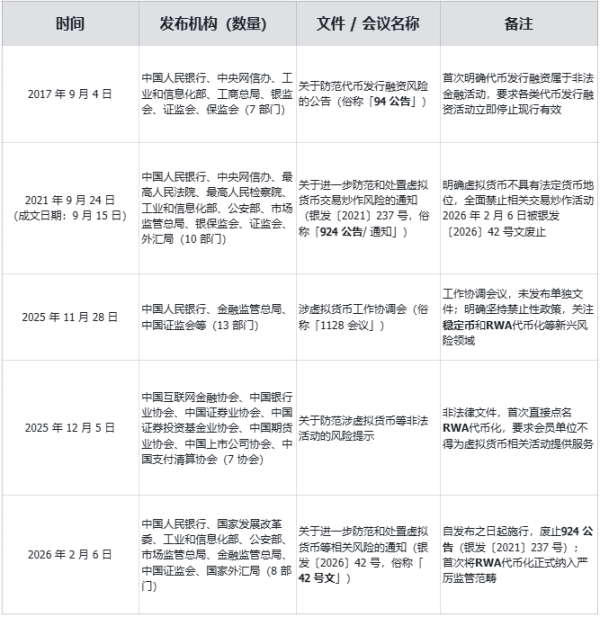
Key conclusion: The No. 42 Notice is currently the most precise and comprehensive regulatory document applicable to virtual currency–related activities. The September 24 Notice has been officially repealed upon the implementation of the No. 42 Notice.
Core Differences Between the No. 42 Notice and Prior Virtual Currency Regulatory Documents
(1) Broadened Regulatory Scope
1. Newly added core regulated entities: For the first time, tokenization of real-world assets (RWA) and stablecoins are explicitly included within the central scope of regulation. The regulatory framework has thus expanded from solely targeting virtual currency trading and speculation to a holistic, end-to-end regulatory model covering “virtual currencies + RWA + stablecoins.”
2. Detailed regulation of stablecoins: It clarifies that “stablecoins pegged to legal tender effectively perform certain functions of legal tender in circulation and use,” and prohibits “any domestic or overseas entity or individual from issuing stablecoins pegged to the RMB outside China without explicit approval from competent authorities in accordance with law and regulation.”
3. Clear definition of RWA: Defined as “activities involving the use of cryptographic techniques and distributed ledger or similar technologies to convert ownership rights, income rights, or other entitlements over assets into tokens (or other instruments bearing token-like characteristics), followed by issuance and trading thereof.”
(2) Elevated Issuing Authorities and Legal Effectiveness
The No. 42 Notice was jointly issued by eight ministries—including the PBOC and NDRC—and coordinated with three additional departments—the Cyberspace Administration of China (CAC), the Supreme People’s Court (SPC), and the Supreme People’s Procuratorate (SPP)—with explicit approval from the State Council. Its institutional hierarchy and legal authority are significantly enhanced compared to prior documents.
(3) Updated and Enhanced Legal Basis
New statutory foundations include the People’s Republic of China Futures and Derivatives Law, the People’s Republic of China Securities Investment Fund Law, and the Regulations on the Administration of the Renminbi, resulting in more robust legal grounding. Meanwhile, references to outdated instruments such as the Regulations on Futures Trading and the State Council Decision on Cleaning Up and Rectifying Various Trading Venues and Effectively Preventing Financial Risks—previously cited in the September 24 Notice—have been removed, ensuring more precise legal applicability.
(4) Refined Definition of Virtual Currencies
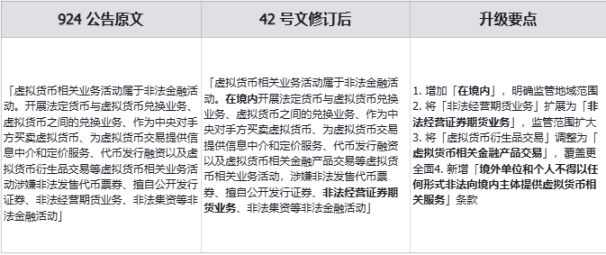
(5) New Definitions for RWA and Stablecoins
The No. 42 Notice introduces dedicated provisions defining the nature of RWA: “Tokenization of real-world assets conducted within China, as well as provision of intermediary or information technology services related thereto, constitutes illegal issuance of tokenized vouchers, unauthorized public offering of securities, unlawful operation of securities or futures businesses, or illegal fundraising—such activities shall be prohibited; exceptions apply only where relevant business operations are carried out under specific financial infrastructure platforms with prior approval from competent business authorities in accordance with law and regulation.”
It also explicitly bans overseas provision of RWA-related services: “No overseas entity or individual may provide real-world asset tokenization services to domestic parties in any form whatsoever.”
Key conclusions: Based on the above provisions, the following are clearly prohibited:
1. RWA projects located in China, with service providers also based in China — illegal
2. RWA projects located in China, with service providers based overseas — illegal
3. NFT projects of similar nature, suspected of illegal issuance of tokenized vouchers — illegal
4. RWA projects located overseas but involving illegal fundraising activities targeting domestic investors — illegal
(6) Refinement of Regulatory Division of Responsibilities: From Multi-Department Coordination to Dual-Track Supervision
The September 24 Notice merely established a multi-department coordination mechanism: “The PBOC, in conjunction with the CAC, SPC, SPP, MIIT, MPS, SAMR, NFRA, CSRC, and SAFE, shall establish a working coordination mechanism.”
The No. 42 Notice innovatively implements a dual-leadership system, clearly dividing supervisory responsibilities into two distinct tracks:
1. Virtual currency supervision: “The PBOC, in conjunction with the NDRC, MIIT, MPS, SAMR, NFRA, CSRC, and SAFE, shall improve the working mechanism.”
2. RWA supervision: “The CSRC, in conjunction with the NDRC, MIIT, MPS, PBOC, SAMR, NFRA, and SAFE, shall improve the working mechanism.”
Key conclusions:
1. Ambiguities and inefficiencies arising from loosely defined inter-agency coordination under previous frameworks have been resolved via clearly delineated statutory authority and accountability mechanisms—leaving no room for buck-passing or administrative inertia.
2. Market participants planning to explore related business activities can now precisely identify governmental powers and responsibilities, thereby minimizing misjudgments in operational planning.
(7) Strengthened Local-Level Accountability
Building upon the September 24 Notice, the No. 42 Notice adds: “Implementation shall be led by local financial regulatory authorities, with participation from branches and dispatched institutions of State Council financial regulators, telecommunications regulators, public security organs, and market regulation authorities, operating in close coordination with cyberspace administration departments, people’s courts, and people’s procuratorates.” This explicitly assigns leadership roles and collaborative mechanisms at the local enforcement level, further reinforcing territorial regulatory accountability.
(8) Enhanced Oversight of Financial Institutions
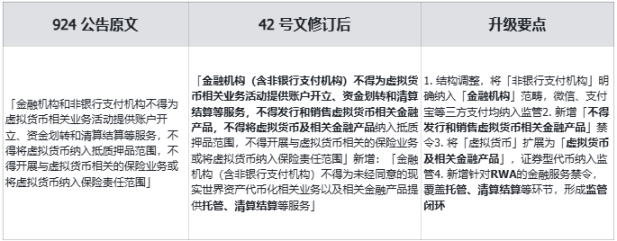
(9) Expanded Supervision of Intermediaries and IT Service Providers
While the September 24 Notice covered only virtual currency–related services, the No. 42 Notice newly stipulates: “Intermediary and information technology service providers must not offer intermediary or technical services for RWA-related activities or associated financial products unless expressly authorized by competent authorities.” This formally extends regulatory oversight to intermediaries and technical service providers operating in the RWA domain.
(10) Tighter Registration and Management Requirements for Market Participants
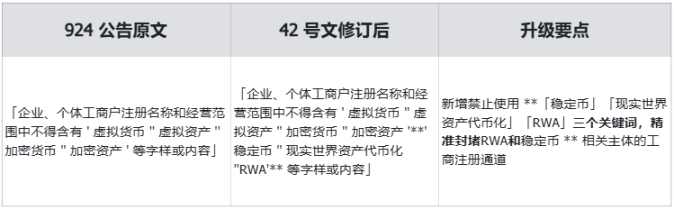
(11) Heightened Crackdown on Cryptocurrency Mining
The September 24 Notice only mentioned “end-to-end tracking and real-time information backup across the full mining, trading, and exchange chain for virtual currencies.” In contrast, the No. 42 Notice separately details Article 9, explicitly stating: “Manufacturers of mining equipment are strictly prohibited from providing sales or other services related to mining equipment within China.” This severs the mining supply chain at its source. Compared to the monitoring requirements in the September 24 Notice, the new rule is stricter, more enforceable, and specifies procedural mechanisms for handling leads received by relevant departments.
(12) Innovative Regulation of Overseas Issuance
Taking into account evolving developments in global crypto markets, the No. 42 Notice introduces a new “dual prohibition” on overseas issuance targeting cross-border activities:
1. Without explicit approval from competent authorities in accordance with law and regulation, domestic entities—and their overseas affiliates under their control—are prohibited from issuing virtual currencies overseas.
2. Regarding RWA: “Where domestic entities directly or indirectly conduct RWA activities abroad in the form of foreign debt, or carry out overseas RWA activities—such as asset-backed securities (ABS) or equity-like tokenization—based on ownership or income rights over domestic assets, relevant departments—including the NDRC, CSRC, and SAFE—shall, in accordance with their respective mandates and applying the principle of ‘same business, same risk, same rules,’ strictly regulate such activities in accordance with law and regulation.”
Key conclusions: Based on the above provisions:
1. Overseas issuance of non-RWA tokens lacking underlying assets — illegal
2. Securities-type tokenization activities resembling foreign debt, equity, or ABS — lawful under strict regulation
3. Regulatory principles for lawful RWA — aligned with securities business regulation: “same business, same risk, same rules”
(13) Strengthened Oversight of Overseas Operations by Domestic Financial Institutions, with Clarified Accountability
The No. 42 Notice newly stipulates: “Overseas subsidiaries and branches of domestic financial institutions providing RWA-related services abroad must operate prudently and in compliance with law, deploy qualified personnel and systems, effectively manage business risks, strictly implement customer due diligence, suitability management, anti-money laundering (AML), and other requirements, and incorporate such overseas activities fully into the domestic institution’s compliance and risk control management system.” This achieves a “through-the-chain” regulatory approach for cross-border operations.
Key conclusions: Based on the above provisions:
1. Overseas branches (e.g., overseas branches or representative offices) of domestic financial institutions may conduct tokenization-related activities.
2. When conducting tokenization activities overseas, such branches must comply simultaneously with local laws and Chinese regulatory requirements, fulfilling legally mandated obligations including heightened prudence and AML compliance.
3. Business information and data generated by overseas branches must be fully integrated into the domestic institution’s compliance and risk control system.
(14) Coverage of Cross-Border Services Provided by Intermediaries
The No. 42 Notice newly stipulates: “Intermediary and information technology service providers offering services to domestic entities—whether directly or indirectly—for overseas RWA activities conducted in the form of foreign debt, or for overseas RWA activities based on domestic rights and interests, must strictly abide by applicable laws and regulations, establish and maintain sound internal compliance and control systems per relevant norms, strengthen business and risk management, and seek prior approval or file reports on such activities with competent regulatory authorities.” This formally brings cross-border service providers under regulatory purview.
Key conclusions: Based on the above provisions:
1. Intermediaries—including law firms and technology companies—may provide tokenization-related services within a regulatorily controlled environment.
2. When engaging in tokenization activities, intermediaries must maintain robust risk management and internal control systems, and report or obtain approvals for such activities from regulatory authorities.
(15) Expanded Scope of Legal Liability
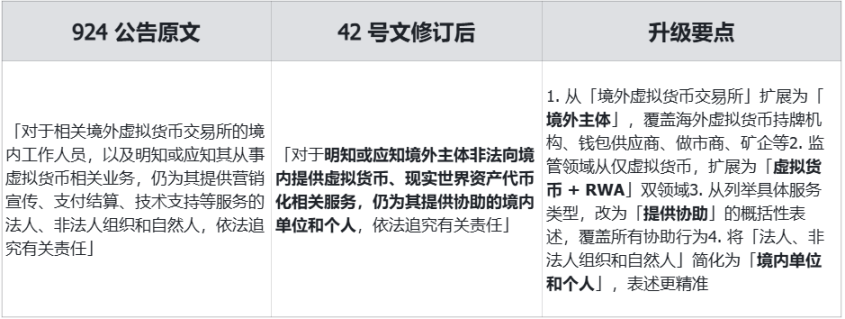
(16) Optimized Civil Liability Provisions
The September 24 Notice stated: “Civil juridical acts involving investment in virtual currencies and related derivatives by any legal person, unincorporated organization, or natural person—where such investment violates public order and good customs—are invalid.” The No. 42 Notice revises this to: “Civil juridical acts involving investment in virtual currencies, real-world asset tokens, and related financial products by any entity or individual—where such investment violates public order and good customs—are invalid.” This expands the scope of investable instruments from “virtual currencies and related derivatives” to “virtual currencies, real-world asset tokens, and related financial products,” thereby broadening regulatory coverage.
Key conclusion: All fundraising schemes marketed domestically under the banner of RWA offer investment rights and interests that are not protected by law.
Current Status and Future Trajectory of RWA Business
The concept and early projects of RWA originated overseas, sharing similarities with the earlier STO (Security Token Offering) concept but offering broader potential—earning the industry moniker “everything can be RWA.” Domestic discussion around RWA began gaining traction in 2024 and peaked in volume between June and August 2025—a trend closely tied to the entry of major domestic institutions including Ant Group, JD.com, and Guotai Junan Securities, as well as regulatory upgrades in the U.S. and Hong Kong, stablecoin legislation, and ongoing licensing initiatives in crypto regulation.
Currently prevalent RWA projects and underlying assets in the market include:
1. Emerging operating cash-flow assets, such as new-energy and computing-power assets
2. Traditional operating assets, such as commercial leasing
3. Consumer-goods projects leveraging cultural IP value-addition
4. Physical assets, including real estate, antiques, artworks, and mineral resources
5. Other asset categories
Mainstream RWA financing solutions adopted by practitioners:
1. Security-token issuance targeting assets listed in categories 1 and 2 above, conducted in jurisdictions with clear regulatory frameworks—fully lawful, yet subject to the highest regulatory standards and operational costs
2. Issuance targeting category 3 assets and NFTs on domestic cultural property exchanges, data exchanges, and industrial property exchanges—subject to lower regulatory thresholds and not explicitly deemed illegal
3. Issuance of token projects lacking cash-flow support—targeting assets in categories 4 and 5 above—on overseas centralized or decentralized exchanges. Though seemingly backed by physical assets, such projects often involve high-risk practices including pyramid-scheme recruitment, price manipulation, fundraising, and market control; they remain undefined in current legal texts.
Given significant differences in underlying asset characteristics, investor profiles, operational rigor, and project-team values, numerous gray-area approaches exist in the RWA space, with some practitioners deliberately blurring regulatory boundaries. Without stringent oversight, there is a high risk of bad money driving out good, leading to frequent high-risk incidents and mass investor fraud. Currently, the field features a highly heterogeneous participant base—including domestic and overseas securities firms, issuance service providers, overseas exchanges, digital intermediaries (“digital compradors”), data service providers, and domestic property-right exchanges.
With the promulgation of the No. 42 Notice, everything has changed. A meticulous textual analysis reveals the regulators’ underlying philosophy and strategic intent:
1. Legislators have comprehensively reviewed regulatory frameworks in the U.S., Europe, and Hong Kong, incorporating international references into both regulatory procedures and terminology—achieving appropriate alignment with global standards.
2. The new regulation comprehensively covers emerging areas such as stablecoins and RWA, while also filling longstanding regulatory gray zones, including mining-equipment sales and enforcement against mining activities.
3. In domains where technological maturity remains insufficient and rule-making authority has yet to be secured, regulators adopt a stance of explicit prohibition to safeguard against financial risks.
4. For necessary alignment with overseas fundraising rules—particularly in jurisdictions where regulatory frameworks are well-defined—tokenization projects implemented to strict standards retain an open window for participation by domestic financial institutions and intermediary service providers.
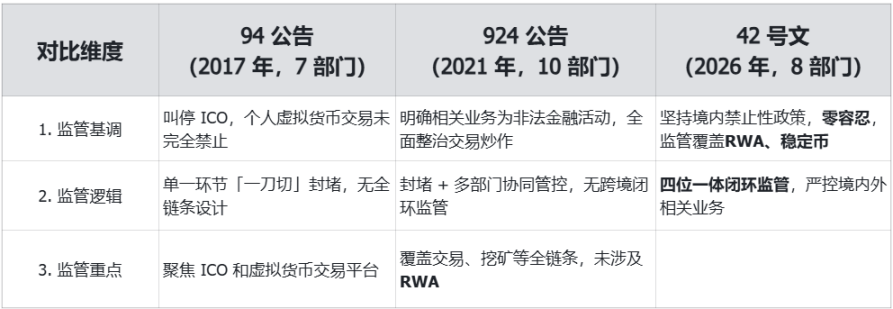
Comparative Table of Core Regulatory Logics: September 4 Notice, September 24 Notice, and No. 42 Notice
CSRC: Which Administrative Permits Apply to RWA Projects?
As the principal regulator overseeing RWA activities, the CSRC promptly issued CSRC Announcement No. 1 of 2026: “Regulatory Guidelines on Tokenized Asset-Backed Securities Issued Abroad Against Domestic Assets.”
The Guidelines explicitly state:
1. Tokenized asset-backed securities issued abroad against domestic assets must strictly comply with laws, administrative regulations, and policy provisions governing cross-border investment, foreign exchange management, and network and data security, and must fulfill relevant approval, filing, or security review procedures required by competent regulatory authorities.
2. Where the underlying assets—or the domestic entities that ultimately control them—fall under any of the following circumstances, related business activities are prohibited:
(i) Explicitly prohibited by law, administrative regulations, or national policies from raising capital via capital markets;
(ii) Determined by competent State Council departments, following lawful examination, to potentially jeopardize national security if tokenized asset-backed securities are issued abroad;
(iii) Where the domestic entity—or its controlling shareholder or actual controller—has committed criminal offenses—including embezzlement, bribery, appropriation of property, misappropriation of funds, or disruption of socialist market economic order—within the past three years;
(iv) Where the domestic entity is currently under lawful investigation for suspected criminal activity or serious violations of law and regulation, with no conclusive determination yet reached;
(v) Where material disputes exist regarding title to the underlying assets, or where such assets are legally non-transferable;
(vi) Where the underlying assets fall under prohibited categories specified in the negative list for underlying assets in domestic asset securitization business.
3. Prior to commencing related business activities, RWA project sponsors must submit a filing report to the CSRC along with complete overseas issuance documentation, fully disclosing information about the domestic filing entity, underlying assets, and token issuance plan. Upon completion of the CSRC filing process, the filing information will be publicly posted on the CSRC website. [Key point: For projects tokenizing domestic assets or income rights overseas, obtaining this CSRC filing constitutes de facto recognition of legality.]
Additionally, for RWA projects that have completed issuance, the CSRC will implement ongoing supervision during their operational phase, maintaining continuous regulatory oversight and information-sharing with overseas regulatory counterparts.
Crypto Salad believes that with the release of these documents, RWA—as a novel concept—has finally undergone a process of “separating truth from falsehood” and secured its survival, returning firmly to the logic of securities-type token issuance and regulation. Although many detailed implementing rules remain pending, the regulatory gray zones surrounding RWA and stablecoins—which persisted over the past three years—have now been fully mapped. With legislative backing, regulators now possess effective tools, and practitioners have clear guidance.
Disclaimer: This article is an original work by the Crypto Salad team. It reflects only the personal views of the author and does not constitute legal advice or opinions on specific matters.
Join TechFlow official community to stay tuned
Telegram:https://t.me/TechFlowDaily
X (Twitter):https://x.com/TechFlowPost
X (Twitter) EN:https://x.com/BlockFlow_News


