RWA Sector Basics: Understanding RWA from the Perspective of Traditional Finance (1)
TechFlow Selected TechFlow Selected
RWA Sector Basics: Understanding RWA from the Perspective of Traditional Finance (1)
Systematically analyze the RWA landscape, providing a one-stop research framework covering financial fundamentals, core technologies, compliant operations, global project matrix, future trends, and entrepreneurial pathways.
 Navigating Web3 tides with focused insights
【Editor's Note】: Since 2025, W Labs has engaged with several large Chinese-funded institutions across sectors including infrastructure, energy, and luxury goods—some even state-owned entities—requesting research analyses and real-world applications of domestic and international RWA. As the year comes to a close, we are sharing some of our publicly available findings with our community.
This series covers extensive content. Rather than asserting whether RWA will become the primary breakout direction for the crypto industry in the future, or labeling it as "gilding the lily" or "wolf in sheep's clothing," we aim simply to present our observations and insights, encouraging readers to reflect more deeply on the industry’s future trajectory.
Amid the global wave of financial technology innovation, tokenization of real world assets (RWA) has emerged as a core convergence point between Web3 ecosystems and traditional finance (TradFi). From BlackRock launching its BUIDL fund (with over $500 million TVL) on the Ethereum mainnet, to Hong Kong Monetary Authority’s Ensemble sandbox handling $500 million worth of RWA transactions, RWA is reshaping asset liquidity, financing efficiency, and global settlement frameworks.
Hong Kong, positioned as an “Eastern RWA Hub,” stands out prominently: following the implementation of its 2025 Stablecoin Ordinance, over 50 compliant projects have emerged within just six months—such as HashKey Exchange’s GF Token ($150 million money market fund), AntChain’s Langxin EV charging station RWA (¥1 billion in new energy assets), and Asseto’s DeRings Tower property tokenization (HK$50 million). This surge not only attracts major Chinese enterprises into global markets but also bridges “Belt and Road” supply chains with international capital. However, recent temporary suspensions by mainland regulators on certain cross-border RWA pilots have briefly cooled market enthusiasm. Yet such pauses cannot halt the structural rise of RWA within regulatory sandboxes and institutional adoption across the U.S., Europe, and China—evident in legislative developments like FIT21 and GENIUS acts, where stablecoins + RWA are evolving into a “digital Bretton Woods system” in great power competition.
This article series offers a systematic analysis of the entire RWA landscape—from financial fundamentals, core technologies, compliance operations, and global project matrices to future trends and entrepreneurial pathways—providing a one-stop research framework. The series consists of four long-form articles: the first introduces foundational RWA knowledge; the second focuses on global regulatory practices and representative projects; the third examines China and Hong Kong’s regulatory landscape and key cases; the fourth elaborates practical implementation paths and future industry directions under current conditions. Our goal is that after reading this series, readers will hold a comprehensive guide to understanding the trillion-dollar RWA赛道. Whether you're an institutional investor, traditional enterprise, or Web3 entrepreneur, we aim to unlock strategic advantages and advance global circulation and digital overseas expansion of Chinese assets.
What is RWA
RWA (Real World Assets) refers to valuable assets existing in the physical world—such as real estate, corporate loans, government bonds, artwork, carbon credits, oil, and even limited-edition whiskey. These assets are transformed into digital tokens via blockchain technology, enabling them to be freely traded, circulated, and combined globally like cryptocurrencies. In traditional finance, these assets often face high entry barriers, poor liquidity, and geographical constraints. Once tokenized, they become “on-chain assets,” breaking down traditional barriers with the following characteristics:
-
Enable fast trading, allowing investors to operate similarly to stock trading;
-
Can be used as collateral to obtain loans;
-
Can be bundled into diversified investment “baskets”;
-
Holders can receive income distributions such as rent or interest;
-
Achieve global circulation without border or time limitations.
Tokenizing RWAs enhances asset liquidity and accessibility, offering users more flexible investment options while lowering participation thresholds, thus driving financial innovation and inclusivity. Through blockchain technology, RWA injects digital vitality into traditional assets, serving as a critical bridge connecting the physical and digital economies, with broad applications across finance, art, energy, and other sectors.
Why Now?
The current surge in real-world asset (RWA) tokenization stems from multiple drivers: technological advancement, regulatory optimization, institutional involvement, and growing market demand. On the technical front, blockchain platforms like Ethereum and Polygon have matured significantly. Smart contracts and oracle technologies enhance security and scalability of on-chain assets, while decentralized identity solutions reduce trust costs in traditional finance.
Regulatory environments are becoming clearer: the U.S. has eased its pace with more defined policies; the Hong Kong Monetary Authority launched a digital asset “regulatory sandbox”; Singapore supports on-chain bond and fund initiatives—creating fertile ground for RWA development. Traditional financial giants such as BlackRock, JPMorgan Chase, and Citigroup entering the space bring capital, resources, and compliance expertise, pushing RWA beyond niche blockchain circles into mainstream financial markets.
On the demand side, persistently high interest rates and declining returns on traditional assets have driven investors to seek new allocations. RWA meets this need by offering enhanced liquidity and global access through tokenization. Moreover, blockchain technology has transitioned from a phase dominated by tech enthusiasts to widespread adoption by pragmatists. Stablecoins are now integrated into real-world economic activities—including cross-border e-commerce, freelancer payments, and global remittances—highlighting RWA’s increasing role as blockchain infrastructure.
Market Size and Growth Rate
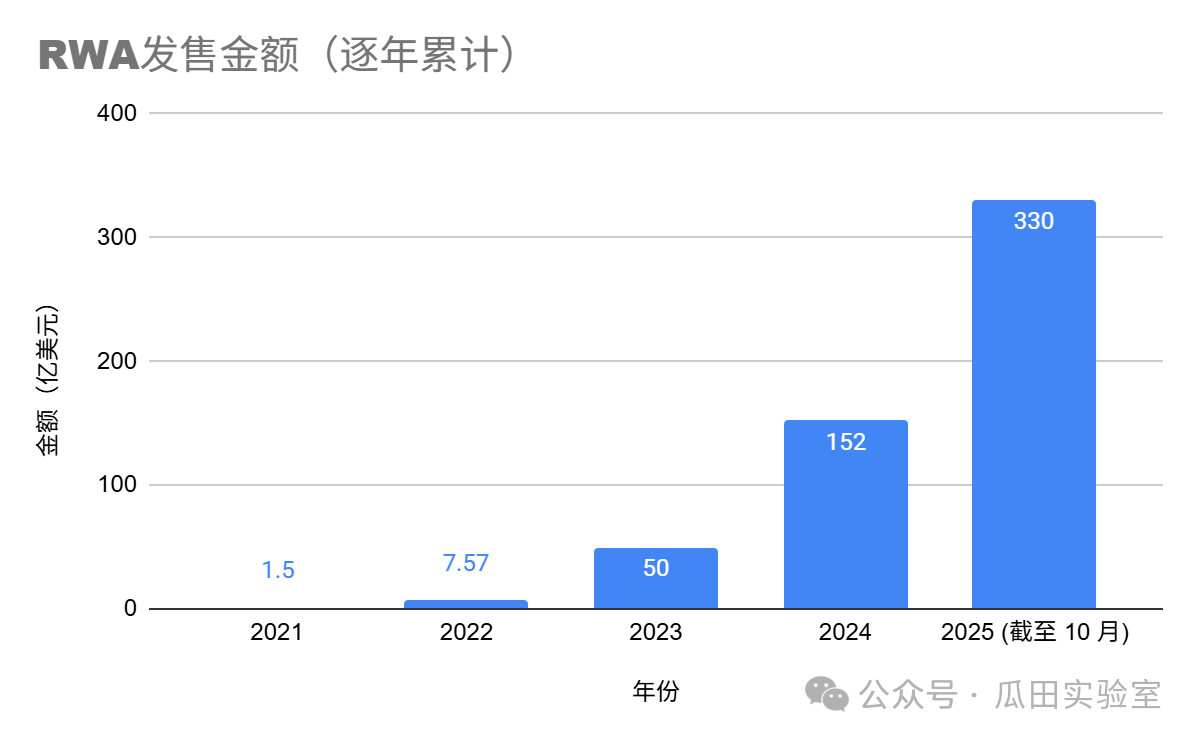
Global exploration of RWA is rapidly heating up—from Hong Kong to Europe, Dubai to North America—revealing diverse trends in institutional design, technical approaches, and business models. To date, the total value of global RWA assets has reached $33 billion. Major consulting and financial institutions have made bold projections about RWA’s future growth:
-
Boston Consulting Group forecasts that by 2030, the RWA market could reach $16 trillion, rising to $18.9 trillion by 2033, representing a compound annual growth rate (CAGR) of approximately 53% over the next eight years.
-
Deloitte estimates that by 2035, the real estate tokenization market will hit $4 trillion, with an average annual growth rate of around 27%.
-
McKinsey predicts that by 2030, about $16 trillion of global assets will circulate on-chain via RWA, with 20%-30% potentially originating from Chinese assets—highlighting immense potential. McKinsey’s 2024 report further suggests that the market cap of tokenized financial assets globally could reach $2–4 trillion by 2030.
-
BlackRock CEO Larry Fink has repeatedly emphasized that RWA is one of blockchain’s most transformative applications, capable of reshaping the global asset management industry. In his annual shareholder letter, he stated: “Tokenization will be the next phase of financial assets—every stock, every bond will run on a unified ledger.”
In the stablecoin sector, payment and settlement volumes based on stablecoins reached $16.16 trillion in 2024—surpassing the combined totals of Visa and Mastercard—marking the emergence of a new payment system independent of traditional banks and the SWIFT network. Traditional cross-border payments involve complex processes, multiple intermediaries, take up to two weeks, and incur high costs. In contrast, stablecoins leverage price stability mechanisms and real-time on-chain settlement to enable peer-to-peer, trustless transactions completed in seconds without reliance on legacy clearing systems.
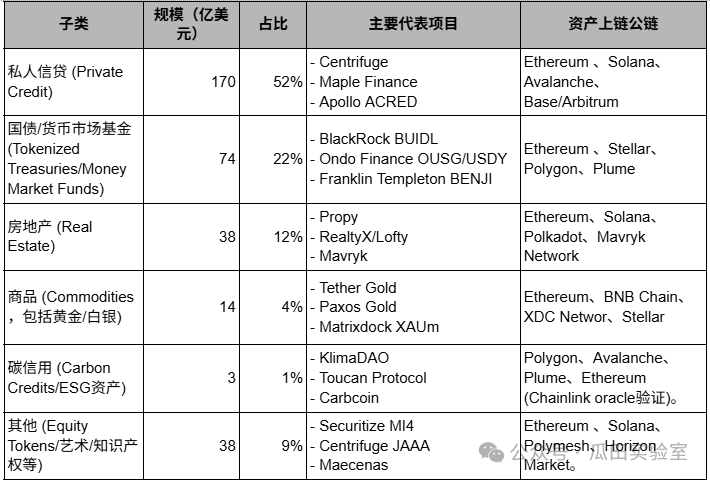
Currently, RWA is primarily concentrated in highly liquid fixed-income instruments. Areas such as real estate, equities, art, and infrastructure remain largely untapped, indicating the market is still in early stages. Institutional participation is the core driver of RWA market growth. Regulated institutions and native DeFi protocols jointly expand supply, with key players including asset managers like BlackRock and Franklin Templeton, banks such as JPMorgan, Citigroup, and Standard Chartered, custodians like BNY Mellon, and DeFi protocols including Maple, Centrifuge, Ondo Finance, and MakerDAO. Their involvement signals RWA’s shift from crypto niches toward mainstream finance—for instance, the European Investment Bank has already issued digital bonds on Ethereum.
According to the latest data from RWA.xyz and CoinGecko, total RWA issuance (as of September 2025) has reached $33 billion. The largest categories are private credit, government bonds, and commodities. Compared to the scale of traditional finance and tangible assets, sectors like real estate, stocks, art, and infrastructure still have significant untapped potential.
What Problems Can RWA Solve?
RWA is a cross-domain field integrating Web3, traditional finance, and the real world. Its emergence brings positive impacts to all three domains.
1. Solving Web3 Challenges
-
Liquidity Shortage: Web3 assets (like NFTs and certain tokens) often suffer from low liquidity due to market fragmentation. RWA addresses this by bringing high-value real-world assets (e.g., government bonds, real estate) on-chain, enhancing liquidity and trading depth. For example, tokenized Treasuries (like BlackRock’s BUIDL) can serve as collateral in DeFi protocols, improving capital efficiency.
-
Asset Homogeneity: Historically, DeFi ecosystems were limited almost entirely to cryptocurrencies. Assets like Ether, USD stablecoins, and Bitcoin exhibit high volatility and strong correlations, leading to a homogenous financial system. Introducing real-world assets diversifies holdings and strengthens overall stability.
-
Lack of Real Yield: Many DeFi protocols rely on internal speculative loops (e.g., yield farming via lending) lacking support from the real economy. In contrast, RWAs generate sustainable yields—such as rental income, bond interest, or commodity appreciation—driven by actual economic activity.
-
Unstable Value Anchors: Many crypto assets are highly volatile and lack stable value foundations. Stablecoins (like USDT, USDC), as representatives of RWA, provide stable value pegged to fiat currencies, enhancing credibility and utility in the Web3 ecosystem.
-
Limited User Adoption: Web3 applications often appeal only to tech-savvy users. By introducing familiar asset classes (like stocks and bonds), RWA lowers entry barriers and promotes mass adoption.
2. Solving Traditional Finance Challenges
-
Inefficient Transactions: In traditional finance, asset transfers (e.g., real estate, bonds) involve multiple intermediaries and long settlement cycles (T+2 or longer). RWA leverages blockchain for real-time settlement (T+0)—for instance, automating coupon payments via smart contracts—to reduce time and cost.
-
High Entry Barriers: High-value assets like private equity funds or real estate often require substantial minimum investments, excluding retail investors. RWA reduces these barriers through fractional ownership (e.g., tokenized real estate shares), expanding market participation.
-
Lack of Transparency: Traditional financial markets often lack real-time transparency. RWA uses blockchain’s public ledger to offer transparent tracking of ownership and transaction history, building greater trust.
3. Solving Real-World Challenges
-
Poor Asset Liquidity: Illiquid real-world assets (e.g., art, private credit) are difficult to monetize quickly. RWA improves their marketability by tokenizing them (e.g., issuing art NFTs on Ethereum) and connecting them to global markets.
-
Financial Exclusion: Globally, many people lack banking services or investment opportunities. RWA enables borderless participation via decentralized platforms (e.g., Polygon, Stellar), empowering investors in emerging markets.
-
Environmental and Social Issues: Tokenizing carbon credits (e.g., via Toucan Protocol) increases transparency and efficiency in emissions trading, supporting sustainable development goals.
4. Solutions Tailored to China’s Context
China’s real estate market has entered an era of “存量 competition” (competition among existing assets). Under this trend, unlocking idle存量 assets and promoting more efficient capital allocation have become central issues in exploring new development paths. The rise of RWA (real-world assets) opens innovative financial solutions for real estate—not merely digitizing properties onto blockchains, but reengineering equity structures using blockchain and smart contract technologies to transform high-value, fragmented, information-opaque assets with cumbersome transaction processes into combinable, manageable, and tradable digital equity units. Embedded smart contract rules clearly define rights, responsibilities, and cash flow relationships, while secondary markets support price discovery and exit mechanisms.
Compared to traditional asset digitization, RWA fundamentally redefines asset ownership. Leveraging blockchain’s immutability and smart contract automation, high-value, low-liquidity physical assets can be divided into freely tradable small-denomination equity units, significantly boosting liquidity and market depth. For example, a commercial property valued at ¥10 million can be tokenized into 10,000 tokens, each representing 1/10,000th ownership, reducing the investment threshold from ¥10 million to ¥1,000 and enabling free trading on secondary markets.
Company type significantly influences RWA awareness—with financial-affiliated real estate asset managers and leading developers demonstrating superior understanding. According to a CRIC survey, 60% of respondents view RWA’s core value as “enhancing asset liquidity,” 20% focus on “lowering investment thresholds,” and about 15% emphasize “expanding financing channels.” Attention to “improving transparency” and “optimizing operational efficiency” remains relatively low. However, automated execution via smart contracts, transparent blockchain management, and refined operations can profoundly transform operational efficiency, risk control, and asset management models.
Advantages and Value of RWA Tokenization
RWA (Real World Assets) tokenization leverages blockchain technology to convert traditional assets like stocks, bonds, real estate, and gold into digital tokens, enhancing liquidity, transparency, and global accessibility, thereby injecting vitality into financial innovation. Its core technical advantages include:
-
Automation, Transparency, and Efficiency of Smart Contracts: Smart contracts automatically execute transaction terms, ensuring transparent, tamper-proof operations without human intervention. Immutable code verified by decentralized nodes eliminates trust risks and enhances security. For example, when an asset hits a price threshold, the contract automatically triggers transfer or liquidation. Automated distribution via smart contracts also greatly improves asset management efficiency.
-
Stability via Over-Collateralization: RWA tokenization converts assets into tradable tokens used as collateral for stablecoin issuance. Smart contracts automatically liquidate based on asset value, ensuring platform liquidity and solvency while preventing over-issuance risks.
-
Real-Time Data Assurance via Oracles: Oracles bridge on-chain and off-chain environments, transmitting real-time data such as asset prices and ownership status. Aggregating multi-source information ensures accuracy and supports legal compliance, safeguarding transaction legitimacy.
-
Global Circulation: On-chain assets support 24/7 global trading, simplifying cross-border investment and enhancing market diversity and liquidity.
-
User Empowerment: Through the “user-as-shareholder” model, RWA integrates marketing with fundraising, strengthening user loyalty and brand visibility.
-
Supply Chain Support: RWA creates an ecosystem loop, optimizing supply chain finance and facilitating corporate capital retention and ecosystem circulation.
These technical advantages, when combined with financial strategies, offer additional benefits to RWA issuers:
-
Profit Enhancement: Newly raised funds can be used to expand production or enter new markets, increasing profitability.
-
Liquidity Unlocking: Fractionalization allows early realization of high-value asset potential.
-
Integrated Marketing and Fundraising: Investor participation builds consensus and expands sales channels.
-
Brand Exposure: RWA projects attract organic traffic, boosting brand recognition.
-
Convenient Management: Optimizes asset management, promotes asset-light models, and facilitates offshore asset conversion.
-
Ecosystem Innovation: Supports closed-loop supply chain finance, alleviating cash flow pressure.
RWA vs. Traditional Financial Models
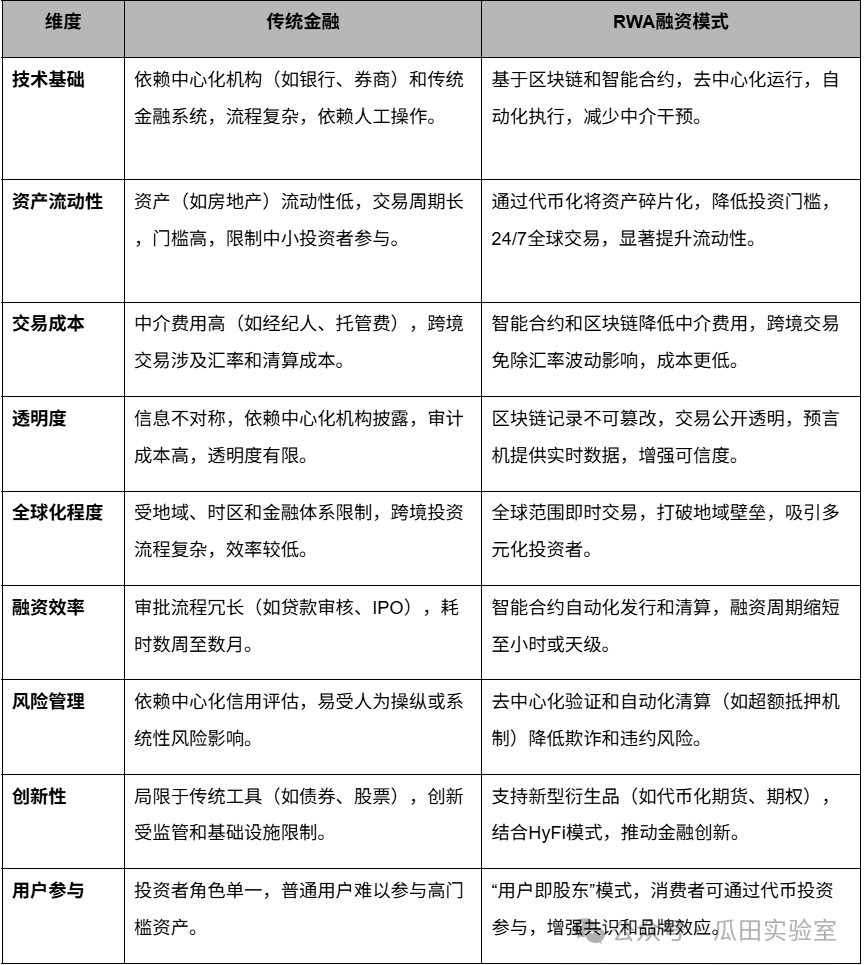
RWA (Real World Assets) financing and traditional finance both aim to fund enterprises and projects backed by tangible assets and subject to regulatory oversight. However, they differ markedly in technology, efficiency, and innovation. Traditional finance relies on centralized institutions, involves complex procedures, high intermediary fees, low asset liquidity, and faces geographic and currency restrictions—effective in mature markets but limited in globalization. In contrast, RWA financing leverages blockchain and smart contracts to tokenize assets, enabling fractional trading, lowering investment thresholds, and supporting 24/7 global circulation—significantly enhancing liquidity. Automated smart contract execution reduces intermediary costs, blockchain immutability improves transparency and trust, and oracles provide real-time data. RWA also fosters new derivatives and “user-as-shareholder” models, advancing financial inclusion and brand effects. Despite challenges in regulation and technical security, RWA far surpasses traditional finance in funding efficiency, global reach, and innovation—demonstrating disruptive potential for the Web3-era financial system, especially in revitalizing illiquid assets and optimizing supply chain finance.
Technical Challenges Facing RWA:
RWA (Real World Assets) tokenization, as an innovative bridge between traditional finance and Web3, still faces significant technical hurdles. These issues not only constrain large-scale deployment but may also trigger systemic risks. According to Chainlink & ConsenSys (2025)'s “RWA Technical Challenges Report,” 35% of global RWA projects in 2024 were suspended due to technical failures, resulting in losses exceeding $800 million. Key pain points center on five areas: oracle reliability, off-chain execution limitations, privacy-transparency trade-offs, lack of standardization, and security vulnerabilities—requiring urgent systemic solutions.
-
Oracle Issues: Blockchains cannot natively access off-chain data and depend on oracles for asset valuations and status updates. Single-point or centralized oracles are vulnerable to attacks, potentially causing smart contract errors. Ensuring data authenticity and solving the “trust transfer” problem are crucial.
-
Off-Chain Execution Limitations: Smart contracts are confined to on-chain logic; enforcement upon default requires traditional legal systems, leading to delays and undermining automation benefits.
-
Privacy vs. Transparency Conflict: Blockchain’s openness aids auditability but risks exposing sensitive commercial or personal data. While zero-knowledge proofs protect privacy, they increase technical complexity and costs.
-
Lack of Standardization: Divergent token standards and compliance frameworks fragment asset liquidity, creating “silos” that hinder global value transfer.
-
Immature Technology and Security Risks: Blockchain still faces shortcomings in user experience, security, and compliance. Risks such as private key mismanagement, smart contract bugs, phishing attacks, cross-chain bridge exploits, oracle manipulation, and regulatory arbitrage could lead to systemic failures. Ignoring technical details may cause business strategies and ecosystem plans to collapse due to user complaints, compliance incidents, or security breaches.
To address these technical challenges, short-term efforts should focus on digitizable assets, improving oracles, compliance frameworks, and privacy-enhancing technologies to build market confidence. Long-term, integrating IoT and AI to develop advanced oracles capable of automatically monitoring non-standardized assets (e.g., real estate, art) can gradually integrate the physical world into the digital ecosystem.
Categories of Tokenizable Assets
Returning to the underlying asset types suitable for tokenization, theoretically any real-world asset can be tokenized and issued as RWA. However, physical assets with the following characteristics hold distinct advantages:
-
Quantifiable Value:
- Assets must have transparent, publicly accessible pricing mechanisms, easily verifiable via authoritative sources (e.g., exchanges, official databases).
- Example: Gold and Treasury bond prices are publicly quoted, making them ideal for oracle feeds.
-
Clear Cash Flow Rules:
- Income streams (e.g., interest, dividends, rent) must follow well-defined calculation and distribution rules, enabling automated execution via smart contracts.
- Example: Fixed-rate and scheduled coupon payments on government bonds are easily distributed on-chain.
-
Low Off-Chain Execution Needs:
- Ownership changes should primarily occur via digital records, minimizing dependence on physical delivery or complex legal enforcement.
- Example: ETF share transfers rely on digital records, not physical handover.
-
High Standardization:
- Assets should adhere to uniform specifications (e.g., standardized contract terms) to facilitate batch processing and cross-platform interoperability, avoiding “asset silos.”
- Example: Gold futures contracts have standardized maturity and settlement rules.
-
Regulatory Compliance Support:
- Asset tokenization must comply with local regulations (e.g., securities laws, AML requirements) to ensure legal circulation.
- Example: Tokenizing U.S. Treasuries requires adherence to SEC regulations.
-
Technical Feasibility:
- Reliable oracles are needed to deliver off-chain data (e.g., price, status); blockchain platforms must support secure smart contracts and robust mechanisms to prevent vulnerabilities, attacks, or data tampering.
- Example: Chainlink oracles provide reliable price data for DeFi protocols.
Which specific asset categories are currently being or have already been tokenized? Common ones include:
-
Commodities: Precious metals like gold are enhanced in liquidity and operational efficiency through tokenization and blockchain integration. In 2022, the market cap of tokenized commodities reached $1.1 billion, accounting for 0.8% of fiat-backed stablecoins. Gold, due to its safe-haven nature and stable appreciation, is particularly suitable as a tokenized anchor asset, supporting global reserves and investment.
-
Currency: Stablecoins (e.g., USDT, USDC) link fiat assets like dollars and Treasuries to DeFi, growing in market cap from $5.2 billion in 2020 to over $300 billion today. Central bank digital currencies (CBDCs), issued by governments as digital legal tender, offer statutory circulation guarantees, distinguishing them from cryptocurrencies.
-
Real Estate: RWA tokenization fragments real property into tradable tokens, increasing owners’ capital liquidity and lowering investment thresholds, enabling broader public participation in commercial or residential real estate investment.
-
Art and Collectibles: NFTs provide immutable proof of ownership and provenance, while fungible tokens (FTs) enable fractional crowdfunding of artworks, lowering entry barriers and improving transparency and payout efficiency—enhancing investment inclusivity and user experience.
-
Intellectual Property (IP): Tokenization simplifies verification and tracking of copyrights and patents, prevents theft, and improves transaction transparency—for example, protecting Dell’s “build-to-order” patent.
-
Stocks, Bonds, and Securities: Tokenization lowers barriers to capital markets, allowing micro-investments in assets like U.S. Treasuries, overcoming high transaction costs and long settlement times (T+1), enabling 24/7 real-time clearing and promoting global capital flows.
-
Carbon Credits and Green Finance: Tokenized carbon reduction certificates can be traded or retired on-chain, supporting transparent, fraud-resistant global carbon markets aligned with ESG and sustainability trends, introducing green financial products into DeFi.
Summary
This article explores the concept, background, technical advantages, application potential, and challenges of RWA (Real World Assets). As an innovative fusion of blockchain and traditional finance, RWA is reshaping global asset management. By tokenizing real-world assets such as real estate, bonds, and art, it injects digital vitality, breaks down geographical barriers and access thresholds, and enables 24/7 global trading, fractional ownership, and automated income distribution via smart contracts. The current boom is driven by technological leaps (e.g., Ethereum scaling), regulatory greenlights (U.S. and European sandboxes), and institutional adoption (e.g., BlackRock’s $2.9 billion BUIDL fund). The market has surged from $860 million in 2023 to $33 billion in 2025, led by private credit and government bonds, with projections reaching trillions by 2030. Stablecoin-based payments are already surpassing traditional systems in volume.
The multidimensional value of RWA is evident: it introduces real yield and stability into Web3, mitigating DeFi’s speculative cycles; in traditional finance, it accelerates T+0 settlements, improves transparency, and cuts intermediary costs; in the real world, it empowers emerging markets and financial inclusion by lowering investment thresholds through asset fractionalization. Compared to traditional models, RWA’s decentralized, global nature vastly outperforms the inefficiencies of centralized systems, fostering “user-as-shareholder” ecosystems and closed-loop supply chain finance. Nevertheless, new technologies inevitably face challenges: oracle data manipulation, reliance on off-chain enforcement, privacy-transparency trade-offs, and lack of standardization have caused numerous RWA project failures. Addressing these requires short-term improvements in compliance modules and long-term integration with AI, IoT, and related fields. Overall, RWA is not merely a technical tool but a bridge of inclusivity—connecting the real economy with a digital future—and driving finance’s evolution from “trusted intermediaries” to “code-based autonomy,” with boundless potential.
In the next article, we will explore global RWA regulatory frameworks and analyze leading international RWA issuance/trading platforms and case studies—stay tuned.
Join TechFlow official community to stay tuned
Telegram:https://t.me/TechFlowDaily
X (Twitter):https://x.com/TechFlowPost
X (Twitter) EN:https://x.com/BlockFlow_News
 瓜田实验室W Labs