








The Hidden Influence of Cryptocurrency: How It Quietly Became the Dominant Force in the Election Game?
TechFlow Selected TechFlow Selected
The Hidden Influence of Cryptocurrency: How It Quietly Became the Dominant Force in the Election Game?
"Just ten years ago, it was the laughingstock of the tech world. Now, a decade later, they will play a pivotal role in helping the Republican Party win the U.S. Senate elections."
 Navigating Web3 tides with focused insights
Writing: Jessica Piper
Translation: BitpushNews an
Television ads come in all shapes and sizes.
In Ohio, a woman shared how Republican Senate candidate Bernie Moreno invested in her business that makes uniforms for female police officers. In Iowa, an ad highlighted Representative Zach Nunn’s military background and his work to lower childcare costs. Meanwhile, in Colorado, a Spanish-language ad promoted Democratic Representative Yadira Caraveo's support for border patrol agents.
All these ads share one striking feature: they are part of a massive campaign by the cryptocurrency industry to back its preferred House and Senate candidates in this fall’s elections. Yet not a single one mentions cryptocurrency itself.
The nascent industry has quietly become one of the largest independent spenders in congressional elections—second only to traditional party groups. Its spending exceeds that of environmental political action committees, pro-Israel groups, and abortion rights organizations. Roughly $1 out of every $12 spent independently in House and Senate races this year comes from crypto-related super PACs.
"The rise of the crypto industry is astonishing," said Moreno, the Republican Senate candidate in Ohio challenging Senator Sherrod Brown and receiving the most crypto industry support of any candidate. "Just 10 years ago, it was the laughingstock of the tech world. Now, just 10 years later, they’re going to play a pivotal role in helping Republicans win control of the U.S. Senate."
The crypto industry’s ads aim to help their favored candidates win—not to make cryptocurrency itself a central campaign issue. This reflects a reality many candidates acknowledge: for most voters, crypto isn’t a top concern. Ads funded by industry-linked super PACs are generally positive portrayals of supported candidates, often focusing on personal stories or urgent issues like border security, economic conditions, and access to IVF treatment.
At the same time, crypto organizations emphasize they aren't inherently partisan, backing candidates from both parties—including Democratic Senate hopefuls in Michigan and Arizona.
Many of the candidates backed by crypto funds are marginal members who hold key committee positions and have advanced the industry’s legislative priorities this year. In Ohio, while neither Brown nor crypto is directly mentioned in the campaign, the goal is clearly to unseat the incumbent senator, who has long been skeptical of the industry.
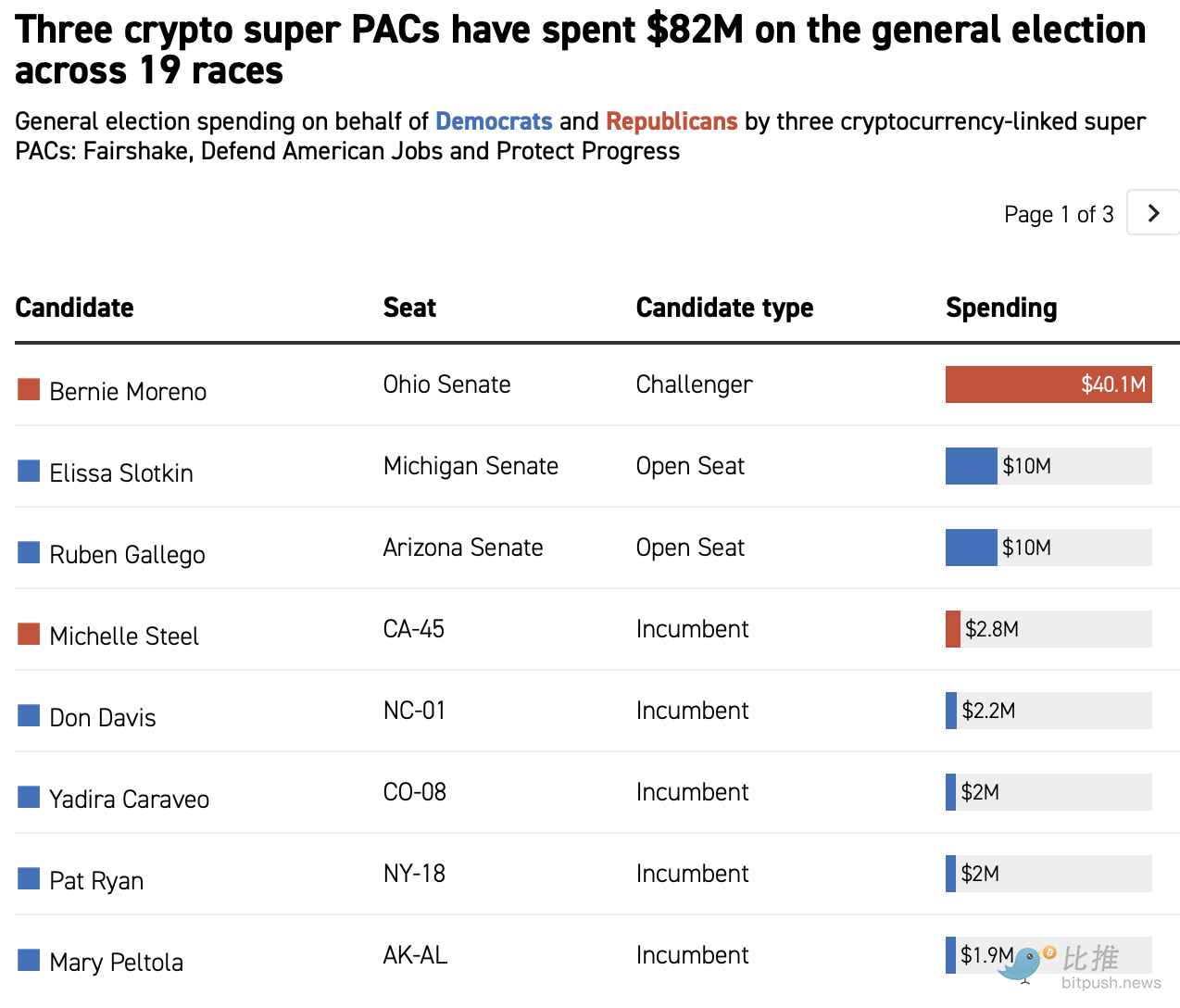
This flood of money is primarily funneled through three distinct super PACs: Defend American Jobs supports Republican Senate candidates; Protect Progress backs Democratic Senate candidates; and Fairshake supports House candidates from both parties. Fairshake also provides funding to the other two groups and has raised over $170 million in this election cycle from pro-crypto companies including Coinbase and Ripple Labs, as well as venture capital firms like Andreessen Horowitz.
Together, these three super PACs have spent $125 million on independent expenditures during this election cycle—accounting for 8% of all outside spending in congressional races, according to Federal Election Commission data. This includes more than $80 million spent on general election efforts.
When asked about the candidates Fairshake supports and the content of its ads, a PAC spokesperson cited a previous statement expressing support for “leaders in both chambers of Congress and from both parties who are committed to delivering real results and working with the industry to advance responsible regulation that fosters innovation, creates jobs, and maintains America’s global leadership.”
Many candidates backed by crypto funding have pushed a major legislative priority for the industry this year: a bill aimed at establishing a regulatory framework for different categories of digital assets. The bill passed the House earlier this year but has yet to be taken up in the Senate.
The biggest target of spending in this election cycle has been defeating incumbent Senator Sherrod Brown—the only sitting member of Congress explicitly opposed by these funds. As chair of the Senate Banking Committee, Brown has been skeptical of cryptocurrency and has warned about the risks it poses to consumers.
Defend American Jobs has spent over $40 million on this race. According to ad-tracking data from AdImpact, the two most-played ads in Ohio this year both come from this group. Yet neither mentions cryptocurrency nor directly attacks Brown.
One ad highlights Moreno as a small business owner who built a life in Ohio, while another emphasizes his support for energy independence and “stopping illegal immigrants from looting Ohio’s tax dollars.”
Crypto-linked super PACs are also supporting Democratic candidates—and sometimes aligning on shared positions, such as immigration policy. An ad from Protect Progress backing Ruben Gallego praises the Arizona Senate candidate for “standing up to his own party to fund 22,000 border patrol agents.” Meanwhile, an ad in Michigan supporting Elissa Slotkin’s Senate bid features her saying, “We need to invest in border security.”
In House races, the diversity of messaging is even more apparent. Among nearly two dozen ads aired in general election congressional races, most incorporate personal narratives from candidates. Five ads defending incumbent Democrats highlight their credentials on immigration and border issues, while two ads supporting vulnerable Republicans focus on their support for IVF treatments.
It's not unusual for an interest group to avoid discussing its core issue in advertising: earlier this year, the pro-Israel super PAC United Democracy Project ran ads in Democratic primaries covering topics ranging from public safety to a candidate’s DUI arrest—even though the group did run anti-Semitism-focused ads in a congressional race in New York.
Cryptocurrency may simply not be a top-of-mind issue for most voters. Estimates on how many Americans own crypto vary widely. A 2023 Federal Reserve survey estimated 7%, while the Philadelphia Fed found 14.7% this summer; crypto companies and advocates believe the actual number could be higher.
Since cryptocurrency is not a central issue in major House and Senate races, most candidates are reluctant to discuss the funding. The majority of candidates backed by crypto PACs—and their opponents—declined to comment on the role this money plays in their campaigns.
Some opponents benefiting from crypto super PAC spending have expressed support for the industry. Mike Rogers, the former congressman running against Elissa Slotkin in Michigan, said in a statement that the crypto sector is “vital to national security” and accused outside groups of trying “to hand control of crypto to the Democrats.” A spokesperson for Kari Lake, the Republican Senate candidate in Arizona, said she holds a “strongly supportive” view of cryptocurrency.
In Alaska, Republican Nick Begich, who is challenging incumbent Democrat Mary Peltola, said he was surprised that Fairshake supports the sitting Democrat, noting his own pro-crypto stance. (Begich says he was an early adopter of Bitcoin.) For voters, however, questions about digital assets and crypto policy usually aren’t at the top of their minds.
“Occasionally someone asks me about crypto, but it’s not in the top 10 things I hear,” Begich said.
Stand With Crypto, a 501(c)(4) nonprofit, has been conducting outreach to encourage cryptocurrency users and supporters to vote in this year’s elections. The group also scores candidates based on their statements about crypto and support for related legislation, though it does not endorse candidates. It says it has received $2.8 million in donations—about 1.5% of what Fairshake has spent.
Join TechFlow official community to stay tuned
Telegram:https://t.me/TechFlowDaily
X (Twitter):https://x.com/TechFlowPost
X (Twitter) EN:https://x.com/BlockFlow_News






