








HBO Exposes Satoshi Nakamoto, Subject Debunks on Scene, Personal Safety Possibly Threatened?
TechFlow Selected TechFlow Selected
HBO Exposes Satoshi Nakamoto, Subject Debunks on Scene, Personal Safety Possibly Threatened?
A $20 million gamble, a $70 billion inference.
 Navigating Web3 tides with focused insights
By Tuoluo Finance
Who is Satoshi Nakamoto?
This question has echoed constantly among crypto believers since Bitcoin’s inception. Yet the legendary Satoshi Nakamoto has never been unmasked. Even amid a parade of imposters, the real Satoshi remains silent—adding to Bitcoin's aura of mystery.
But some refuse to accept this enigma. Last week, HBO, the renowned television production company, released a new documentary titled *Money Electric: The Bitcoin Mystery*, claiming it would finally reveal Satoshi’s true identity. In the end, HBO did put forth its candidate for "Satoshi." However, the accused swiftly denied it, accusing HBO of endangering his personal safety with baseless allegations.
In this fiasco of mistaken identity, what remains are only unsolved riddles—and a long-dormant Bitcoin wallet worth nearly $70 billion.
On the morning of October 9 (Beijing time), HBO's documentary *Money Electric: The Bitcoin Mystery* premiered. Days earlier, HBO had boldly claimed it would solve crypto’s greatest unsolved mystery: Who is Satoshi Nakamoto? HBO carries undeniable weight. As the oldest continuously operating subscription television service in U.S. history, it enjoys widespread recognition and critical acclaim. Its productions—including global hits like *Game of Thrones*, *The Sopranos*, and *Sex and the City*—are regular Emmy Award contenders.
The film was directed by Cullen Hoback, known for his investigative prowess. His previous documentary series *Q: Into the Storm*, which explored the QAnon conspiracy theory, earned an Emmy nomination in 2021.
With these dual credentials, many believed HBO could genuinely uncover Satoshi’s identity. The crypto world trembled. Prediction markets sprang into action, placing real money bets. Before the full release, wagers exceeded $20 million—making this over-100-million-RMB gamble a spectacle drawing intense public attention.
From available information, everything about Satoshi Nakamoto is shrouded in mystery. We only know he described himself as a Japanese-American born on April 5, 1975. In 2008, he published the whitepaper titled *Bitcoin: A Peer-to-Peer Electronic Cash System*. In January 2009, the Bitcoin network launched. After gradually fading from public view, Satoshi disappeared entirely by 2013.
Based on this, prediction markets quickly identified top candidates. Initially leading the pack was Len Sassaman, an obscure cryptographer and staunch decentralization advocate who died by suicide in 2011. Then Adam Back, inventor of Proof-of-Work (PoW), briefly took the lead—until he promptly denied any connection. Ultimately, Nick Szabo emerged as the most heavily bet individual.
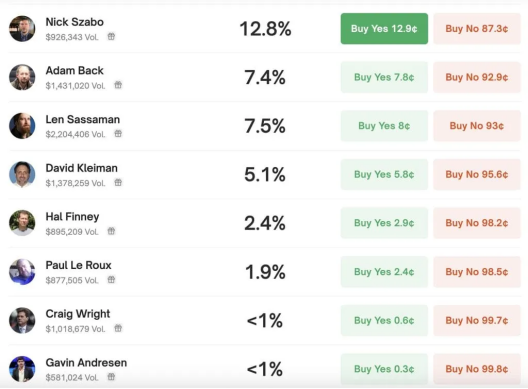
Of course, such large bets weren’t made without reason. In 1998, Nick Szabo proposed a digital currency called "Bit Gold," describing it as “fully digital and solving double-spending through proof-of-work.” This concept predated Satoshi’s work by a decade. Moreover, Szabo’s writing style in later works—such as *Bitcoin: The Future of Money?*—bore striking similarities to Satoshi’s. These parallels significantly boosted credibility around the theory that Szabo might be Satoshi.
Yet notably, Nick Szabo has repeatedly denied being Satoshi. At this point, the list of likely candidates seemed exhausted—even Craig Wright ("Faketoshi") made appearances. Surprisingly, however, HBO ultimately named someone not even on the list: Peter Todd.

This name may not ring a bell for the general public, but within the industry, Peter Todd is well known. A Canadian software developer, early Bitcoin Core contributor, and cryptography consultant, Todd began coding for Bitcoin in 2012 and calls himself a “crypto clockmaker” on X. He first submitted code to Bitcoin Core in April 2014 and later proposed several Bitcoin Improvement Proposals (BIPs). In 2016, he co-launched the privacy-focused cryptocurrency Zcash with Edward Snowden, cementing his reputation. Today, he remains the founder of OpenTimestamps, an open-source timestamping project.
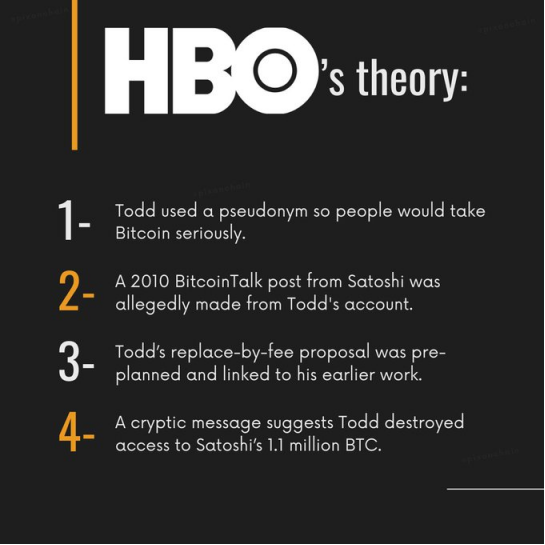
Judging by his resume, Todd is undoubtedly accomplished—but there appears to be no direct link to Satoshi. So why did HBO conclude he was the creator? HBO presented several pieces of evidence: For example, the timing of Satoshi’s forum posts allegedly matched a student’s schedule, with more activity on weekends—consistent with Todd’s status at the time. Another mysterious claim suggested Todd had destroyed access to Satoshi’s 1.1 million BTC. But clearly, these circumstantial clues fall far short of proof. Worse still, HBO’s key argument borders on absurdity.
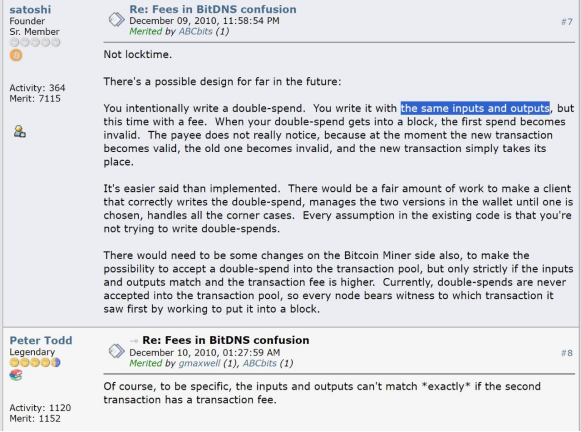
Their central argument hinges on a 2010 email thread originally posted by Satoshi. Peter Todd replied to a technical discussion about input/output mechanics. Shortly afterward, both accounts involved ceased activity. Later, Todd implemented the transaction fee replacement feature discussed in that thread. From this, HBO concluded that Todd must have accidentally responded using Satoshi’s own account—thereby proving he is Satoshi.
Clearly, this logic is flimsy and arguably cherry-picked. Upon the documentary’s release, backlash erupted across the crypto community, with widespread condemnation of HBO’s speculative reasoning.
Beyond all else, Satoshi claimed to be a Japanese-American born in 1975. By 2008, he would have been 33 years old. But at that time, Peter Todd was still an undergraduate under 23, born and raised in Canada, and didn’t begin contributing to Bitcoin until 2014—hardly matching the established profile. More critically, Satoshi’s wallet balance has remained unchanged since 2010, holding approximately 1 million BTC (rumored to be 1.1 million), none of which has ever been spent. As a founder involved in multiple projects, Todd clearly has financial needs and incentives to use funds.
Peter Todd himself expressed shock and frustration. Before the documentary aired, he publicly stated, “I am not Satoshi.” He dismissed producer Cullen Hoback’s claims as unfounded and factually false, emphasizing that he merely replied to an old email thread. He mocked the director, saying, “A filmmaker famous for covering QAnon has now fallen into QAnon-style conspiracy thinking.”
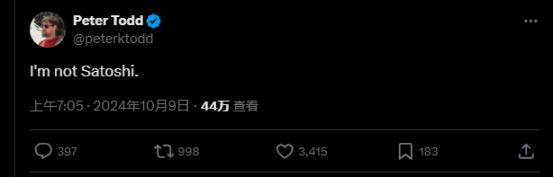
In a recent interview, Todd reiterated that the director’s accusation was purely a publicity stunt—an attempt to create surprise and boost viewership. Being thrust into the center of the “Satoshi” controversy has caused him serious concern. After all, being perceived as the custodian of a million BTC makes one a prime target for criminals. Incidents involving threats or attacks aimed at seizing private keys are all too common. While his personal safety isn't currently compromised, Todd says he’s already being harassed—people keep asking him to reveal pet names, fueling new meme coin schemes. It’s become a grotesque form of entertainment.
Across the industry, professionals widely criticized HBO’s conclusion, calling it disrespectful to both Satoshi and the broader crypto space.
Who is Satoshi Nakamoto? This question has persisted for 16 years since Bitcoin’s birth. To date, theories range from individuals to organizations—even state-level conspiracies. Recently, prominent U.S. investor Kyle Bass went so far as to claim that Bitcoin’s creator is actually a Chinese intelligence agency. While absurd, such claims reflect how deeply this mystery has been distorted.
One thing is clear: As of 2024, no one can definitively answer this enduring riddle. Whether Satoshi is alive or dead, the secret may already lie buried. HBO’s attempt to expose the truth may not have been about solving the mystery—but rather bringing it back into the spotlight.
Still, we must ask: Does the crypto world truly need a flesh-and-blood Satoshi? When Bitcoin emerged, Lehman Brothers had just collapsed, shaking the global financial system. Bitcoin introduced a unique peer-to-peer digital currency, launching the arduous journey of decentralized ideals.
Today, Bitcoin has risen from $0.0008 to $64,000, growing into a behemoth valued at over $1.3 trillion—far beyond what even Satoshi might have imagined. Throughout this rise, retail investors, institutions, and true believers have poured in. Despite varied motives, their self-interest has unexpectedly yielded collective progress. And this outcome owes much to Satoshi’s absence. In other words, Satoshi’s disappearance freed BTC from personality cults, transforming it into ownerless Bitcoin—the world’s BTC—and solidifying it as the absolute faith of the crypto world.
Contrast this with coins tied to identifiable leaders—ETH, BNB, DOT—all inevitably subject to figurehead worship. Take Ethereum: when ETH’s price stalls, people blame Vitalik Buterin; when the roadmap is unclear, they demand answers from him; when development lags, they scrutinize his personal life. This dynamic is surely not what “Satoshi” would have wanted.
Here’s another thought-provoking question: What if Satoshi is still alive? Why wouldn’t he reveal himself? Perhaps because disclosure would lead to worse consequences than silence. Imagine possessing such immense wealth while being the founder of the world’s largest decentralized digital currency. Regulatory confrontation would be inevitable. Personal safety would be at constant risk. The likely outcome? A tragic end.
In the final analysis, for both markets and individuals, preserving this mystery is the best possible outcome. The greatest suspense films end ambiguously—and this principle applies perfectly to Satoshi. For now, crypto enthusiasts worldwide can focus solely on participating in this historic financial experiment, building upon Satoshi’s original vision. Perhaps, as the saying goes: “No one is Satoshi, yet everyone is Satoshi.”
Regardless, we should all pay tribute to this unseen architect of cryptography. As said during Coinbase’s IPO bell-ringing ceremony: “Thank you, Satoshi. Whoever you are.”
Join TechFlow official community to stay tuned
Telegram:https://t.me/TechFlowDaily
X (Twitter):https://x.com/TechFlowPost
X (Twitter) EN:https://x.com/BlockFlow_News






