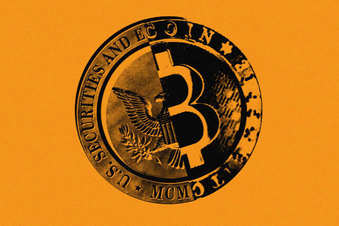
On this day 11 years ago, the man who might have been Satoshi Nakamoto was cryogenically frozen
TechFlow Selected TechFlow Selected
On this day 11 years ago, the man who might have been Satoshi Nakamoto was cryogenically frozen
Truth doesn't need promotion; time will prove everything.
 Navigating Web3 tides with focused insights
Author: David, TechFlow
On August 28, 2014, a man named Hal Finney passed away.
His body was then sent to a cryonics facility in Arizona, USA. There, it was preserved in liquid nitrogen, awaiting the day when future medicine might be able to "resurrect" the dead.
Exactly 11 years have now passed, yet most people seem to have never heard of Hal Finney.
In the world of crypto, however, he may be one of the most important figures in Bitcoin's history:
Finney was the first user of the entire Bitcoin network, aside from its creator Satoshi Nakamoto.
On January 3, 2009, a mysterious individual using the pseudonym "Satoshi Nakamoto" created Bitcoin. Nine days later, Nakamoto sent 10 bitcoins to Finney—the first transaction in Bitcoin’s history. At that time, only two people existed on the entire network: Nakamoto and Finney.
Today, Bitcoin’s market capitalization exceeds trillions of dollars. But in the beginning, this world-changing financial system was merely a transfer experiment between two individuals.
In 2009, 53-year-old Finney read the Bitcoin whitepaper published by Nakamoto and immediately recognized its revolutionary potential.
He downloaded and ran the Bitcoin software, helping Nakamoto fix bugs in the early code. Bitcoin’s survival and development into what it is today would not have been possible without Finney’s contributions.
Yet in the same year Bitcoin was born, Finney was diagnosed with ALS (Amyotrophic Lateral Sclerosis).

This disease gradually robs a person of muscle control, eventually leading to full-body paralysis. Five years later, he died. He chose cryopreservation, hoping future medicine could bring him back to life.
One of the ways to pay for the freezing procedure? Bitcoin.
11 years later, on the 11th anniversary of Finney’s passing, it seems people haven’t truly forgotten this Bitcoin pioneer.
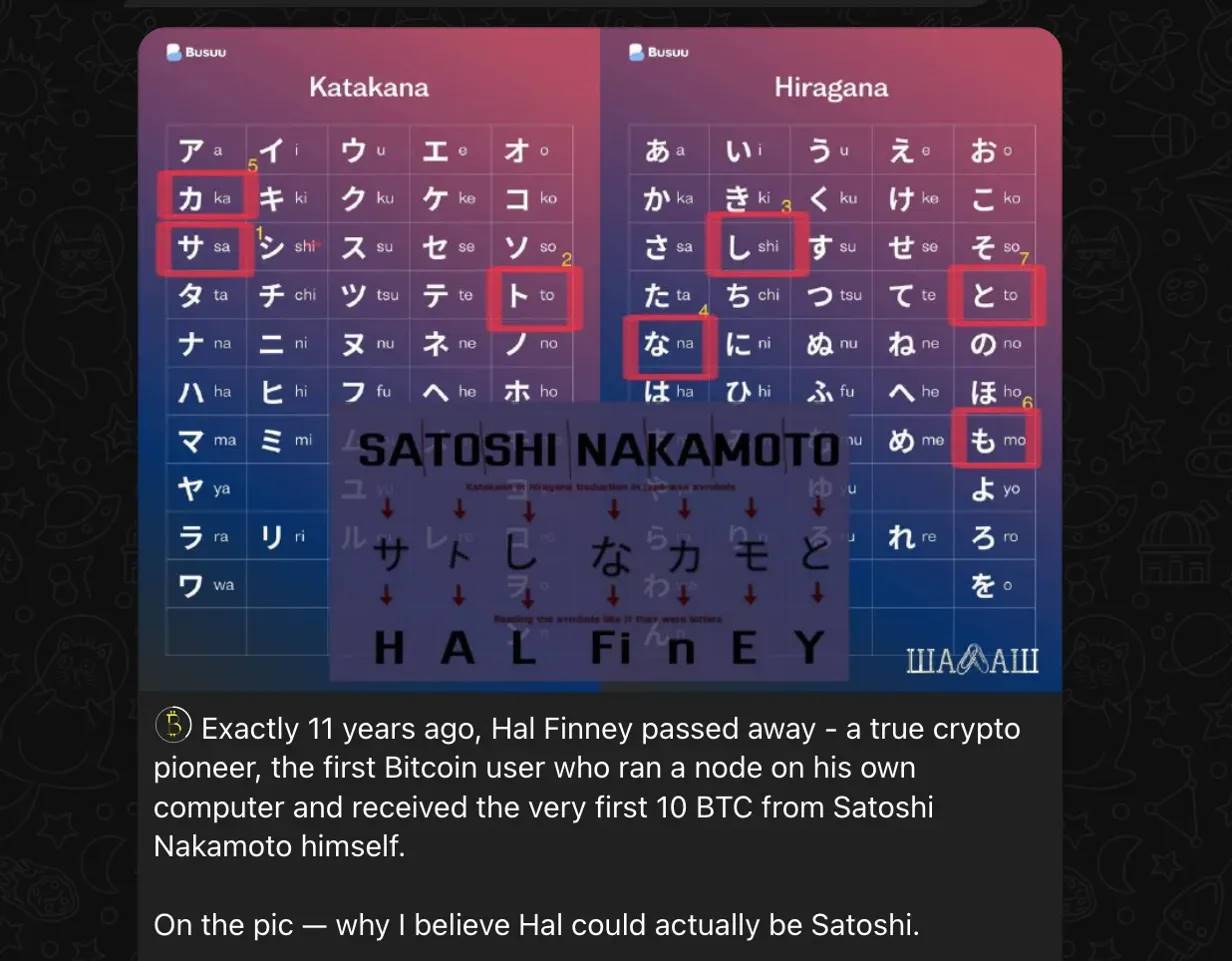
Somewhere on social media, someone posted an image of a Japanese kana chart, using the name "Satoshi" as a starting point. By leveraging subtle visual coincidences between Eastern and Western characters, they suggested these kana resemble the shape and arrangement of Hal Finney’s English name.
This kind of wordplay is easily dismissed as overinterpretation.
But interestingly, Finney was actually a cryptographer who spent his life studying how to hide and encode information.
To him, embedding his real name within the pseudonym "Satoshi Nakamoto" would have been a simple intellectual game—a form of cryptopunk-style obfuscation.
Still, Finney denied being Nakamoto during his lifetime.
In 2013, nearly fully paralyzed, he wrote on a forum: "I am not Satoshi Nakamoto." He also publicly shared email exchanges with Nakamoto, showing two distinct personalities and writing styles.
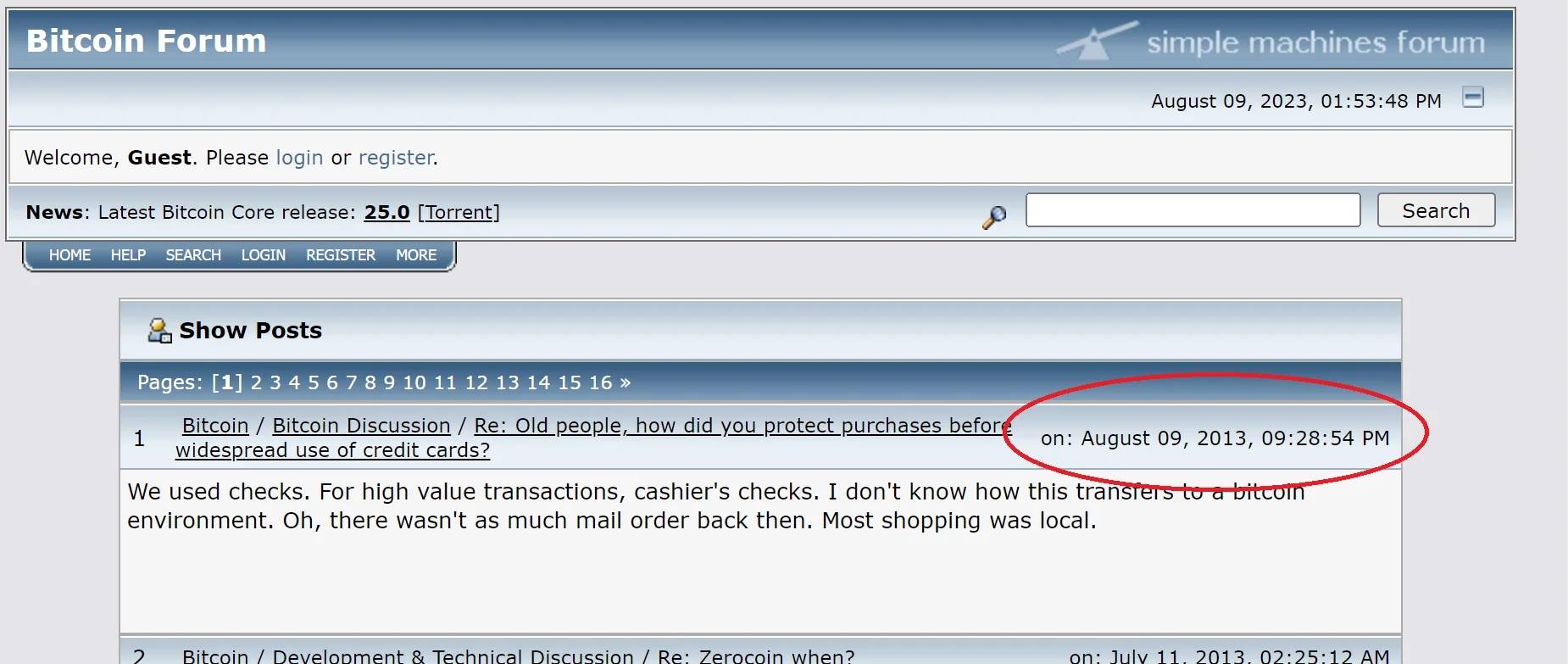
And after 2014, Nakamoto gradually stopped posting on forums. A year later, Finney’s body was frozen in liquid nitrogen.
The Neighbor of the Fake Satoshi
The speculation that "Finney might be Nakamoto" also stems from other notable coincidences.
In March 2014, U.S. Newsweek published a report claiming to have found the real Satoshi Nakamoto. The journalist traced a Japanese-American man living in Temple City, California—his real name was Dorian Satoshi Nakamoto. After the article came out, media outlets from around the world flocked to the quiet town.
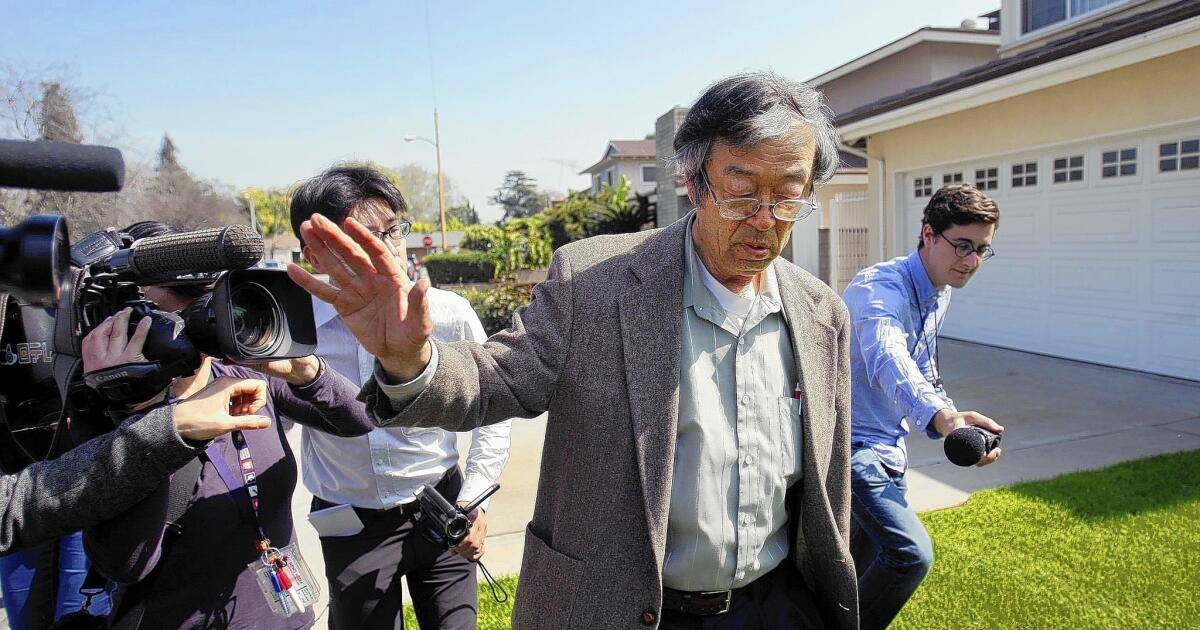
But this turned out to be a mistake. Dorian was an unemployed engineer who knew nothing about Bitcoin. Nakamoto himself, after years of silence, briefly reappeared in response:
"I am not Dorian Nakamoto."
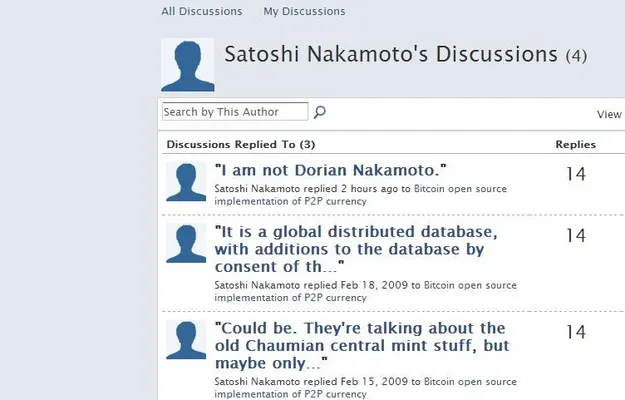
Interestingly, Hal Finney also lived in Temple City. He had lived there for 10 years, just a few blocks away from the house where journalists chased Dorian with questions.
This geographical coincidence sparked speculation: Did Finney borrow his neighbor’s name as a pseudonym?
The Japanese name Satoshi Nakamoto certainly fits the mystique Nakamoto wanted to project. Of course, it could also be pure coincidence. However, there are indeed some temporal overlaps between Finney and Nakamoto.
Excluding that one sudden reply in 2014 denying he was Dorian, Nakamoto last appeared publicly on forums in April 2011. In an email, he wrote:
"I've moved on to other things." Since then, he vanished completely, never touching the over a million bitcoins in his wallet.
Finney was diagnosed with ALS in August 2009. The disease progresses gradually—first affecting fingers, then arms, legs, and finally the whole body.
By the end of 2010, Finney’s health had clearly deteriorated. Nakamoto’s disappearance overlapped in time with the worsening of Finney’s condition—but whether there’s any connection remains unknown.
More thought-provoking is the fact that in 2004, Finney created a system called RPOW. The core problem it addressed was exactly the key issue Bitcoin later solved:
How to prevent double-spending of digital currency without a central authority.
Tales of a Cryptography OG
OG stands for "original gangster," roughly meaning "old-timer" or veteran.
In the crypto industry, OG often refers to those who entered the space early, achieved much, and made significant contributions. But true OGs never call themselves OGs.
If someone were to create Bitcoin in 2008, there were probably fewer than a few hundred people worldwide capable of doing so. Hal Finney might well have been one of them—an authentic cryptography OG.
This isn't exaggeration. Creating Bitcoin required a rare combination:
Top-tier cryptographic skills, deep understanding of distributed systems, familiarity with the history of digital currency, and a firm belief in creating money free from government control.
Finney’s story began in the early 1990s. At the time, the U.S. government classified strong encryption as munitions, banning its export. A group of hackers calling themselves "cypherpunks" believed privacy was a fundamental human right and decided to fight regulation with code.
It was in this context that Phil Zimmermann created PGP (Pretty Good Privacy), software that allowed ordinary people to use military-grade encryption. In 1991, Zimmermann released PGP’s source code freely onto the internet, causing a major uproar.
Finney was the second programmer recruited by Zimmermann. At the time, PGP was still a rough prototype. Finney’s task was to rewrite the core encryption algorithms to make them faster and more secure.
He spent months rewriting the entire encryption engine, dramatically improving the speed of PGP 2.0.
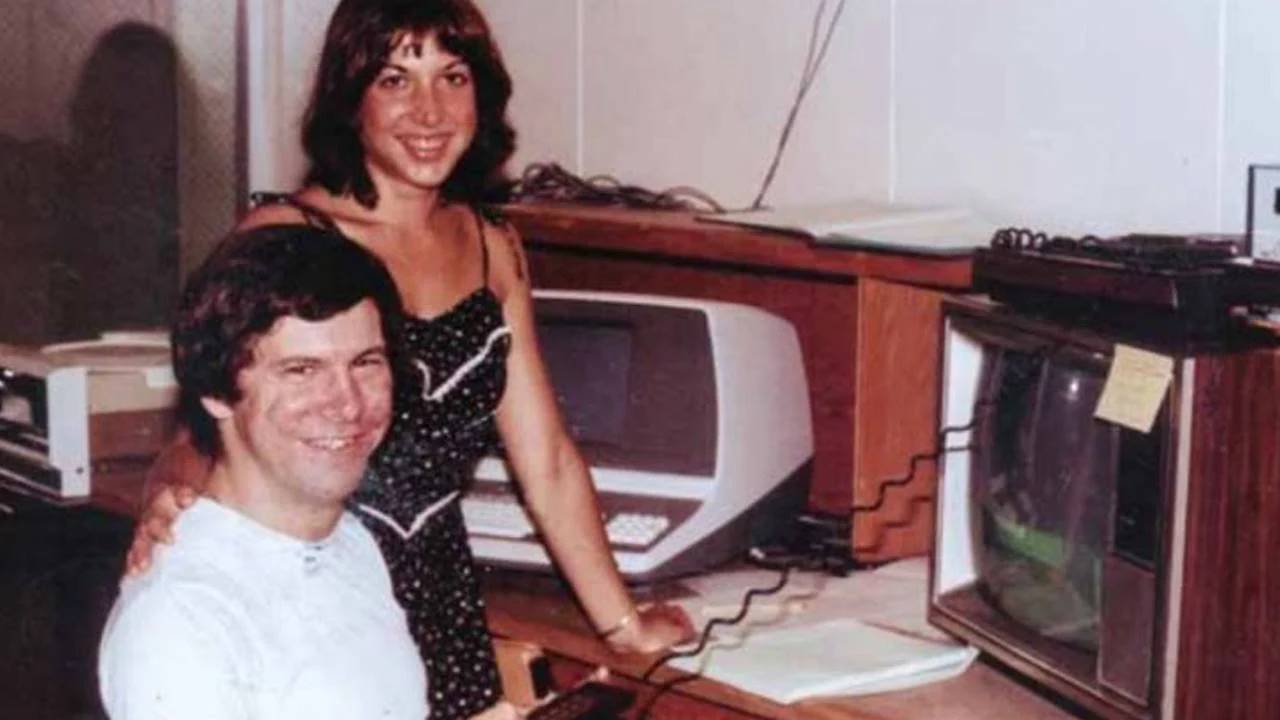
This experience made Finney a central figure in the cypherpunk movement.
The prevailing view among cypherpunks was that cryptography could reshape power structures in society and return privacy rights to individuals. They communicated through a mailing list, discussing topics ranging from anonymous communication to digital cash.
Finney didn’t just participate—he operated two anonymous email remailers, allowing people to send messages while hiding their identities. Within this community, creating government-independent digital currency was a recurring dream.
In 2004, Finney proposed his own solution: RPOW (Reusable Proof of Work).
His idea worked like this: Users would generate a proof of work by consuming computing power and send it to an RPOW server. Instead of simply marking it as "used," the server would verify it and issue a new, equivalent RPOW token back to the user. This token could be transferred to others, who could then redeem a new token from the server.
Does this sound familiar to Bitcoin’s proof of work?
RPOW never gained widespread adoption, but it proved one thing: Digital scarcity can be created. You can use computing power to produce non-counterfeitable, transferrable digital tokens.
Four years later, on October 31, 2008, someone named Satoshi Nakamoto posted the Bitcoin whitepaper to the same cypherpunk mailing list. Finney immediately understood what it meant.
"Bitcoin looks like a promising idea," he replied to Nakamoto’s post.
Bitcoin solved the final problem RPOW couldn’t: complete decentralization. No servers needed, no trust required—just a network collectively maintaining a ledger.
On January 3, 2009, the Bitcoin genesis block was mined. Finney downloaded the software and became the first person besides Nakamoto to run a full node.
In the following days, the entire Bitcoin network consisted of just two people. Finney later recalled: "I exchanged a few emails with Nakamoto, mostly reporting bugs and him fixing them."
On January 12, Nakamoto sent 10 bitcoins to Finney—the first transaction in Bitcoin history.
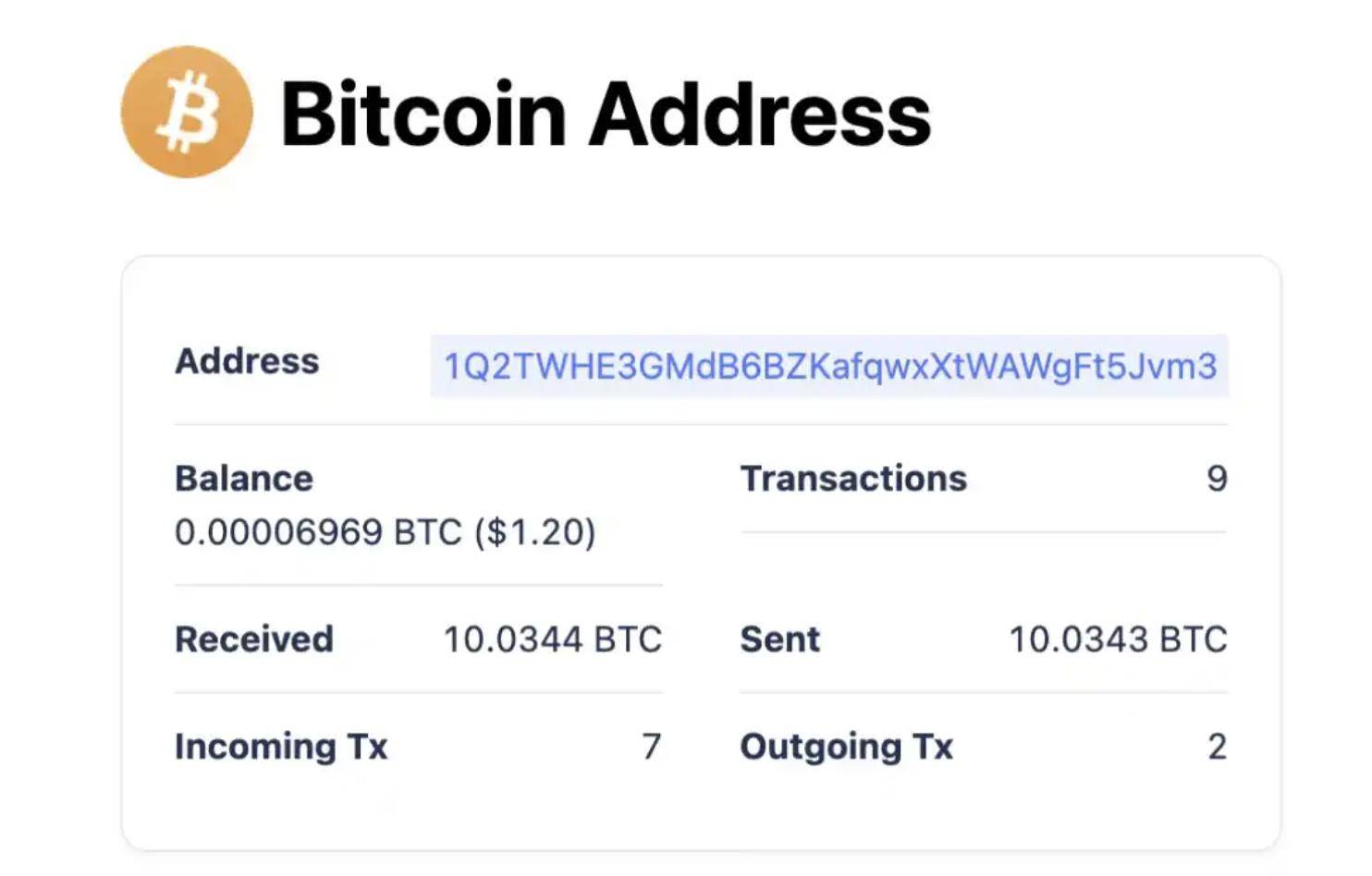
Unfortunately, just months after helping launch Bitcoin, Finney was diagnosed with ALS. As his condition worsened, his activity declined. Around the same time, Nakamoto also gradually faded from view after 2010, disappearing completely by 2011.
Two trajectories, two individuals, intersecting at the pivotal moment of Bitcoin’s birth, then diverging toward different fates—one vanishing into the depths of the internet, the other ultimately preserved in liquid nitrogen. Their true relationship may forever remain a mystery.
When the Crypto Stars Shone Brightly
The technological lineage from RPOW to Bitcoin’s POW is clearly visible. Speculating whether Finney was Nakamoto has little meaning—it’s more like idle chatter.
But perhaps more worth remembering is that over a decade ago, two early forum users—Nakamoto and Finney—exchanged ideas and supported each other, repeatedly testing a once-obscure cypherpunk experiment until it went live.
No witnesses, no applause—just two computers quietly running in some corner of the internet.
They couldn’t have foreseen that this seemingly geeky "peer-to-peer electronic cash system" would, over a decade later, usher in an era of its own, creating a trillion-dollar market; nor could they have imagined that central banks would seriously study it, Wall Street embrace it, and its name appear in financial transformation.
More importantly, the Bitcoin created by these cryptography pioneers continues to correct, change, and influence the beliefs and investment choices of countless people.
Finney once said something during a discussion on digital cash—a statement that still resonates today:
"Computer technology can be used to liberate and protect people, not to control them."
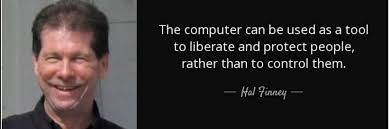
This was written in 1992—17 years before Bitcoin. Yet it accurately predicted the dilemmas we face today, and the solution Bitcoin attempts to offer.
And Nakamoto, the still-anonymous figure, was even more defiant, leaving behind a line that has since become legendary and revered:
"If you don't believe me, I'm sorry, I don't have time to convince you."
This quote later became a spiritual totem for the crypto community. It represents an attitude: Truth doesn’t need selling—time will prove everything.
On August 28, 2014, Hal Finney passed away. His final programming project before death was a software tool designed to enhance the security of Bitcoin wallets. Even when fully paralyzed, operating his computer only through an eye-tracking device, he continued contributing code to the system he helped bring into existence.

Nakamoto has not reappeared since 2011. His one million bitcoins remain untouched, like a digital monument reminding people of the system’s origins. Some say this is the ultimate "proof of burn"—the founder, by never spending his wealth, proves he created Bitcoin not for personal gain.
If one day in the future, medicine truly revives Finney, what would he think of today’s crypto world? Would he feel proud of Bitcoin’s success, or disappointed by certain directions it has taken?
We’ll never know.
Whether or not Hal Finney was Satoshi Nakamoto, he remains an indispensable figure in Bitcoin’s history. Without his participation, support, and contributions, Bitcoin might never have evolved from an idea into reality.
The moment when the stars shone brightly has passed, but the light they left behind continues to illuminate the path forward.
Join TechFlow official community to stay tuned
Telegram:https://t.me/TechFlowDaily
X (Twitter):https://x.com/TechFlowPost
X (Twitter) EN:https://x.com/BlockFlow_News
 深潮TechFlow