Embarking on a New Journey: Reviewing the Most Promising Blockchains and Layer2 Platforms from the Perspective of Application Innovation
TechFlow Selected TechFlow Selected
Embarking on a New Journey: Reviewing the Most Promising Blockchains and Layer2 Platforms from the Perspective of Application Innovation
The crypto market is entering the next phase, namely the large-scale adoption phase of cryptocurrency technology.
 Navigating Web3 tides with focused insights
Author: Asher Zhang, TechFlow
Vitalik Buterin, co-founder of Ethereum, stated during his participation in TOKEN 2049 that the crypto industry is no longer in its early stages, but remains early when it comes to "actual usability." Overall, this accurately reflects the current state of the crypto industry. Previous performance bottlenecks are no longer the main constraint—real-world adoption has become the key challenge.
Currently, apart from a highly active airdrop farming culture, there are few genuine use cases on mainstream public blockchains or Layer2 networks. Since the beginning of this year, after many token airdrops concluded, on-chain metrics have plummeted dramatically. The primary reason for this phenomenon is the lack of breakout sectors similar to DeFi and killer applications like Uniswap. However, the crypto industry is evolving rapidly. Bitcoin and Ethereum have been accepted by mainstream financial markets, and numerous traditional institutions are actively investing across various Web3 sectors. The future of crypto remains promising. This article reviews the most promising public chains and Layer2 solutions from the perspective of real-world adoption.
Ripple
Although Ripple and its native token XRP have not generated significant discussion热度 in the crypto market recently and have underperformed in terms of price gains this year, Ripple still holds considerable influence when viewed through the lens of adoption.
Ripple employs a decentralized consensus mechanism known as the Ripple Protocol Consensus Algorithm (RPCA). It enables global transfers and settlements to be completed within seconds. Compared to traditional banking systems, Ripple drastically reduces transaction confirmation times, making it an ideal solution for cross-border payments. Ripple has partnered with numerous financial institutions, banks, and payment processors, including Santander, American Express, and Standard Chartered. These collaborations have enabled Ripple’s payment technology to be more widely integrated into the global financial system.
Despite Ripple’s success, its token XRP has been controversial. The U.S. Securities and Exchange Commission (SEC) previously accused Ripple of illegally selling unregistered securities via XRP. However, recent developments have significantly favored Ripple. Below is a brief timeline of this legal case.
In July 2023, a court ruled that “XRP itself is not a security.” In October, a federal judge rejected the SEC’s appeal. On October 20, Ripple announced that the SEC had dropped all charges against its CEO Brad Garlinghouse and Executive Chairman Chris Larsen. On August 8, 2024, Judge Analisa Torres of the U.S. District Court for the Southern District of New York ruled that Ripple’s programmatic sales of XRP to retail customers via exchanges did not violate federal securities laws. However, the court found that Ripple’s 1,278 institutional sales violated securities laws, resulting in a $125.035 million fine—far less than the $1 billion in disgorgement plus pre-judgment interest and $900 million in civil penalties originally sought by the SEC.
Toncoin
In this cycle's crypto bull market, major innovations have been scarce. However, meme coins and small games on the Ton network have attracted massive user engagement. Within the TON ecosystem, Notcoin was the first to gain explosive popularity. Since its launch on January 1, 2024, its user base surged rapidly, surpassing 30 million participants in a short time. Following Notcoin’s success, “Tap to Earn” projects on TON gained widespread attention, with titles like Hamster Kombat and Catizen becoming particularly popular. Catizen, a clicker cat-raising game developed by Pluto Studio, serves as the first title on its GameFi platform and reached nearly 20 million registrations within just two months. Overall, mini-game narratives on the TON blockchain have emerged as a notable trend in this bull run.
The viral success of these mini-games on TON can be largely attributed to Telegram. TON was originally developed by the Telegram team before being open-sourced to the community due to regulatory pressure from the U.S. SEC. TON utilizes a unique multi-layer, multi-chain architecture designed for high speed and scalability, enabling it to support a massive number of users. Earlier integration between Telegram and TON allows mini-games built on TON to acquire users quickly from Telegram’s vast user base.
In reality, many of these TON-based mini-game projects resemble meme tokens with minor gameplay additions, offering little true innovation. Most are essentially combinations of traditional Web2-style casual games and DeFi mechanics. Nevertheless, thanks to Telegram’s massive reach, they attract enormous user traffic. While lacking technical breakthroughs, these projects serve as a critical entry point for many Web2 users into Web3, giving them significant importance.
Base
Base is an Ethereum Layer2 network launched by Coinbase, the largest cryptocurrency exchange in the United States. According to Growthepie data, as of August 15, daily transaction volume across the Ethereum Layer2 ecosystem exceeded 13 million (approximately 13.15 million), reaching an all-time high in daily transaction value. Base has been the primary driver behind this surge in Layer2 transaction activity. During the same period, Arbitrum processed around 1.8 million daily transactions, Op Mainnet about 470,000, while Ethereum’s mainnet averaged roughly 1.1 million daily transactions throughout most of the year. As of September 22, DefiLlama data shows Base ranks sixth in total value locked (TVL).
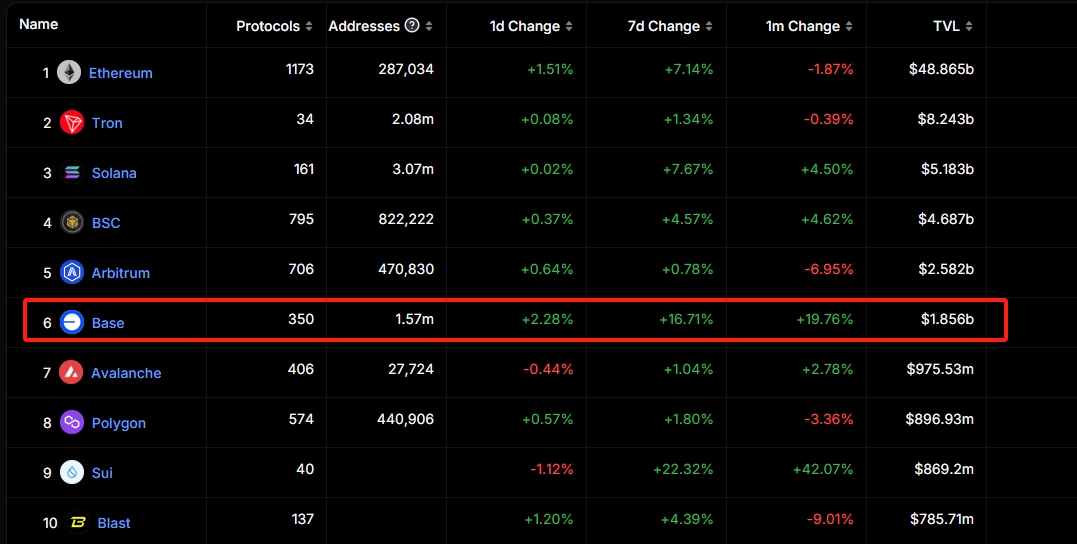
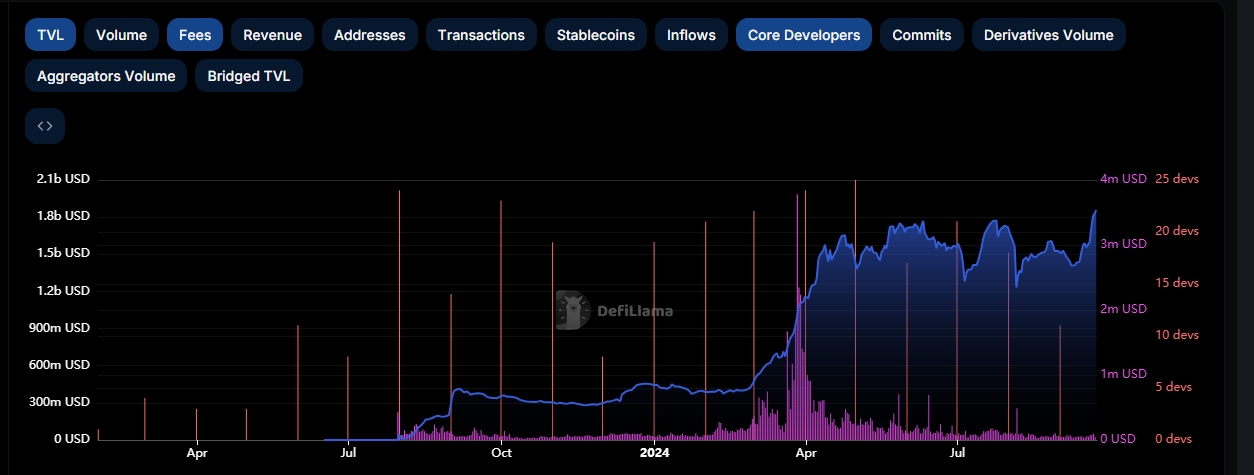
Besides transaction volume, Base also exhibits high developer activity and fee revenue, establishing itself as the undisputed leader among Layer2 networks within just over a year.
Prominent applications on Base include Farcaster. Farcaster is a decentralized social networking protocol. At its peak in July, it achieved over 100,000 daily active users and currently maintains around 70,000. While its DAU lags behind TON’s mini-apps, it remains high by crypto standards. Additionally, Farcaster offers notable product innovation. With the recent meme token boom, Farcaster’s plugin system enables timely delivery of related content, leading more meme projects to publish announcements via Farcaster and driving increased user inflow seeking real-time updates. Furthermore, Farcaster founder Dan developed Warpcast, an application built on the Farcaster protocol. Beyond standard social features, Warpcast introduces channels and actions, enabling richer forms of interaction. This kind of crypto-native social innovation is meaningful and positions Farcaster as a potential leader in SocialFi within the true Web3 landscape.
Solana
Solana has drawn significant attention during this bull market. Early on, Solana’s DePIN sector was highly anticipated, spawning leading projects such as Render and Helium. Subsequently, other sectors like fully on-chain gaming and AI also saw prominent projects emerge on Solana. Recently, amid broader market weakness, the MEME sector has once again brought Solana into the spotlight. pump.fun on Solana directly fueled the meme coin craze, allowing users to easily create meme tokens without providing liquidity. According to DefiLlama, pump.fun generated $48 million in revenue during Q2, averaging $525,000 per day. Alongside the surge in pump.fun, Solana’s DeFi ecosystem has experienced substantial growth.
Recently, Solana introduced three major technical innovations—Actions, Blinks, and ZK Compression—which were well received by the market. Solana Actions is an API enabling websites to interact with the Solana blockchain for on-chain activities such as transfers, voting, and donations. Blinks are concrete manifestations of Actions, taking the form of QR codes, URLs, or clickable buttons. ZK Compression leverages a process called state compression, allowing developers to store certain types of data more economically using Solana’s ledger space instead of more expensive account space.
However, Solana now faces new challenges. From a technological development standpoint, as modular blockchain architectures gain traction and Layer2 solutions proliferate, the cost for Dapps to launch their own app-specific chains is decreasing. To capture more value, several Dapps have chosen to spin off their own chains—most notably the decentralized perpetual exchange dYdX. In response, Solana is now considering a shift toward becoming a Layer2. However, if Solana adopts an expansion model similar to Ethereum’s Layer2 ecosystem, SOL may end up playing a role akin to ETH—a domain where Ethereum holds absolute dominance.
Ethereum and Its Leading Layer2s
From a technical perspective, Ethereum and its top Layer2 networks are unquestionably strong. However, in terms of real-world application adoption, they remain underwhelming. The more impressive the metrics of a Layer2 appeared before its token launch, the sharper the decline often was afterward. This stems primarily from Ethereum’s Layer2 development strategy still being in the phase of technical breakthroughs—especially regarding cross-Layer2 interoperability.
Currently, there are too many Layer2s on Ethereum, each with different standards, resulting in isolated silos. This lack of interoperability severely limits the development of Ethereum-based applications. That said, significant progress has been made in cross-Layer2 communication, with initiatives such as Polygon Labs’ AggLayer, Avail, Hyperlane, and LayerZero showing promising advancements.
In terms of application development, Arbitrum and Optimism lead the pack. Arbitrum has attracted multiple companies to build within its ecosystem, including heavyweight Franklin Templeton and Securitize, which helped BlackRock tokenize assets. The Arbitrum Foundation has announced partnerships with popular NFT brands such as Azuki and ApeCoin. Projects built on Arbitrum include previously trending Web3 games like Xai and XPET. Optimism, meanwhile, is focusing on expanding its Superchain ecosystem. Many Layer2 networks built using the OP Stack have emerged, including Base, opBNB, Zora Network, and DeBank Chain.
Conclusion
Crypto technology is maturing, but key pieces of the puzzle—such as cross-Layer2 and cross-chain interoperability—are still missing. As a result, developers are currently focused on final-stage technical攻坚. Yet the industry is entering its next phase: large-scale adoption of crypto technology. Ripple, having entered the financial sector early, already operates at scale. Ton and Base are growing rapidly thanks to their powerful backends (Telegram and Coinbase), though neither has yet produced a truly disruptive application. Other public chains and Layer2s remain relatively slow in application adoption. Looking ahead, once cross-Layer2 and cross-chain interoperability are realized, developer focus will shift toward building applications. Together with the influx of users coming through platforms like Ton and Base, this transition will drive the prosperity of Web3.
Join TechFlow official community to stay tuned
Telegram:https://t.me/TechFlowDaily
X (Twitter):https://x.com/TechFlowPost
X (Twitter) EN:https://x.com/BlockFlow_News
 比推 BitpushNews