The Evolution of OP Stack: OP Succinct Unlocks the Potential of ZK Rollup
TechFlow Selected TechFlow Selected
The Evolution of OP Stack: OP Succinct Unlocks the Potential of ZK Rollup
Can OP Succinct become the killer weapon for OP Stack against ZK Stack?
 Navigating Web3 tides with focused insights
Author: YBB Capital Researcher Ac-Core
TL;DR
OP Succinct’s primary function is integrating ZKPs into the modular architecture of the OP Stack to transform OP Stack Rollups into fully verified ZK Rollups;
If Ethereum's long-term scaling future involves converting every Rollup into a ZK Rollup, OP Succinct aims to leverage Rust and SP1 to deploy a Type-1 zkEVM (fully Ethereum-equivalent) on the OP Stack;
The OP Succinct Proposer mainly handles parallel proof generation, proof aggregation, and verification;
The current OP Stack system relies on a "7-day fraud proof window," which delays transaction finality by up to one week if disputes arise. OP Succinct uses ZK proofs to drastically shorten transaction confirmation time, eliminating the need for extended fraud-proof windows;
OP Succinct can significantly reduce transaction costs.
1. Recent Recap: OP Mainnet Updates and the Relationship Between OP Stack and OP Labs

Image source: Blockscout
1.1 Key Developments on OP Mainnet
On March 30, 2024, OP Labs deployed “fault proofs” on the OP Sepolia testnet, officially launching them on OP Mainnet on June 11, 2024, advancing decentralization to its first stage. This enables users to withdraw ETH and ERC-20 tokens from OP Mainnet and challenge or cancel invalid withdrawals—without relying on trusted third parties—across chains like Base, Metal, Mode, and Zora.
To ensure user asset security and trust, Optimism employs fault proofs to enhance the accuracy and validity of on-chain transactions and prevent malicious activity. The mechanism includes:
Data Availability: Fault proofs first ensure all Layer-2 data is accessible and verifiable by Layer-1;
Challenge Period: During a defined challenge window, anyone can dispute data posted on Layer-2.
If someone detects inconsistencies between Layer-2 and Layer-1 data, they can submit a challenge. Proof Submission: If challenged, the Layer-2 operator must provide counterproofs demonstrating data correctness; Finality: If no valid challenges are raised during the period, or if the operator successfully refutes them, the transaction is finalized and deemed valid.
1.2 Relationship and Distinction Between OP Stack and OP Labs
OP Labs is the team or organization developing the Optimism solution, while OP Stack is a technical framework for building and scaling Ethereum Layer-2 networks. The relationship between OP Labs and OP Stack can be understood as that between developers and their development tools.
OP Labs
OP Labs is the core contributor to the Optimism project, responsible for developing and maintaining the Optimism Layer-2 solution. It is a team focused on building and improving Ethereum-scaling technologies such as Optimistic Rollups. OP Labs’ main goal is to reduce load on the Ethereum mainnet, lower transaction costs, and increase throughput. Additionally, OP Labs collaborates with other projects—such as Succinct Labs—to advance new scaling technologies like OP Succinct, focusing on zero-knowledge proof optimization.
OP Labs is the primary team behind the development and maintenance of the Optimism network. Its mission is to build an efficient solution for scaling Ethereum, with a focus on reducing fees and increasing speed. Beyond developing Optimistic Rollups, it actively promotes next-generation technologies such as zero-knowledge proofs through collaborations like OP Succinct with Succinct Labs.
OP Stack
OP Stack is a modular architecture or technology stack used to build and scale Ethereum Layer-2 networks. Composed of customizable components, it allows developers to construct their own Layer-2 chains tailored to specific needs. It provides a standardized way for developers to rapidly deploy custom scaling solutions.
OP Stack is a modular framework developed by OP Labs. This framework supplies foundational infrastructure for building Layer-2 networks, enabling developers to quickly spin up various scaling networks. Due to its modular design, OP Stack supports flexible selection of different validation mechanisms—such as Optimistic Rollups or ZK Rollups—meeting diverse project requirements.
In essence, OP Labs is the developer of OP Stack, while OP Stack is the technical toolkit provided by OP Labs to help developers build and scale Ethereum Layer-2 networks.
Before diving into OP Succinct, it’s essential to understand the four key components of each OP Stack chain: 1. op-geth: Receives transactions from users and generates/executes blocks; 2. op-batcher: Batches user transactions and submits them to L1; 3. op-node: Reads batched data from L1 and drives op-geth to perform state transitions in non-sequencer mode; 4. op-proposer: Regularly posts output roots to L1 to capture L2 state, facilitating withdrawals.
2. Succinct Labs and OP Labs Join Forces to Inject ZK Capabilities into OP Stack
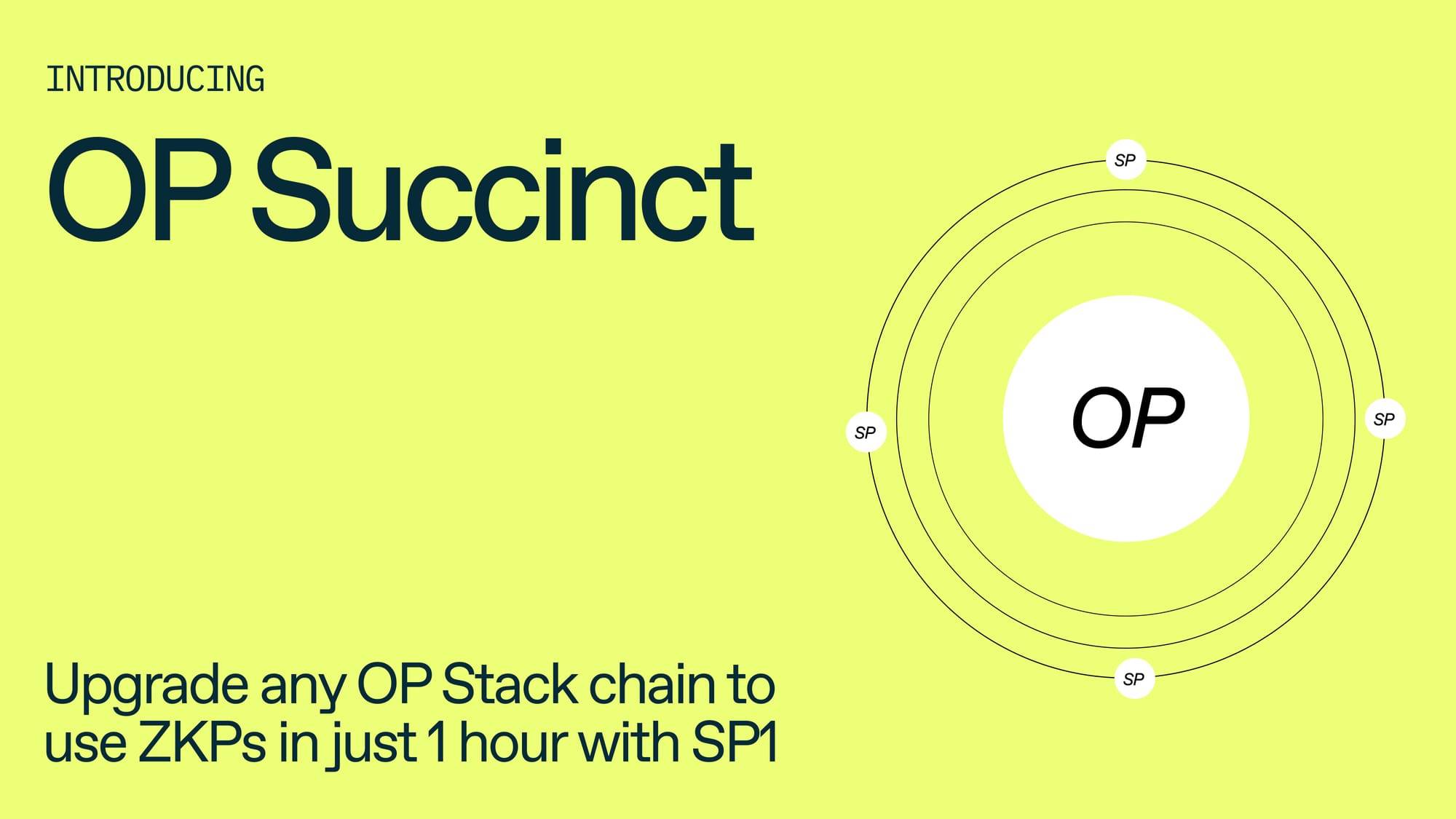
Image source: Succinct Blog
2.1 Architecture of OP Succinct
Building upon the “four main components of OP Stack” discussed in Section 1.2, OP Succinct is a lightweight upgrade allowing chains to use only ZK-verified blocks while keeping the other three components unchanged (op-geth, op-batcher, and op-node). OP Succinct primarily consists of the following four parts:
Range Program: A program written in Rust that executes block batches, designed to run within a zkVM;
Aggregation Program: Aggregates proofs from the range program to reduce on-chain verification costs. Also written in Rust and designed for execution in a zkVM;
OP Succinct L2 Output Oracle: A Solidity smart contract containing an array of L2 state outputs, where each entry represents a commitment to the L2 chain state. This contract already exists in Optimism’s original system but has been modified to use ZK proofs as the authentication mechanism;
OP Succinct Proposer: Monitors transaction batches posted on L1 and controls proof generation for the range and aggregation programs.
2.2 What Ethereum Scaling Narrative Does OP Succinct Tell?
zkEVM Rollups are notoriously difficult to build due to deep cryptographic expertise requirements. When building the modular OP Stack, the OP Labs team designed it to support various validity proof mechanisms and open-sourced Kona (see Extended Link 1) to implement the State Transition Function (STF)—the logic governing transaction state changes—for OP Stack Rollups using Rust. Ultimately, Kona and the SP1 program enable generating zero-knowledge proofs (ZKPs) for the OP Stack, theoretically allowing all OP Stack chains to be upgraded to use ZKPs.
SP1 (Succinct Processor 1) aims to allow any developer to seamlessly integrate a Type-1 zkEVM rollup using standard Rust code. With OP Succinct, any existing OP Stack chain can be upgraded to a Type-1 zkEVM rollup in just one hour, delivering high performance required by applications. This brings several advantages:
Fast Finality via ZKP: Reduces proof latency to minutes, effectively replacing the 7-day fraud proof challenge period;
Cost Efficiency: Average transaction cost drops to mere cents;
Transitioning OP Stack to ZK: Requires only deploying a smart contract and launching a lightweight OP Succinct proposer service (see below), enabling proof generation via API calls (covering batcher/sequencer, op-node, indexer, etc.);
Type-1 zkEVM: All tools and smart contracts compatible with OP Stack Rollups also work with OP Succinct Rollups;
Enhanced Scalability: Customizable OP Succinct rollups can introduce new precompiles and modify rollup logic.
According to the official GitHub documentation, the process requires only installing Rust, Foundry, and Docker. Any existing OP Stack rollup can be upgraded to a Type-1 zkEVM rollup in two simplified steps: 1. Deploy the ZK L2OutputOracle.sol contract; 2. Launch the OP Succinct proposer service (see GitHub Extended Link 2 for details).
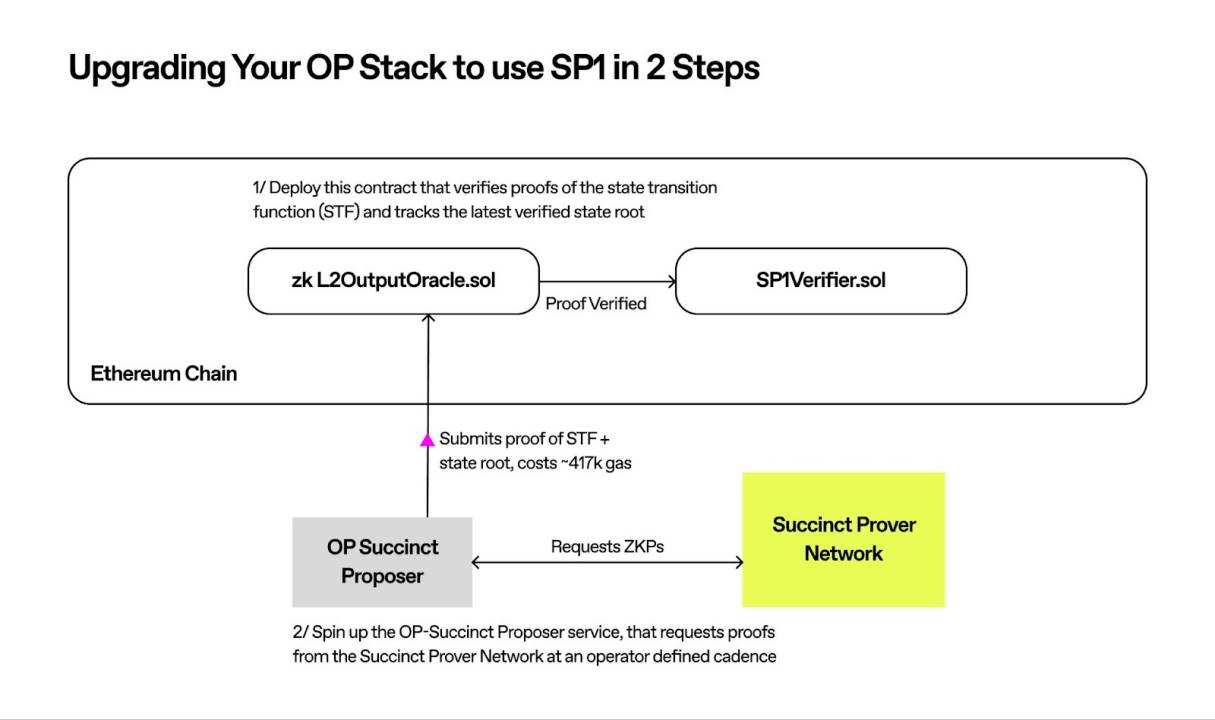
Upgrading OP Stack Rollup with ZK proofs, image source: Succinct Blog
2.3 Building Type-1 zkEVM Using SP1 Reth
Succinct believes the future of EVM Rollups lies in maintainable zkEVMs written in Rust. Currently, OP Rollups face three main issues: the excessively long 7-day fraud proof window, complex interoperability, and reliance in some cases on multi-party data availability rather than fraud proofs. Moreover, building a zkEVM is a time-consuming process, prompting the development of SP1 to address these challenges.
SP1 is a high-performance, 100% open-source, fully customizable zkVM capable of verifying the execution of arbitrary Rust (or LLVM-compiled language) programs. Public data shows that the OP Succinct Stack has already run successfully on OP Mainnet, OP Sepolia, and Base, achieving proof costs as low as $0.01–$0.02 per Ethereum transaction (see Extended Link 3). The vision is to eventually write all blockchain infrastructure—including rollups, bridges, and coprocessors—in Rust (or other LLVM-compiled languages) and secure them using ZKPs.
Based on summaries from the Succinct blog and open-source GitHub content, SP1’s performance edge over other zkVMs stems from several key factors:
1. Precompile-Centric Architecture: SP1 supports a flexible precompile system that significantly accelerates operations such as secp256k1 and ed25519 signature verification, and sha256 and keccak256 hashing, reducing RISC-V cycles for many programs by 5–10x. Its goal is to match the performance of ZK circuits while preserving the flexibility and developer experience of a zkVM;
2. Full Open-Source: SP1 is 100% open-source, allowing teams like Arbitrum and Scroll to implement custom precompiles, greatly reducing cycle counts and speeding up proof generation;
3. Industry Standard: Since launch, the concept of internal precompiles in zkVMs has become an industry standard, adopted by projects like RISC0, Valida, Nexus, and Jolt. SP1 is the only production-ready zkVM offering broad precompile support for critical cryptographic operations;
4. Efficient Memory Read/Write: SP1 uses an innovative memory proof method with a single challenge to ensure memory consistency across multiple proofs, avoiding the overhead of Merkleized memory;
5. Core Efficiency Optimizations: Features include a lower blowup factor, next-gen lookup arguments (e.g., LogUp based on logarithmic derivatives), and a FRI variant from Plonky3, improving trace area utilization efficiency.
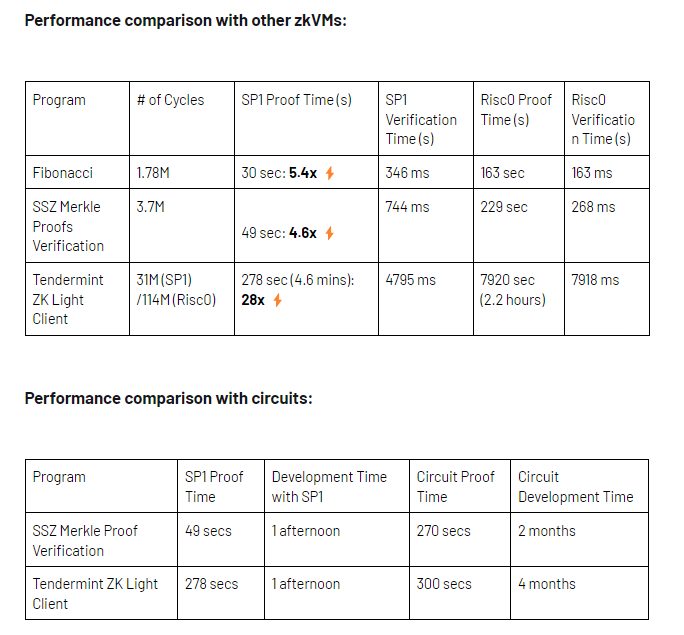
Image source: Succinct Blog, see Appendix in Extended Link 4
3. Can OP Succinct Become OP Stack’s Killer Weapon Against ZK Stack?
Image credit: @jtguibas
If Ethereum’s short-term scaling path favors OP and long-term favors ZK, then assuming OP Succinct succeeds, it would mark a significant milestone in Ethereum’s evolution. OP Succinct offers an upgrade path for ETH rollups to transition from optimistic to zero-knowledge verification—lowering transaction costs, accelerating finality, and preserving the security and privacy benefits of ZK rollups—opening new possibilities for application-layer growth.
Among the so-called “Four Horsemen” of Layer 2, OP Stack currently holds a slight ecosystem advantage over ZK Stack. The Matthew effect may intensify further. With OP Succinct entering the picture, it could siphon traffic and potential from ZK Stack. If OP Succinct delivers on its promises, it might even disrupt traditional zkEVM rollups.
However, based on current public information, we can observe that ensuring developers promptly detect unknown vulnerabilities when modifying STF functions or adding new precompiles remains a systemic risk requiring ongoing attention.
Extended Links:
(1) https://github.com/anton-rs/kona?ref=blog.succinct.xyz
(2) https://github.com/succinctlabs/op-succinct
Join TechFlow official community to stay tuned
Telegram:https://t.me/TechFlowDaily
X (Twitter):https://x.com/TechFlowPost
X (Twitter) EN:https://x.com/BlockFlow_News
 @YBBCapital