Interview with Brevis Co-founder: The Second Wave of ZK, Real-World Implementation Under Infinite Computing Is Key
TechFlow Selected TechFlow Selected
Interview with Brevis Co-founder: The Second Wave of ZK, Real-World Implementation Under Infinite Computing Is Key
From real-time Ethereum proofs to full application coverage across Web3 and Web2.
 Navigating Web3 tides with focused insights
What's happening in the Ethereum ecosystem? Why did Vitalik Buterin, Ethereum's official Twitter account, and OG Ethereum researcher Justin Drake all retweet and engage in discussion?
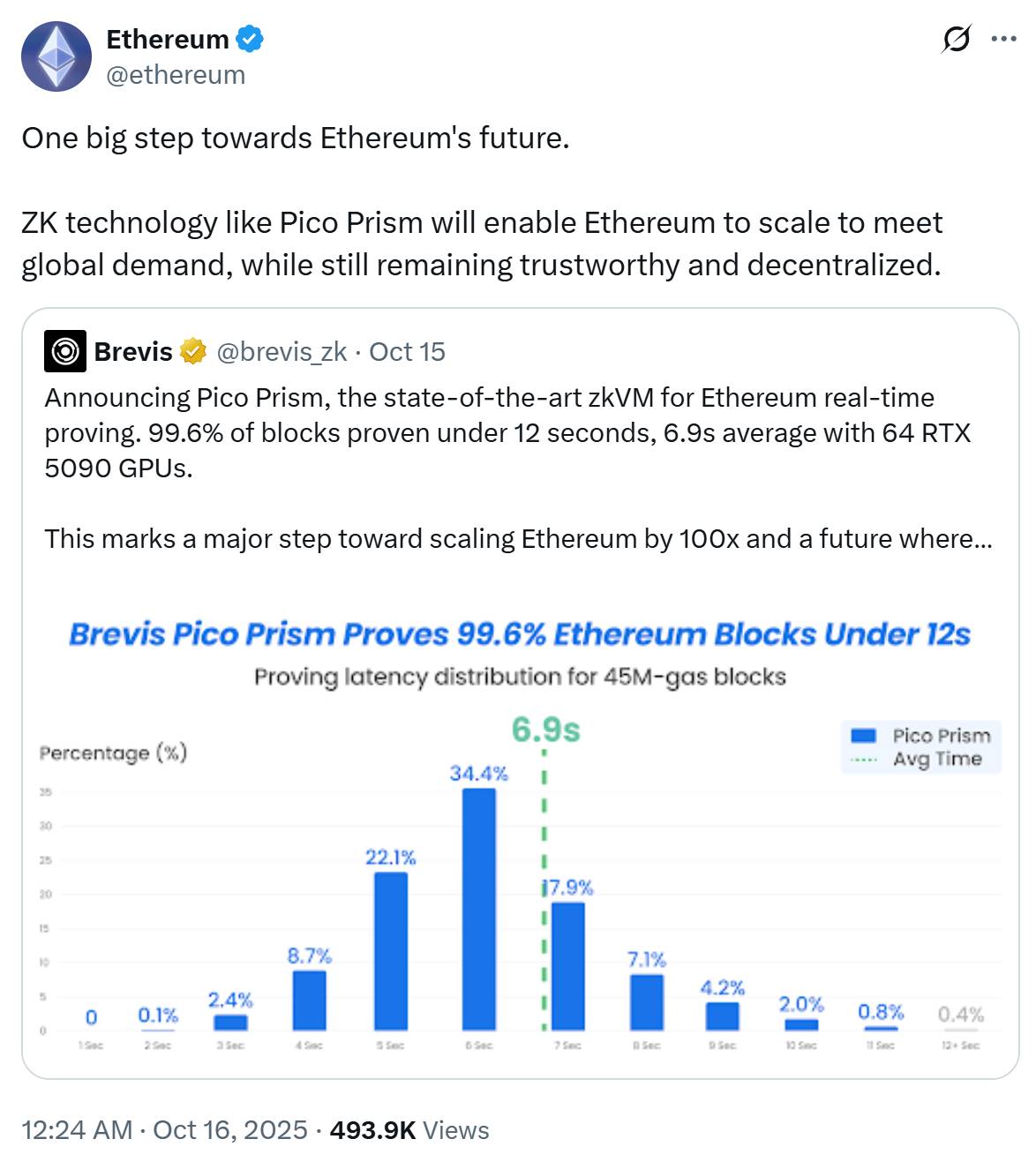
On October 15, 2025, zk-powered omnichain data computation and verification platform Brevis announced that its zkVM Pico Prism has achieved real-time proving for Ethereum on consumer-grade hardware: Using 64 RTX 5090 GPUs, it completed proofs for 99.6% of Ethereum L1 blocks within 12 seconds, with 96.8% of block proofs generated under the 10-second threshold set by the Ethereum Foundation. In a test conducted on September 1, 2025, under Ethereum’s current gas limit of 45M, Pico Prism achieved an average proving time of just 6.9 seconds.
In response to this release, Ethereum’s official Twitter account retweeted, calling it “a big step forward for Ethereum’s future.”
The collective excitement from Ethereum’s core team, founder, and OGs naturally raises questions within the community: What makes Pico Prism such a significant breakthrough? And how did Brevis achieve this milestone?
Just before Brevis announced Ethereum real-time proving,TechFlow sat down for an in-depth conversation with Michael, co-founder and CEO of Brevis.
When discussing Pico Prism—the project behind the recent buzz—Michael expressed pride:
This breakthrough not only means we are now the world’s fastest zkVM, but also represents a major advancement for the Ethereum community, enabling massive scalability and even truly infinite scaling of Ethereum. Additionally, achieving real-time Ethereum proving greatly enhances blockchain processing efficiency and confirmation speed. This can be seen as a landmark move for Ethereum’s major network upgrades over the next year, potentially leading Ethereum toward a full architectural shift centered around zkVM.
When asked about Brevis’ differentiation from other ZK projects, Michael highlighted three key advantages:
First, we place strong emphasis on real-world adoption and have already achieved widespread use across multiple scenarios. Second, we offer powerful future scalability, capable of adapting to evolving and diverse demands. Third, we prioritize usability and universality—developers don’t need to deeply understand the complexities of ZK; they can simply generate proofs and leverage powerful off-chain computing capabilities.
Finally, as a project whose development closely aligns with Ethereum’s roadmap, Michael shared unique insights on the topic of “E Sentinel”:
Ethereum represents not only the most mature and robust technical path today, but also embodies a culture of openness, verifiability, and respect for developers and innovation—values highly aligned with Brevis. However, it’s important to emphasize that Brevis is not built solely for Ethereum. Our architecture is inherently multi-chain native. We envision that ten years from now, 99% of computations related to Ethereum or EVM will occur off-chain and be made verifiable through Brevis.
In this edition, let’s dive into the deeper industry implications behind Brevis’ technological achievements and its core differentiators during the rise of the second wave of ZK, guided by Michael, co-founder and CEO of Brevis.

The Second Wave of ZK Arrives: Brevis Moves from Experimentation to Real-World Adoption
TechFlow:
Thank you for your time. Could you start by introducing yourself and sharing what Brevis is currently working on?
Michael:
Hello everyone, I’m Michael, co-founder and CEO of Brevis. It’s a pleasure to have this deep conversation with you.
I come from a technical background, with my bachelor’s and PhD both focused on computer science, specifically distributed systems and network computing. Over the past seven years, I’ve been dedicated to building blockchain infrastructure. Before founding Brevis, I co-founded Celer Network, a widely adopted cross-chain interoperability and bridging platform.
I’ve actually been involved in blockchain since early on—since 2015—and have nearly a decade of experience in research and development.I’ve always held a core belief: driving large-scale adoption of blockchain technology.
For Brevis, we describe ourselves as a solution for the “infinite computing layer” in Web3. Simply put, our goal isto enable blockchain applications to perform arbitrarily complex computations while maintaining the same decentralization and security as blockchains, thereby massively scaling blockchains.
Blockchain has long been called the “world computer,” and there have been many attempts and advances in scaling over the past few years. Yet it remains very cumbersome—the fundamental reason being that when a computation occurs on-chain, every node must re-execute it, making on-chain computation slow and expensive. What Brevis does is allow applications to offload complex smart contract computations off-chain, then generate a zero-knowledge proof—a highly securemathematical proof—to verify the correctness and reliability of that off-chain computation. The on-chain contract no longer needs to perform the complex computation itself; it simply verifies the mathematical proof quickly. This preserves blockchain’s decentralization and security while granting applications traditional computing performance.
Currently, Brevis is no longer an experimental project—we’re already serving many top-tier DeFi, infrastructure, stablecoin, and other projects,including PancakeSwap, MetaMask, Linea, and Uniswap. On mainnet, we’ve generated over 100 million ZK proofs, our partners collectively serve over 190,000 users, we’ve helped grow approximately $4 billion in TVL, and distributed over $300 million in verifiable reward calculations.
Overall, Brevis aims to give smart contracts infinite computing power in Web3 for the first time, transforming blockchains from systems limited to simple computations and basic financial rules into truly powerful intelligent systems. That’s our mission.
TechFlow:
We know Brevis began exploring ZK back in 2023, when the field was still in its early stages. How did you choose this path at that time?
And now, some major ZK projects like Starknet and zkSync don’t seem as popular as before—even facing market skepticism. Has this affected your work? Why did you stick with this direction?
Michael:
In my view, every technological wave evolves in phases. Typically,the first wave of a new technology sees very limited applications, while the second wave dramatically expands its use cases.
We can look back at internet history—every major tech followed this pattern. For example, mobile internet had two waves: from initial simple apps to the entire internet moving to mobile, including the rise of short video. AI also evolved similarly—initially solving narrow problems, then exploding in capability with advancements in compute, leading to new cycles like large language models (LLMs).
ZK is no different. Around 2021, ZK became a hot topic in blockchain, but practical applications were extremely limited, mostly confined to ZK-based Layer 2 networks. While we recognized ZK as a solid use case for L2, we saw those applications as too narrow and facing competition from solutions like Optimistic Rollups.
By 2023, ZK entered a cooling-off period—but for infrastructure-focused teams like ours, that wasn’t the core issue. We don’t see ourselves merely as a ZK project. We’re not driven by technology, but by demand. We aim to solve real industry problems, and ZK happens to be an effective tool. Our core problem is enabling large-scale computations to become verifiable and executable on blockchains.ZK is not the goal—it’s a means.
Our key difference from other ZK projects is that we bring ZK into real-world use cases.For instance, PancakeSwap wanted to offer personalized user experiences, especially custom fee rates based on trading volume. This was impossible with traditional smart contracts. With ZK, large traders can generate proofs of their trading volume, allowing smart contracts to apply different fee structures—enabling differentiated user experiences.
In collaboration with Euler, the team wanted to go beyond simple lending incentives and instead use complex models like time-weighted metrics to better distribute rewards—something previously impossible on smart contracts. We solved this using ZK.
Another example is Linea, which used ZK to implement a sophisticated, time-weighted incentive distribution model, ensuring compliance, security, and transparency. This couldn’t be done with traditional smart contracts, but ZK made it possible.
From these real applications, we see that ZK not only solves complex computation challenges but also enables customized services tailored to user needs. Thousands of users across multiple domains are already using these systems.
So we are fundamentally a demand-driven project, where product and technology evolve from real needs. We believe this is the only way to bring ZK into broader applications and usher in the era of ZK 2.0.
Real-World Use, Infinite Scalability, Usability & Universality: Three Keywords Defining Brevis’ Competitive Edge
TechFlow:
ZK has a high learning curve, and there are many ZK projects in the space. If you had to pick three keywords to help readers quickly grasp Brevis’ differentiation, what would they be?
Michael:
First, we emphasize real-world deployment.Many ZK projects remain academic concepts or focus on niche use cases irrelevant to end users. From day one, we’ve been demand-driven, with multiple applications handling thousands of user requests daily, solving real problems. Our focus now isn’t on theoretical potential, but whether ZK can successfully operate on mainnet, processing millions of proofs daily. Our core goal is to serve real users with ZK technology, ensuring real-world adoption and practical application.
For example, when building our zkVM, we didn’t just aim to create a general-purpose zkVM. Instead, we designed a highlymodular architecturethat allows integration of different coprocessors based on specific application needs. This is a key distinction: we have both a VM and various coprocessors that plug into it, turning ZK from theory into productive power.
Second is powerful future scalability.We didn’t just build a single coprocessor or zkVM—we designed a highly modular system to adapt to evolving needs. Our current architecture includes two core components: Pico zkVM and ZK Coprocessor. Pico zkVM verifies computational correctness, while ZK Coprocessors handle more complex application requirements, such as enabling smart contracts to access blockchain historical data or validate user behavior over time.
With this architecture, we support applications in privacy, blockchain history verification, and can rapidly integrate new modules. We’re currently developing ZK-TLS and plan to launch soon. We’re also exploring AI-related ZK Coprocessors. This high degree of extensibility ensures our system adapts to multidimensional future applications.
Third is usability and universality.We want our system to be accessible to a broad range of developers, not just cryptography or ZK experts. Our design goal is to let developers generate proofs easily without needing to master complex ZK principles, and allow blockchains to verify them at low cost.
To achieve this, we built our tech stack on zkVM so developers can write familiar Rust programs without learning complex ZK development tools. This lowers the barrier, enabling developers to easily integrate their apps with ZK and harness powerful off-chain computing.
Infinite Computing Layer for Everything: Unlocking Endless Innovation Scenarios for Brevis
TechFlow:
Recently, due to ZEC’s strong performance, attention has returned to privacy and ZK-related tokens. Earlier you mentioned early ZK use was limited—how does Brevis’ ZK technology improve upon older narratives like ZEC?
Michael:
Let’s first clarify “zero-knowledge proof (ZK).” In Chinese it’s often shortened to “zero-knowledge proof,” but the full term is “zero-knowledge succinct proof.”
ZK technology serves two main areas: privacy protection and succinctness.Privacy focuses on hiding transactions and data to ensure confidentiality. Succinctness allows us to move complex computations off-chain, generate a compact proof, and have the blockchain verify it—greatly enhancing blockchain computing capacity.
In blockchain, ZK applications are now more focused on this succinct proving approach.For example, we help PancakeSwap verify whether users performed certain trades, or prove data authenticity on cross-chain platforms. This cycle of off-chain computation and on-chain verification enables blockchains to handle more complex tasks without sacrificing decentralization or security.
On privacy, ZK offers clear advantages.For instance, we recently partnered with Kaito to launch a ZK-powered Yapper leaderboard. As meme culture thrives, many boost their rankings via tweets to earn rewards. But how do you prove you’re a whale with massive trading volume? Publicly revealing your wallet risks exposing your identity.
To solve this, we co-designed a method where users can prove they hold wallets meeting certain criteria without revealing addresses. For example, a user can prove they hold $1 million in a token without exposing their wallet. This protects privacy while verifying identity or reputation, increasing their weight on leaderboards.
ZK’s privacy protection extends beyond identity proofs—it applies broadly in DeFi.Users can prove they’re long-term holders of specific tokens or active traders in certain protocols. Future DeFi projects could then offer customized incentives—like better loan rates or bonuses—to enhance user loyalty.
Another classic use case is perpetual options exchanges.On DEXs like Hyperliquid, user trades, order books, and positions are public, risking targeted attacks. Centralized exchanges use dark pools to protect data, but DEXs struggle to balance privacy and transparency.
With ZK, we can achieve centralized-exchange-level privacy without exposing transaction details. Every trade, order match, and balance can be proven correct via ZK without revealing private data. We’re collaborating with leading perpetual options platforms to launch this feature.
Lastly, while ZK first showed promise in privacy, at Brevis it now represents a new paradigm—an infinite computing layer—that significantly boosts blockchain computation. In the future, we’ll see ZK combining privacy and computing power, accelerating the arrival of ZK 2.0.
TechFlow:
As the “infinite computing layer for everything,” how should we understand this “infinite”? In which dimensions does this infinity manifest?
Michael:
First, Brevis offers infinite computing power.
Let’s revisit a fundamental issue: the limits of blockchain computation. Traditional blockchains face a core bottleneck—computation cost. In conventional models, thousands of nodes must re-execute the same computation for consensus. Even a simple 1+1 calculation repeated a million times becomes prohibitively expensive. This is blockchain’s core problem: computational complexity scales directly with cost.
Brevis overcomes this with advanced ZK (zero-knowledge) verifiable computing, enabling off-chain computation. Only one node performs the complex task and generates a succinct ZK proof; others simply verify it—which is computationally trivial. For example, a complex computation requiring replication across all nodes might cost a million times more, but with Brevis, verification costs may be just one-millionth of the original.
This drastically reduces computational complexity and cost, enabling blockchains to handle far more complex tasks and overcoming inherent capacity limits. Blockchains are no longer constrained by gas, TPS, or block times—they achieve true “infinite computing power.”
Second, Brevis enables infinite application scenarios.Our official use cases span stablecoin cold starts, blockchain growth, RWA, perpetual DEXs, InfoFi, MEV, rollups, smart DeFi, and more—all powered by Brevis. Through core products like Pico zkVM and ZK Coprocessor, verifiable computing becomes widely applicable.
Third, we prioritize developer experience—pursuing infinitely low barriers to entry.Traditional ZK development requires deep knowledge of cryptography, circuit design, and proof systems—complex for most developers. In contrast, Brevis abstracts this complexity via zkVM. Developers simply write logic in familiar languages like Rust or Go, without mastering ZK internals.
This makes ZK app development simpler and faster, enabling more developers to enter the space. We see diverse applications because Brevis gives developers freedom and flexibility, greatly boosting development efficiency.
TechFlow:
How can this “infinite” capability transform Web3—and even Web2?
Michael:
At a macro level, privacy tech doesn’t just solve performance issues—it fundamentally transforms trust models.Traditional internet computing is centralized—data and computation handled by central entities, forcing users to trust them. This works but has limitations.
Web3 emerged to disrupt this centralized trust, promoting decentralized computation and asset management. Yet decentralization brings performance challenges—higher computational complexity increases costs, becoming a bottleneck.Brevis bridges this gap by combining decentralization with powerful computing, offering an infinite computing layer that resolves the tension between decentralized trust and computational capacity.
For example, despite being called “smart,” today’s smart contracts are quite limited. They can’t access user transaction history or run complex logic. Calculating a user’s contribution score across multiple protocols is impossible on-chain. Brevis’ infinite computing layer breaks this barrier, making smart contracts truly intelligent—supporting dynamic incentives, personalized fees, time-weighted rewards, and more.
This means Web3 evolves from a simple transaction processor to a platform for complex logic, even integrating intelligent decision-making and AI—realizing a truly decentralized, intelligent on-chain world.
Beyond Web3, Brevis holds huge potential in Web2.For instance, AI model training mostly relies on public data from platforms like Reddit or Google. While abundant, such data pales in value compared to private user data. Yet there’s no effective way to manage or trade private data—users can’t share it due to privacy concerns.
With Brevis’ verifiable computing, users can prove data validity without revealing specifics. For example, if I want to know someone’s trading activity over the past month without seeing each transaction, Brevis can use ZK to verify the data’s authenticity while preserving privacy. This unlocks new data pipelines for AI training and reshapes traditional data trust models.
Decentralized AI applications also benefit from verifiable computing.Imagine a medical AI analyzing images to assess illness severity. If results come from an unverified, low-quality model, users won’t trust them. With Brevis, every AI output can be verified to originate from a high-quality model. This turns decentralized AI from a concept into a reality delivering high-quality services.
Brevis’ core role is breaking down trust barriers between Web2 and Web3, enabling data and computation to be verified and processed in decentralized environments while preserving privacy.This is not just a Web3 breakthrough—it offers Web2 a new trust model and data usage paradigm.
Whether in AI training, DeFi, or smart contract execution, Brevis is transforming how data flows and computation happens. We’re moving toward a more decentralized, intelligent future—and Brevis provides the powerful computing backbone and privacy safeguards to make it happen.
TechFlow:
Among your current partners, could you highlight specific ecosystem examples to help readers better understand Brevis’ impact?
Michael:
I’ve mentioned several—I’ll briefly categorize our ecosystem applications.
First, in smart DeFi,we help DeFi protocols dynamically adjust user experience and economic models based on users’ historical behavior or market conditions. For example, PancakeSwap leveraged Brevis’ ZK tech to launch a new trading model—users generate proofs of trading volume to qualify for tiered fee discounts; CAKE holders get extra rebates in specific pools. We collaborate with many DeFi protocols to make experiences more personalized and dynamic.
Next, we’ll launch a Gas Fee Rebase program with Uniswap—users generate proofs of gas spent in pools to receive rebates.
Second is stablecoin cold starts—helping stablecoins deeply embed into DeFi ecosystems through sustained incentive systems.We partner with Usual Money, OpenEden, MetaMask, etc., building decentralized incentive systems for stablecoin growth. Users providing liquidity or trading across protocols earn automatic rewards via historical behavior proofs—enabling transparent, secure, compliant, and verifiable distributions.
Additionally,our collaborations extend to blockchain growth itself.Effective reward distribution drives sustainable growth. Brevis makes rewards transparent, verifiable, and automated. We also partner with Kernel to enable cross-chain asset security proofs and reward disbursement.
Fourth is the privacy aspect we discussed,such as our InfoFi collaboration with Kaito, enabling privacy-preserving self-verification. ZK also plays a major role in AI.
Brevis supports numerous use cases and has achieved real-world deployment through extensive partnerships.
Pico Prism Ethereum Real-Time Proving: A Key Milestone Toward Ethereum’s Full Shift to zkVM
TechFlow:
During your journey toward becoming the “infinite computing layer for everything,” what concrete technical breakthroughs has Brevis achieved? Could you share some key milestones?
Michael:
Certainly. Over the past one to two years, we’ve made several critical technical breakthroughs.The most notable is our recently launched Prism version of Pico zkVM,a powerful zero-knowledge proof virtual machine capable of proving any computation regardless of complexity. It’s one of our core products, enabling any computation to be ZK-proven.
Especially with our newly released multi-GPU version of Pico Prism, we’ve achieved 99.6% real-time proving coverage for Ethereum mainnet blocks on consumer-grade hardware,with an average proving time of just 6.9 seconds—70% faster than the second-fastest zkVM solution, at 50% lower cost. Overall performance efficiency improved fourfold—a major breakthrough for us.
Why is this breakthrough so significant?
This achievement not only establishes us as the world’s fastest zkVM—generating proofs at lower cost and higher efficiency—but also marks a major leap for the Ethereum community.
Ethereum, as a decentralized, security-first platform, has long faced bottlenecks in scalability and performance. The traditional Ethereum network consists of thousands of nodes, each re-executing the same computation. Scaling block size linearly increases node workload and cost.
Verifiable computing changes this fundamentally. Now, only one node needs to generate a ZK proof for a block, and that proof can be verified by millions of nodes across the network—with verification costing just one ten-thousandth (or less) of the original computation.
ZK’s magic lies in the fact that proving time doesn’t scale with computation size. No matter how complex the task, proving time remains nearly constant.
Thanks to this property, we can instantly scale Ethereum’s capacity by 10x or even 100x. It’s simple—just add more GPUs to the proving node to significantly boost transaction throughput. We estimate we could achieve up to 1000x improvement in the near term.
Moreover, since Pico zkVM supports multi-GPU parallel computing, we can further optimize at the network level to enhance Ethereum’s overall computational capacity. This means blockchains can handle much higher transaction volumes without massive additional resources—even achieving truly infinite scaling.
Real-time proving is a key milestone for Ethereum’s future. Instantly generating proofs means blocks can be validated immediately upon creation, greatly improving processing efficiency and confirmation speed. This paves the way for Ethereum’s upgrade—future Ethereum may fully transition to a zkVM-centric architecture, replacing today’s redundant computation model.Within the next year, this will become a landmark move in Ethereum’s major network upgrades.
Modularity is another key strength.Through a powerful plugin system, we extend zkVM with specialized functions. For example, our ZK Data Code Processor gives smart contracts memory. Traditional contracts lack historical data access, but with this coprocessor, they can analyze past data and execute complex logic.
This modular design allows developers to flexibly expand functionality based on needs, greatly improving efficiency and cost-effectiveness. Simply put, with the ZK Data Code Processor, smart contracts handling complex data like trading history can see 100x efficiency gains and multiple-fold cost reductions.
TGE Approaching: Aiming for 99% of EVM Computation to Be Off-Chain and On-Chain Verified
TechFlow:
With TGE approaching, Brevis has launched the Brevis Proving Grounds campaign, where users complete tasks to earn Brevis Sparks—a key factor in TGE airdrop allocation. How can ordinary users participate more effectively?
Michael:
Great question. The rules for our Brevis Proving Grounds campaign are very clear.We want users to genuinely understand ZK technology and the boundaries of verifiable computing—not just complete a checklist of test tasks.
We don’t want users just clicking buttons. We want them to experience real applications—smart DeFi, reward distribution—and feel the tangible benefits of ZK firsthand. This way, they understand how our services are built and serve the broader ecosystem.
Our goal is to explore ZK’s potential together with the community—not just complete a testnet, but deeply experience ZK’s capabilities. This activity differs from traditional testnets; it’s a deep dive into what ZK can truly do.
TechFlow:
With TGE coming, Brevis enters a new phase. What will be your main priorities going forward?
Michael:
One priority is expanding our developer and partner ecosystems.We have many developers and partners planning to use ZK or Brevis technologies like PICO and ZK Coprocessor to build diverse applications.
Another key goal is launching the verifier network.We don’t intend to bind to any specific chain or perform all verifications centrally. Instead, we aim to decentralize the entire ZK verification process by building a distributed verifier network—this is a core focus moving forward.
TechFlow:
Your team seems heavily focused on EVM or Ethereum. Are you personally a loyal “E Sentinel”? How do you see the future of Ethereum and EVM?
Michael:
Much of Brevis’ work—including Real-Time Ethereum Proving—aligns with Ethereum’s future roadmap, largely because Ethereum currently represents the most mature and robust technical path. Beyond being a public chain, it embodies a culture of openness, verifiability, and respect for developers and innovation—highly aligned with Brevis’ values.
Join TechFlow official community to stay tuned Telegram:https://t.me/TechFlowDaily X (Twitter):https://x.com/TechFlowPost X (Twitter) EN:https://x.com/BlockFlow_News
 深潮TechFlow