ZK Roadmap "Dawn Moment": Is Ethereum's endgame roadmap accelerating全面?
TechFlow Selected TechFlow Selected
ZK Roadmap "Dawn Moment": Is Ethereum's endgame roadmap accelerating全面?
Ethereum's ZK roadmap is approaching a singularity moment.
 Navigating Web3 tides with focused insights
Author: imToken
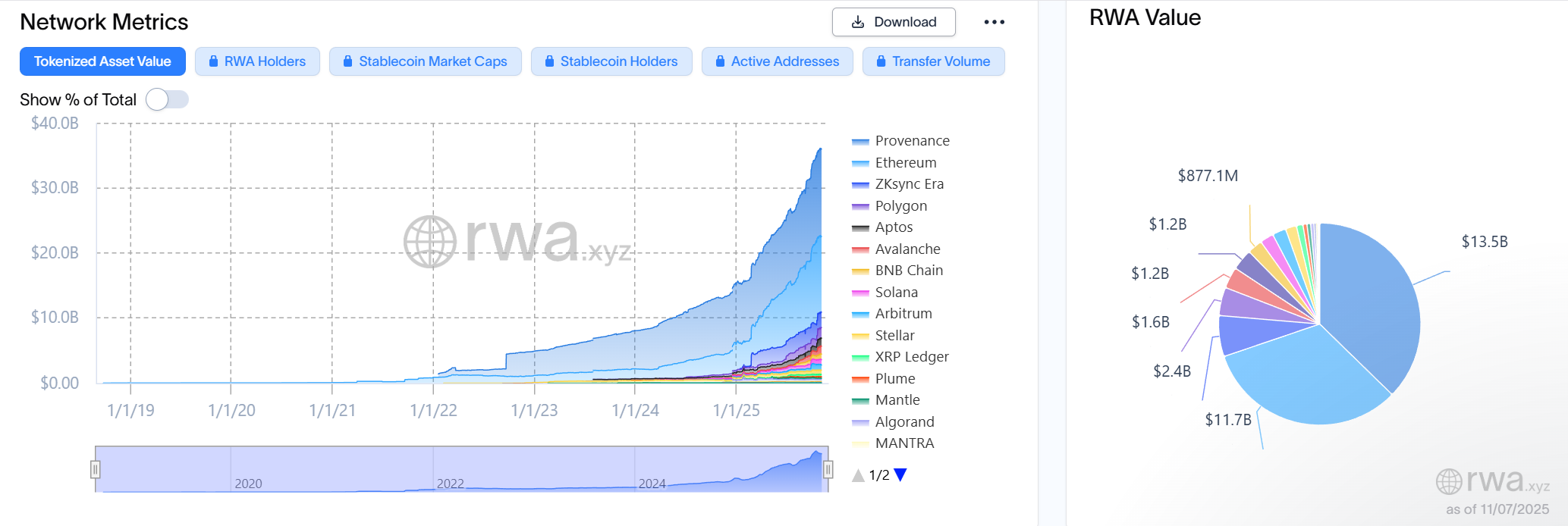
Fun fact: besides Ethereum's mainnet, which chain currently leads in RWA?
The answer is—ZKsync.
Yes, one of the original "Big Four" Layer 2 projects, recently praised by Vitalik for doing "a lot of underappreciated yet highly valuable work within the Ethereum ecosystem," is now emerging as the most representative project on Ethereum’s ZK roadmap.
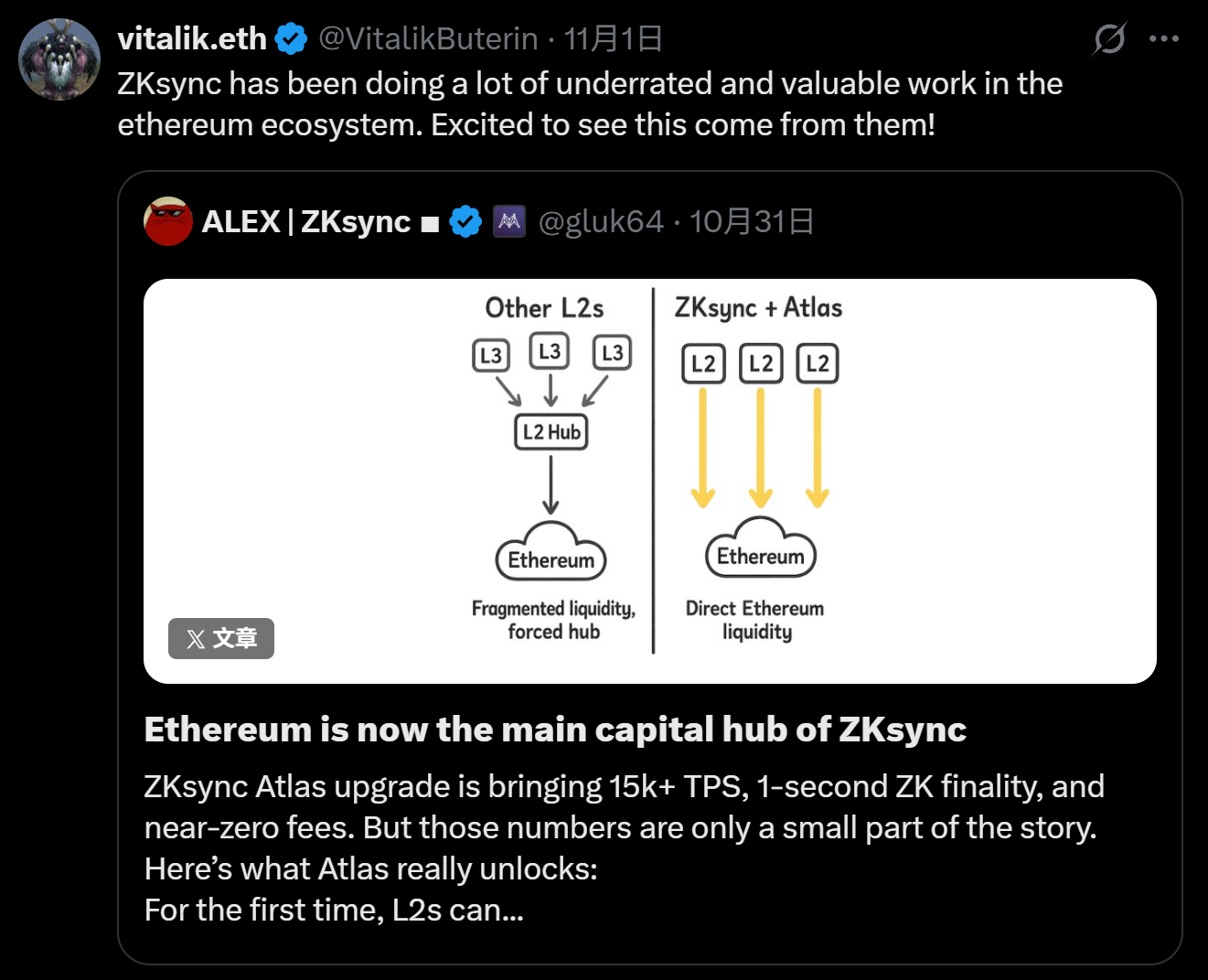
Beneath this progress lies a deeper signal: Ethereum is accelerating toward its "singularity moment" in the zero-knowledge proof (ZKP) era. Ethereum's ZK path is evolving from a Layer 2 scaling tool into a core architectural logic that reshapes trust, performance, and ecosystem structure.
An Ethereum belonging to the "era of proofs" is gradually taking shape.
I. ZKsync: A New Standard-Bearer for Ethereum's ZKP Vision
As an Ethereum scaling solution developed by Matter Labs based on ZK Rollups architecture, ZKsync was born with strong advantages—it was one of the early ZK Rollup scaling solutions funded by the Ethereum Foundation.
In fact, since 2019, it has grown almost hand-in-hand with Ethereum’s ZK technology track:
-
March 2019: Received funding from the Ethereum Foundation's fifth grant program to support its work on ZK-based Layer 2 scaling;
-
September 2019: Raised $2 million in seed funding led by Placeholder VC;
-
March 2021: Closed a $50 million Series A round led by Union Square Ventures;
However, due to prolonged development timelines, ZKsync hasn't had a smooth journey over the years.
During the unclear Rollup competition landscape between 2021–2023, OP-stack Layer 2s like Optimism and Arbitrum took an early lead. Meanwhile, new blockchains such as Solana and Aptos rose rapidly, pushing ZK-based solutions like ZKsync to the sidelines due to their long iteration cycles.
It wasn’t until last year, after the mainnet launch and token airdrop, that ZKsync re-entered public view—but not without controversy. Its airdrop distribution mechanism sparked debate, a smart contract vulnerability triggered a trust crisis, and Matter Labs later became embroiled in intellectual property disputes.
Despite these negative headlines, ZKsync continued making remarkable progress both technically and ecologically. Not only has it advanced core infrastructure development, but it alsolaunched the Atlas upgrade of ZK Stack last month—the key step forward in ZKsync’s push toward enterprise-grade blockchain adoption.
Source: ZKsync
This upgrade features a high-performance sequencer capable of processing 25,000 to 30,000 transactions per second, along with the Airbender proving system enabling sub-second finality.
Notably, Airbender is currently the fastest zkVM verified on a single GPU. For example, using an RTX 4090, average verification time is just 51 seconds at a cost as low as $0.01, setting a new industry record.
Another major breakthrough from ZKsync is its Prividiums private chain architecture, allowing enterprises to interact fully compatibly with Ethereum while preserving privacy—validating transaction correctness without exposing ledger details, thus achieving seamless interoperability between public and private systems.
This means that for applications such as tokenized securities, cross-border payments, or foreign exchange settlements, businesses can achieve instant settlement and privacy protection within compliance frameworks—a capability that makes ZKsync an ideal base layer for RWA (real-world assets).
For this reason, ZKsync stands out in the RWA space. According to data from rwa.xyz, at the time of writing, its issued tokenized assets exceed $2.4 billion, second only to Ethereum mainnet, making it the second-largest RWA issuance network globally.
In other words, ZKsync is not only a testbed for ZK technology, but also becoming a primary ledger engine for real-world asset tokenization.
II. Is the Endgame of zkEVM Finally Here?
For a long time, zkEVM has been seen as one of the "endgame solutions" for scaling Ethereum—not only because it addresses performance bottlenecks, but also because it redefines blockchain trust mechanisms.
The core idea is to enable Ethereum’s mainnet to generate and verify ZK proofs. In other words, after each block execution, a verifiable mathematical proof is produced, allowing other nodes to confirm correctness without re-executing computations.
Specifically, zkEVM offers advantages in three areas:
-
Faster verification: Nodes don’t need to replay transactions; they simply verify the zkProof to confirm block validity;
-
Lower overhead: Significantly reduces computational and storage burdens on full nodes, enabling easier participation by light clients and cross-chain verifiers;
-
Stronger security: Compared to the OP approach, ZK state proofs are confirmed on-chain in real-time, offering higher tamper resistance and clearer security boundaries;
Now, all of this is rapidly becoming reality.
Recently, the Ethereum Foundation (EF) officially released the L1 zkEVM real-time proof standard, marking the first time the ZK path has formally entered the mainnet-level technical roadmap. This standard is considered a critical starting point for fully integrating zero-knowledge proof mechanisms—within the next year, Ethereum’s mainnet will gradually transition to an execution environment supporting zkEVM verification, shifting structurally from “heavy execution” to “proof verification.”
According to EF’s published roadmap, targets include keeping block proof latency under 10 seconds, limiting individual zk proof size to under 300 KB, adopting 128-bit security levels, avoiding trusted setups, and enabling consumer hardware to participate in proof generation—lowering decentralization barriers.
This means Ethereum’s mainnet will no longer be merely a settlement layer, but evolve into a self-verifying “verifiable world computer.”
Against this backdrop, ZKsync is among the earliest implementers. Founder Alex stated that with the completion of the Atlas upgrade, ZKsync has achieved true verification integration with Ethereum mainnet—their operational rhythm, confirmation speed, and liquidity are now nearly perfectly synchronized.
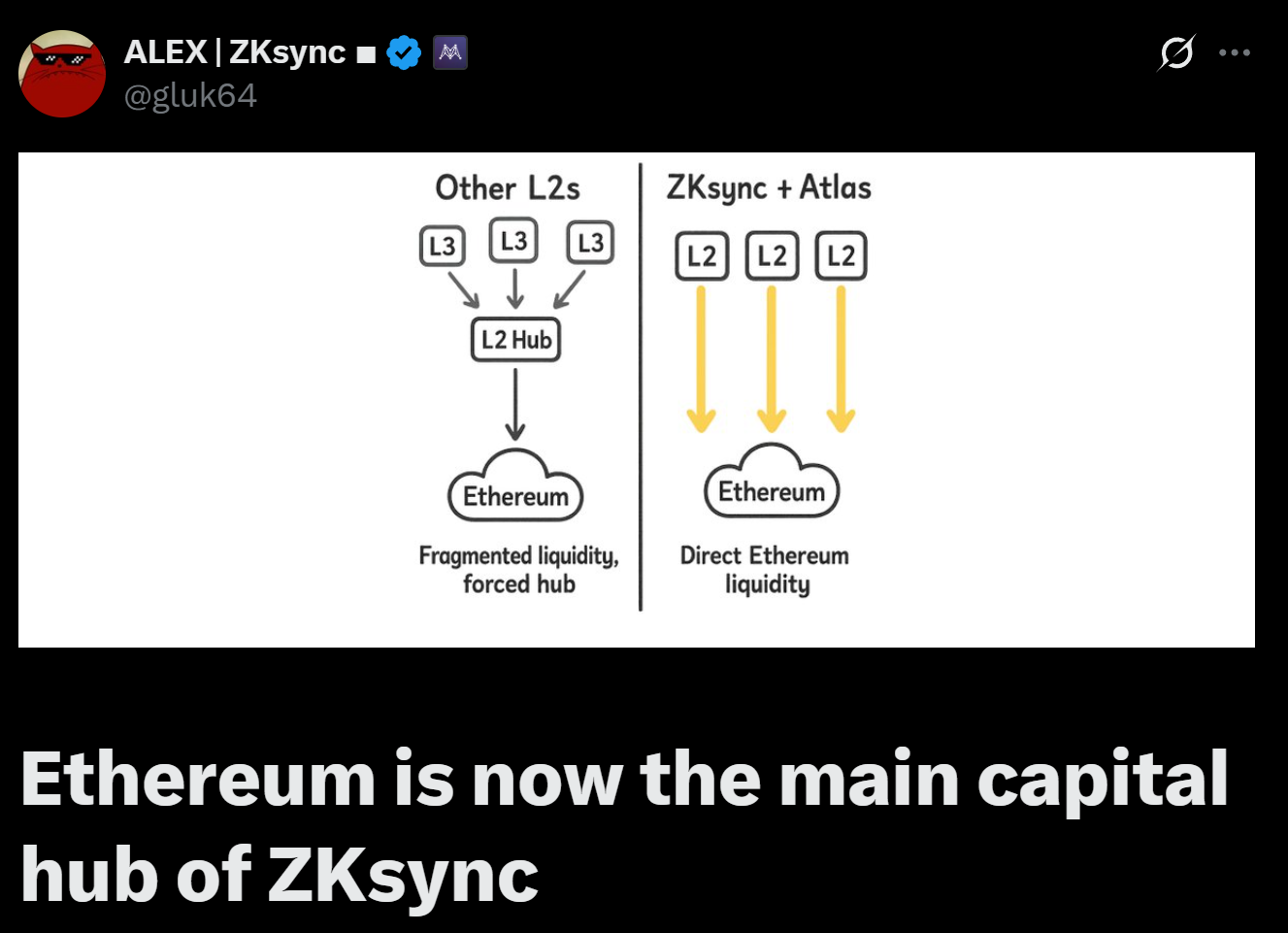
Currently, ZKsync achieves final transaction confirmation in about 1 second—much faster than Ethereum’s 12-second block interval. This means transacting on ZKsync is essentially equivalent to transacting directly on mainnet, requiring only mainnet confirmation. More importantly, unlike Optimistic Rollups, ZK Rollups do not require a seven-day challenge period, resulting in an order-of-magnitude improvement in transaction and capital flow speed.
Under this architecture, Layer 2 is no longer a fragmented extension, but truly becomes a “parallel scaling network” of Ethereum mainnet. Liquidity no longer needs to be duplicated, and verification delays are significantly reduced.The long-standing issue of “L2 fragmentation” plaguing the Ethereum ecosystem finally has a technical solution.
III. What Future Is Ethereum Building Toward?
If you’ve followed Vitalik’s recent social media activity, you’ll notice a clear trend—he frequently shares discussions related to Ethereum scalability, especially topics concerning zkEVM and Layer 2 architectural evolution.
Among these mentions, projects like Starknet and others representing the ZK ecosystem consistently point in one direction: Ethereum’s ZK era is accelerating comprehensively.
Notably, unless delayed, Ethereum’s next network upgrade, Fusaka, is scheduled to go live on mainnet December 3. This upgrade is arguably one of the most impactful since The Merge and Dencun, with the core goal of making Layer 2 cheaper, faster, and more open.
Through the PeerDAS (Peer Data Availability Sampling) mechanism, Fusaka delivers higher data throughput for Rollups. It also introduces a new branching process called Blob-only parameter, restructuring network bandwidth, storage, and data writing methods to further optimize mainnet resource usage.
For Rollup developers, this means lower data write costs and greater flexibility in interaction design. For wallet and infrastructure providers, it enables support for more complex interactions and heavier node loads. For end users, it translates to lower-cost, faster-response on-chain operations. For enterprises and regulated users, simplified EVM extensions and state proofs will make on-chain interactions easier to integrate with regulatory systems and large-scale deployments.
Therefore, when zkEVM and Fusaka are both implemented, the Rollup ecosystem is poised to enter a true phase of scale, and looking back over recent years, Ethereum’s roadmap continues to evolve:
From The Merge’s consensus upgrade, to Dencun’s data layering, and now the upcoming Fusaka and zkEVM—the entire trajectory revolves around a central question: how to balance decentralization and scalability.
Today, that answer seems to be emerging clearly through the mathematical brilliance of ZK.
Join TechFlow official community to stay tuned
Telegram:https://t.me/TechFlowDaily
X (Twitter):https://x.com/TechFlowPost
X (Twitter) EN:https://x.com/BlockFlow_News
 @imTokenOfficial