The "Stability" and "Instability" of Stablecoins in 2024
TechFlow Selected TechFlow Selected
The "Stability" and "Instability" of Stablecoins in 2024
The market capitalization of fiat-backed stablecoins surged to $161.2 billion in 2024, yet remains below the peak of $181.7 billion reached in 2021.
 Navigating Web3 tides with focused insights
Author: CoinGecko
Translation: Baihua Blockchain
Stablecoins are tokens whose value is pegged to other assets—such as commodities or fiat currencies—to stabilize their price. By maintaining a link with specific fiat currencies, assets, or commodities, most stablecoins serve as a bridge between the real world and cryptocurrency, tokenizing these assets onto blockchains.
Since 2014, companies like Tether and Circle have issued tokenized currencies backed by real-world financial assets such as bank deposits and short-term securities. Users can directly enter the crypto space through these companies, converting real-world deposits into newly minted stablecoins. Conversely, they can also redeem stablecoins back into fiat currency.
However, not all stablecoins are fully backed by tangible real-world assets. Decentralized stablecoins such as DAI and AMPL maintain their pegs through mechanisms like over-collateralization of crypto assets or supply adjustments (rebasing), enabling stablecoin issuance without centralized entities while preserving their pegs.
The true value of a stablecoin lies in its ability to maintain its peg at all times—even during market volatility. Unfortunately, many stablecoins have failed this test. In this report, we cover stablecoin types, total market capitalization, transaction volumes, and emerging stablecoin models.
Five Key Takeaways from CoinGecko’s 2024 "State of Stablecoins Report":
Fiat-backed stablecoin market cap surged to $161.2 billion in 2024 but remains below the 2021 peak of $181.7 billion
Although the fiat-backed stablecoin market grew in 2024, reaching a total market cap of $161.2 billion, it still fell short of the historical high of $181.7 billion set in 2021.
Commodity-backed stablecoins grew 18.1% in 2024, reaching $1.3 billion—just 0.8% of the size of fiat-backed stablecoins. Despite growth, commodity-backed stablecoins remain small, with a 2024 market cap of only $1.3 billion, representing just 0.8% of the total market cap of fiat-backed stablecoins.
Stablecoins account for 8.2% of the global crypto market cap and increase their dominance during market downturns
Stablecoins hold an 8.2% share of the global crypto market cap, and their market dominance rises further during periods of market weakness.
8.7 million addresses hold stablecoins, with 97.1% holding USDT, USDC, or DAI. The majority of stablecoin holders are concentrated in USDT, USDC, and DAI, with approximately 97.1% of addresses holding one of these three.
Stablecoins continue to struggle with maintaining their pegs, especially during uncertain times. Although stablecoins are designed to maintain a stable price, many face challenges in doing so during market turmoil and uncertainty.
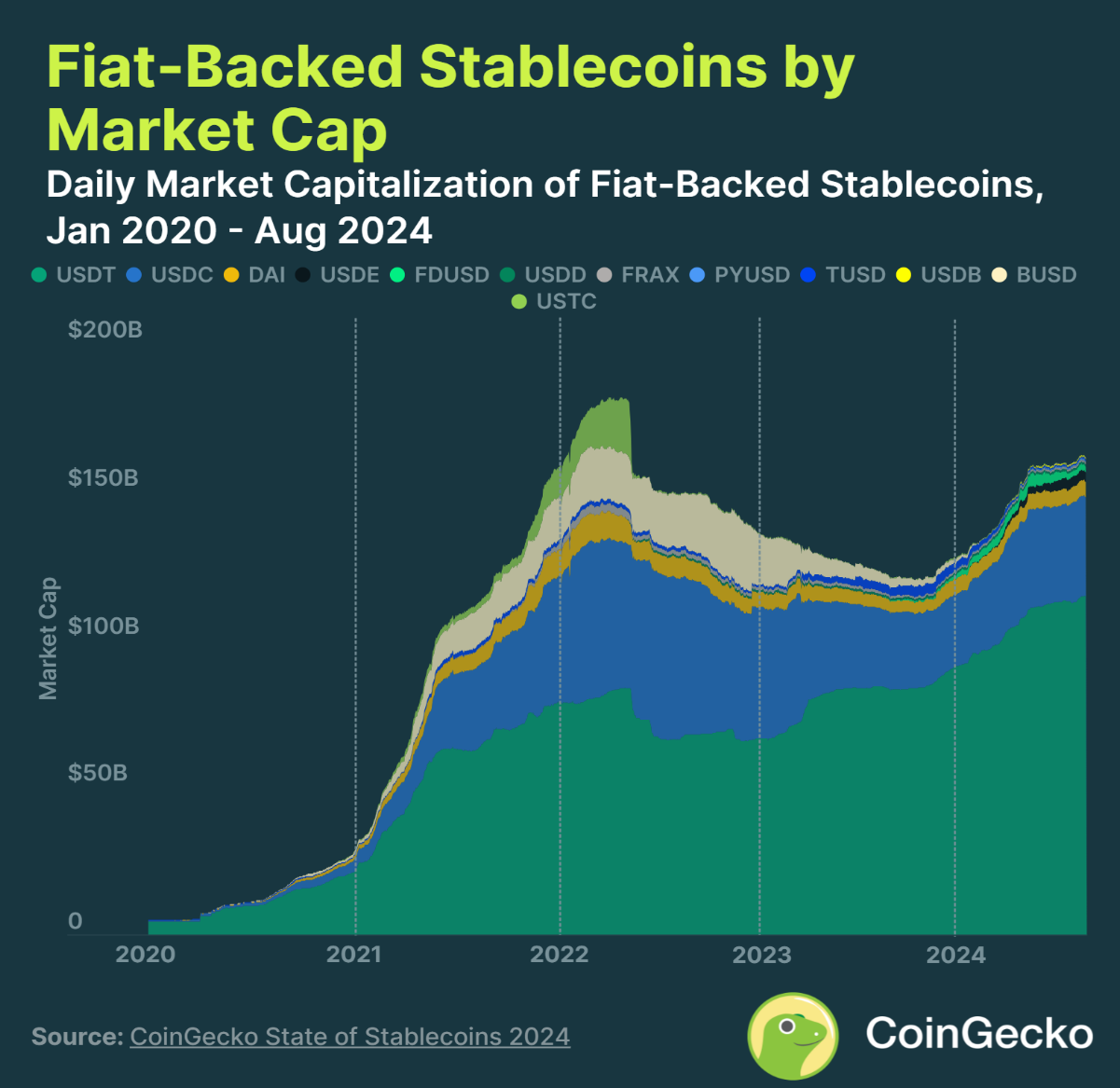
Since 2020, the total market cap of the top ten fiat-pegged stablecoins has grown significantly. During the 2020–2021 bull run, the market cap surged 3,121.7% from $5 billion at the start of 2020 to $181.7 billion in March 2022. Following the collapse of Terra and its UST stablecoin, stablecoin market cap declined temporarily but reversed course in November 2023. As of August 2024, the total market cap of fiat-pegged stablecoins had increased by 35.4%, rising from $119.1 billion to $161.2 billion.
The top three USD stablecoins—Tether (USDT) at $114.4 billion, USDC at $33.3 billion, and Dai (DAI) at $5.3 billion—account for 94% of the total stablecoin market cap. Meanwhile, USDT's market share has consolidated to 70.3%, while USDC's market share has been declining since the U.S. banking crisis in March 2023. Stablecoins pegged to other currencies (such as the euro, yen, and Singapore dollar) account for only 0.2% of the market share.
1. Commodity-backed stablecoins grew 18.1% in 2024, reaching $1.3 billion—just 0.8% of fiat-backed stablecoin market cap
As of August 1, 2024, the market cap of commodity-backed stablecoins reached $1.3 billion. Despite new entrants such as Kinesis and VeraOne, Tether Gold (XAUT) and PAX Gold (PAXG) still dominate 78% of this market. Although commodity-backed stablecoins have grown 212-fold since 2020 and rose 18.1% in 2024, they represent only 0.8% of the market cap of fiat-backed stablecoins.
Precious metals are the preferred underlying assets for these stablecoins, but in recent years, stablecoins backed by other commodities have also emerged. The Uranium308 project launched a stablecoin tied to the price per pound of U308 uranium compound, but the project has since ceased operations.
2. Stablecoins account for 8.2% of the global crypto market cap and increase their dominance during market downturns
As of August 1, 2024, stablecoins make up 8.2% of the global crypto market cap. At the beginning of 2020, stablecoins played a minor role in the crypto industry, accounting for only about 2% of the global market cap, peaking at 6% during the early DeFi boom.
Stablecoin dominance rose sharply between November 2021 and May 2022, primarily driven by the exponential growth of Terra’s UST stablecoin, which increased its market share from 4.8% to 15.6%. However, after UST collapsed, stablecoin market share plummeted. It then rebounded rapidly during the subsequent bear market as investors sought safety, reaching a high of 18.4%.
3. Stablecoins account for 8.2% of the global crypto market cap and increase their dominance during market weakness
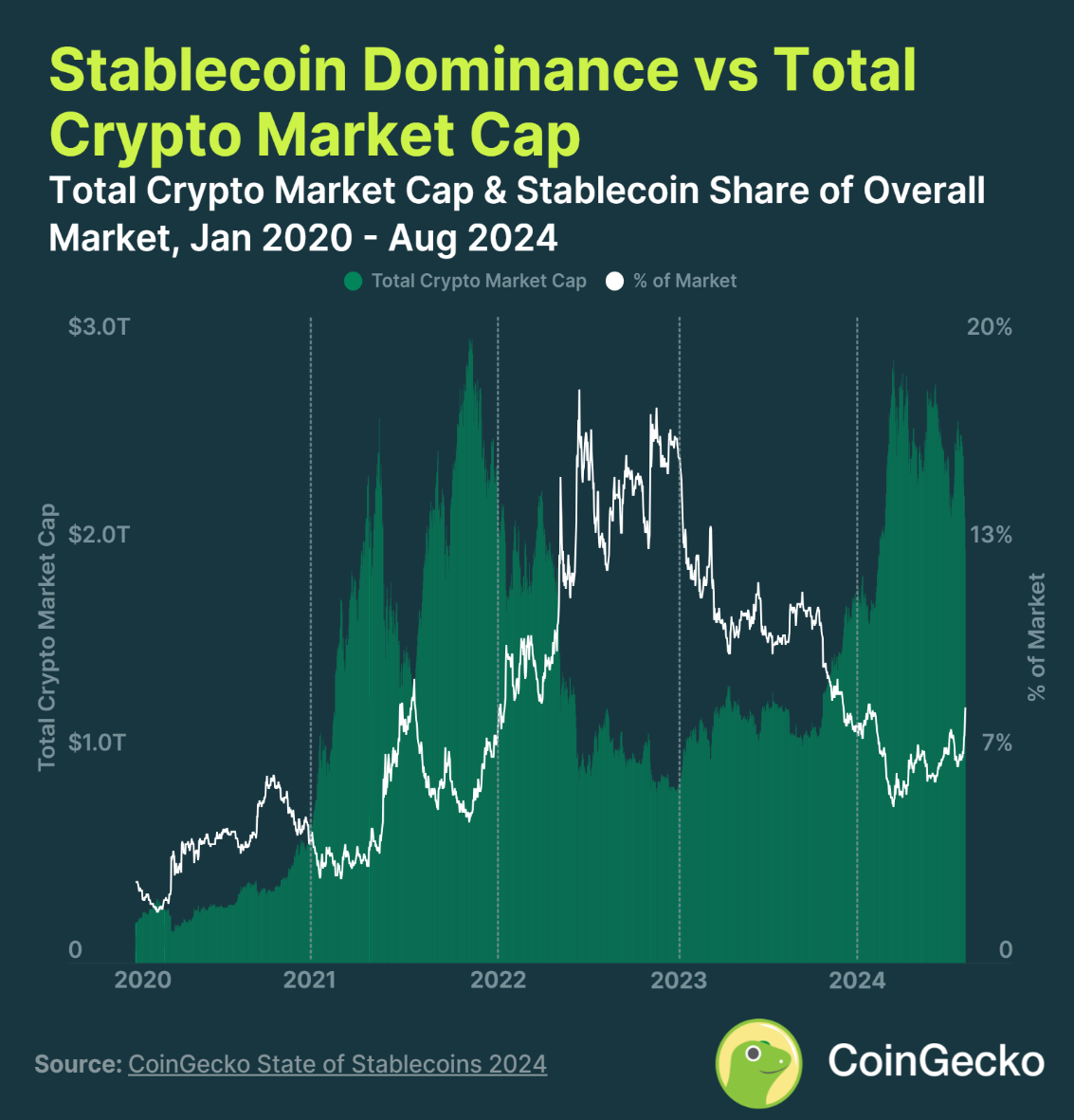
As of August 1, 2024, stablecoins represent 8.2% of the global crypto market cap. In early 2020, their share was very small—only about 2% of the total global market—but peaked at 6% during the initial DeFi surge.
Stablecoin dominance increased significantly between November 2021 and May 2022, largely due to the rapid expansion of Terra’s UST stablecoin, pushing its market share from 4.8% to 15.6%. After UST’s collapse, stablecoin market share dropped sharply. However, as investors turned to stable assets during the ensuing bear market, the share surged again, hitting a peak of 18.4%.
4. 8.7 million addresses hold stablecoins, with 97.1% holding USDT, USDC, or DAI
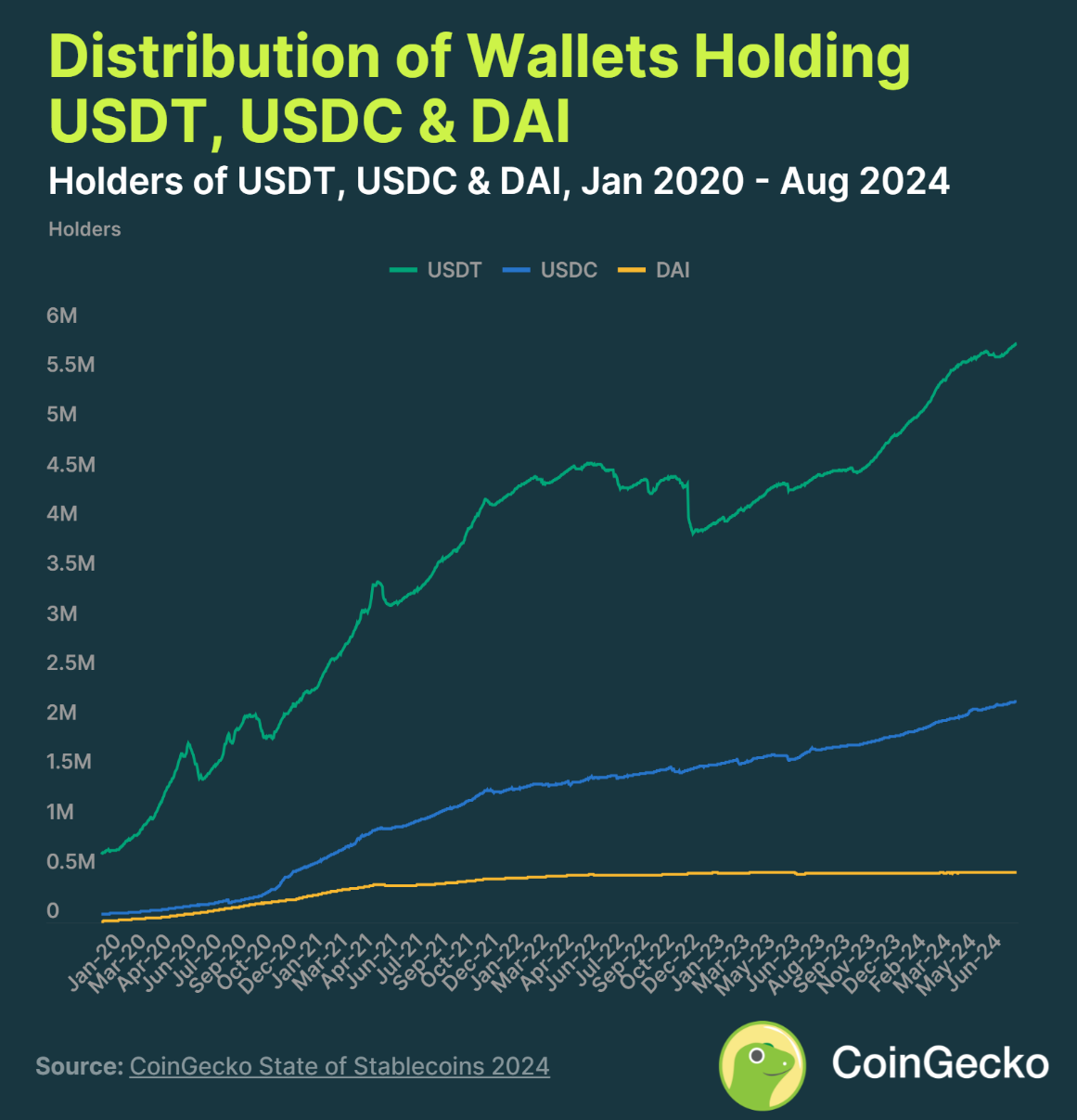
The top ten stablecoins collectively have 8.7 million holder addresses, with the top three—USDT, USDC, and DAI—accounting for 97.1% of these addresses.
USDT has the largest number of holder addresses, exceeding 5.8 million wallets—2.6 times more than its closest competitor, USDC. The remaining eight stablecoins each have fewer than 1 million holders, with DAI held by just over 505,000 wallets.
These stablecoins experienced rapid growth in 2020, but after the Terra collapse in 2022, concerns over the solvency of other stablecoins significantly slowed their growth rate.
5. Stablecoins still face challenges in maintaining price stability, especially during periods of market uncertainty
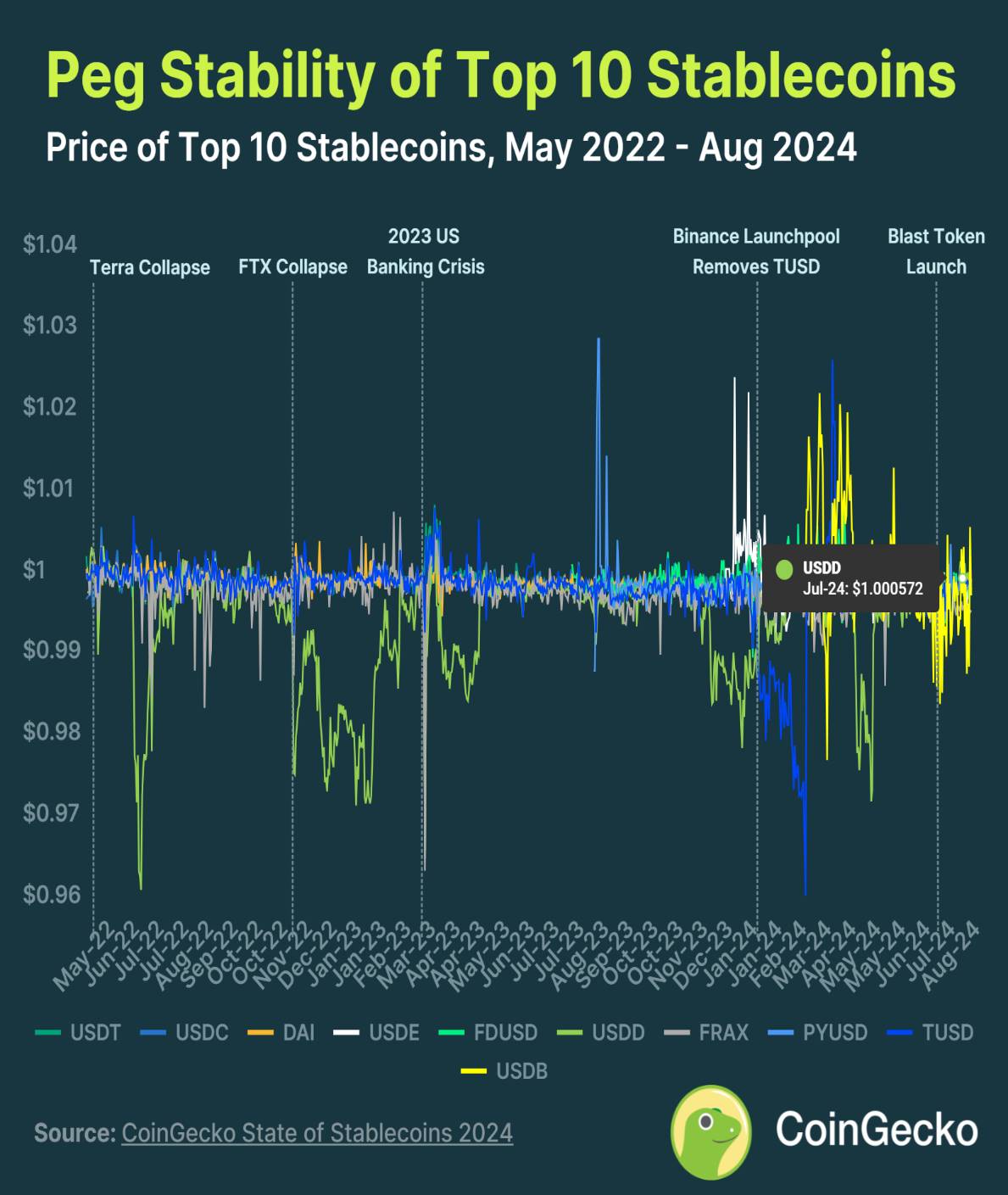
In the past, stablecoins struggled to maintain their pegs during volatile periods. However, mature stablecoins like USDT, USDC, and DAI are now better able to maintain their $1 peg. Stablecoins typically deviate from their peg during market stress—for example, during the March 2023 banking crisis—due to uncertainty around the safety of deposits at banks such as Silvergate and Signature.
Newer stablecoins, particularly partially algorithmic ones such as USDD, DAI, and FRAX, tend to be more volatile and rely on market arbitrage to maintain their peg. Nevertheless, there have been numerous failures, including Iron Finance and Basis Cash, which were unable to sustain their pegs successfully.
Join TechFlow official community to stay tuned
Telegram:https://t.me/TechFlowDaily
X (Twitter):https://x.com/TechFlowPost
X (Twitter) EN:https://x.com/BlockFlow_News
 CoinGecko