








Chatting About Three Recent Major Trends: OTC Markets, Stablecoin Innovation, and the Rise of Prediction Platforms
TechFlow Selected TechFlow Selected
Chatting About Three Recent Major Trends: OTC Markets, Stablecoin Innovation, and the Rise of Prediction Platforms
These three categories are extremely important and are undergoing significant innovation.
 Navigating Web3 tides with focused insights
Author: Route 2 FI
Translation: TechFlow
I’m seeing more and more traders on Twitter start buying altcoins. Right now, many believe OG DeFi tokens will make a comeback (e.g., Aave right now).
Personally, I'm locked into many altcoins—mainly through over-the-counter (OTC) deals or angel rounds—and I also hold a solid amount of $ETH.
Today, I want to expand on a tweet I posted a few weeks ago:
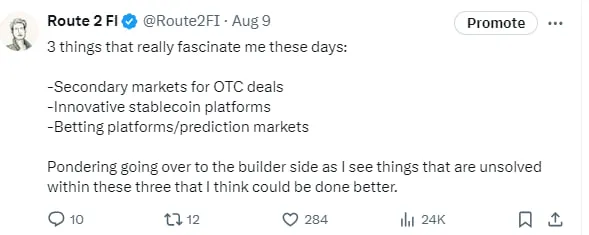
These three categories are crucial, but let’s dive deeper into them—why they’re interesting, and why this space is currently seeing so much innovation.
OTC Markets, Stablecoins, and Prediction Platforms

Imagine waking up to find your locked tokens suddenly worth 100x—but you won’t be able to access them for another year.
Imagine a world where your locked tokens no longer sit idle, stablecoins become exciting again, and you can bet on the future with surgical precision…
Let’s start by discussing secondary markets.
1. Secondary OTC Markets
Remember how Binance was significantly impacted by the FTX collapse? That period was wild. Due to insufficient OTC liquidity, Binance started selling their $FTT holdings directly on the market. Investors holding locked/staked/bound FTT wanted a seamless way to sell their positions at a discount to anyone willing to buy.
This event highlighted a major problem in crypto: What do you do when you're sitting on potentially valuable (or dangerous) locked tokens?
This is where secondary OTC markets come in.
Not Just for Whales
First, a quick explanation.
In crypto, OTC (over-the-counter) refers to direct trades between parties, rather than going through traditional exchanges. Historically, this space has been dominated by large players making big moves they don’t want publicized.
But now, OTC isn’t just for whales anymore. With the surge in token sales, airdrops, and vesting schedules, demand for easier OTC solutions is growing fast.
That’s where secondary markets step in.
Why Are Secondary Markets Important?
Imagine this: You were an early contributor to a promising project. The token’s current fully diluted valuation (FDV) is $10 billion, while you got in at $100 million. Congrats—you’re up 100x on paper!
But here's the catch—you’re still locked for another 36 months.
This isn’t just a thought experiment—it’s happening across crypto. Early investors sit on massive unrealized gains, trapped by vesting schedules and lockups. Secondary markets offer an escape hatch—or at least a way to realize some value today.
Currently, several projects are trying to solve this: Stix, OffX, Http OTC, and Secondary Lane.
How Do They Work?
The typical process looks like this:
-
You present your SAFT (Simple Agreement for Future Tokens) to prove ownership of the tokens you want to sell.
-
The platform displays your offer to a closed group of potential buyers.
-
If there’s interest, legal approval may be required (yes, securities laws and all that fun stuff).
-
In some cases, protocol-level approval might also be needed.
It’s not as simple as listing a trade on Uniswap, but for those sitting on locked tokens, it could be a lifeline.
Tokenized SAFTs and Decentralized OTC
Now, things get even more interesting.
What if we start tokenizing SAFTs themselves, or creating derivatives based on locked tokens? Imagine being able to trade shares of future token allocations. We already have liquid staking—why not introduce liquid locking too?
Add in a fully decentralized OTC market to seamlessly trade these derivatives. No intermediaries, no closed groups—pure, permissionless trading of locked assets. Sounds great in theory, but regulatory hurdles are… well, you know.
And yes, secondary OTC markets aren’t all sunshine and sports cars. While they can improve liquidity and price discovery, there are serious concerns:
Insider trading: What happens when team members start dumping tokens before bad news breaks?
Market manipulation: With relatively low liquidity, these markets could become prime targets for pump-and-dump schemes.
Regulatory nightmare: The SEC already views crypto with suspicion. Adding another layer of complexity won’t make them any happier.
The Future of Secondary OTC Markets
Where is all this heading? If I had to bet (more on betting later in part three), I’d say we’ll see more innovation here. Demand exists—and in crypto, demand often breeds solutions, for better or worse.
We might see:
-
More sophisticated derivatives based on locked tokens
-
Integration with DeFi protocols to enhance liquidity and lending
-
Fully decentralized, compliant platforms serving everyone—including global institutional investors
One thing is certain: As long as new projects come with vesting periods and lockup schedules, there will be demand for secondary markets.
Whether they ultimately benefit the ecosystem remains to be seen.
But that’s part of the fun, right?
So, how could we transfer locked tokens via a contract agreed upon by both parties—without communicating with the DeFi protocol or startup team?
Could we create a contract (smart contract address) that transfers/exchanges tokens from one specific address to another under exact terms?
For example:
Bob will receive Monad tokens—15% at TGE, then 85% over the next 36 months. Bob’s wallet address is 0x…. His tokens are currently valued at $5 billion (token valuation), with a total paper value of $200,000.
Karen wants to buy these tokens for $100,000 (50% discount = $2.5B valuation), accepting the 36-month lockup terms.
Bob logs into his wallet. The protocol sends him the tokens, then he signs a message from Karen, automatically routing all future token distributions to her—15% at TGE and monthly releases over the next 36 months.
Not sure if this is feasible today, but a token standard could theoretically be built for this.
Risks:
-
Bob tells the protocol he wants to change the payout address. So ideally, coordination with the team is still necessary.
Just for reference, I don’t recall Monad’s actual valuation—this is purely illustrative.
I’m not sure how to solve this OTC secondary issue without team/legal involvement, but that would be the dream—making OTC sales truly seamless.
2. Innovative Stablecoin Platforms
Let’s talk about stablecoins. But not the old-school USDT or USDC—we’re talking about the weird, fascinating 2.0 stablecoins. Because honestly, after recent 20% daily swings, a bit more stability sounds nice.
Besides, stablecoins are the bedrock of DeFi—the safe harbor during storms, what you wish you’d moved into before the last crash.
But traditional stablecoins like USDC and USDT have issues:
-
They’re centralized, meaning single points of failure
-
They face ongoing regulatory scrutiny
-
They’re not very capital-efficient
Still, several projects are trying to fix these problems—possibly creating new ones along the way.
Ethena’s USDe
Let’s focus on Ethena—they’re attempting something… unusual. They call it a “synthetic dollar protocol,” which sounds like something out of a financial dystopia sci-fi novel.
Here’s how USDe works (in theory):
-
You deposit staked ETH (e.g., stETH) as collateral.
-
Ethena opens corresponding short positions on derivatives exchanges.
-
You receive USDe tokens in return.
The idea is to hedge against ETH price volatility via short positions, maintaining stable value. It’s like riding a seesaw, hoping you don’t fall off.
Essentially, you can stake your USDe as sUSDe and earn yield from:
-
ETH staking rewards
-
Funding rate and basis yield from hedging positions
Risks (because there are always risks)
-
Funding risk: What happens when funding rates stay negative for extended periods?
-
Liquidation risk: Large spreads between ETH and stETH could cause trouble.
-
Smart contract risk: Because no DeFi project is complete without hacker threats, right?
Ethena has an insurance fund to cover some of these risks, but in crypto, we know “insurance” often means “the first thing to vanish when things go south.”
While Ethena is gaining attention, they’re not the only ones reimagining stablecoins:
Usual Money
At its core, Usual aims to be a secure, decentralized issuer of fiat-backed stablecoins. They’re building multi-chain infrastructure aggregating tokenized real-world assets (RWAs) from major players like BlackRock, Ondo, Mountain Protocol, and others.
The ultimate goal? Convert these RWAs into a permissionless, on-chain verifiable, composable stablecoin called USD0. Like building a bridge between the dull (but stable) world of traditional finance and the wild west of DeFi.
USD0 is marketed as the world’s first RWA stablecoin aggregating various U.S. Treasury token offerings. Here’s why it could matter:
-
Security: Backed by actual U.S. Treasuries.
-
Transparency: Real-time transparent reserves address one of the biggest criticisms of existing stablecoins.
-
Bankruptcy remoteness: Unlike stablecoins tied to commercial bank deposits (looking at you, USDC, during the SVB crisis), USD0 aims to be truly decoupled from traditional banking risks.
They also have a “useless governance token”—though it might not be so useless after all:
-
It grants ownership of actual protocol revenue, not just voting rights on unread proposals.
-
Staking $USUAL earns more $USUAL, creating a positive feedback loop for long-term holders.
-
There are discussions about future buybacks to boost “real value”—always a popular move in crypto circles.
Perhaps most notably, Usual is allocating 90% of its supply to the community. A bold move in a space where founders and VCs usually keep most of the pie.
Challenges and Questions
Of course, it’s not smooth sailing. Usual faces significant challenges:
-
Regulatory scrutiny: Anything tied to U.S. Treasuries is bound to attract regulators. How will Usual navigate this complex landscape?
-
Competition: The stablecoin space is crowded. Can Usual carve out a meaningful niche?
-
Adoption: For DeFi users, does it really matter whether a stablecoin is backed by Treasuries instead of dollars?
Potential Impact
If these new stablecoin models actually work (and “work” means they become relevant and widely used, not just speculative curiosities), we could see major shifts in DeFi:
-
Higher capital efficiency in lending
-
New types of yield-generating strategies
-
Potentially lower systemic risk (or just newer, more exciting kinds of risk)
Honestly, looking at these new stablecoin platforms, I think, “Didn’t we learn anything?” I lived through the UST collapse—that felt like a root canal performed by a drunk gorilla.
But another part of me—the part that’s been huffing hope since 2017—is excited. Because this is exactly what crypto excels at: taking existing financial concepts, adding layers of complexity, and somehow ending up with something innovative.
In my next piece, I’ll dive deeper into stablecoin opportunities. Watch Ethena, Usual, Anzen, Elixir USD, and Mountain USD for yield plays and optimal investment strategies.
3. Prediction Markets
Now, let’s talk about everyone’s favorite pastime: speculative betting. Why limit yourself to price movements? You can bet on anything!
Imagine being able to wager on the exact date of the last Bitcoin halving, or the color of CZ’s shoes when he gets out of prison. Now that would be fun.
Welcome to the world of crypto prediction markets, where your gut feeling might make you rich (or, more likely, cost you a small fortune).
Prediction markets aren’t new, but blockchain tech is giving them a massive upgrade. The concept is simple: Create a market for any future event, let people trade based on their predictions, and see how the wisdom (or collective stupidity) of the crowd unfolds.
Non-Sports and Sports Betting
In crypto prediction markets, we have two flavors:
-
Non-sports prediction markets: Bet on anything—from interest rate cuts to whether Vitalik will wear a suit.
-
Sports betting: When you want to combine gambling addiction with your love of sports.
Polymarket
Take Polymarket, a prime example of a crypto prediction market.
How does it work?
Create a market around any yes/no question, let people trade. That’s it!
Popular markets include politics, crypto events, celebrity gossip—whatever you can imagine, someone’s probably betting on it.
But Polymarket isn’t alone.
New platforms like LimitlessExchange and HedgehogMarkets are jumping in too. LimitlessExchange offers ETH-denominated markets, while Solana-based HedgehogMarkets attracts users with its unique parimutuel system.
One of the most exciting developments is permissionless markets. Imagine launching a prediction market on anything—no need for approval from some guy who’s never lost thousands on a meme coin.
This is crypto-powered free speech at its finest.
Another breakthrough is AI-driven market resolution. Imagine a prediction market where AI automatically resolves complex, nuanced outcomes—without human intervention.
It’s like we’re building a real-life oracle.
Sports
Now, let’s talk about putting your ETH on the line in sports. SX Bet, Azuro, and Overtime are bringing sports betting into the Web3 era:
-
Instant payouts: No more waiting days to withdraw your winnings.
-
Transparency: All bets settle on-chain, including odds. No more shady bookies.
-
Global access: Bet anytime, anywhere.
Some crypto sports betting platforms have daily volumes that would make small countries jealous.
But it gets crazier.
There are signs of highly leveraged bets emerging in crypto prediction markets. Take LogX Trade, for instance—they’re building perpetual futures contracts for events like “if Trump wins the election.”
But don’t forget, quiet prediction markets already exist within meme coins.
Tokens like TRUMP and BODEN are just proxy bets on election outcomes—holders are merely speculating on who wins and how others will speculate.
It’s meta-betting, and it’s fascinating to watch.
Looking ahead, I ask myself: Will decentralized prediction markets become standard tools for business and governance decisions—or will the almighty blockchain someday need to be consulted when having children?
One thing is certain: In crypto prediction markets, the lines between gambling, investing, and forecasting blur beyond recognition.
The possibilities are equal parts thrilling and terrifying.
The Future of Prediction
Where is all this headed? If I had to bet (obviously, I do), I’d say we’re moving toward a future where the boundaries between prediction markets, traditional finance, and everyday decision-making become incredibly fuzzy—really, deeply fuzzy. What can we expect?
-
Create a market and let AI resolve it: Imagine markets auto-generated around trending topics, with AI handling all outcome verification.
-
Merge this with real-world governance: Could prediction markets influence policy decisions?
-
Micro-predictions for everything: Bet on tomorrow’s weather, how many likes a tweet gets, or whether my crush will notice me.
Consider this: Another innovative solution involves using yield-bearing stablecoins—or designing a lending protocol that lets users borrow against their positions.
Example: Place a $1,000 bet on Trump winning, using leverage. The position doesn’t settle until November. So bet $1,000 while only spending $200 (5x leverage → capital efficient). Platforms like Levr bet already do this.
Or, you could borrow against your position—making prediction markets even more appealing.
Your $1,000 Trump bet → borrow 500 USDC, usable for anything.
The potential is staggering. We’re talking about a world where collective intelligence connects in real time, information has a price, and ideas trade as efficiently as stocks.
It’s like Wikipedia and Wall Street had a baby—and that baby loves to gamble.
But don’t get too carried away. We still have hurdles:
-
Regulatory challenges: Governments aren’t fans of unregulated gambling apps. Feels like magic, huh?
-
Oracle problem: How do we ensure fair and accurate resolution of bets?
-
Market manipulation: High liquidity brings high responsibility—and potential chaos.
The Future Is Unpredictable
Things are moving fast. From secondary OTC markets offering lifelines to locked token holders, to innovative stablecoins challenging our notions of value, to prediction markets letting you bet on almost anything—the future of finance is being written (and rewritten) in real time.
Are these innovations the key to unlocking the next wave of crypto adoption? Or just more sophisticated ways for degens to lose money?
Honestly, probably both.
All I know is: Crypto’s creativity and audacity continue to amaze me. Just when you think you’ve seen it all, someone shows up with an AI-driven, quantum-entangled, blockchain-based solution to a problem you didn’t even know existed.
What comes next? I don’t know.
But I’ll be here, ready for whatever it is—probably making reckless bets on prediction markets, chasing every shiny new stablecoin promising endless wealth.
Because in crypto, the only thing crazier than the latest innovation is missing out on it completely.
Remember, anon: The future isn’t written yet—but with these new tools, maybe we can bet on it.
Just make sure you never bet more than you can afford to lose. Of course, this isn’t financial advice—but in this wild west of finance, who really knows what counts as advice anymore?
Join TechFlow official community to stay tuned
Telegram:https://t.me/TechFlowDaily
X (Twitter):https://x.com/TechFlowPost
X (Twitter) EN:https://x.com/BlockFlow_News
 @Route2FI


