








Roundtable Discussion: Decoding the "American" Complex in the Crypto Market
TechFlow Selected TechFlow Selected
Roundtable Discussion: Decoding the "American" Complex in the Crypto Market
As the crypto market repositions itself, no one can escape the Kondratiev Wave.
 Navigating Web3 tides with focused insights
Author: Hedy Bi, OKG Research
This article is jointly produced by OKG Research, the research institute of OKLink, and PANews: data-driven insights into the real on-chain world.

“Uncontrolled mobs are not the voice of the people, but merely a loud and angry noise,” said President Kennedy the day after Martin Luther King Jr. was assassinated in Memphis. Last weekend, a gunshot across the Atlantic not only boosted Trump’s approval ratings (according to Polymarket data), but also warmed up the Bitcoin market.
Yet this should not be the signal for crypto markets. Vitalik Buterin, co-founder of Ethereum, also posted today opposing political voting decisions based solely on “pro-crypto” stances.
Regarding the impact of U.S. developments on crypto markets, this will be one of the key analytical focuses for our research institute this year. As early as May, OKG Research proposed that the rivalry between the two major U.S. political parties would influence crypto market performance, as it reflects whether the U.S. financial system recognizes virtual assets and supports broader compliance and development of related industries.
Moreover, with the launch of spot Bitcoin ETFs in the U.S. and increasing institutional participation, we cannot deny that factors related to the “United States” are exerting an ever-growing influence on crypto markets. In my earlier article titled "Decoding Crypto Market Reorientation: The Pain of Transformation Amid Global Liquidity Challenges", I analyzed how the new positioning of crypto markets and Bitcoin has evolved—from being a niche safe-haven asset to becoming highly sensitive to macroeconomic dynamics. Bitcoin has transitioned from “digital gold” into an “amplifier” of U.S. equity markets like the Nasdaq.

The crypto market’s “American complex” extends beyond finance or politics—it's a multidimensional and intricate phenomenon. However, we can still grasp its pulse through one category of data: on-chain data. With the maturation of blockchain technology and tools such as multi-chain explorers like OKLink, on-chain analytics now enable us to break through the “information cocoons” of traditional trading. On-chain data, with its immutable and traceable nature, offers unprecedented transparency to the market. In this context, I invited Ai Auntie and Phyrex—special guest analysts from the “Decrypting Web3 Truths” series jointly launched by OKG Research and PANews—to explore the crypto market’s “American complex,” delivering you a genuine view of the on-chain world through data.
OKG Research
A Sword of Damocles hanging over the crypto market: U.S. monetary policy decisions based on economic conditions, along with developments in U.S. spot crypto ETFs and election dynamics, must all be closely watched.
Ultimately, the crypto market’s “American complex” comes down to the U.S. economy—we all agree this is the foundational logic. The Federal Reserve’s monetary policy, shaped by assessments of the U.S. economy, remains a Sword of Damocles looming over the crypto market, particularly the timing of interest rate cuts and their relationship with economic trends, which are central concerns for investors. Phyrex added that rate cut decisions directly affect market liquidity and investor risk appetite, thereby significantly influencing the crypto market.
The Fed’s monetary decisions are grounded in the current state of the U.S. economy, which is reflected through several key indicators. The three macro indicators I recommend most are monthly unemployment rate, CPI, and PPI.
Phyrex further explained that for long-term analysis, the main indicators to watch are non-farm payrolls, CPI, and core PCE. Ai Auntie shared that beyond monthly unemployment, CPI, and PPI, she also tracks additional metrics such as weekly initial jobless claims, monthly unemployment rate, core PCE (Personal Consumption Expenditures index), and the University of Michigan Consumer Sentiment Index, all of which serve as critical inputs for the Fed’s interest rate decisions. She emphasized that deviations between actual data and market expectations often trigger significant market volatility.
Additionally, I believe overall capital flows—such as inflows and outflows in BTC spot ETFs—and the impact of U.S. elections on crypto markets are equally important. Both Phyrex and Ai Auntie noted that the Republican Party’s favorable stance toward cryptocurrencies and shifts in Trump’s popularity are notable political factors that inject additional optimism into the market. Beyond monetary policy, Ai Auntie highlighted the importance of direct indicators such as CME open interest, BTC ETF inflows/outflows, and Coinbase Bitcoin premium, which reflect American public sentiment and investment appetite toward Bitcoin and other cryptocurrencies.
OKG Research
On-chain data primarily reflects users’ anticipatory behavior rather than directly capturing the immediate effects of U.S. economic events.
In a previous discussion with Phyrex at PANews, I pointed out that the crypto market largely trades on the “expectation of expectations.” When observing on-chain data, what we see is more about “forward-looking anticipation.” For example, Phyrex explained that if the market expects a Republican victory, it may anticipate increased liquidity and a potential Fed rate cut in September, further boosting liquidity. These expectations eventually manifest in on-chain data. Ai Auntie noted that on-chain data does not directly reflect the instant impact of U.S. economic events on trading volume and frequency, because economic data releases follow fixed schedules and market reactions—especially within centralized exchanges—are swift and immediate.
In summary, the transmission path of U.S. economic events to the crypto market operates through market expectations, which shape sentiment and capital flows, indirectly affecting crypto assets. The mechanism typically begins with centralized exchanges before propagating to on-chain activity.
OKG Research
Two directions in on-chain data—“capital flows” and “BTC holder distribution”—are crucial indicators for predicting future market trends.
“Capital flows” in on-chain data have always been a key focus, encompassing large transaction movements, whale address distributions, and fund inflows and outflows. The first two can be easily tracked using on-chain analytics tools. Regarding capital flows, I assess total market inflows by monitoring USDT market cap expansion and BTC spot ETF inflows. For outflows, large transactions provide strong signals.
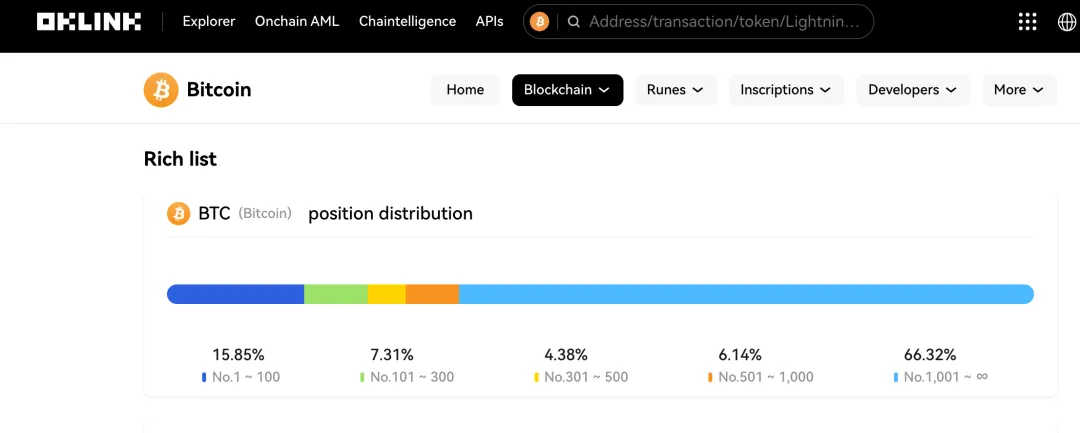
Source: OKLink
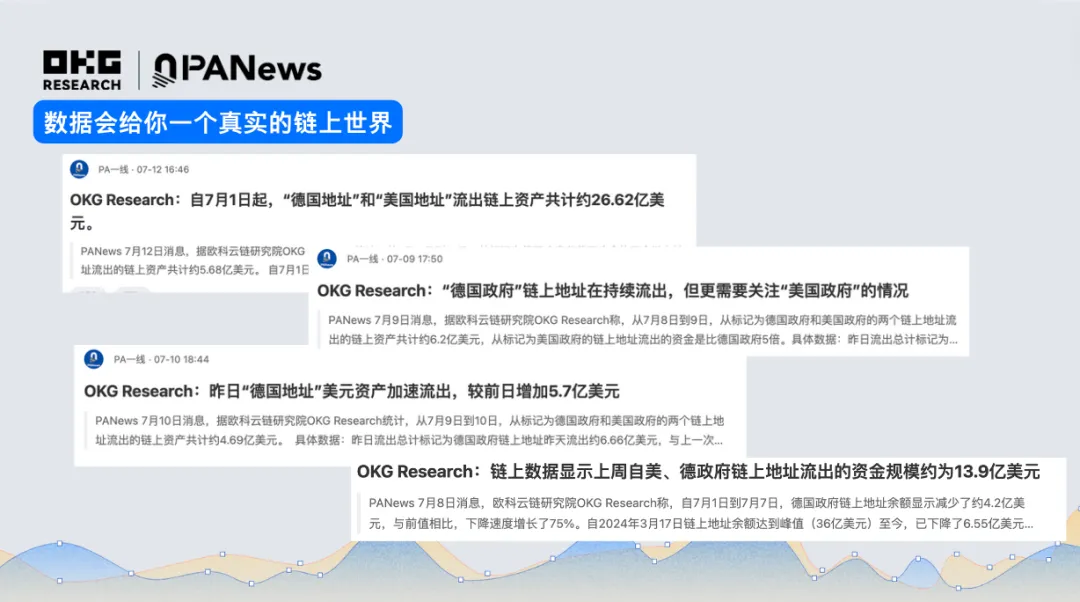
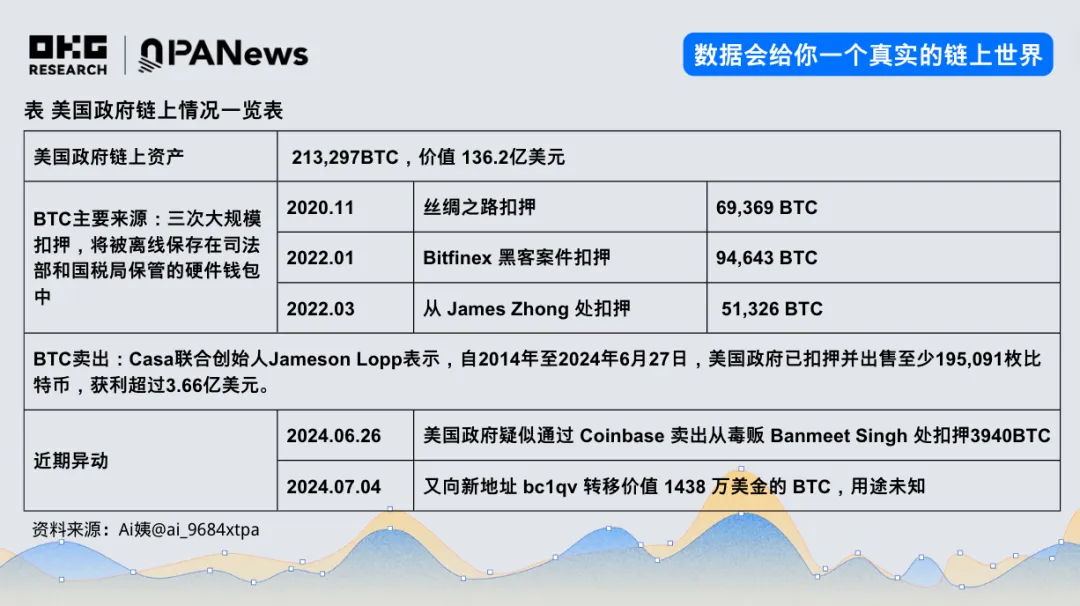
Ai Auntie brought up the concept of “sell-off anticipation” when discussing outflows. Since the U.S. government is among the largest holders of Bitcoin, tracking whale-level on-chain movements becomes critical. Just last week, we monitored sell-offs from addresses labeled as “German” and “U.S.”
Phyrex introduced a fresh perspective on BTC holder distribution worth deeper exploration. This cycle differs from past ones: previously driven by native crypto innovations, this cycle is led by Bitcoin spot ETFs. Given that Bitcoin currently accounts for around 50% of the total market cap, it has become a pivotal data point to monitor.
Here, he introduced the URPD indicator—the BTC holder distribution chart—which clearly shows where active traders are positioned.
OKG Research
On-chain data, breaking the “information cocoon” for the first time, holds significance comparable to an ECG.
From a cyclical perspective, on-chain data serves as a benchmark. In the short term, especially large transactions, they are the cause of price movements.
Looking back at traditional finance, profits stem from information asymmetry—the essence of intermediation. However, on-chain data represents the first significant breakthrough in dismantling information silos and access barriers. Anyone worldwide can access every transaction record on the blockchain, including sender, receiver, and amount. The only barrier is learning how to use the right tools—like the OKLink multi-chain explorer. After acquiring the data, interpreting its underlying value becomes the essential next step.
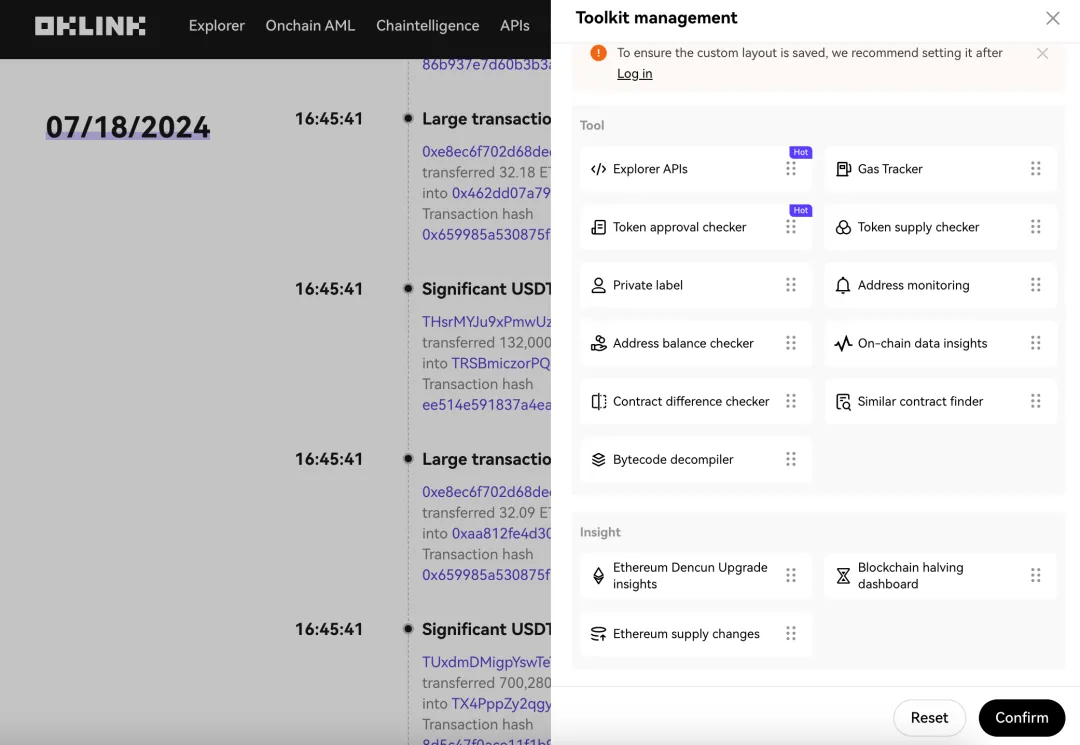
Source: OKLink
In terms of on-chain analytics, Phyrex emphasized its accuracy in identifying cyclical market shifts, particularly over longer timeframes. Ai Auntie added that on-chain data also provides real-time insights into crypto market activity across multiple dimensions—including transaction volume, holdings, and active addresses. For investors, these metrics act like the market’s “electrocardiogram,” aiding accurate decision-making. Their responsiveness and impact even surpass those of any traditional financial sector.
In my view, from a macro-cycle standpoint, on-chain data serves as the evaluation standard. In the short term, on-chain data—particularly large transactions—are the root cause of volatility. Due to their precision, immediacy, and directness, these anomalies amplify emotional swings in the market, thereby influencing investor behavior.
Finally, I asked Phyrex and Ai Auntie: if you could pick just one metric to gauge the crypto market, what would it be? They answered URPD and token price, respectively. Here, I’d like to reiterate one belief: as the crypto market repositions itself, no one can escape the Kondratiev wave.
Join TechFlow official community to stay tuned
Telegram:https://t.me/TechFlowDaily
X (Twitter):https://x.com/TechFlowPost
X (Twitter) EN:https://x.com/BlockFlow_News
 @OKGResearch






