








Four Pillars: Ethereum ETF Approval Imminent, Ethena Could Deliver Higher Yields
TechFlow Selected TechFlow Selected
Four Pillars: Ethereum ETF Approval Imminent, Ethena Could Deliver Higher Yields
The approval of Ethereum ETFs could boost yields for Ethena's synthetic dollar sUSDe, similar to what happened after the approval of Bitcoin ETFs.
 Navigating Web3 tides with focused insights
Author: xpara
Translation: TechFlow
Key Takeaways
-
The SEC is expected to approve spot Ethereum ETFs, potentially bringing $5 billion in inflows within six months.
-
Approval of Ethereum ETFs could boost yields for Ethena’s synthetic dollar sUSDe, similar to the effect seen after Bitcoin ETF approval.
-
Ethena's products face risks from funding rate volatility, liquidity challenges, and potential smart contract and custody operational risks, but these issues have been transparently addressed.
-
Ethena plans to enhance the utility of its ENA token and is preparing to launch the Ethena application chain.
2024 has been a unique year for the crypto industry. The approval of Bitcoin ETFs at the beginning of the year enabled traditional investors to gain exposure to Bitcoin price movements through regulated financial products, driving positive market sentiment and market cap growth.
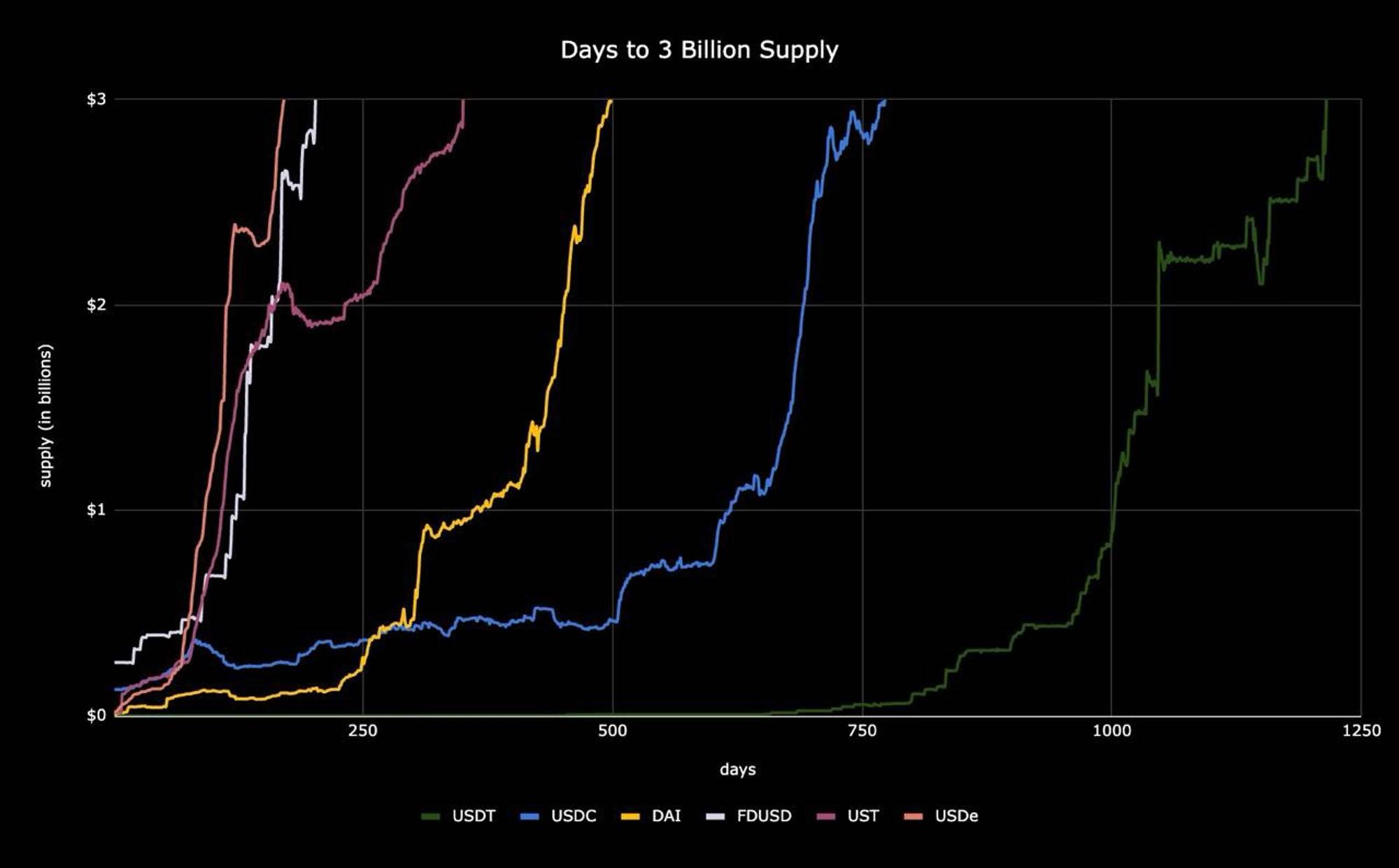
In terms of industry trends, current focus lies on launching proprietary rollups and memecoins. Compared to the previous bull cycle, this phase hasn't seen many fundamental innovations. However, in the DeFi application space, Ethena stands out. Ethena’s synthetic dollar USDe became the fastest crypto dollar to reach $3 billion, surpassing records set by DAI and USDC. Its success is attributed to a non-forkable architecture, a unique business model, and sustainable yield opportunities.
Currently, the biggest market focus is the anticipated approval of Ethereum ETFs, expected to be announced this July. This could bring new liquidity to the Ethereum ecosystem and create additional opportunities, providing fresh development momentum for Ethena’s products—USDe, sUSDe, and ENA. This article will explore current sentiment around Ethereum ETFs and their implications for Ethena.
1. Current Status of Ethereum ETFs and Inflow Estimates
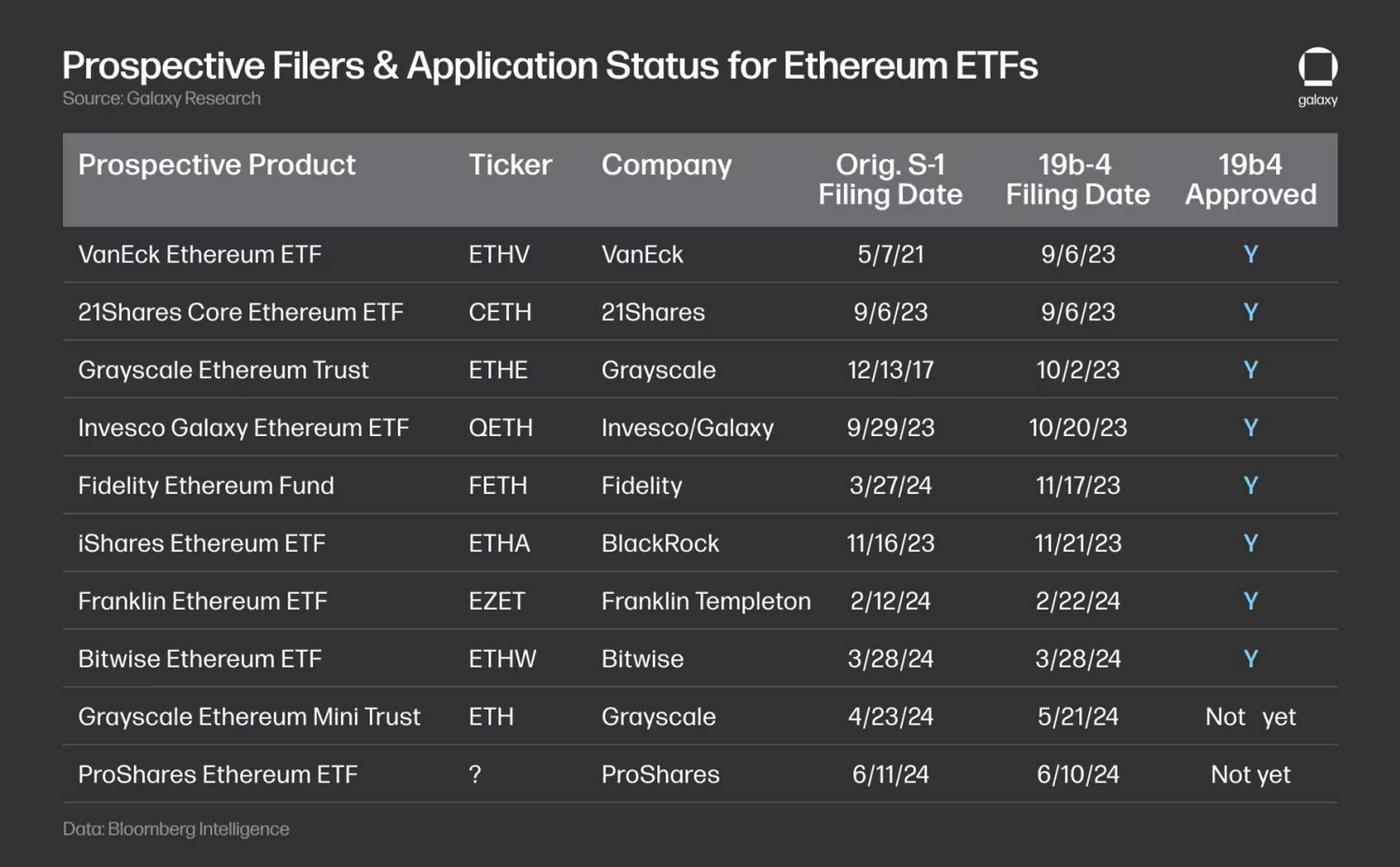
Prior to May 2024, sentiment around Ethereum ETFs was primarily skeptical and uncertain. This uncertainty stemmed from the U.S. SEC's historical reluctance to approve cryptocurrency ETFs, especially those tied to altcoins like Ethereum. As of July 2024, however, the U.S. Securities and Exchange Commission (SEC) has taken steps toward approving spot Ethereum ETFs. Following the approval of spot Bitcoin ETFs at the start of the year, the SEC in May 2024 granted a rule change allowing exchanges to list spot Ethereum ETFs. Multiple asset management firms including BlackRock, Bitwise, and Fidelity have already submitted applications for these products. As of July 16, spot ETFs are likely to begin trading on July 23.
Source: Galaxy, "Sizing the Market for the Ethereum ETF"
1.1 Estimated Inflows Post-Approval
Source: Galaxy Digital, CoinDesk, Crypto Adventure, CryptoSlate, CoinDesk, Cointelegraph, The Block, Investing.com
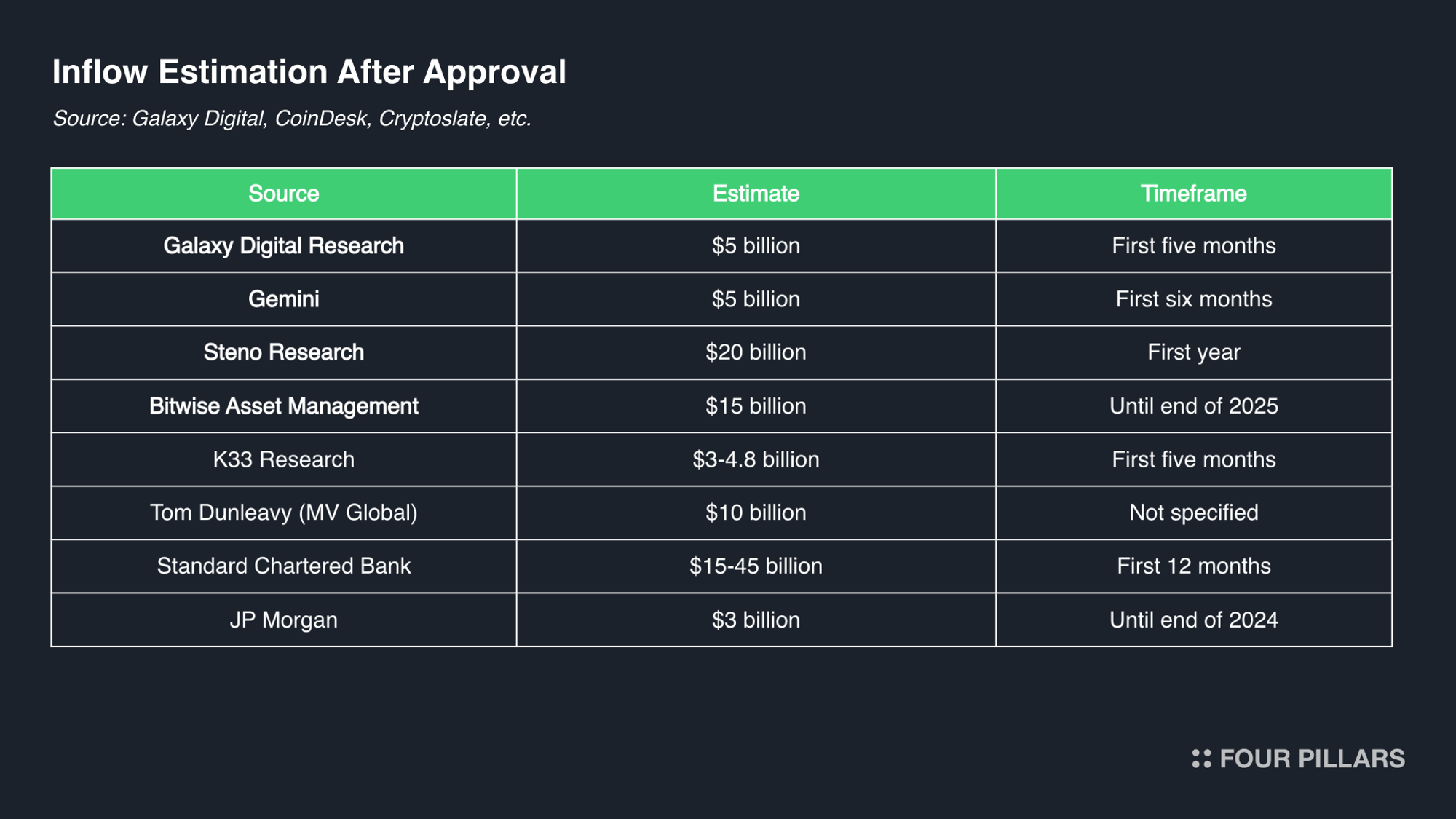
Estimating inflows into Ethereum ETFs is challenging due to different market dynamics compared to Bitcoin, such as large amounts of ETH locked in staking, bridges, and smart contracts, which may amplify ETH price sensitivity. As retail access improves, demand is expected to drive early inflows, with institutional interest growing as wealth management platforms expand accessibility. However, the lack of staking rewards may reduce some appeal.
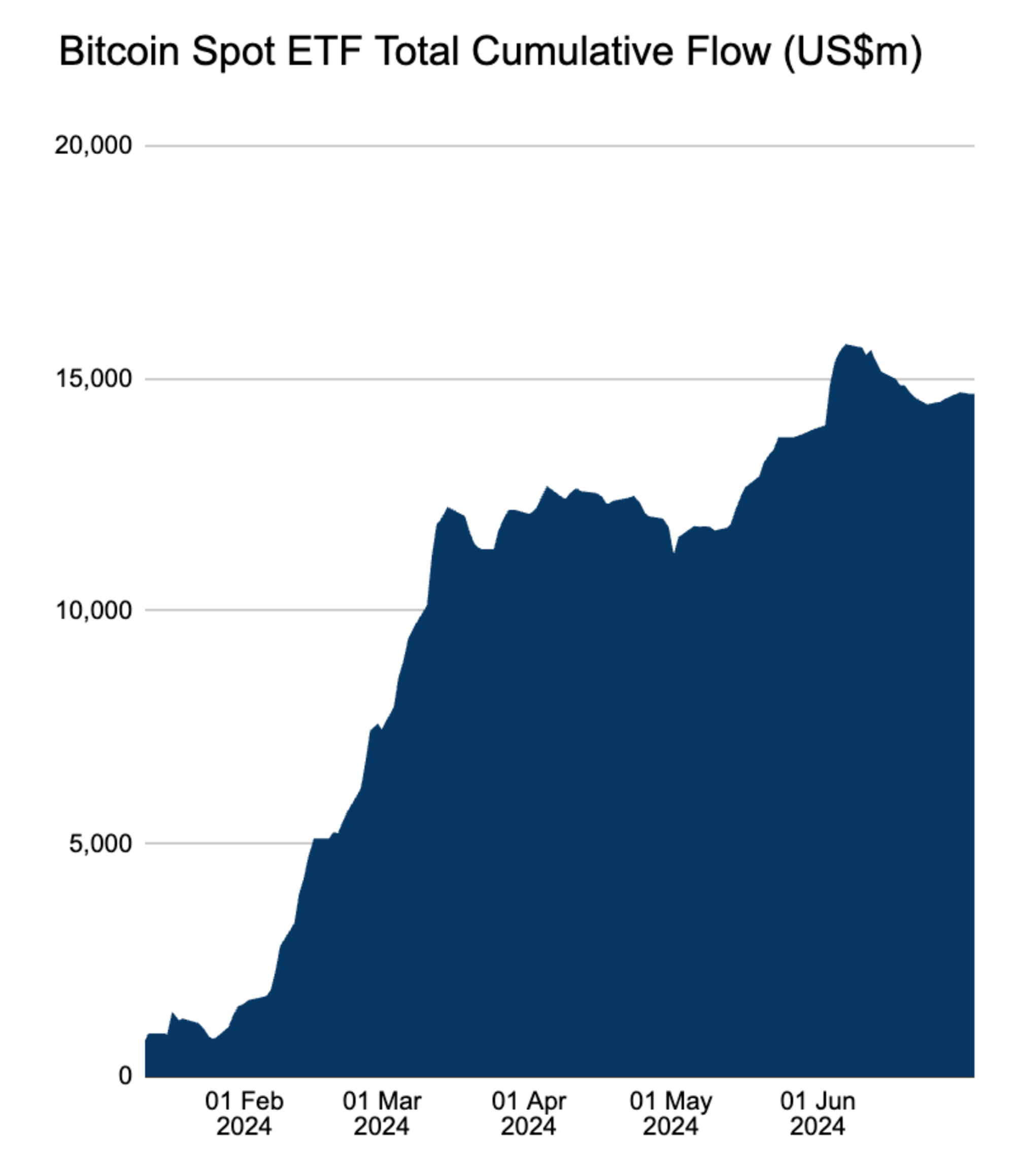
Cryptocurrency exchange Gemini predicts that spot Ethereum ETFs could see up to $5 billion in net inflows during the first six months of trading. In contrast, analysts at JPMorgan are more conservative, forecasting $3 billion in net inflows for 2024. Many analysts use Bitcoin ETF performance as a benchmark, estimating inflows between 15% and 50% of Bitcoin ETF levels. Bitcoin ETFs attracted $15.1 billion in net inflows within their first five months.
There remains debate over whether Ethereum ETF approval will have a similarly significant impact on ETH price as Bitcoin ETFs had on BTC. Some analysts believe the effect may be milder due to current market conditions and investor saturation. Ilan Solot, Co-Head of Digital Assets at Marex Solutions, said: “Generalized pessimism is a powerful foundation for outperformance. For ‘sell the news’ strategies, many will try to replay the BTC ETF scenario. However, I worry that many inflow forecasts may be over-benchmarked against BTC ETF figures.”
2. Potential sUSDe Opportunities from Ethereum ETF Approval
Approval of spot Ethereum ETFs could make sUSDe an attractive option for investors, similar to what occurred following Bitcoin ETF approval. Additionally, approval could bring more institutional capital into the Ethereum ecosystem, increasing demand for USD-denominated yield-generating assets like sUSDe. As a high-yield synthetic dollar, sUSDe may attract investors seeking ETH market exposure while maintaining USD-denominated positions.
sUSDe serves as a complementary investment strategy alongside Ethereum ETF exposure. Let us first revisit the situation during Bitcoin ETF approval and examine how sUSDe yield works and what factors could influence it.
2.1 Review of the Bitcoin ETF Approval Period
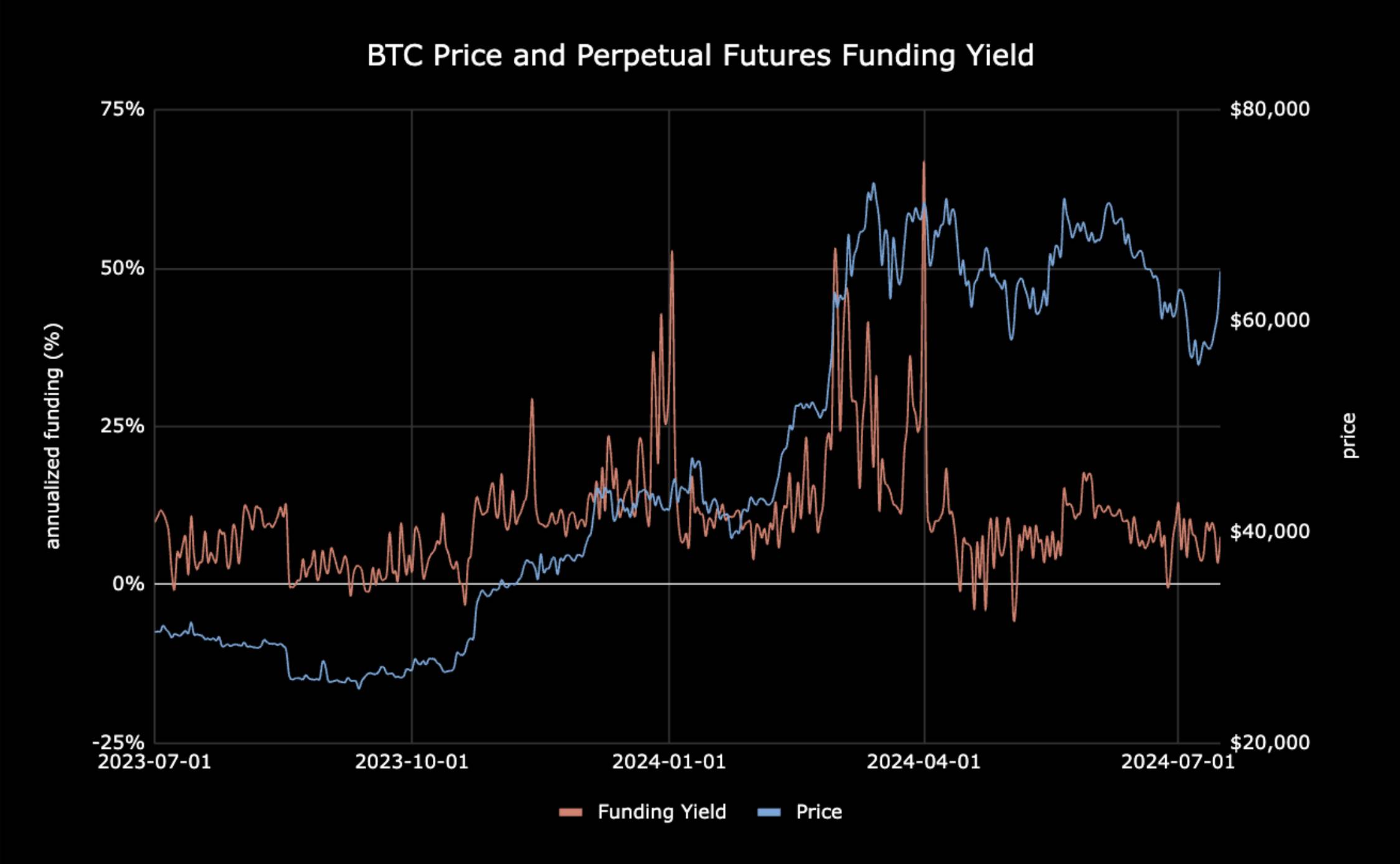
Bitcoin ETF approval had a profound market impact, boosting prices and funding rates. Funding rates are periodic payments between long and short positions in futures markets; as more traders take long positions anticipating price increases, these rates rise significantly. These rates are influenced by supply-demand dynamics of the underlying asset.
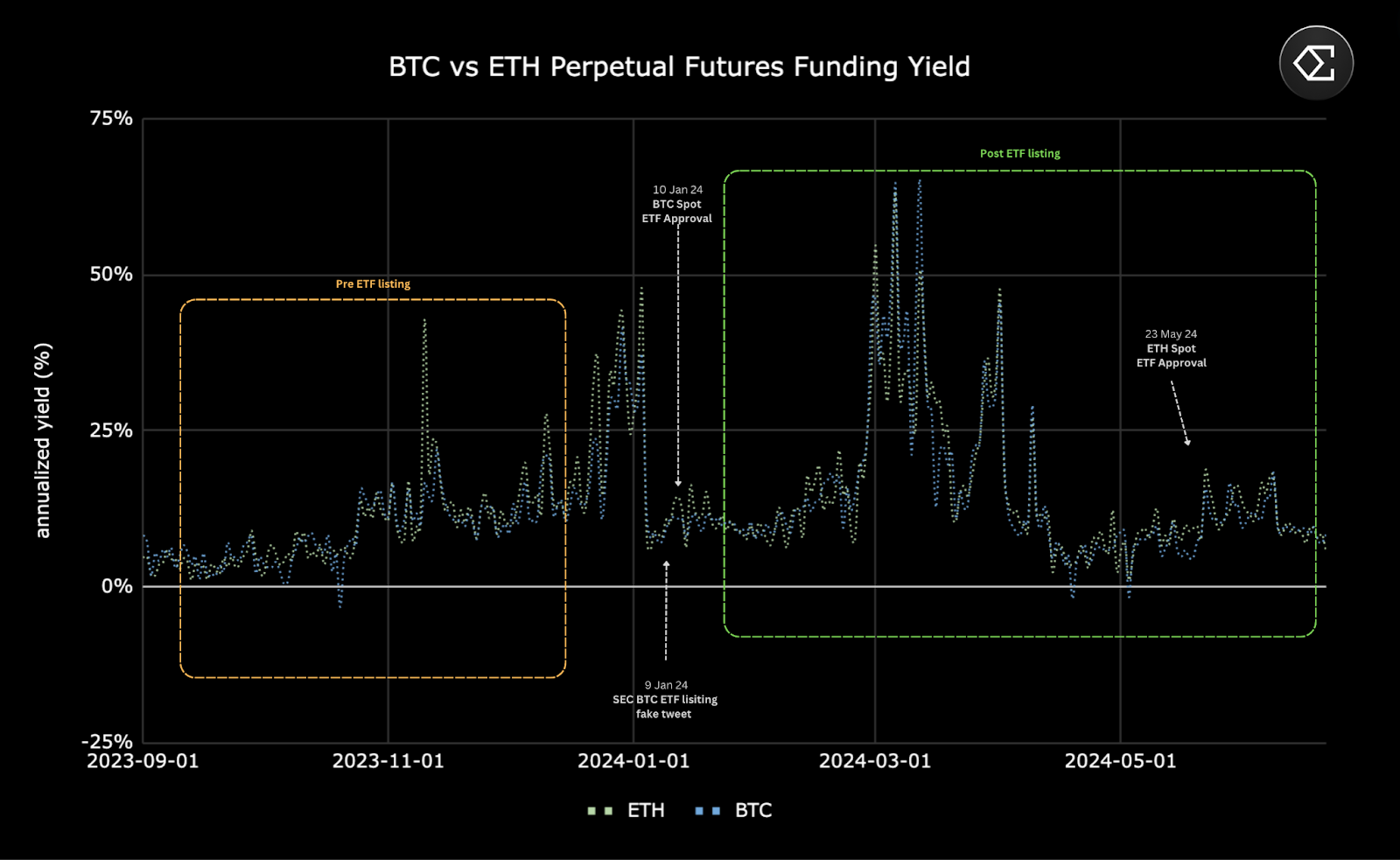
Before approval, funding rates were relatively stable, hovering around 10%. However, after approval, they surged dramatically, reaching annualized levels as high as 50%. Similarly, Ethereum ETF approval could push ETH perpetual futures funding rates higher, benefiting sUSDe holders since part of the token’s yield comes from these funding payments.
Additionally, Bitcoin’s price rose following approval. The chart below shows the correlation between Bitcoin’s price and annualized funding rates on perpetual futures contracts from July 2023 to July 2024. Data indicates both Bitcoin price and funding rates increased sharply after approval. The U.S. SEC approved Bitcoin ETFs on January 10, 2024, causing Bitcoin’s price to surge from around $40,000 to nearly $80,000 within months.
Source: Ethena
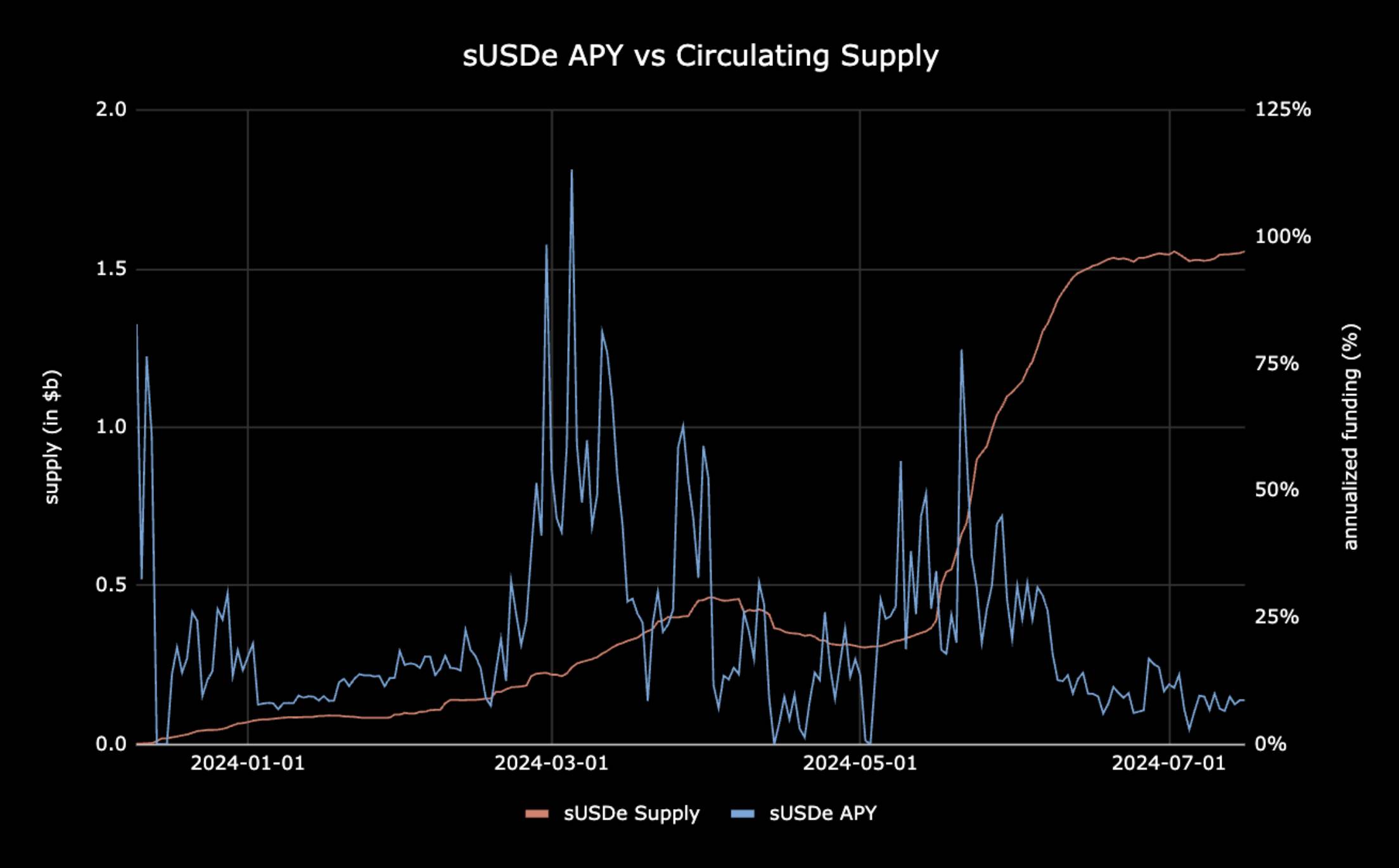
USD-denominated assets like Ethena’s USDe gained notable attention after Bitcoin ETF approval. These assets offer stability and attractive yields, making them ideal collateral on DeFi platforms. For example, sUSDe yields spiked above 30% post-ETF approval, highlighting their appeal among investors seeking stable yet high-yielding assets. Let’s now examine how this yield mechanism operates and the factors that might influence it.
Source: Ethena
2.2 Potential Impact on sUSDe Yield
Ethena’s USDe, a synthetic dollar token, became particularly attractive after Bitcoin ETF approval. By leveraging increased market activity and rising funding rates, USDe generated over 30% yield after ETF approval. This impressive return was achieved through multiple strategies, including delta hedging on staked Ethereum collateral and basis arbitrage exploiting spreads between spot and futures markets. Let’s explore how it works and why Ethereum ETF approval could affect this yield.
2.2.1 Mechanism Behind sUSDe Yield Generation
Source: Yield Explanation | Ethena Labs
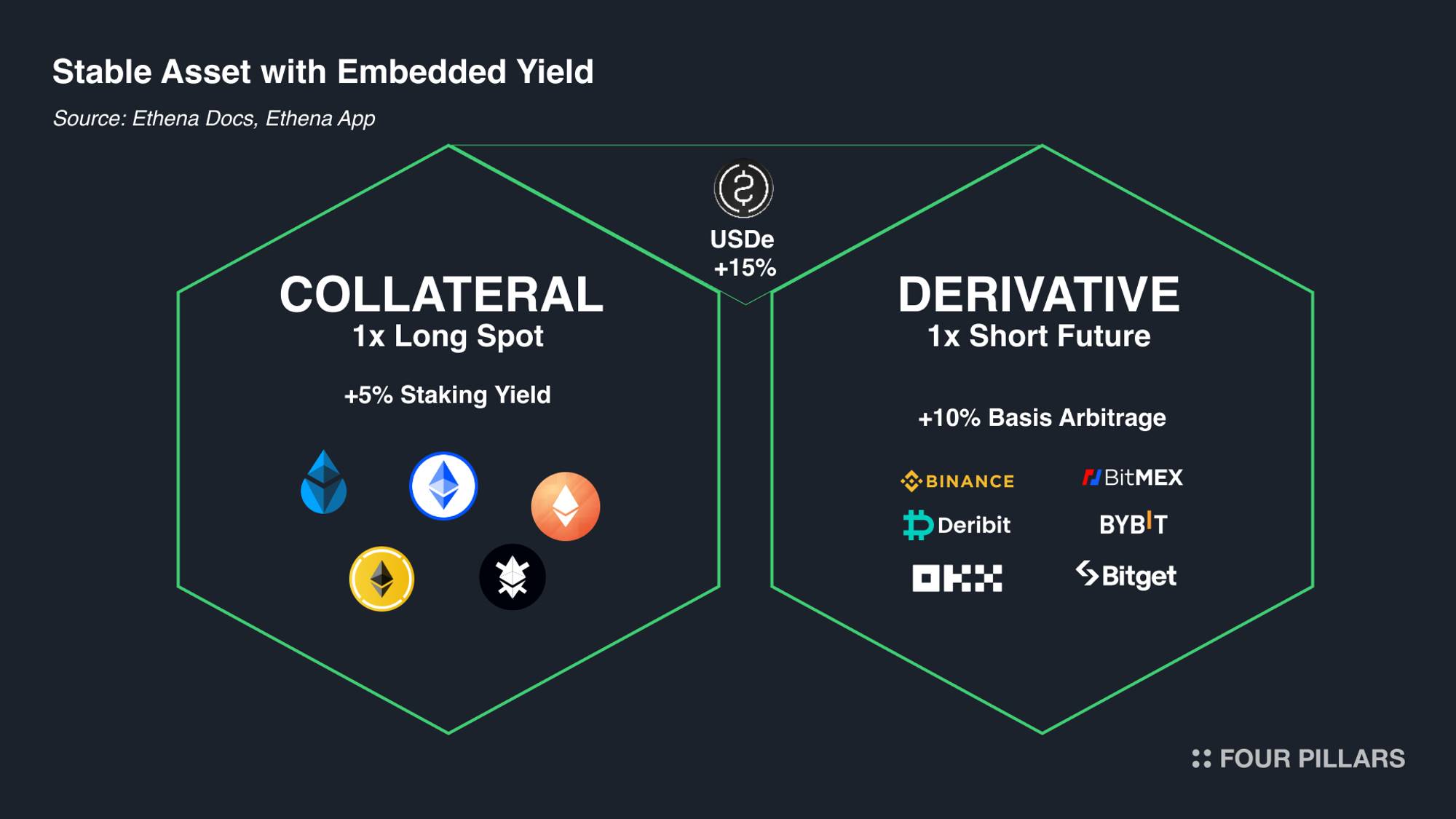
Within the Ethena protocol, the yield mechanism for sUSDe (staked USDe) operates via a reward-bearing “Token Vault” system, similar to other staking tokens like Rocket Pool’s rETH. When users stake their USDe, they receive sUSDe tokens representing proportional ownership of total USDe held in the staking contract.
The protocol generates yield from two main sources: staking rewards from holding assets like stETH as collateral, and funding and basis gains earned through delta-hedged derivative positions. These returns are distributed to sUSDe holders by gradually increasing the value of sUSDe relative to USDe over time. Importantly, the protocol ensures sUSDe value can only increase or remain stable—any potential losses are covered by Ethena’s insurance fund. (However, the insurance fund currently covers only about 1%.) Users require no additional action to earn yield; simply holding sUSDe allows them to benefit from protocol-generated returns. For further details on how it works, read Steve’s article from Four Pillars titled “Ethena: Scaling Synthetic Dollars to Billions”.
2.2.2 Ethereum ETF and sUSDe Yield
One key driver of higher sUSDe yields is the persistent presence of basis and funding rates in perpetual futures markets. With Ethereum ETF approval, demand for perpetual contracts is expected to improve, as institutional investors may seek ETH exposure through various financial instruments. This increased demand could lead to a sustained environment of positive funding rates, benefiting sUSDe holders who earn additional yield from these payments.
Source: Ethena
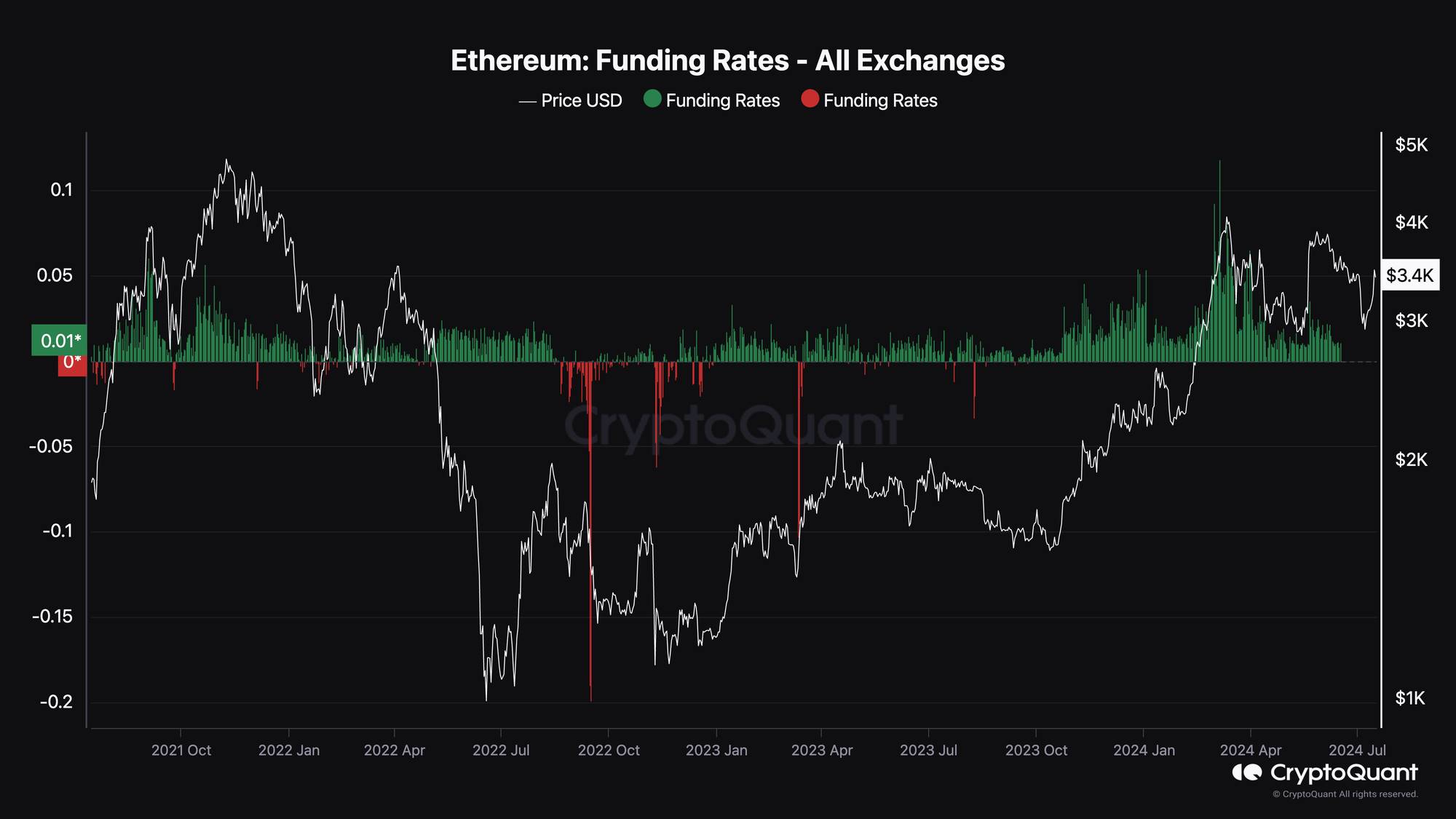
As more spot volume shifts to regulated ETFs, lagging spot demand on offshore exchanges may create arbitrage opportunities. This could sustain basis between spot and futures prices, which traders can exploit, leading to higher yields for sUSDe holders. Moreover, positive sentiment post-ETF approval may push funding rates higher, further enhancing sUSDe’s yield potential. Historical data shows funding rates tend to rise during periods of positive sentiment.
However, market dynamics are complex and unpredictable, and actual outcomes may vary due to multiple factors.
Source: Ethereum: Funding Rates - All Exchanges | CryptoQuant
3. Risks of USDe and sUSDe
Ethena’s rapid growth has made it the fastest crypto dollar to reach $3 billion. This raises questions: Is this growth sustainable? What are the risks? In this section, we examine some of these risks.
3.1 Funding Rate and Liquidity Risk
Source: App | Ethena
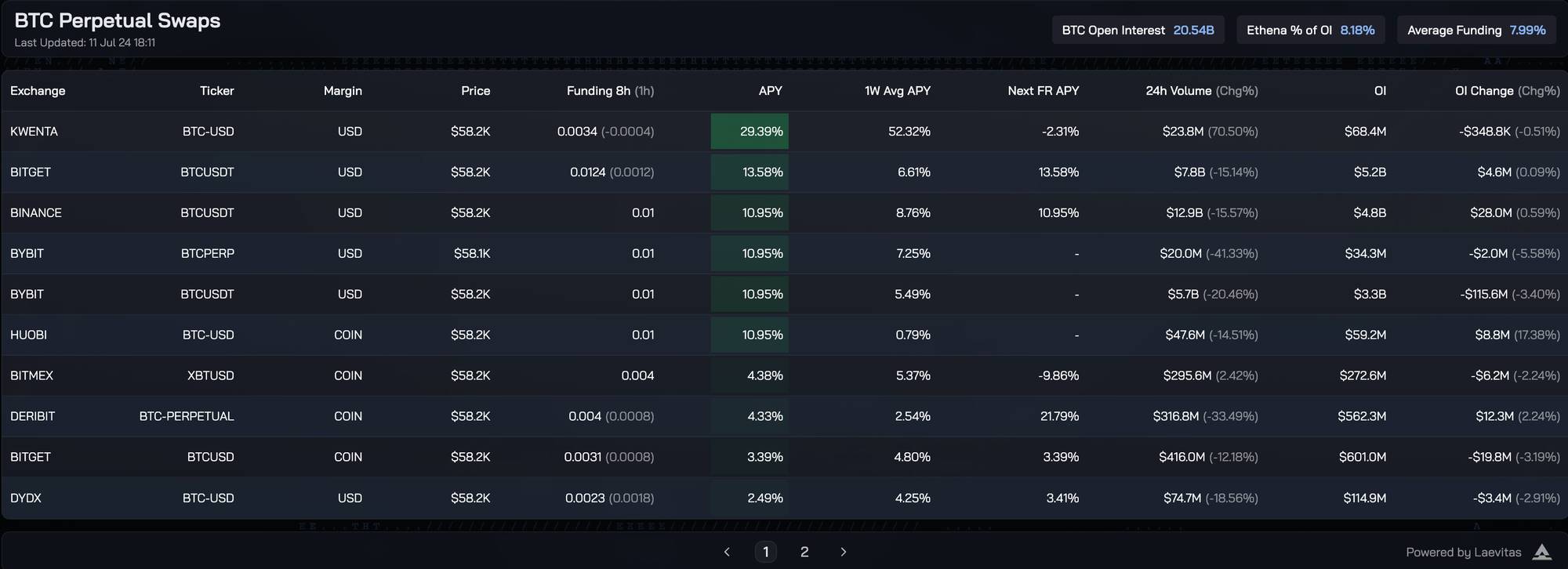
Ethena faces risks related to funding rates and liquidity. If short positions outnumber long positions, funding rates could turn negative, resulting in protocol losses. A negative funding rate would require the protocol to make large payments to longs, potentially depleting reserve funds (insurance fund). According to Ethena research, combined yield from stETH and short ETH funding was positive 89% of days, but negative 11% of days.
As USDe’s market cap grows, managing it becomes harder, making it difficult to maintain delta-neutral positions and utilize reserve funds effectively. Additionally, liquidity risk arises if underlying derivatives markets lack sufficient depth. This could affect USDe’s stability and overall yield distribution to stakers. For instance, if centralized exchange liquidity drops during market downturns, Ethena may struggle to rebalance positions.
3.2 Custody and Smart Contract Risk
Source: Solution: The Internet Bond | Ethena Labs
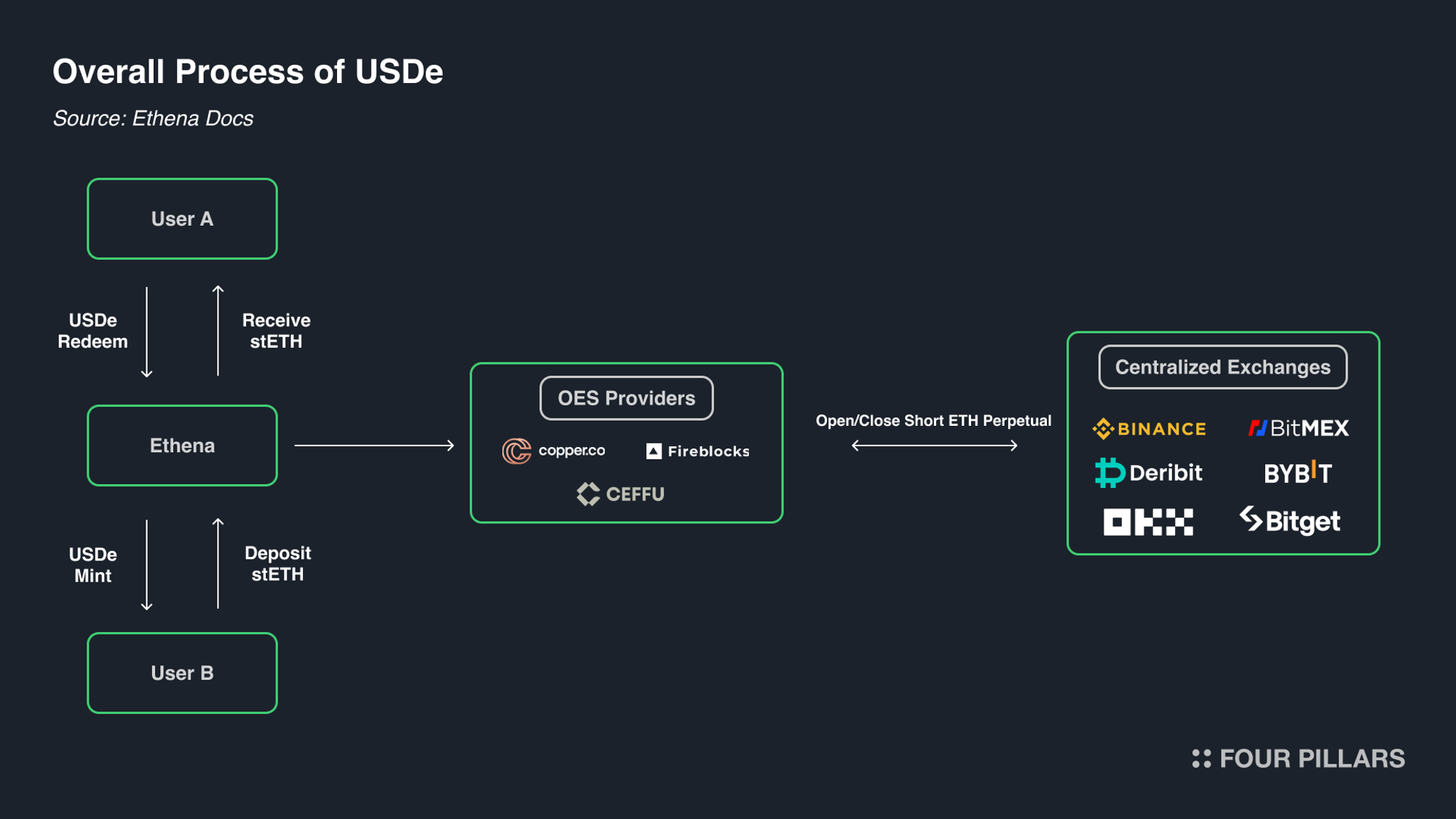
Ethena also faces custody and smart contract risks. The protocol relies on external platforms such as centralized exchanges and off-exchange settlement (OES) providers, introducing potential operational or security vulnerabilities. If these platforms face insolvency or operational issues, Ethena’s ability to execute trades and maintain delta neutrality could be compromised. However, if a centralized exchange goes bankrupt, Ethena’s perpetual positions would be closed, but the collateral assets themselves should remain safe, as they never enter the exchange.
Moreover, vulnerabilities or bugs in smart contracts could lead to unintended consequences or exploits. Although Ethena has taken measures to mitigate these risks, such as using multiple providers and active monitoring, they remain a significant concern.
3.3 Ethena’s Risk Profile
As Conor Ryder, Research Lead at Ethena, noted, Ethena carries potential risks but is one of the few projects that publicly researches and builds real-time dashboards to disclose its status.
These dashboards are accessible on Ethena’s website and platforms like Dune Analytics and DefiLlama, providing real-time information on custodial wallet holdings, exchange sub-account positions, on-chain wallet assets, USDe supply, and key metrics for USDe and sUSDe. Position dashboards detail collateral assets, derivative positions used for delta hedging, and USDe circulation. (Certain information isn’t available on other platforms.)
Conor Ryder also stated: “To be clear, USDe isn’t safer or better than other projects—we just offer a risk profile uncorrelated with other DeFi projects. No ties to traditional banking systems. Real yield doesn’t come from thin air. Bringing CeFi cash flows into DeFi.”
4. $ENA and the Story Behind USDe
Ethena launched its governance token ENA on April 2, 2024, marking a significant step toward decentralization and community governance. As part of the launch, Ethena distributed 750 million ENA tokens—5% of total supply—to early ecosystem contributors and participants in its “Shard Campaign.”
To incentivize broader participation in the Ethena ecosystem, Ethena previously launched the Season 1 “Shards” Campaign in early April 2024. The ongoing Season 2 “Sats” Campaign will conclude on September 2, 2024. The campaign incentivizes participants to earn Sats through strategies on Pendle and Morpho, with a total token allocation committed at 15–20% of all point-based activities.
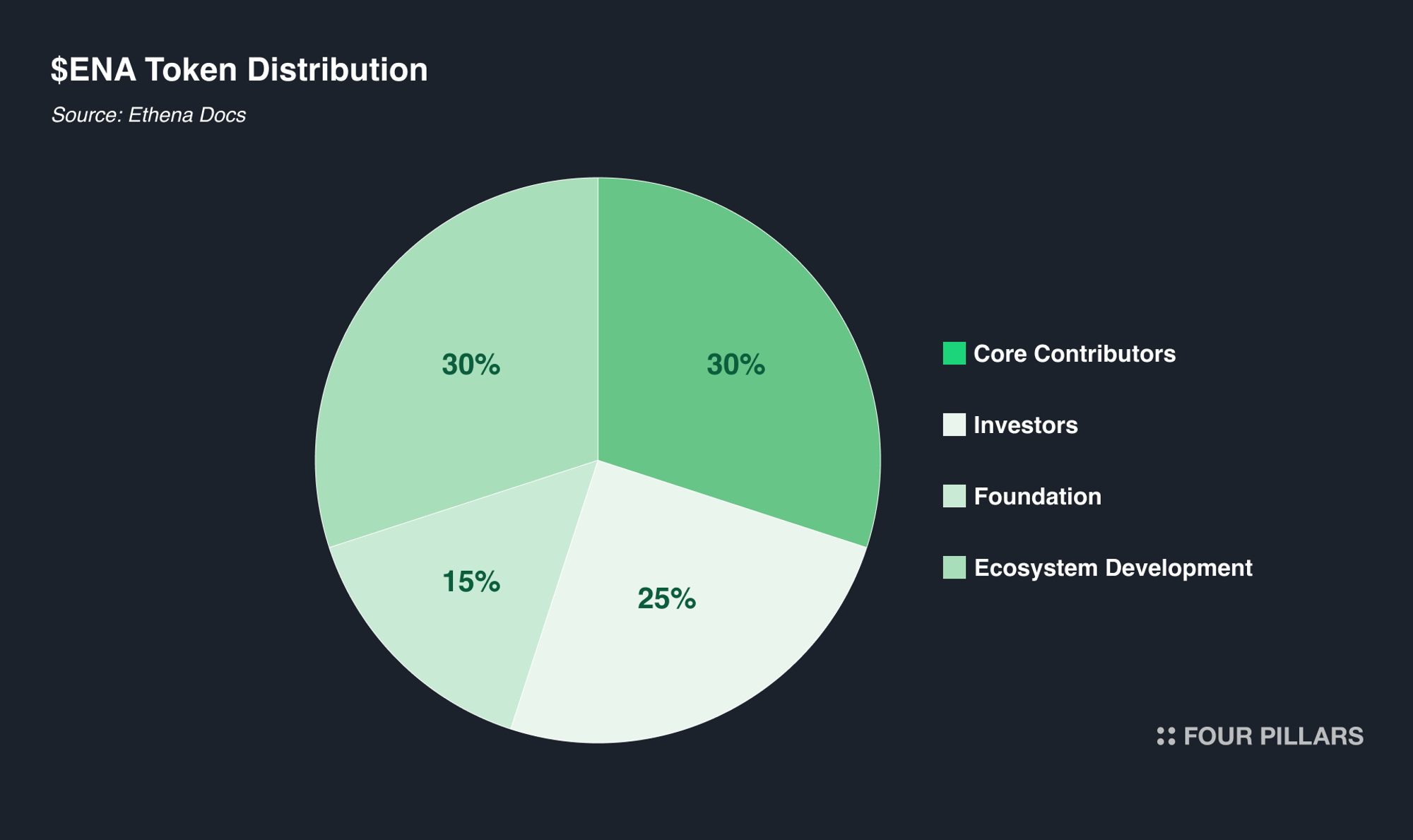
ENA’s tokenomics are designed to balance incentives for contributors with maintaining an active ecosystem. Core contributors hold 30%, investors 25%, the Ethena Foundation 15%, and the remaining 30% is allocated to ecosystem development, including airdrops and funding new projects.
Source: ENA Token Launch — Ethena Labs
Like many application tokens, $ENA serves as Ethena’s governance token, enabling holders to vote on various matters, including decisions on USDe collateral assets (modifications or additions), selection of custodians (OES providers), cross-chain implementation, grants, choice of exchanges, and risk management frameworks.
However, ENA currently has limited utility. Despite Ethena’s rapid TVL growth and its status as one of the top revenue-generating projects, these revenues are not currently shared with token holders.
This will change in Ethena’s future development. Ethena won’t just be another DeFi project. It has a roadmap to make $ENA more valuable, with two key opportunities being potential revenue sharing and the Ethena Appchain.
4.1 Potential Revenue Sharing
Source: Token Terminal [Date: Monday, May 27, 2024]
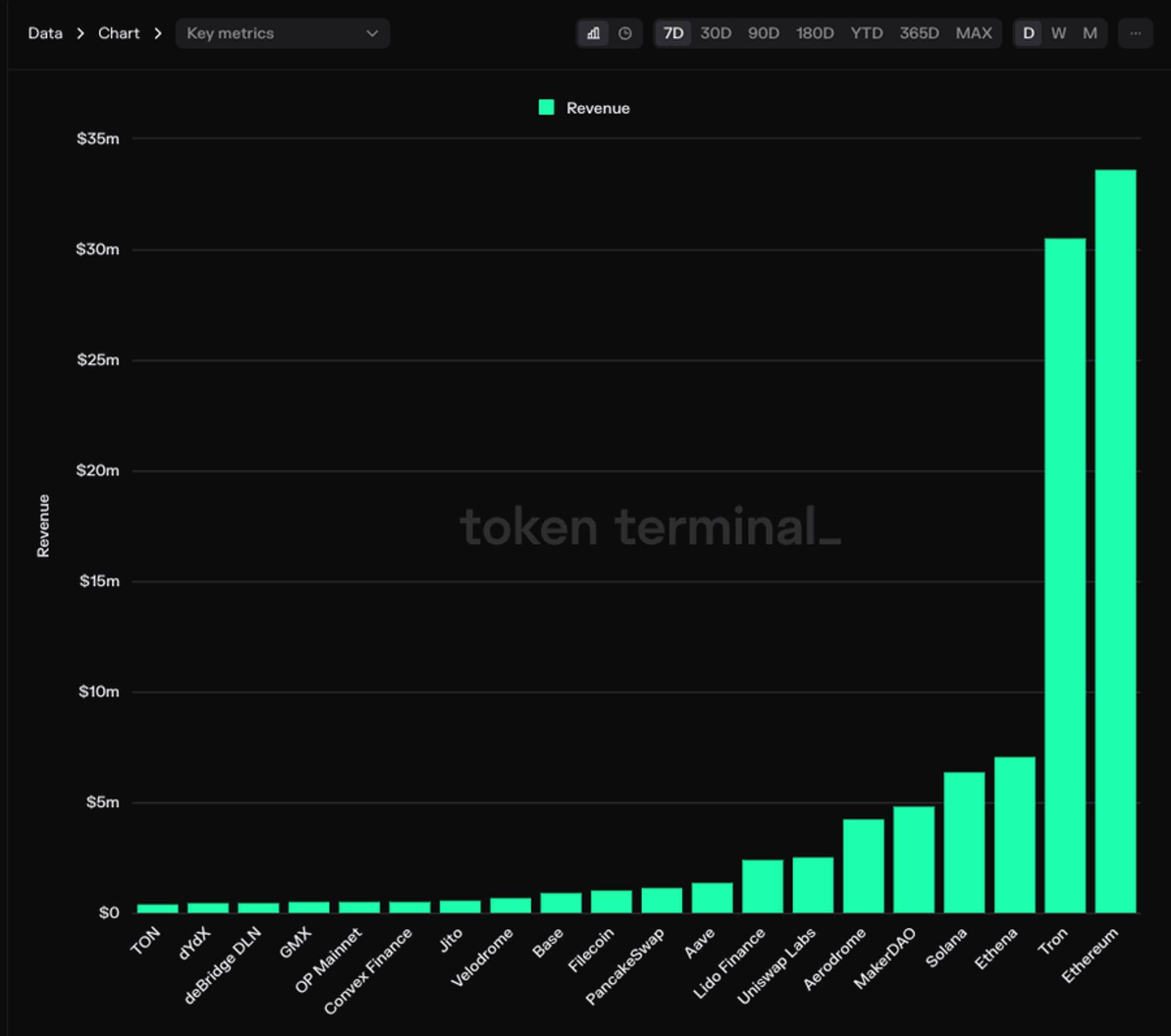
Ethena has experienced significant revenue growth, with its synthetic dollar USDe becoming the fourth-largest stablecoin by market cap. Key points on Ethena’s revenue growth include:
-
Revenue Leader: In the final week of May, Ethena’s USDe generated $7 million in revenue, surpassing Solana’s $6.3 million. Only Tron and Ethereum’s DApps exceeded it.
-
Market Cap: USDe’s market cap has surpassed $3 billion, making it the fastest-growing crypto dollar asset in crypto history.
-
Revenue Forecast: According to Token Terminal, Ethena is projected to generate $222.5 million in revenue over the next 12 months.
As the governance token of the Ethena protocol, ENA holders may have opportunities to vote on proposals, including mechanisms for revenue distribution. This could allow ENA holders to influence decisions on allocating protocol revenue, potentially including returning a portion of earnings from USDe staking or other protocol activities back to token holders.
4.2 ENA Appchain and Restaking
Recently, Ethena updated the ENA token roadmap and introduced new tokenomic initiatives. Ethena launched ENA staking to secure cross-chain transfers and integrated ENA into its financial infrastructure, including the upcoming Ethena Appchain. Additionally, users must lock at least 50% of claimable tokens, incentivizing long-term ENA holding. This move is part of a strategic effort to ensure ecosystem stability and growth.
Source: Update to $ENA Tokenomics — Ethena Labs
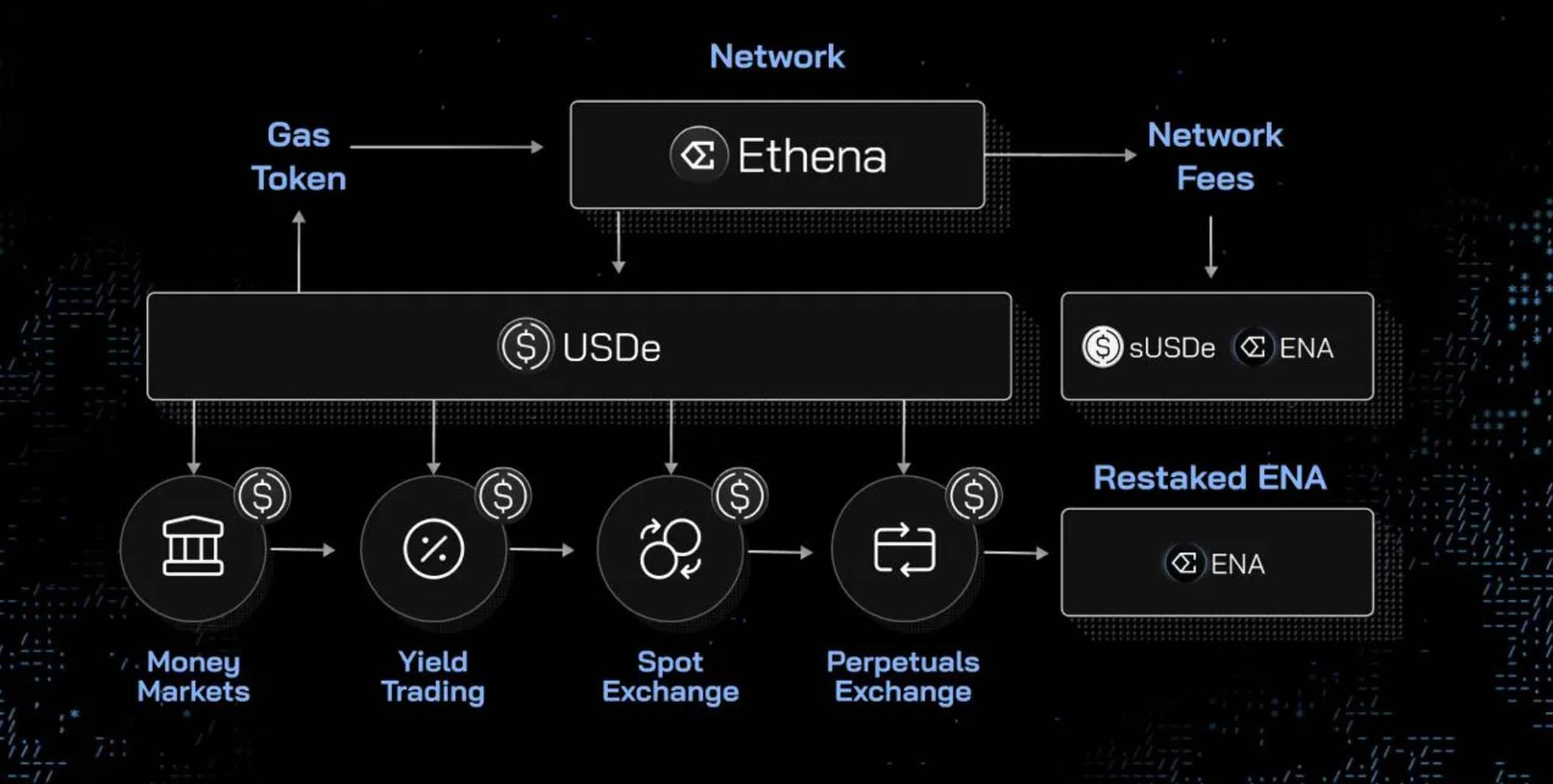
The protocol introduced universal restaking of ENA, with ENA restaking pools within Symbiotic potentially earning rewards. These pools will provide economic security for USDe cross-chain transfers, utilizing the LayerZero DVN messaging system. This initiative is part of Ethena Appchain development, aiming to build financial applications and infrastructure using USDe as the primary asset. ENA staked in these pools will earn various rewards, including multipliers, Symbiotic points, and potential future allocations from LayerZero.
Looking ahead, ENA’s utility will expand significantly. Ethena’s roadmap plans to integrate ENA into various financial applications and infrastructure solutions on the Ethena Appchain, including spot DEXs, perpetual DEXs, yield trading platforms, money markets, and uncollateralized lending protocols. Additionally, ENA could be used for on-chain prime brokerage services, options, and structured products. These diverse applications will not only enhance ENA’s utility but also drive demand as the ecosystem grows.
5. Looking Ahead
Source: X (@leptokurtic_)
The approval of Ethereum ETFs marks a pivotal moment for the crypto market, mirroring the impact of Bitcoin ETFs earlier in the year. This development is expected to bring substantial liquidity and institutional interest to Ethereum, potentially influencing price and market dynamics. Ethena, with its synthetic dollar USDe and yield-bearing token sUSDe, is well-positioned to benefit from these changes. Increased demand for ETH-related financial instruments could drive positive funding rates and create arbitrage opportunities, leading to higher yields for sUSDe holders—a pattern observed after Bitcoin ETF approval.
However, it’s essential to recognize the inherent risks associated with such rapid growth and market shifts. Ethena must navigate challenges related to funding rate volatility, liquidity management, and potential custody and smart contract vulnerabilities. Despite these risks, the platform’s transparent risk management approach and proactive measures—such as real-time dashboards and diversified provider usage—enhance confidence.
Since inception, USDe has achieved exponential growth, becoming the fastest crypto dollar to reach a $3 billion market cap. With the anticipated approval of Ethereum ETFs, Ethena is expected to grow further. Moreover, expanding ENA’s utility through initiatives like revenue sharing and the Ethena Appchain could provide additional value and stability. Therefore, closely watching this opportunity is crucial.
Appendix A: Key Timeline for Ethereum ETFs
A.1 January 2024: Bitcoin ETF Paves the Way
In January 2024, the approval of spot Bitcoin ETFs marked a significant milestone and paved the way for altcoin ETFs, with Ethereum emerging as the next likely candidate. The success of Bitcoin ETFs brought unprecedented net inflows, cementing BTC’s status as a legitimate investment asset. The launch of these Bitcoin-tracking funds became one of the largest ETF launches in history. According to Morningstar Direct, this translated into $8 billion in net inflows. By the end of June, nine newly launched products had accumulated $38 billion in assets, demonstrating strong investor demand for crypto exposure via traditional financial instruments.
Source: Bitcoin ETF Flow – Farside Investors
A.2 May 2024: Ethereum ETF Gains Momentum
In May 2024, the U.S. Securities and Exchange Commission (SEC) made a significant rule change by approving applications for major exchanges to list spot Ethereum ETFs. This decision allowed Nasdaq, NYSE, and Cboe to list eight Ethereum ETFs. The SEC’s approval came after applicants revised their filings to align with regulatory preferences, notably removing Ethereum staking provisions from ETF operations, which was seen as a potential hurdle to approval.
The rule change required ETF issuers to update their Form 19b-4, used to propose new rules or amend existing ones for self-regulatory organizations (like stock exchanges). While the SEC approved Form 19b-4 for these eight spot Ethereum ETFs—including those from Bitwise, BlackRock, and VanEck—issuers still needed approval of their separate S-1 registration statements before officially commencing trading.
A.3 June 2024: Expectations and Delays
In June 2024, anticipation for Ethereum ETF approval continued to build. SEC Chair Gary Gensler indicated the approval process was progressing smoothly, with some analysts predicting a possible launch as early as July 4. However, the SEC delayed the launch of spot Ethereum ETFs, pushing the timeline to mid-July or later.
A.4 July 2024: Delays and Uncertainty
By July 2024, delays in Ethereum ETF approval led to investor uncertainty. While some analysts predicted a launch within the next two weeks, the market remained cautious. Bitwise filed an amended S-1 form, indicating these products were nearly ready to launch, but SEC comments pushed the timeline further. Market sentiment was mixed, with some analysts warning ETH price could decline if ETFs fail to generate significant inflows.
A.5 Mid-July 2024: Launch Confirmation Imminent
Reports indicate spot Ethereum ETFs could begin trading as early as next week. According to sources familiar with the matter, the U.S. SEC has informed Ethereum ETF issuers that their funds can begin trading on July 23, 2024. The SEC reportedly had no further comments on recently submitted S-1 forms and requested final versions by Wednesday, July 17. Market reaction reflects optimism about the potential impact of these new financial products on the broader crypto ecosystem.
Join TechFlow official community to stay tuned
Telegram:https://t.me/TechFlowDaily
X (Twitter):https://x.com/TechFlowPost
X (Twitter) EN:https://x.com/BlockFlow_News
 Four Pillars






