








In the fiercely competitive Solana LSD landscape, can Jito stand out?
TechFlow Selected TechFlow Selected
In the fiercely competitive Solana LSD landscape, can Jito stand out?
This research report analyzes Jito's technical principles and business developments from the perspectives of MEV and liquid staking, as well as potential growth drivers and investment highlights for Jito's future business.
 Navigating Web3 tides with focused insights
Author: Metrics Ventures
Jito Network is the first protocol in the Solana ecosystem to combine MEV and liquid staking, leveraging MEV revenue as staking rewards to enhance users' staking income. The diagram below provides a high-level abstraction of Solana's capital flows within the Jito protocol. Jito dominates both the MEV and liquid staking sectors in the Solana ecosystem. As the Solana ecosystem experiences significant growth in this market cycle, both MEV and liquid staking businesses are expanding rapidly. This report analyzes Jito’s technical principles and business progress from the perspectives of MEV and liquid staking, while also exploring potential future growth drivers and investment highlights.

1 MEV Leader: Reshaping Solana's MEV Landscape
1.1 Solana's MEV Challenges and Solutions
MEV (Maximal Extractable Value) refers to the maximum value that validators can extract by reordering transactions when generating blocks on a blockchain network. There are many examples of MEV:
-
Sandwich attacks: The most typical form of MEV, where MEV searchers observe pending trades that could affect asset prices and submit transactions before and after the target trade to profit from price movements, increasing the original trader's execution cost.
-
Liquidations: Continuously monitoring for undercollateralized loan positions and quickly seizing the opportunity to execute liquidations for profit.
-
NFT minting: During NFT mint events, front-running other mints to secure high-value NFTs.
-
Airdrop claiming and selling: Quickly claiming airdropped tokens upon availability and selling them early at relatively favorable prices.
There are many other instances of MEV, but they all fundamentally involve transaction ordering manipulation to maximize individual gains. Discussions about MEV initially centered around Ethereum, but similar issues exist in other blockchain networks like Solana. Due to Solana's unique transaction processing mechanism, its MEV challenges differ somewhat from Ethereum's.
Compared to Ethereum, Solana differs in two key aspects:
(1) No public mempool: Transactions are sent directly to validators who process them immediately, whereas on Ethereum, transactions are stored in a public mempool awaiting inclusion in blocks by miners;
(2) First-In-First-Out (FIFO) transaction processing: Transactions are processed strictly in the order they arrive, unlike Ethereum where miners can freely select and reorder transactions, prioritizing those with higher gas fees.
Therefore, competition for transaction ordering on Solana has shifted from "high fees" to "low latency"—not competing through gas fees but rather striving to reach validators first. Combined with Solana's extremely low transaction fees, bots flood the network with spam transactions to win priority placement. Among identical transactions, only the first executed one succeeds; all others fail. According to Jito Network data, during Epoch 414, 60% of block computations were consumed by invalid arbitrage transactions, over 98% of which failed. This forces Solana validators to waste substantial computational resources processing failed transactions, significantly reducing network efficiency.

To reduce Solana's congestion from invalid spam transactions, Jito reshapes the MEV landscape by introducing a private mempool and block space auctions. The basic architecture of Jito's solution is shown in the figure below and consists of four main components: Searchers, Relayers, Block Engine, and the Jito-Solana validator client. Relayers first filter transaction data and verify signatures, then pass the validated transactions to the Block Engine and validator clients. Searchers submit Bundles (a group of pre-ordered transactions that must be executed atomically—either all succeed or none do) along with Tips (incentive payments to validators for including the Bundle). The Block Engine selects the most profitable Bundles from submissions and forwards them to validators for execution.

1.2 MEV Business Data Overview
From a data perspective, MEV revenue on Solana is growing rapidly, and Jito's ability to capture MEV on Solana continues to strengthen.
According to Blockworks Research, starting in March 2024, MEV revenue earned by Solana validators surpassed that of Ethereum and began significantly outpacing it by May. On May 12, Solana generated more total economic value (transaction fees + MEV revenue) in a single day than Ethereum did. The meme coin frenzy on Solana has increased MEV opportunities—especially after the emergence of pump.fun—where a meme coin’s lifecycle may last only minutes, making transaction ordering critically important. For example, developers creating new tokens often need to accumulate their own positions simultaneously across multiple wallets at the moment of launch, requiring strict transaction sequencing. During periods of intense FOMO trading, Jito tips also experience sharp fluctuations.


Jito Network has captured much of Solana's MEV growth. News data shows that adoption of the Jito-Solana client has exceeded 78%, up from just 31% at the end of 2023, indicating that a majority of validators have adopted Jito’s MEV solution. Jito's MEV revenue reflects this trend—the number of daily Bundles submitted via Jito is rising rapidly, exceeding 9 million on June 14. Daily tip income and staker rewards have also surged accordingly, with daily tips consistently exceeding 10,000 SOL and reaching 16,000 SOL on June 7.

Solana's ecosystem recovery has driven a resurgence in MEV, and the surge in trading volume fueled by the meme coin craze has directly led to an explosion in MEV revenue. Enthusiasm for meme coin trading has remained strong despite broader market cooling in recent months—for instance, pump.fun data shows that newly deployed tokens have stayed at relatively high levels since April, with transaction fees and revenues remaining stable. This sustained trading activity helps keep MEV revenue elevated. On March 9, 2024, Jito Labs announced on social media that it had temporarily suspended use of its mempool due to negative externalities affecting users, aiming to reduce user losses caused by transaction reordering and sandwich attacks. However, data indicates this move had little impact on Jito’s MEV revenue.


2 Liquid Staking: Rapid Market Share Growth, Rising to Leadership
2.1 Solana's Liquid Staking Market Landscape
Compared to Ethereum, Solana's liquid staking sector has developed slowly. Consider these statistics: Over 65% of Solana is staked, compared to approximately 27% on Ethereum (per Coinbase data), yet about 95% of staked SOL uses native staking, while nearly half of staked ETH utilizes liquid or restaked derivatives.


These differences stem from technological and ecosystem disparities between the two chains:
(1) Ethereum requires a minimum stake of 32 ETH to become a validator, while Solana has no such requirement, lowering the barrier to entry;
(2) Ethereum’s native protocol does not support delegation—ordinary users cannot directly delegate to a validator through Ethereum itself and must rely on third-party protocols. To stake natively, users must run their own validator node with 32 ETH;
(3) The slashing mechanism is not yet active on Solana, so choosing a specific validator is less critical for ordinary users. In contrast, Ethereum’s slashing mechanism forces users to carefully select validators to avoid penalties for validator misbehavior, necessitating third-party services like staking pools;
(4) Solana’s DeFi ecosystem remains immature, limiting farming opportunities even for holders of LST assets. Without compelling yield incentives, demand for holding LSTs remains weak. On Ethereum, the rich DeFi ecosystem has integrated LSTs like stETH as foundational base assets. Complex composability allows users to amplify leverage and yields across multiple protocols.
Thus, demand for liquid staking on Solana remains limited, and user habits have yet to fully develop. However, existing data shows a steady increase in Solana’s liquid staking ratio—from around 2% in June 2023 to 6.38% today, tripling over the past year. Historically, stSOL and mSOL dominated the LST market, but with Lido exiting the Solana ecosystem and Jito aggressively capturing market share, JitoSOL now accounts for over 40% of the market—about 2.5 times larger than second-place mSOL. This shift underscores Jito’s dominance and suggests significant room for further growth in its liquid staking business.


2.2 Jito's Liquid Staking Business Data Overview
Jito’s liquid staking business is experiencing rapid growth—both JitoSOL TVL and market share are expanding quickly. From September 15 to November 25, 2023, Jito launched a points program rewarding users for holding and using JitoSOL in DeFi protocols, culminating in an airdrop. This triggered a period of rapid TVL growth for JitoSOL, enabling it to surpass mSOL. After the airdrop, TVL and market share dipped slightly before entering a phase of relatively stable growth. Jito now boasts over $1.6 billion in TVL, making it the highest-TVL protocol in the Solana ecosystem.


The current APY for staking JitoSOL is 8.26%, composed of two parts: Solana’s base staking yield and MEV revenue sharing. Of the MEV tips received by Jito, 5% go to the protocol treasury and 95% are distributed to validators, who in turn pass most of these earnings to delegators. The MEV component of APY is volatile, occasionally reaching up to 1.5% during periods of high on-chain activity.

In terms of LST utility, integration of JitoSOL into DeFi protocols is expanding rapidly. Currently, Kamino and Drift host the largest TVL of JitoSOL. However, over 60% of JitoSOL still resides in wallets, indicating that the asset’s liquidity potential remains largely untapped. To grow its business, Jito must prioritize expanding farming opportunities, enhancing security, and boosting yield incentives.

2.3 Competitive Landscape Analysis

Based on market share among Solana's liquid staking protocols, Marinade.Finance is currently the only comparable competitor to Jito. bSOL, jupSOL, and INF each hold about one-fifth of JitoSOL’s market share and remain relatively weak competitors. We therefore focus primarily on comparing Marinade and Jito.
In terms of service offerings, both Jito and Marinade support liquid staking. Marinade additionally offers native staking, helping users delegate to better-performing validators and reducing selection costs. However, since Solana natively supports direct staking without slashing penalties, third-party native staking doesn’t solve a pressing user problem and generates no revenue for the protocol. Jito’s advantage lies in its leadership position in MEV. However, MEV revenue isn't exclusive to JitoSOL holders—according to Marinade’s documentation, any user who delegates via the protocol to a jito-solana validator can receive MEV rewards. That said, given the close relationship between jito-solana validators and Jito Labs, these validators likely maintain stronger loyalty to Jito.

From a business trajectory perspective, jitoSOL rapidly gained market share from mSOL starting in August 2023. The airdrop points program launched in September accelerated this trend. Market expansion slowed after the airdrop distribution at year-end, but mSOL’s share continued to decline without signs of stabilization, indicating clear headwinds in its business development.

In terms of yield, Jito currently offers users an APY of 8.26%. Marinade’s native staking APY is 8.18%, but due to a 6% management fee charged on mSOL, its liquid staking APY is slightly lower at 7.68%. The difference between the two is relatively small.

Regarding DeFi integration, mSOL has a total supply of approximately 5.5M, with about 3.4M held in wallets (~61.8%), a figure similar to JitoSOL. Given the limited number of DeFi protocols on Solana, both projects employ largely similar farming strategies—providing liquidity pairs on major DEXs, using LSTs as collateral or lending assets in lending protocols. mSOL’s strategy is somewhat more diverse: it has been integrated into several centralized exchanges (CEXs) like Coinbase and Gate, facilitating easier swaps with SOL, and also supports use cases such as options trading and NFT purchases.

In terms of tokenomics, both tokens serve similar functions—governance and liquidity mining incentives in DeFi farming. Marinade Earn Season 3 is即将 launching, offering 25M MNDE tokens to incentivize participation in specific farming strategies.
Finally, comparing valuations and TVL, Marinade and Jito have similar TVLs, but Marinade’s market cap is less than one-tenth of Jito’s. Based on business metrics, Marinade appears relatively undervalued. However, looking at token performance, MNDE has appreciated by only about 1x over the past year—far lagging behind SOL’s rise—and even declined by 50% over the past six months. Poor price support from the team and market makers has eroded its visibility and investor interest (data as of June 22).
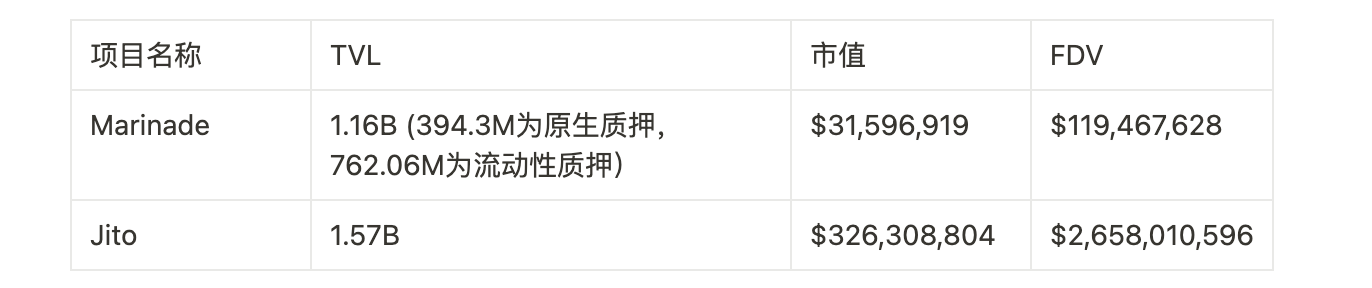

In summary, Jito launched its airdrop points program in September 2023, coinciding with Solana’s ecosystem revival. At that time, its main competitors were Lido and Marinade. With Lido exiting Solana, Jito quickly captured that market share. Its timing aligned perfectly with Solana’s recovery, allowing it to attract new capital and swiftly surpass Marinade. Today, Marinade lacks the momentum to compete further, whether in business metrics or token performance. However, the competitive landscape is no longer a two-player race—Solana’s resurgence has attracted new entrants. jupSOL and INF have emerged strongly, both offering APYs above 9%, leading among peers and collectively capturing nearly 20% of the market. jupSOL benefits from Jupiter—the leading Solana DeFi platform—and its team has pledged 100k SOL to boost returns for jupSOL holders. INF, part of Sanctum’s LST liquidity solution, earns a share of trading fees on the Sanctum platform—a unique revenue stream exclusively benefiting INF holders. While Jito leads in MEV, its MEV rewards aren't exclusive to JitoSOL holders. After the airdrop concluded, JitoSOL’s TVL growth slowed. Jito must remain vigilant against emerging competitors and act quickly to introduce new incentives to sustain business expansion.
3 Tokenomics and Price Performance
On November 25, 2023, the Jito Foundation announced the launch of JTO, its governance token. JTO has a total supply of 1 billion, allocated as follows:
-
10% (100 million tokens) for retroactive airdrops: 80% (80 million) to JitoSOL points program participants, 15% (15 million) to Jito-Solana validators, and 5% (5 million) to Jito MEV searchers. Of these airdropped tokens, 90% were immediately unlocked, with the remaining 10% linearly released over one year;
-
24.3% controlled by DAO governance, with release speed determined by community votes;
-
25% allocated for ecosystem development—including funding contributors and advancing Solana’s leading liquid staking protocol—managed by the Jito Foundation;
-
The remainder allocated to team and investors, subject to a 1-year cliff and 3-year linear vesting schedule.
According to the distribution plan, JTO’s primary inflation comes from the 10% airdrop portion being linearly released and the 25% ecosystem allocation. Per Token Unlock data, approximately 198,440 JTO are released daily. Since team and investor allocations have a one-year cliff, there will be no large unlocks in the next six months—the first major unlock occurs in December 2024.


Currently, JTO has limited utility beyond governance voting. It is also used as a liquidity mining incentive on platforms like Kamino and Meteora to boost DeFi yields for JitoSOL.

In terms of price performance, JTO generally tracks SOL closely. Here we compare SOL, JTO, and JUP—another asset considered a proxy for Solana beta. Over the past three months, all three have followed similar trends, but JTO exhibits significantly higher volatility. Using JTO as a Solana beta investment entails both higher risk and potentially higher returns. Currently, the broader Solana ecosystem is weakening, partly due to market focus shifting toward ETH ETF speculation. JTO experienced about two months of consolidation after launch before beginning an upward breakout. It has twice pulled back to the $2.3–$2.7 range, which appears to be a strong support zone based on order book and candlestick patterns. As of June 22, the price is near the bottom of this range.


4 Summary: Investment Highlights for Jito
In conclusion, here are the key investment takeaways for Jito:
-
Business fundamentals: Jito’s core businesses are liquid staking and MEV. Key metrics to watch include overall MEV growth on Solana, the adoption rate of Jito-Solana validators, and JitoSOL’s TVL and market share. MEV revenue enhances staking yields, but this is not a monopoly—other LSD protocols staking through Jito-Solana validators can also earn MEV rewards. JitoSOL’s growth is most critical for Jito’s success. When APYs are comparable, competitive advantages lie in DeFi integration depth, strategy diversity, and security.
-
Competitive landscape: JitoSOL achieved rapid market expansion over the past year due to (1) the points and airdrop program, (2) Solana’s swift ecosystem recovery, and (3) stagnation among early liquid staking protocols. These factors converged to enable JitoSOL’s success. However, with the airdrop complete and new competitors entering the space, JitoSOL faces greater challenges in market expansion. Ongoing monitoring of Jito’s competitive dynamics with emerging protocols is essential.
-
Tokenomics and price analysis: JTO is a governance token with limited utility beyond voting and minimal value capture mechanisms. Current inflation stems mainly from liquidity mining emissions in DeFi protocols. Higher incentives drive greater demand for JitoSOL, boosting TVL and attracting investment in JTO—creating some incentive for the team to support the token price. Price-wise, JTO largely mirrors SOL but with higher volatility. Compared to JUP, which we previously analyzed, JTO offers stronger business growth potential but also higher price swings, making it a higher-risk, higher-reward bet on the Solana ecosystem. Currently, altcoins and the Solana ecosystem are weak, and JTO has broken below key support levels. Waiting for reversal signals may offer a better entry point.
Join TechFlow official community to stay tuned
Telegram:https://t.me/TechFlowDaily
X (Twitter):https://x.com/TechFlowPost
X (Twitter) EN:https://x.com/BlockFlow_News
 @MetricsVentures







