SOL ETF opens the floodgates—can Jito leverage this to ignite a Solana ecosystem rebound?
TechFlow Selected TechFlow Selected
SOL ETF opens the floodgates—can Jito leverage this to ignite a Solana ecosystem rebound?
Jito is at the intersection of new capital inflows and microstructure improvements.
 Navigating Web3 tides with focused insights
Author: Sam Schubert, Carlos
Translation: AididiaoJP, Foresight News
Bitwise's SOL staking ETF (BSOL) has begun trading, joining SSK as the only two Solana spot ETFs currently available in the U.S. Notably, Bitwise aims to maximize staking rewards by targeting a 100% staking ratio, potentially achieving a 7.34% staking yield. It will be interesting to see whether BSOL can truly stake 100% of its SOL holdings. SSK and Europe’s SOL ETP have operated for over four years, deliberately maintaining staking ratios far below 100%. The reason is purely operational: these issuers must ensure sufficient liquidity to meet daily redemption demands.
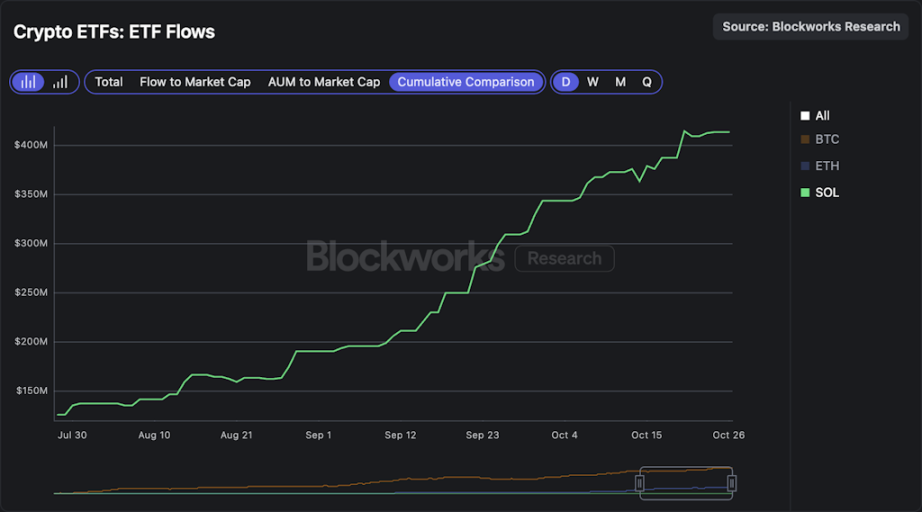
Compared to these players, Bitwise will conduct internal staking via Helius, which could enhance BSOL’s operational efficiency. For the first three months, Bitwise will waive management fees on the first $1 billion in assets under management. BSOL may open the floodgates for additional SOL ETFs, whose potential inflows could significantly exceed the $415 million that SKK has accumulated since July.
In crypto, MegaETH’s public sale launched yesterday and, at the time of writing, has received approximately 9x oversubscription with nearly $450 million committed. It is now clear the auction will settle at $0.0999, implying a fully diluted valuation of $999 million. With the sale ending in two days, we may see the oversubscription multiple rise further (unverified speculation suggests around 20x), and allocation criteria will be determined based on social signals (Twitter profiles, on-chain history, etc.). Over the past few days, MEGA has been trading at a fully diluted valuation between $4–5 billion in Hyperliquid’s pre-listing market, suggesting capital deployed in this sale is likely to be rewarded, though most users may not receive their desired allocation size.
Analyzing Jito's Weakness and Its Potential Reversal Forces
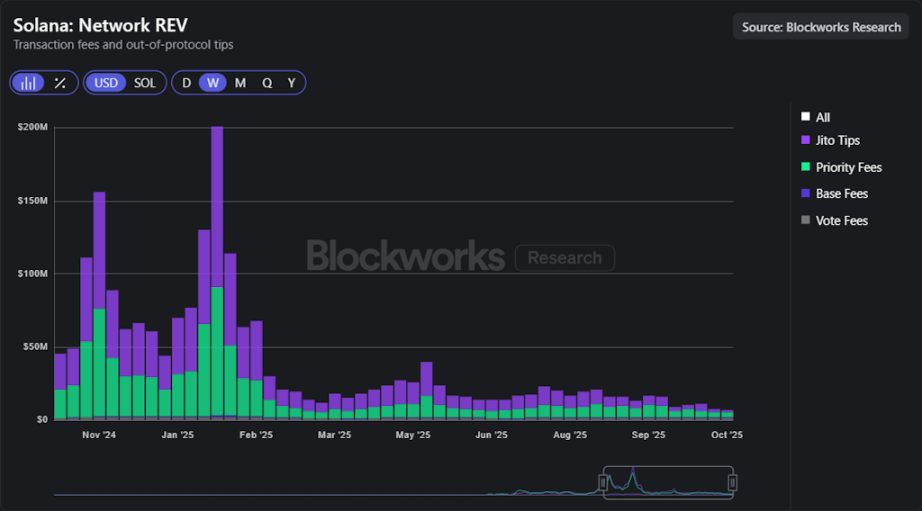
Jito token (JTO) has shown persistent price weakness and significantly underperformed Solana itself. Jito’s share of network fees has sharply declined—from over half of Solana’s revenue base to under 30% today—complicated further by a general decline in Solana’s overall income. The key question now is whether Jito possesses reflexivity: can it benefit from a rebound in Solana’s network activity, given that it was designed precisely to enhance such activity?
Solana’s architecture, once praised, has recently come under scrutiny as many applications and DeFi activities have underperformed relative to the broader crypto market. This raises the question: why hasn’t a competitive perpetual futures exchange emerged on Solana capable of matching Hyperliquid’s execution quality? Why are teams like Eclipse Labs building Atlas instead? The architecture offers speed, but not always predictable transaction ordering, fair fee routing, or strong spam resistance.
Jito’s Block Building Market (BAM) aims to solve this by preserving Solana’s monolithic design while giving apps chain-like control over transaction ordering and fees. A potential example is adopter velocity buffers, which could slow harmful traffic and narrow spreads—similar to what Hyperliquid has deployed. The goal is clearer queues, less latency gaming, and higher-quality execution, potentially enabling better applications and stronger DeFi activity, possibly supporting a rebound in Solana’s revenue. All BAM fees will be routed to the DAO, creating a new revenue stream, and BAM mainnet recently crossed the threshold of 10M+ SOL staked.
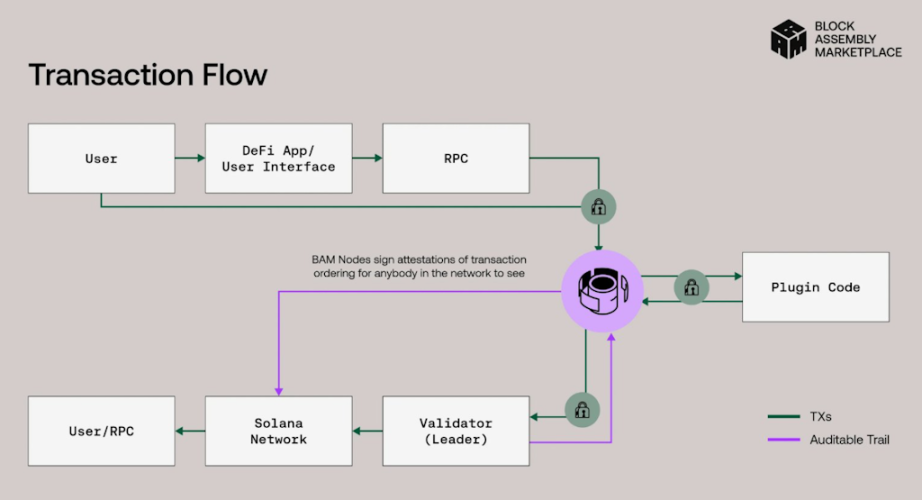
A recent $50 million strategic investment led by Andreessen Horowitz (via private token sale) signals strong backer confidence. It underscores BAM’s role as core Solana infrastructure, improving markets by giving applications control over transaction ordering while reducing harmful MEV. BAM is a network that scales Solana and unlocks on-chain primitives—such as central limit order books and dark pools—that were previously unfeasible due to MEV.
Solana staking ETFs are coming. VanEck has filed an S-1 for a JitoSOL ETF that would directly hold Jito’s liquid staking tokens. As more funds launch and scale, the potential for higher LST penetration increases, tightening the link between traditional finance inflows and Jito’s value accrual. Note that liquid staking on Solana has been steadily rising and now accounts for nearly 15% of total staked supply.
Since SIMD-0096, validators have received all priority fees instead of splitting them with a burn mechanism, giving them a disproportionately large share of network revenue. Once SIMD-0123 activates, it will reintroduce balance by requiring validators to share a portion of these fees with stakers, boosting staking yields and distributing rewards more evenly across the network. Both dynamics—greater ecosystem activity sharing rewards with stakers and the expansion of liquid staking—directly translate into revenue for Jito through fees from managing liquid staking.
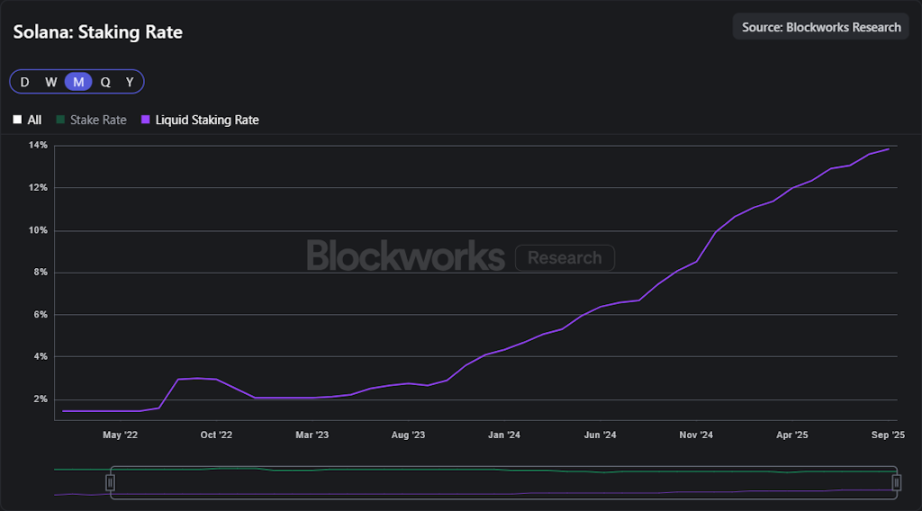
However, competition in Solana’s liquid staking market has intensified. JitoSOL once held nearly half of the staking liquidity but has seen its share drop to about 25%, as new entrants fragment the landscape. Sanctum, in particular, has gained momentum through its branded LST model and partnerships, enabling protocols to launch custom staking products that directly compete with Jito’s offerings.
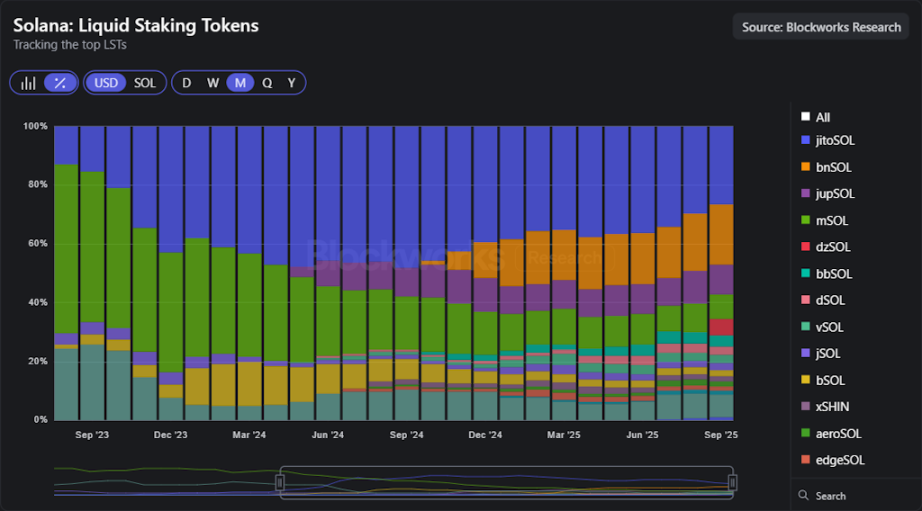
In this context, Jito is aligning protocol incentives with token holder value. Following JIP-24, all Block Engine and BAM fees flow into the DAO treasury. The DAO allocates all revenue toward ongoing JTO buybacks, executing approximately $2.5 million in buybacks since August 2025. SubDAO is launching Vault, JTO auctions, and a TWAP buyback system to automate this process. Monthly buyback amounts are set to match the prior month’s revenue, establishing a direct and recurring link between network activity and token value.
Join TechFlow official community to stay tuned
Telegram:https://t.me/TechFlowDaily
X (Twitter):https://x.com/TechFlowPost
X (Twitter) EN:https://x.com/BlockFlow_News
 Blockworks