Missed Solana Seeker Season 1? Season 2 Could Be Even Bigger
TechFlow Selected TechFlow Selected
Missed Solana Seeker Season 1? Season 2 Could Be Even Bigger
Season 2 is easier than Season 1, with activity progress resetting every 30 days, and consistency being more important than trading volume.
 Navigating Web3 tides with focused insights
Author: @scemgtfo
Translation: TechFlow
TechFlow Intro: Seeker (Solana’s second-generation smartphone) holders who missed the initial large-scale $SKR airdrop need not despair—the ecosystem’s Season 2 (S2) engagement campaign officially launched last week. Compared to Season 1, S2 features significantly lowered task thresholds, shifting focus from sheer volume to sustained participation—and introduces SKR staking as a high-weight loyalty signal.
This article is a comprehensive, step-by-step S2 engagement guide, walking you through enabling diagnostics, cultivating on-chain activity tiers, exploring the dApp Store, and leveraging 24% APY staking to lock in future reward weightings. For players aiming to secure a foothold in the Web3 mobile ecosystem, now is the optimal time to enter.
Full Text Below:
Are you regretting not completing more activities or earning more points on your Solana Seeker (Chapter 2 smartphone) to qualify for the $SKR airdrop? Don’t worry—you’re not late! Season 2 (S2) launched just last week. Below is the Solana Seeker Season 2 Ultimate Guide, designed to help you maximize developer and user rewards.
TL;DR: Season 2 is simpler than Season 1. Progress resets every 30 days, sustained participation matters more than transaction volume, and SKR staking has now become the primary loyalty signal.
Solana Seeker Season 2 Ultimate Guide
Last week, the Solana Seeker (Chapter 2) ecosystem officially kicked off its Season 2 (S2) campaign. While it shares many similarities with Season 1, this iteration includes key updates—most notably the removal of several highest-difficulty tasks—making it far more accessible to participants.
1. What Are Seeker Season Campaigns?
The Season Campaign is a tracking system located in the rightmost tab of your native Seeker Wallet, labeled “My Seeker Activity.” It determines your “Rank” within the ecosystem by measuring your participation across multiple categories—a ranking widely expected to influence future airdrops (e.g., $SKR).
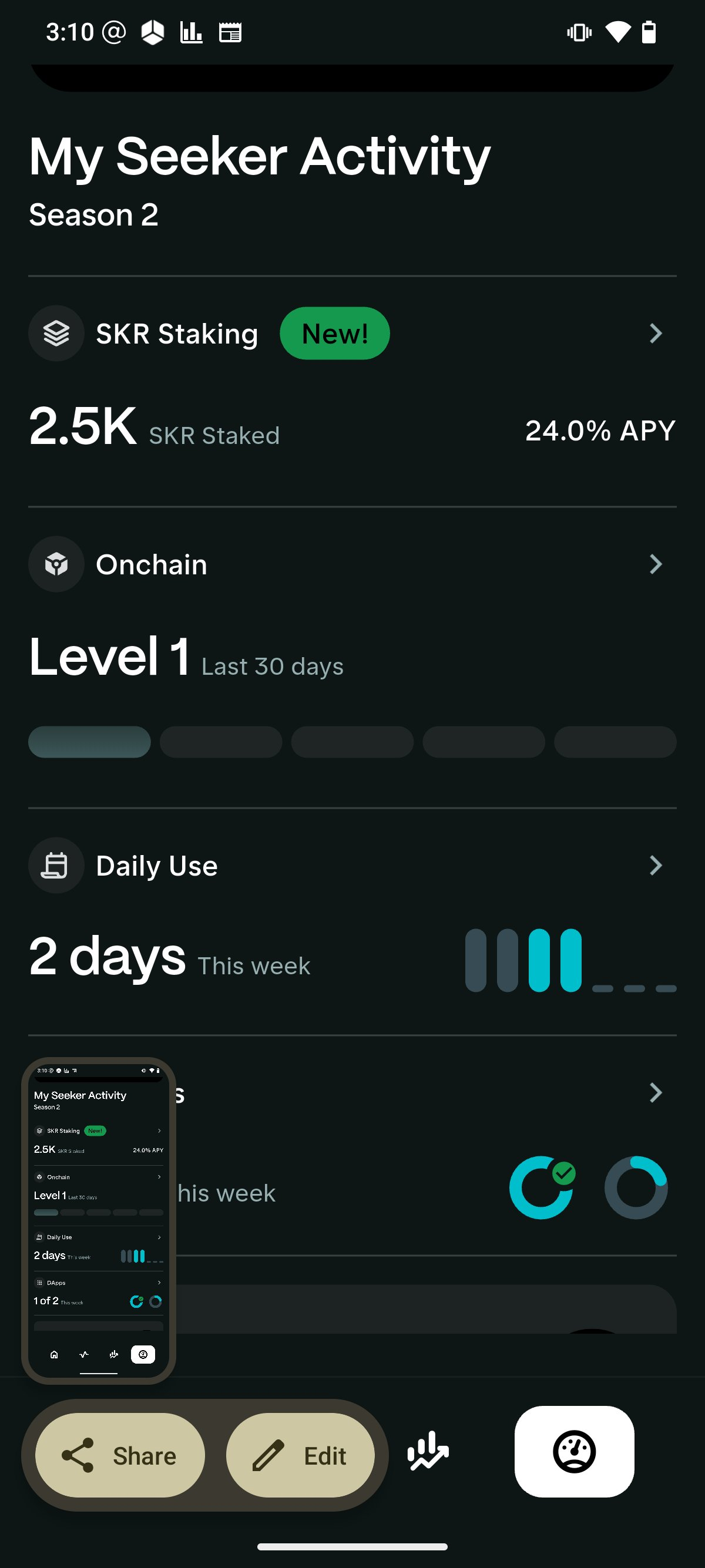
If you’re new to Seeker, follow these two critical steps to ensure your activity is tracked correctly:
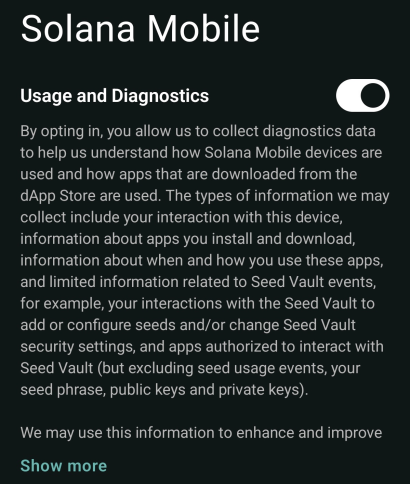
Enable Diagnostics: Go to Settings → Solana Mobile → Turn on Usage & Diagnostics. Note: This allows the system to measure your engagement. Avoid automation tools (e.g., auto-clickers), as such activity is visible to the system.
Update Your Wallet: Open the dApp Store, swipe left across the top banner, and ensure your wallet is updated to the latest version. On older versions, the Activity tab will not appear.
2. The Four Core Activity Categories
I. On-Chain Activity
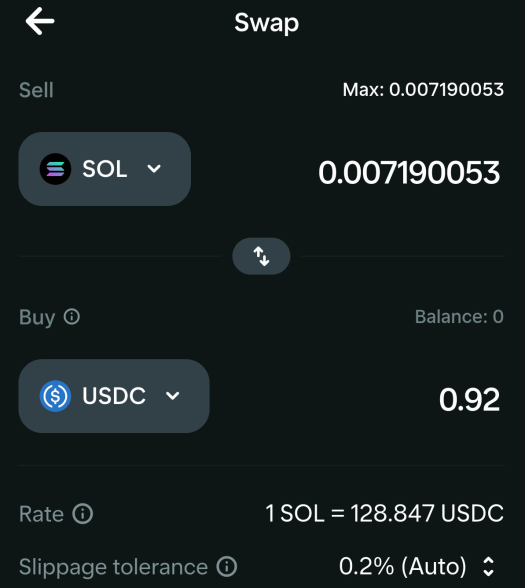
This measures how actively your wallet interacts with the Solana blockchain—including swaps, staking, DeFi usage, and trading.
- Ranking System: Progress is displayed as tiered levels (up to Level 5). Higher tiers correspond to higher perceived airdrop weightings.
- 30-Day Rule: Your level is calculated based on total activity over the past 30 days. If you pause interaction for several days, your level will decline.
Strategies:
- Low-Cost Transactions: Execute small daily swaps (e.g., swap 0.001 SOL for USDC). To minimize fees, use Jupiter’s web interface or Jupiter Wallet extension.
- Transaction Frequency Matters: In Season 1, ~50 swaps per day was the baseline to reach Level 4. Season 2 appears to require slightly more.
- Diversify: Mix your activities (e.g., staking + daily swaps + occasional NFT minting).
II. Daily Use
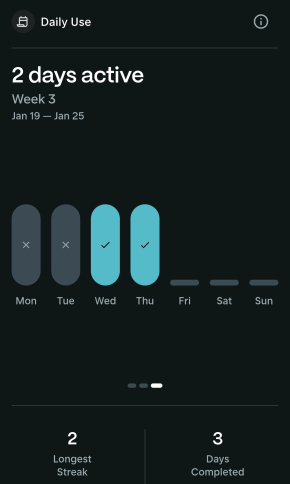
This measures how frequently you actually use the device.
Strategy: This is the easiest category to complete—simply open several different apps each day.
Pro Tip: Maintain consecutive usage days, as long-term consistency is likely to trigger a multiplier bonus.
III. dApp Exploration
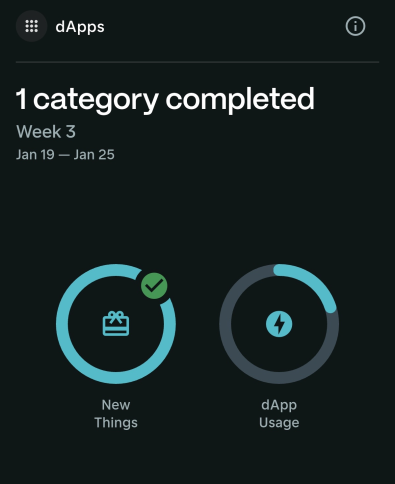
This tracks your exploration and usage of the Solana dApp Store.
S2 Update: The hardest metric from Season 1—“In-Store” tracking—has been removed. Now, only two rings must be filled:
- Freshness: Download new apps from the store weekly. If all newly listed apps have been downloaded, delete an existing app and reinstall it.
- dApp Engagement: Actively use the apps you’ve downloaded.
Timing: Aim to complete these tasks early in the week. If you wait until the weekend, progress may not sync in time for the weekly deadline.
IV. SKR Staking
Season 2 introduces high-yield SKR staking, offering users up to 24.0% APY for locking tokens to support network growth. This new activity category enables instant staking and features a flexible 48-hour unstaking window—striking a balance between generous rewards and liquidity.
Beyond passive yield, staking holds strategic centrality in Season 2’s reward framework. It serves as a formal “loyalty” indicator—and is highly likely to carry significant weight in future $SKR airdrops. By combining staking with daily on-chain swaps and dApp exploration, you can maximize your developer and user points before the season’s final snapshot.
Conclusion: Your Path to the $SKR Airdrop
In summary, maximizing your $SKR airdrop potential in Season 2 hinges on three pillars: maintaining high on-chain activity (aiming for Level 5 via daily swaps), consistently using your Seeker device, and keeping pace with weekly dApp Store updates. Don’t forget—the newly launched SKR staking offers up to 24.0% APY with only a 48-hour exit delay, making it one of the most meaningful loyalty signals in the ecosystem.
I’ve already begun my tier-climbing journey—and the best part is that Season 2 has only just begun. You still have ample time to accumulate points and secure your position ahead of the next wave of rewards.
Join me now—you’re still early! Not financial advice (NFA); do your own research (DYOR).
Join TechFlow official community to stay tuned
Telegram:https://t.me/TechFlowDaily
X (Twitter):https://x.com/TechFlowPost
X (Twitter) EN:https://x.com/BlockFlow_News
 @scemgtfo