








Podcast Notes | Conversation with Lattice Fund Co-Founder: Why Are Retail Investors Always Struggling to Profit in Crypto Markets?
TechFlow Selected TechFlow Selected
Podcast Notes | Conversation with Lattice Fund Co-Founder: Why Are Retail Investors Always Struggling to Profit in Crypto Markets?
FDV caps the market's upside potential, and there is a significant liquidity mismatch between the primary and secondary markets.
 Navigating Web3 tides with focused insights
Compiled & Translated: TechFlow
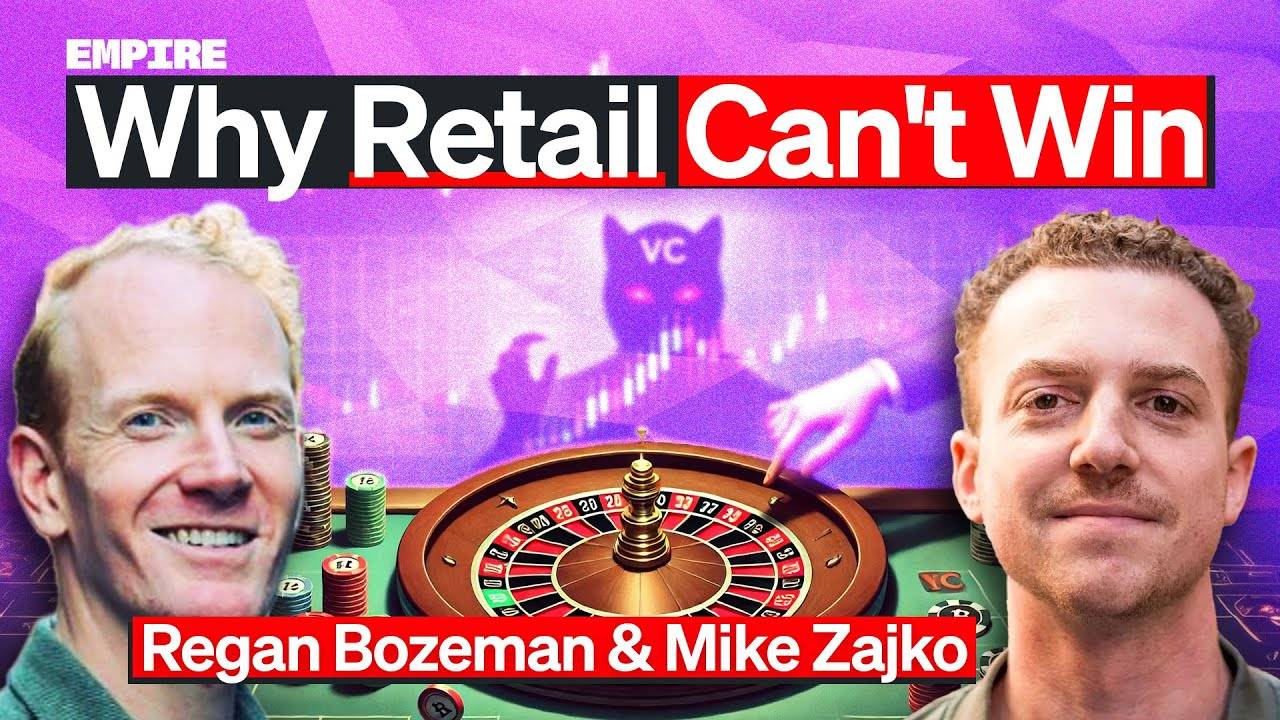
Hosts: Jason Yanowitz, Co-founder of Blockworks; Santiago R Santos, Investor
Guests: Regan Bozman, Co-founder of Lattice Fund; Mike Zajko, Co-founder of Lattice Fund;
Podcast Source: Empire
Original Title: Why Retail Can't Win | Regan & Mike, Lattice Fund
Release Date: June 25, 2024
Introduction
In this episode, Mike and Regan from Lattice Fund dive deep into the structural issues shaping this market cycle. They discuss why retail investors struggle to achieve significant gains, the evolution of token distribution methods, and the impact of venture capital on market dynamics. The conversation then shifts to emerging opportunities in DePin and the evolving landscape of L1s and L2s. Finally, they explore the growing importance of token distribution and audience engagement for new blockchain projects.
Key Takeaways:
-
The current market cycle is more driven by macroeconomic factors than by new crypto-native innovations. This makes the market feel different, lacking novel applications that attract both retail and institutional investors.
-
Due to higher valuations before public sales and widespread token airdrops, retail investors' potential returns are significantly reduced. This structural shift makes it difficult for retail participants to achieve substantial early investment gains.
-
FDV limits upside potential, tying retail-held tokens to higher fully diluted valuations, further constraining market growth.
-
Lattice Fund's investment strategy focuses on early-stage projects, highlighting the advantages of small teams and funds. They also discuss how to survive and grow in the current market environment.
-
There is a massive liquidity mismatch between primary and secondary markets, with discussions on ETFs’ market impact and the effectiveness of airdrops as a marketing tactic.
Why Has This Cycle Ended?
-
In this segment, the guests discuss structural problems in the current crypto market cycle and explain why this cycle feels different from previous ones.
-
Jason introduces today’s guests, Regan and Mike, co-founders of Lattice Fund.
-
Jason notes that the current cycle feels unusual and wants to discuss structural issues such as low circulating supply, high fully diluted valuation (FDV), and token allocation.
-
Regan believes the biggest difference lies in the fact that this cycle is more driven by macroeconomic factors rather than crypto-native innovation. For example, the launch of Bitcoin ETFs and macro capital inflows have driven the market, but there has been a lack of major new innovations. While meme coins have generated buzz, they aren’t the main market drivers.
-
Mike adds that the current market lacks new applications capable of attracting retail and institutional investors. In past cycles, such as DeFi Summer and the NFT boom, retail users could enjoy and profit from participating in various new apps. Now, infrastructure-level innovations like Eigenlayer are harder for average investors to understand and engage with.
-
Jason concludes that structural issues in this cycle leave investors confused and dissatisfied, especially those accustomed to profiting from new applications and innovations.
Why Can't Retail Make Money?
-
Regan acknowledges that some people made money through memes, but he mainly refers to traditional VC-backed token markets. He points out that in the past, participating in token sales offered extremely high returns—for example, turning $20,000 into $500,000 during Solana’s ICO. However, such opportunities are now scarce.
-
Regan explains a major shift: projects now have much higher valuations before public sales, and many don’t sell tokens publicly at all, instead distributing them via airdrops. This greatly reduces retail investors’ potential gains. For instance, participating in an Eigenlayer airdrop might only double your initial investment, rather than delivering hundredfold returns as in the past.
-
Mike adds that this structural change makes it hard for retail investors to achieve massive early returns like before. Past cycles allowed retail users to enjoy and profit from new apps and innovative projects—opportunities that are now fewer.
-
Jason also notes that traditional capital markets follow a model of multiple funding rounds before IPO, which resembles changes in the crypto market. Retail investors in crypto differ significantly from their stock market counterparts.
Market Upside Cap
-
Regan believes that projects now have higher pre-public sale valuations (FDV). This means retail investors receive tokens tied to higher nominal FDVs, limiting upside potential. For example, if a project goes public at a $10 billion FDV, the room for further price appreciation is severely constrained.
-
Jason mentions that as the industry matures and success stories accumulate, more capital flows in, driving up private valuations before public listings.
-
Mike adds that the current system resembles traditional capital markets, with heavy participation from venture capital funds, reducing retail access.
-
Mike notes that many projects opt to work with single investors instead of conducting public token sales, partly to avoid regulatory risks. While this protects project teams, it also limits retail participation.
-
The guests also discuss solutions. Mike suggests that projects should allow broader retail participation through public token sales during growth stages, rather than relying solely on large VC funds.
-
Regan argues that projects should conduct public sales earlier at lower valuations and raise less in presales, giving communities more upside room.
Lattice Fund's Strategy
-
Mike points out that when projects list at high valuations (e.g., $5 billion or more), a key question is: who will buy them afterward? Traditionally, retail investors were the main buyers of new tokens, but currently, there’s a lack of large institutional buyers to absorb these high-valuation tokens. Therefore, even if short-term returns appear strong, long-term value sustainability may be questionable.
-
Regan explains that Lattice’s investment strategy focuses on early-stage projects. In today’s market, many large funds set high minimum investments, making it hard for early-stage founders to secure funding. Lattice chooses to operate in this relatively uncrowded space, focusing on helping startups grow early rather than joining later-stage, heavily funded projects.
-
Regan says Lattice prefers to keep its team and fund small and stick to its core strategy. This approach not only generates solid returns but allows the team to focus on what they do best.
-
Finally, Mike mentions that legal and compliance remain top concerns for founders launching tokens. Many want alternatives to airdrops and high-FDV, low-circulating-supply models, but no clear solution exists yet. Thus, despite willingness to innovate, airdrops remain the dominant token distribution method due to regulatory uncertainty.
Surviving This Cycle
-
Mike highlights a massive liquidity mismatch between primary and secondary markets. Many projects reach multi-billion dollar valuations before going public, creating immense selling pressure upon listing. Even well-executed projects like Arbitrum face price drops due to large token unlocks.
-
Mike says investors need to be smarter about token selection, and overall industry growth is needed to attract more participants and capital. He believes the core issue is structural imbalance in capital flows, requiring more new entrants and funds to rebalance the market.
-
The guests discuss ETFs’ market impact. Although ETF launches signal institutional entry, most ETF buyers are still self-directed retail investors. This means while ETFs increase accessibility for top-tier assets (like Bitcoin and Ethereum), they don’t necessarily drive large inflows into mid-to-long-tail assets (lower-market-cap tokens).
-
Regan notes that investment strategies may shift. Previously, investors bought ETH and then rotated into altcoins. But now, with the rise of L2s and diverse token options, capital may spread more widely. This dispersion could affect top-tier asset performance but may also create more opportunities for mid-to-long-tail tokens.
-
The guests believe future capital flows may differ from the past. ETFs and other new products could reshape market dynamics, making it easier for money to enter top assets and potentially spilling over indirectly into others via wealth effects.
Low Liquidity, High FDV
-
Mike observes that in high-FDV, low-floating-supply environments, almost no one except VCs can profit. After investing early, VCs typically move to the next deal or sell holdings. Even if teams continue building, without a loyal supporter base, long-term survival becomes challenging.
-
Regan adds that natural buyers post-listing are usually retail investors. However, airdrops absorb much of this demand. Those wanting a project’s token often already received it via airdrop, so they’re unlikely to buy more at high FDVs. This worsens market structure and liquidity issues.
-
He argues that low float and high FDV is actually a “red herring”—a misleading distraction. Current float ratios haven’t changed dramatically from the last cycle. Many successful L1s (like Solana, AVAX, Near) launched with floats under 1%. The real problem is mismatched capital inflows and outflows, not float ratio or FDV itself.
-
Jason recalls a key lesson from his CoinList days: “tokens are the product.” In Web2, product-market fit drives success. Similarly, in Web3, building a loyal community that loves your token is crucial. Successful projects are often those that let early contributors profit—turning them into loyal advocates who help spread the word.
-
Solana is a classic example. Though not popular in 2019–2020 and struggling to raise funds, Solana built a loyal base by rewarding early contributors. These supporters helped promote the project, attracted developers and users, and drove long-term success.
Airdrops
-
Jason raises whether airdrops should be abandoned, as discontinuing them might anger communities used to farming them.
-
Mike believes airdrops are effective as a marketing and user acquisition tool, guiding people toward product usage. However, relying solely on airdrops as the primary token distribution method may not be ideal.
-
He suggests airdrops should be part of a broader toolkit, not the only strategy. For example, point systems could grant users eligibility for future token sales based on accumulated points.
-
Regan argues that token sales are the most logical way to give early users and communities unlimited upside. He acknowledges U.S. regulations are challenging, but compliant token sales are possible in friendlier jurisdictions. For instance, Europe’s MiCA regulation opens new pathways. He believes blindly following the airdrop trend without innovating is a big mistake.
-
Regan emphasizes that the industry’s turning points over the past five to six years often coincided with new token distribution mechanisms—such as ICOs, DeFi yield farming, and DePin projects like Helium. He believes airdrops, as a marketing tactic, have been overused, and the market now needs fresh approaches to regain attention.
-
Mike notes that seeing “points programs” in go-to-market strategies feels like basic table stakes. Differentiation is needed. They discuss node sales as a new fundraising method, where users pre-purchase rights to run nodes and support decentralized networks.
Unique GTM and Fundraising
-
Jason brings up Gala, which seemed like a massive scam in the last cycle.
-
Regan finds it hard to judge definitively but notes the idea of reselling validator services within a network and supporting decentralization is interesting. Such models could offer regulatory breakthroughs where users genuinely contribute to the network.
-
Mike discusses using points programs as gateways to token sales. This not only gives people access but incentivizes specific actions during the campaign to earn eligibility. He hopes someone will try this approach.
-
Jason contrasts traditional VC funds (seed, Series A, B, etc.) with crypto markets, noting the lack of later-stage (e.g., D, E round) funds in crypto.
-
Regan believes the best growth-stage strategy over the past four to five years has simply been buying large amounts of tokens. While such funds should exist, if we treat Token Generation Events (TGEs) like IPOs at Series A/B stage, growth investors should directly buy tokens or participate in OTC rounds. He doesn’t see a major gap where protocol teams need $75 million D-rounds.
-
Mike notes that in traditional IPOs, investment banks form syndicates and market shares to high-net-worth clients. In crypto, growth-stage funds might end up distributing tokens via airdrops, raising questions about who the next buyer will be.
-
Jason references a tweet by Arthur from Defiance, suggesting large VC fundraises may extract value unless they allocate a significant portion to liquid tokens.
-
Regan says this concern applies equally to traditional VC firms. The real issue is the lack of pre-IPO or allocating entities focused on liquid tokens, causing structural imbalances between capital inflows and outflows. Smart allocators should direct more capital toward liquid markets.
-
He also believes hedge funds find operating liquid portfolios difficult in volatile crypto markets. But as the industry matures, more LPs will include crypto assets like Bitcoin in their portfolios, helping resolve structural mismatches.
DePin
-
Jason observes that DePin founders are often not crypto-native, making the space particularly interesting. He mentions projects like Geodnet, noting these founders focus more on tokens as flywheel incentives rather than community-building or price speculation.
-
Mike believes the DePin space has evolved over the past six months, with more crypto-native individuals entering to chase quick profits. He cites Demo’s team—with backgrounds in automotive, Consensys, and Chainalysis—as an example of diverse expertise enabling industry success.
-
He stresses that teams with domain expertise are more likely to succeed because they can bring in crypto specialists to complement their skill sets.
-
Regan expresses excitement about DePin and hopes to convey that enthusiasm. Having worked on network launches for seven years, they believe the current challenges are well-known, but the focus should be on finding solutions rather than complaining.
-
Regan says their investment thesis has always centered on products that expand markets or the infrastructure supporting them. They see DePin as one of the first categories to achieve real scale. They mention apps like Layer 3 and Galaxy, which are developing proprietary tech stacks to capture more value.
-
Regan references projects like Blur, which vertically integrate and own more infrastructure to capture greater value. They believe this trend will lead to app repricing and increased market value capture in this cycle.
L1s & L2 Landscape
-
Jason mentions blockchain projects with built-in distribution channels, such as Telegram’s TON and Coinbase’s Base. They discuss how these projects leverage existing user bases to drive blockchain adoption.
-
Mike believes distribution channels will become increasingly important advantages. He notes they’ve invested in projects like Layer 3 and Galaxy, which serve as many people’s first touchpoint with crypto. Though technically less advanced, their distribution edge enables success.
-
Regan believes technological tools have made launching blockchains easier. Innovation is shifting from pure tech to building unique user bases. He also notes increasing VC funding flowing into apps rather than infrastructure.
-
Regan explains their core strategy is investing in early-stage projects, with about 20% of the fund allocated to purchasing liquid tokens in secondary markets. They focus primarily on products likely to have tokens, believing this offers the greatest opportunity for native value capture.
-
Mike says although the first half of the year was somewhat disappointing due to a lack of visible innovation, he’s been impressed by the quality of new founders entering the space over the past three months. He believes the market is improving, with more interesting projects emerging and founder quality rising.
Join TechFlow Official Community
Telegram Subscription Group:
Twitter Official Account:
Twitter English Account:
Join TechFlow official community to stay tuned
Telegram:https://t.me/TechFlowDaily
X (Twitter):https://x.com/TechFlowPost
X (Twitter) EN:https://x.com/BlockFlow_News
 深潮TechFlow


