Your colleague might not be human, your diploma could be worthless.
TechFlow Selected TechFlow Selected
Your colleague might not be human, your diploma could be worthless.
Silicon Valley bigwigs give 10 predictions for 2026...
 Navigating Web3 tides with focused insights
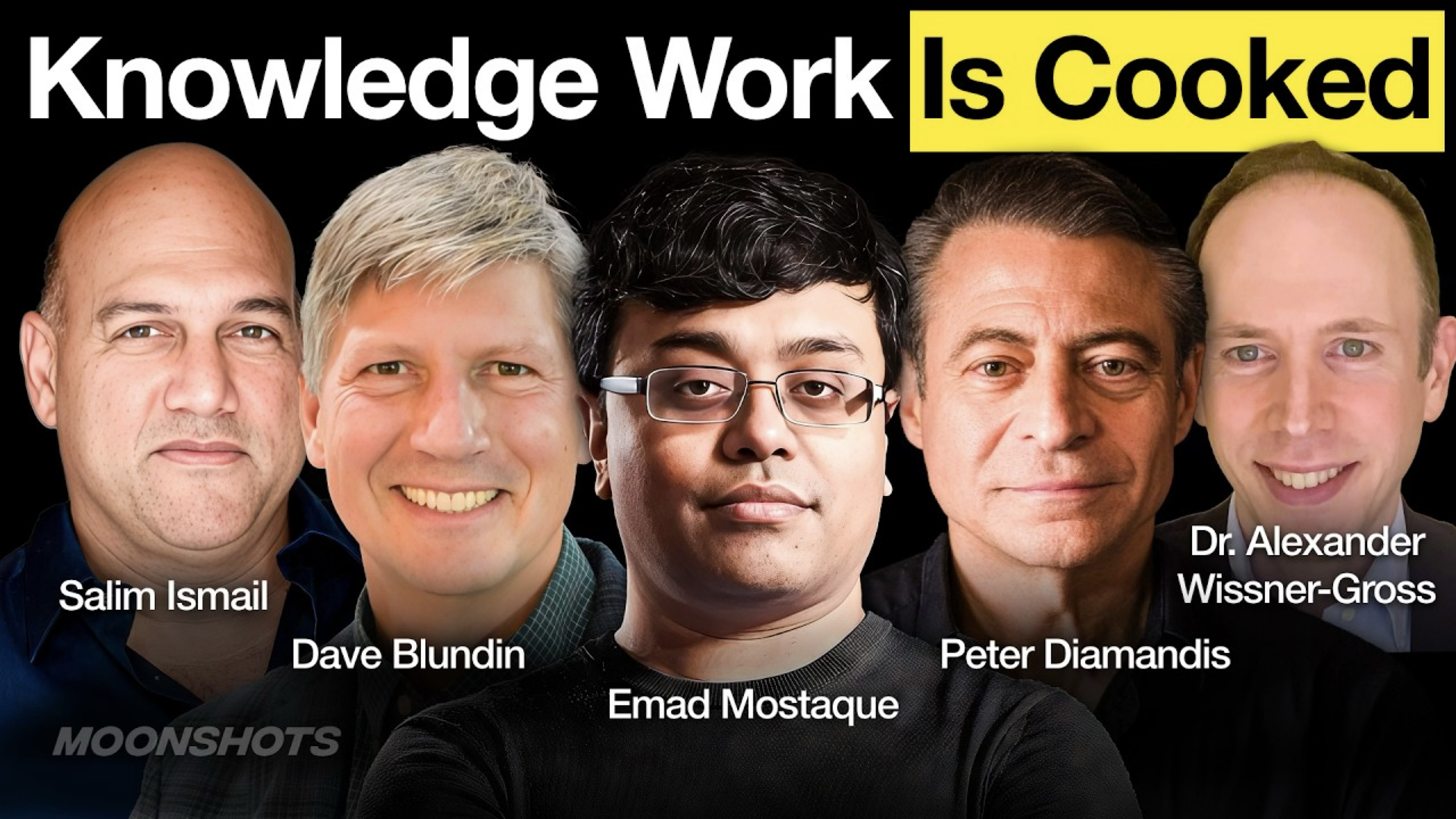
Recently, the renowned Silicon Valley podcast Moonshots brought together five top thinkers, including Peter Diamandis (founder of XPRIZE and Singularity University), Emad Mostaque (former CEO of Stability AI, one of the key drivers behind Stable Diffusion), Alexander Wissner-Gross (physicist/computer scientist), Salim Ismail (founding executive director of Singularity University), and Dave Blundin (Chairman of Link Ventures), to make 10 highly disruptive predictions for 2026.
In this article, we categorize the 10 disparate predictions into three dimensions: "Intelligence, Economy, Physics," thus breaking the original prediction order. Friends interested in the original text can watch the video or listen to the podcast directly.
01 Intelligence Explosion: The End of Moore's Law and the Birth of "New Species"
In these predictions, breakthroughs concerning computing power and the nature of AI occupy a central position.
Prediction 1: AI Model Size Skyrockets 100x (via Quantization Techniques)
Predictor: Dave Blundin
We used to think the power of AI was built by piling up "mountains of data" with NVIDIA GPUs. But Dave Blundin hit the nail on the head: what truly brings exponential dividends is the meticulous refinement of software and algorithms, especially the art called "quantization."
However, the "quantization" here is not about numbers in the stock market.
Traditional AI training is like feeding models expensive "16-bit" or "32-bit" floating-point numbers—akin to an emperor's golden hoe, precise yet heavy.
Yet, the latest research, particularly the "miracles" born under the pressure of the chip embargo on China, has proven:
Even if we compress model precision to "Ternary"—that is, log₂3 (1.58) bits, the model's capabilities remain almost unchanged, but the computational power and memory bandwidth required for its runtime can plummet exponentially, like a burst dam. It's like performing "weight loss surgery" on a burly giant, making him run faster and jump higher.
What does this mean?
Imagine, under the same hardware conditions, our AI models could become 100 times larger than they are now! If GPT-4 represents the average level of a human university student, then by 2026, we could achieve reasoning power on our portable phones and laptops that surpasses the terrifying capabilities of today's cloud-based giant supercomputers.
The prediction specifically mentions China.
When the "hard currency" of high technology (high-end chips) was restricted, Chinese developers were pushed to the brink, which also ignited their extreme pursuit of algorithmic efficiency. This may give rise to a peculiar paradox:
The U.S., with its computational advantage, might become "algorithmically lazy," while China, "thirsty" for computing power, might unexpectedly pioneer a new era of next-generation computing architecture in this arms race.
Prediction 2: AI Solves a "Millennium Prize Problem"
Predictor: Alexander Wissner-Gross
Did you know? The seven "Millennium Prize Problems" proposed by the Clay Mathematics Institute are like seven "Mount Everests" on the map of human intellect. Decades later, only one (the Poincaré conjecture) has been conquered. The remaining ones, such as the Riemann hypothesis, hailed as the "Holy Grail of Mathematics," and the Navier-Stokes equations describing the fluid motion we rely on for survival, represent the limits of human cognitive ability.
Now, top teams like Google DeepMind and xAI are treating the conquest of these mathematical problems as the ultimate "alchemical furnace" for training AI's "reasoning ability."
Once AI can, through its own logic, solve the Navier-Stokes equations that have puzzled the physics community, it will be monumental—this means our grasp on nuclear fusion control will become more precise, weather forecasting will become more reliable, and even aerodynamic design may usher in physics-level disruptive breakthroughs.
By 2026, we might truly witness the birth of an "Alien Intelligence."
This intelligence will not be content with merely "reciting" human knowledge from the internet. Instead, it will use pure logical deduction to discover truths hidden deep in the universe that humans have never touched—
That will be another form of "intelligence," a kind of "life" we have never seen before.
Prediction 3: New AI Acronyms Create Young Billionaires
Predictor: Dave Blundin
Every wave of technological change spawns new "terminology," and whoever masters the power to define these terms can seize the gold mine of wealth.
Just as RLHF (Reinforcement Learning from Human Feedback) once made Scale AI, in 2026, we are likely to welcome a brand-new, familiar AI acronym. These potential new abbreviations and categories include:
- SAI (Synthetic Agent Infrastructure): Platforms providing tools for building, deploying, and managing autonomous AI agents at scale.
- RAC (Reality Alignment Certification): Services that verify whether AI outputs align with reality and prevent hallucinations in critical applications.
- HAC (Human-AI Collaboration): Frameworks and tools designed to optimize collaborative work between humans and AI, rather than having AI replace humans.
- DAE (Digital Afterlife Execution): Managing AI agents, digital twins, and autonomous systems upon human death or incapacitation.
- SRS (Synthetic Reputation System): Building and managing AI twins for negotiating trust and screening opportunities.
Most excitingly, this transformation significantly lowers the barrier to entrepreneurship.
In the past, a remarkable AI project might require a massive team of hundreds to support it. But now, an 18-year-old prodigy with a deep understanding of a specific technical niche—such as Human-AI Collaboration (HAC)—armed with sheer courage and exceptional talent, could entirely possibly build a company worth tens of billions of dollars from scratch.
This is truly the prelude to the era of the "One-Person Unicorn,"
a golden age of individual intellectual explosion has quietly begun.
02 Economic Restructuring: From "Digital Transformation" to "AI Native"
The logic of the old world is "+AI,"
The logic of the new world is "AI Native."
Prediction 4: The Funeral of Digital Transformation, The Coronation of AI Native Rewriting
Predictor: Salim Ismail
This is probably the moment that sends shivers down the spines of traditional consulting giants like McKinsey and Accenture.
Ismail says, "Digital transformation" is dead. Enterprises will form AI teams, rebuild capabilities from scratch, and are expected to reduce headcount by 10 to 20 times.
Over the past decade, the "digital transformation" we shouted about was actually an expensive form of "pseudo-innovation." Simply put, it was "moving radio announcers onto TV screens to read scripts." The processes remained the same, just turning paper forms into Excel and offline approvals into OA systems.
In essence, this was "patching" old production relations, not a "revolution."
2026, the form changes—
The future winners will no longer be those trying to patch up old systems, but those daring to "rewrite" everything from scratch with AI. Imagine a bank no longer needing to maintain a massive compliance department of thousands, but deploying an Agent-based automatic compliance system, patrolling 24/7 without blind spots.
This transformation will bring about an ultimate "business minimalism."
The new organizational structure is extremely lean:
"Humans set the vision + AI handles the closed loop."
This also means the SaaS era of making easy money by selling standardized software may be coming to an end. Why? Because when AI can generate the most suitable application in real-time based on your needs, who needs to buy those rigid, bloated general-purpose software?
Consulting firms' business models will also be forced to shift from "optimizing processes" to "assisting enterprises in self-destruction and rebirth."
Prediction 5: Knowledge Work Automation Rate Breaks 90%
Predictor: Alexander Wissner-Gross
The prediction shows that AI will achieve a 90% proficiency rate on the most economically valuable tasks (GDP-Val).
What does this mean?
It means digital drudgery has reached a dead end.
If your daily work involves moving information on a screen, organizing Excel spreadsheets, writing basic code, or drafting bland official documents, then by 2026, the value of your labor will approach zero.
AI can do these jobs ten thousand times faster than you, and the cost is almost zero.
Of course, history tells us that technological progress doesn't necessarily lead to absolute mass unemployment (just as cars didn't starve coachmen but created a shortage of drivers), but it will indeed cause severe "skill mismatch."
In the 2026 workplace, the human role will fundamentally change—
from laboriously "drawing the picture" to deciding "what to draw" and judging "whether it's drawn well." Aesthetics, judgment, and understanding of complex systems will become the new hard currency.
Prediction 6: Remote Turing Test Passed (Is the Colleague on Zoom Human or Ghost?)
Predictor: Emad Mostaque
In the future, there might be a full-stack AI employee—whether an accountant, lawyer, or marketing expert—available for rent to companies at an astonishingly low cost (perhaps just $50 per month). This kind of "employee" doesn't sleep, complain, or quit, and possesses exceptional abilities.
When the product manager in a video conference can not only chat and laugh but also pull up data in real-time, instantly create PPTs, and even give perfect emotional feedback when you complain, but is actually just an AI Agent, the cornerstone of workplace trust completely collapses.
This will force us to retreat to the most primitive trust mechanism—
"Physical contact."
In the online world, every interaction will be presumed to be AI-generated unless you have cryptographic signatures proving your biological nature. In this era where screens are filled with AI, "human service" will shift from a norm to an extremely expensive luxury.
Face-to-face handshakes and real eye contact will become the highest form of business etiquette.
Prediction 7: The Great Education Split—Diploma Mills vs. Agency Accelerators
Predictor: Salim Ismail
The traditional model of "attend lectures - memorize - take exams - get a certificate" will go completely bankrupt.
After all, if knowledge itself becomes readily accessible, if knowledge-processing work is automated, what reason is there for universities that exist to "instill knowledge" to continue?
In the world after 2026, a Harvard diploma might be less convincing than your GitHub commit history, the real projects you've built on the blockchain, or the vertical model you've personally trained.
Employers will no longer look at "what you've learned," but only at "what you've accomplished."
Education will face a moment of great divergence:
One type is "diploma mills," which continue to mass-produce "test-takers" destined for unemployment for the old world;
The other type is "agency accelerators," which train people's resilience, entrepreneurial spirit, and ability to leverage AI to tackle complex problems.
The core of future education boils down to three words: Agency.
In this era of infinite AI empowerment, your ambition to change the world is ten thousand times more important than the inventory of knowledge in your head.
Physical Escape: Fleeing Earth, Aging, and Physical Constraints
The first two chapters were about the revolution of Bits; this chapter is about the conquest of Atoms.
Prediction 8: Billionaires' Space Race (Bezos vs. Musk)
Predictor: Peter Diamandis
This is Peter Diamandis's prediction:
In 2026, Bezos (Blue Origin) might pull off a surprise victory, landing first at the Shackleton Crater at the Moon's south pole.
Why there?
Because there is water ice.
In space, water is not just the source of life; after electrolysis, it becomes liquid hydrogen and liquid oxygen—the perfect rocket fuel. Musk (SpaceX) is focused on Mars, but he needs Starship to refuel in orbit; if Bezos secures the Moon's water, he controls the only "gas station" to deep space. This also validates Bezos's patient, steady strategy, as opposed to Musk's rapid iteration model.
In 2026, lunar ice mining will become a commercial priority, not a distant future concept.
This marks the official opening of the "Cislunar Economy"—
The lunar economy begins with resource extraction, not just leaving flags.
Prediction 9: Level 5 Autonomous Driving and the Robotics Singularity
Predictor: Emad Mostaque
When we talk about autonomous driving, many are still debating radar vs. cameras. But true masters see something more fundamental: the location of computing power.
Level 5 means AI is steadier than the most experienced human driver in any extreme environment, be it blizzards or off-road conditions. The explosion of this capability benefits from the chip in the vehicle, but even more from cloud computing power.
A robot doesn't need to carry an Einstein in its own head; it only needs to connect, via ultra-low latency networks, to the omniscient "world model" in the cloud—
It is merely an execution terminal; the real intelligence flows in the cloud.
Simultaneously, in 2026, we will witness humanoid robots stepping out of Boston Dynamics' labs and truly taking over the infamous "3D jobs"—Dull, Dirty, Dangerous.
This not only solves labor shortages but also revolutionizes urban form—
For the past century, our cities were designed for "stationary steel"—for private cars that sit parked 95% of the time, we sacrificed the most valuable land in city centers to build parking lots. But in 2026, Robotaxi will turn these stationary iron blocks into "flowing computing power." Cars no longer need to rest; they flow perpetually like red blood cells in the city's veins.
This means that tens of thousands of acres of prime real estate in city centers will be freed up; parking lots become parks, residences, or commercial complexes.
Prediction 10: The "Kitty Hawk Moment" for Reversing Aging
Predictor: Peter Diamandis
This is the most humanistic and craziest of all the predictions.
Peter Diamandis's view is:
Aging is not hardware failure; it's a software glitch. Our genes (DNA) aren't broken; it's just that the epigenetic markers (the switches for genes) are messed up.
Imagine your computer slowing down; you don't need to replace the hardware, just reinstall the operating system. Through "Yamanaka factors," we are learning how to "reboot" cells, rolling them back to their youthful settings.
In 2026, we might see pioneers like Life Biosciences begin human trials, perhaps restoring blind eyes or regenerating livers.
Once successful,
This will be the evolutionary inflection point for the human species.
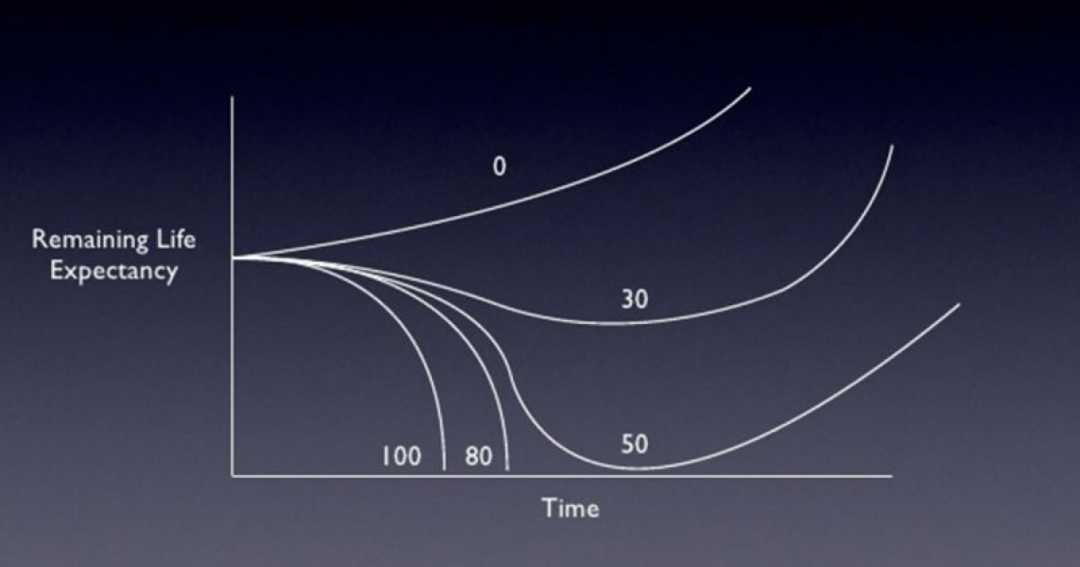
We will reach "Longevity Escape Velocity"—
For every extra year you live, technological progress will increase your life expectancy by more than a year.
From then on, death is no longer an inevitable philosophical destiny, but becomes an engineering problem that can be managed, delayed, and even ultimately solved.
These 10 predictions from Moonshots paint a picture where "Abundance" and "Obsolescence" coexist.
On one hand, energy, computing power, health, and even space resources will become unprecedentedly cheap and accessible; on the other hand, old social contracts, professional identities, and business models will collapse at a startling speed.
2026 might be the last year in human history where we have the chance to actively choose our direction.
We are not waiting for the future to happen; we are forced to change tires on a highway.
Understand that the new moat has only three pillars:
1. Extreme Ambition (Agency): Machines have no desires; you do.
2. Unique Taste: Machines can generate ten thousand solutions; only you can decide which one is "beautiful."
3. Leadership: Don't be a craftsman; be a general. Your core value is no longer finding answers, but defining "what is a good question."
The new era,
The train has changed, the tracks have changed, even the destination has changed.
The only thing that remains unchanged is the courage to explore the unknown.
Join TechFlow official community to stay tuned
Telegram:https://t.me/TechFlowDaily
X (Twitter):https://x.com/TechFlowPost
X (Twitter) EN:https://x.com/BlockFlow_News
 Moonshots Clips