








Messari Research Report: A Comprehensive Look at Particle Network
TechFlow Selected TechFlow Selected
Messari Research Report: A Comprehensive Look at Particle Network
Particle Network's public testnet launched on May 2, alongside a rewards program called Particle Pioneer.
 Navigating Web3 tides with focused insights
Author: AJC, Messari Research Analyst
Translation: TechFlow
Key Takeaways
-
Particle Network is developing a modular L1 blockchain that enables chain abstraction, allowing each user to have a single, unified on-chain address and balance across all blockchains.
-
Through its L1 blockchain, Particle Network delivers three core functionalities: Universal Accounts, Universal Liquidity, and Universal Gas. Each function uniquely eliminates manual multi-chain interactions in the user experience.
-
Particle Network also implements dual staking via Babylon and aggregates data availability. Dual staking leverages BTC to bootstrap crypto-economic security, while aggregated data availability mitigates single points of failure in network data availability.
-
Particle Network launched its public testnet on May 2, alongside a reward program called Particle Pioneer. As of this writing, 1.3 million accounts have registered, and 6.71 billion PARTI points have been distributed.
Introduction
One constant in the crypto industry is the ever-increasing number of blockchains. Whether it’s Layer-2 (L2) rollups on Ethereum, alternative L1s, or application-specific chains, new blockchains seem to launch every month. While this expanding set of blockchains offers users various customized options, the multi-chain ecosystem has drawbacks for both developers and users. Developers must not only focus on their applications or products but also decide which blockchain ecosystem to deploy on. For users, more chains mean increased complexity and fragmented liquidity, making the user experience (UX) far less seamless than Web2.
To truly compete with Web2 in terms of adoption, Web3 needs to reach a point where the average user doesn’t even know which blockchain they’re transacting on—a concept known as chain abstraction. To achieve this, Particle Network is building a modular L1 blockchain that enables chain abstraction by giving each user a single, unified on-chain address and balance across all blockchains.
Background
Particle Network was announced in April 2022, co-founded by Pengyu Wang and Tao Pa. Both founders have backgrounds in mobile game development and created Particle Network to provide backend infrastructure for developers. To date, Particle Network has raised $25 million through four funding rounds, with notable investors including Spartan Group, Gumi Crypto, Animoca Ventures, LongHash Ventures, and Alibaba Group. On May 2, 2024, Particle Network launched its incentivized L1 testnet, offering point rewards through the Particle Pioneer platform. The mainnet is scheduled to launch in the second half of 2024.
Network Features
Through its L1 blockchain, Particle Network delivers three core features: Universal Accounts, Universal Liquidity, and Universal Gas. Each feature aims to achieve chain abstraction by eliminating manual multi-chain interactions in the user experience.
Universal Accounts
(Image source: Particle Network)
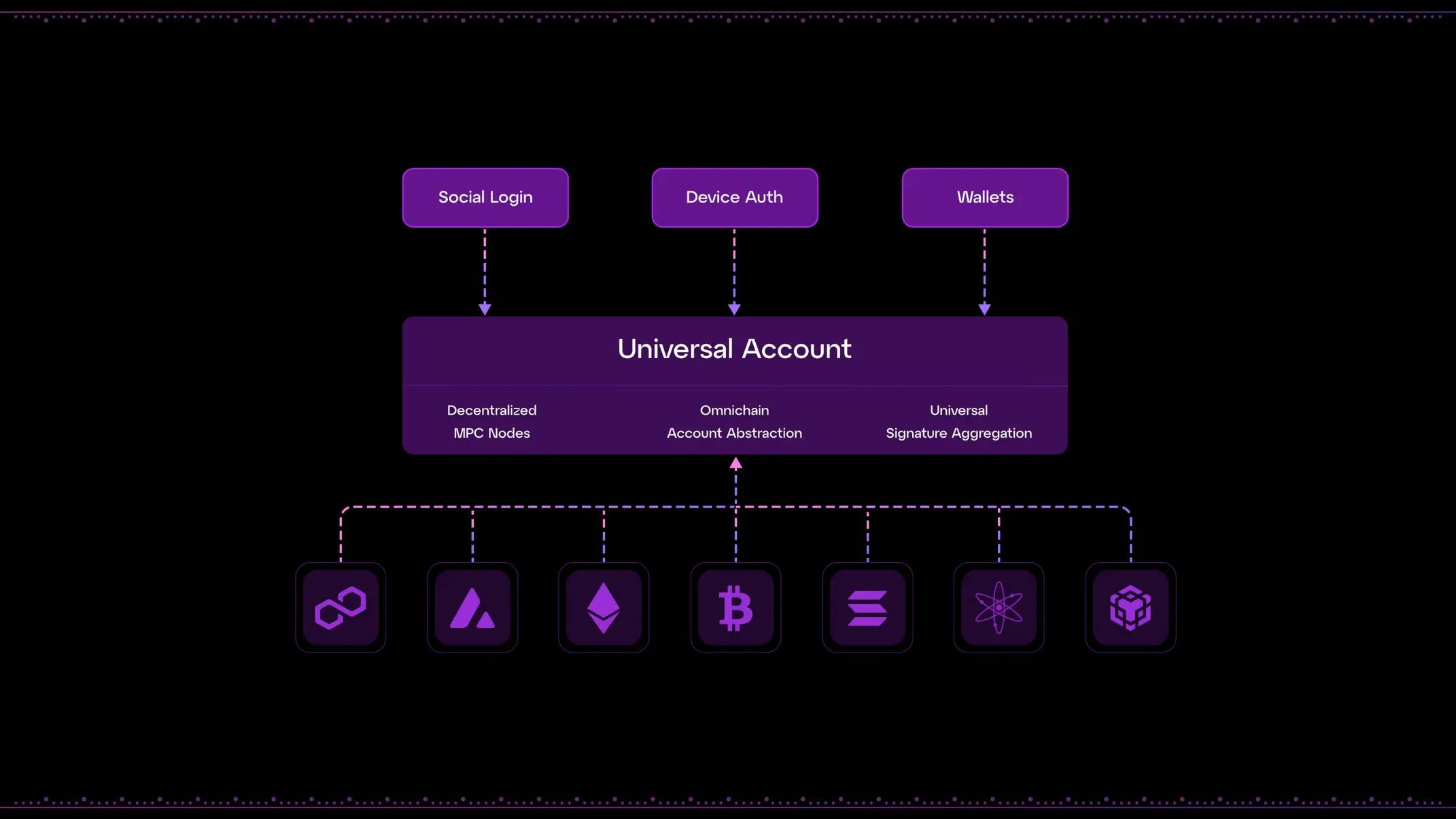
Universal Accounts allow each user to have a single, unified address, balance, and interaction point regardless of the underlying chain hosting the application or funds. Additionally, Universal Accounts are compatible with both EVM and non-EVM networks, including even limited-programmability networks like Bitcoin. Particle Network achieves this by using ERC-4337 smart contract wallets (smart accounts). Smart accounts offer greater flexibility, programmability, and security compared to typical externally owned accounts (EOAs). Moreover, Universal Accounts improve upon standard smart accounts by making them cross-chain compatible. As a result, Particle Network users interact solely with a unified balance rather than directly managing individual accounts.
For example, suppose a user wants to mint an NFT on an L2 rollup but holds all their ETH on the Ethereum mainnet. With an EOA, the user would need to sign the following transactions:
-
Approve bridge contract
-
Bridge ETH from Ethereum to the L2
-
Approve minting contract
-
Mint NFT
However, if the user uses a Universal Account, they only need to sign one transaction instead of four.
Particle Network is also developing a Universal WaaS SDK, enabling any application to easily integrate Universal Accounts into their products. Furthermore, Universal WaaS will allow applications already integrated with Particle Network’s existing wallet abstraction services—such as Modular Smart Wallet-as-a-Service or BTC Connect—to automatically upgrade any existing smart account into a Universal Account.
Universal Liquidity
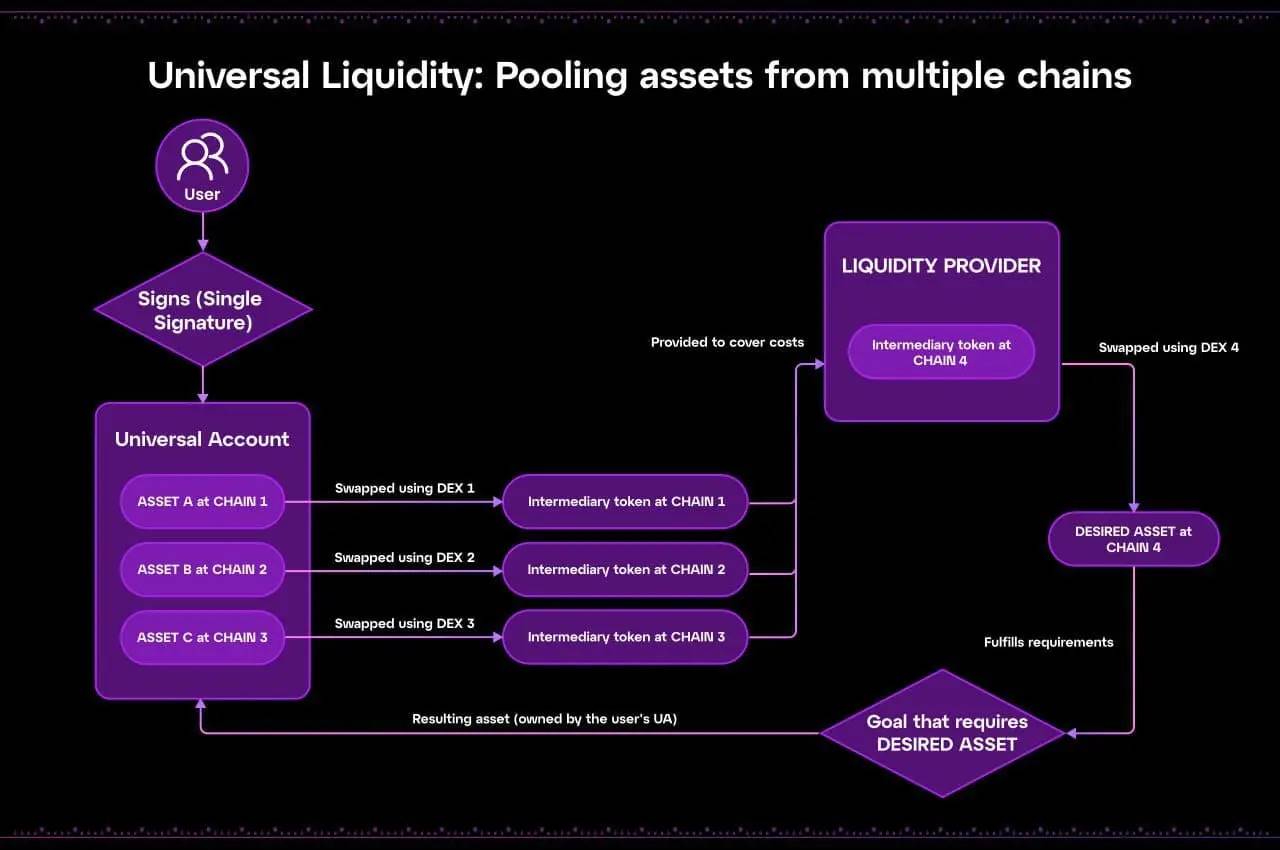
Universal Liquidity serves as the foundational layer of Particle Network’s cross-chain functionality, enabling Universal Accounts to maintain a single balance across all supported chains. Simply put, Universal Liquidity is Particle Network’s cross-chain bridging solution. Therefore, Universal Liquidity allows users to conduct transactions on any supported blockchain regardless of where their funds are located.
For instance, imagine a user wants to buy an SPL token on Solana but holds all their funds on Ethereum. Using Particle Network’s Universal Account, the user only needs to sign one transaction to complete this purchase. This is because Universal Liquidity handles the actual transfer of funds from Ethereum to Solana in the background. Through Particle Network’s distributed network of Bundler nodes, these transactions (UserOperations) are executed on behalf of the user. Ultimately, Universal Liquidity aims to automate cross-chain activities on a per-transaction basis. Typically, cross-chain actions involve multiple transactions across several blockchains. With Universal Liquidity, the user experience is streamlined, enabling users to perform cross-chain activities within a single transaction.
Universal Gas
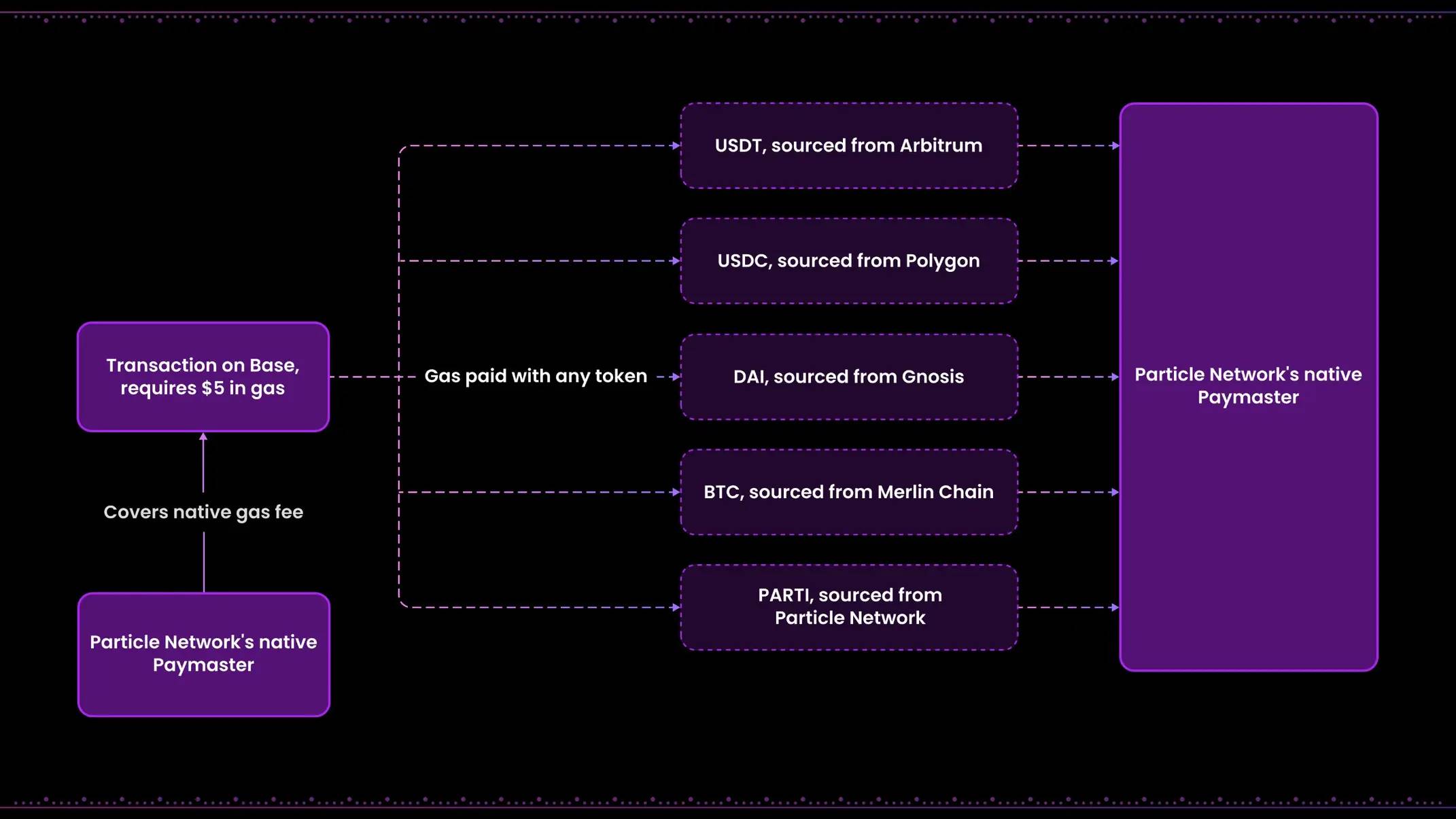
All multi-chain frameworks must overcome the challenge of gas payments. Particle Network’s Universal Gas addresses this complexity by abstracting away specific gas tokens. Through Particle Network’s Paymaster, users can pay gas fees for transactions using any supported token on any supported chain. For example, USDC on Ethereum can be used to pay gas fees for transactions on Solana.
When conducting a transaction via a Universal Account, Particle Network prompts the user to select which token they wish to use for paying associated gas fees. Users can choose multiple tokens—even across different blockchains—to cover gas costs. These tokens are then transferred to the Paymaster, exchanged into Particle Network’s native PARTI token, and used to settle the relevant transaction on Particle Network. Bundler nodes are subsequently incentivized to execute the transaction.
Technology
Particle Network is a modular L1 blockchain built using the Cosmos SDK and CometBFT. The Cosmos SDK is an open-source software development kit (SDK) for building sovereign and public PoS blockchains. The Cosmos SDK is used to build custom application layers or state machines, while CometBFT securely replicates that state machine across all nodes in the network. CometBFT is an application-agnostic engine that handles the networking and consensus layers through two primary components:
-
Consensus algorithm, i.e., Tendermint.
-
Socket protocol, i.e., Application Blockchain Interface (ABCI).
Tendermint validates requests on the source chain and confirms changes on the destination chain. Its consensus provides instant finality and Byzantine fault tolerance. Additionally, Particle Network adopts Berachain’s BeaconKit to implement an EVM-compatible execution environment.
Modules
Particle Network’s core functionalities (Universal Accounts, Liquidity, and Gas) are delivered through three key modules: Master Key Storage Center, Decentralized Messaging Network, and Decentralized Bundler.
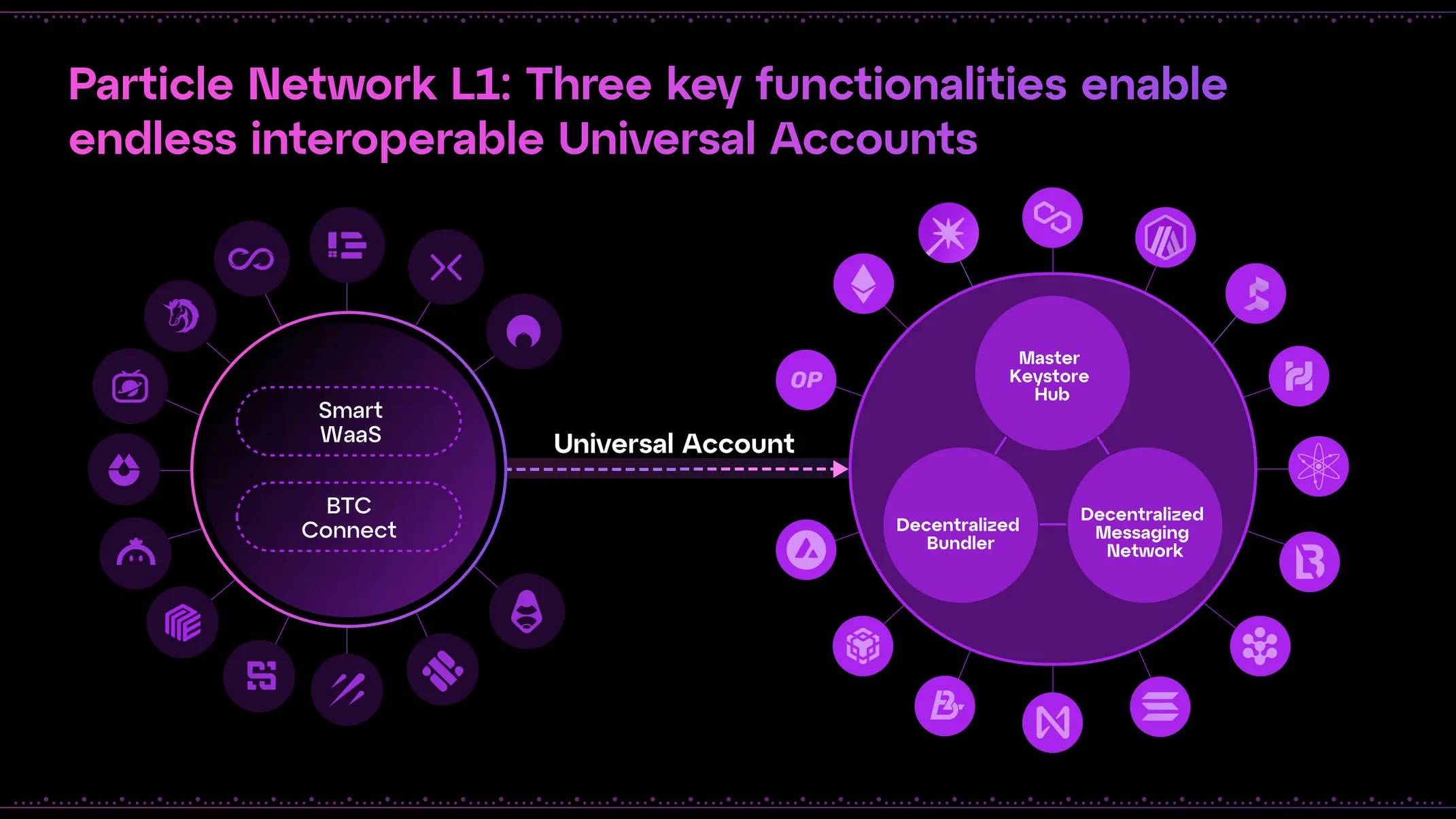
Master Key Storage Center
The Master Key Storage Center module acts as the central source of truth on Particle Network. It works by synchronizing state changes of Universal Accounts across all supported blockchains, maintaining consistency of state across the network. This module records any changes occurring on Particle Network, such as a user adding a signer to their Universal Account.
Decentralized Messaging Network
Particle Network’s Decentralized Messaging Network (DMN) relays successful UserOperations (transactions from Universal Accounts) from external blockchains to Particle Network. DMN is powered by a system of Relayer Nodes, centralized messaging nodes operating on Particle Network. Additionally, DMN works in conjunction with the Master Key Storage Center to pass state data to and retrieve data from supported blockchains. DMN is powered by Hyperlane, an interoperability layer enabling supported blockchains to connect and communicate seamlessly.
Decentralized Bundler
The Decentralized Bundler module is responsible for executing UserOperations, serving as the core component of Universal Liquidity. This module consists of a distributed network of Bundler nodes. Bundler nodes execute transactions on behalf of Universal Accounts, such as purchasing NFTs or swapping tokens. They accomplish this by interacting with liquidity providers. In this context, liquidity providers are not traditional DEX liquidity providers but rather multi-chain liquidity pools capable of bridging funds.
For example, suppose a user wants to buy SOL on Solana, but their funds are equally split among USDC on Ethereum, Optimism, and Arbitrum. The Universal Account signs a single transaction enabling the following steps:
-
Particle Network’s L1 processes the UserOperation associated with the signed transaction.
-
Bundler nodes relay the UserOperation to liquidity providers, sending USDC from Ethereum, Optimism, and Arbitrum to their respective liquidity providers.
-
Upon receiving the USDC, the liquidity providers send USDC on Solana to the user’s account.
-
Bundler nodes execute the transaction on a Solana DEX, swapping USDC for SOL on behalf of the user.
Finally, Watchtower Nodes ensure all these interconnected modules operate correctly. They do so by providing execution proofs or fraud proofs for every block generated in each epoch on the Particle Network.
Dual Staking
Particle Network uses a Delegated Proof-of-Stake (DPoS) consensus mechanism featuring a dual staking system. Once live on mainnet, Particle Network will utilize two distinct sets of validator nodes: one secured by Particle Network’s native token, and another secured by BTC via Babylon’s Bitcoin staking protocol. Both sets of validator nodes will independently reach consensus. If either set deems a block invalid, the block will not be finalized. The purpose of the dual staking system is to bootstrap crypto-economic security using both a proven crypto asset (BTC) and the network’s native token.
Aggregated Data Availability
A key challenge faced by blockchains is data availability. Data availability ensures that all data required to validate transactions is accessible and that all nodes can access the chain’s state. Whenever a blockchain relies on a single data availability solution, it introduces a single point of failure. If the data availability solution fails, nodes cannot guarantee block validity. Therefore, Particle Network leverages Aggregated Data Availability (AggDA), a unique approach utilizing multiple data availability networks: Celestia, Avail, and NEAR DA.
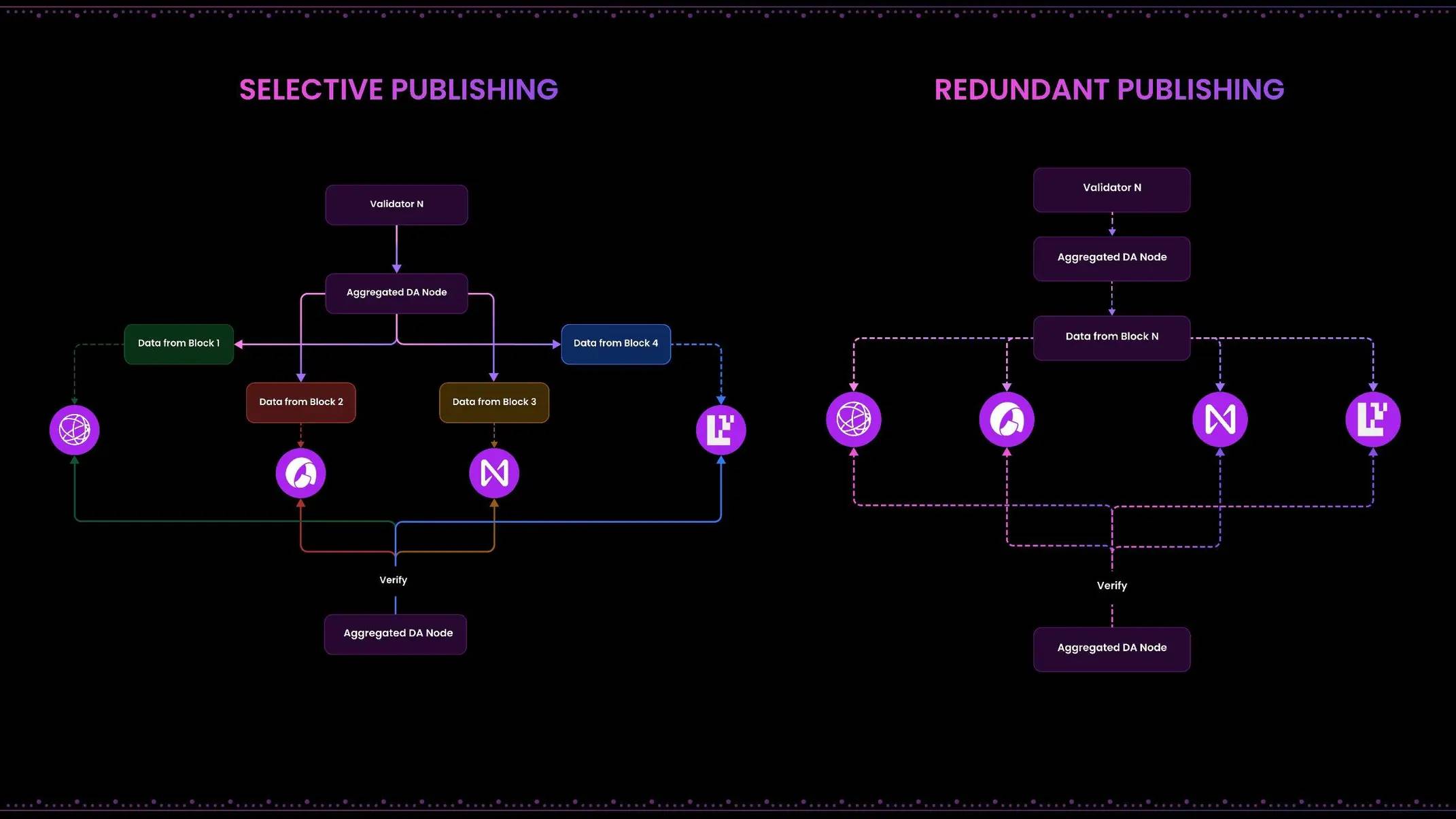
For each block generated on Particle Network, data is randomly published in the following ways:
-
Selective Publishing - Data related to the block is published to only one supported data availability solution. This method helps reduce data publishing costs.
-
Redundant Publishing - Data related to the block is published to all supported data availability solutions. While more expensive than selective publishing, this method diversifies risk in case any single data availability solution fails.
Public Testnet
Particle Network’s public testnet went live on May 2, 2024. The testnet showcases two of Particle Network’s core features: Universal Accounts and Universal Gas. Users can register for the testnet using an EVM wallet (e.g., MetaMask or Rainbow) to create a Universal Account. Additionally, via Particle Network’s BTC Connect, users can also control a Universal Account using a Bitcoin wallet (e.g., Unisat or OKX).
Users can test Particle Network’s Universal Gas functionality by depositing native tokens (e.g., ETH on Ethereum, BNB on BNB Smart Chain) into supported testnet networks. Once deposited, these tokens are automatically converted into Universal Gas (USDG). Users can then use USDG to send transactions on the testnet. As of this writing, over 9.6 million transactions using USDG have occurred on Particle Network’s testnet, and over 121.5 million UserOperations related to these transactions have been recorded. Note that this is an early implementation of Universal Gas and may differ on mainnet.
Particle Pioneer
The Particle Pioneer program aims to encourage user participation in the Particle Network testnet. The program rewards testnet users with PARTI points, which qualify addresses for upcoming airdrops, bonuses from People’s Launchpad, and whitelist spots for various ecosystem projects. People’s Launchpad is a project within the Particle Network ecosystem designed to bootstrap ecosystem applications and protocols.
Addresses earn points by sending transactions and using USDG to pay gas fees. Each transaction earns 50 points, up to a maximum of 100 transactions per day. Additionally, addresses earn extra points through daily check-ins. The longer an address continuously sends transactions, the more points they earn.
Particle Pioneer also allows addresses to earn additional points via Particle Pioneer NFTs, reserved for active addresses on the testnet and those who participated in prior campaigns. There are three types of NFTs, offering point boosts ranging from 2% to 30%.
To date, 1.3 million accounts have registered for the Particle Pioneer program, and 6.71 billion PARTI points have been distributed.
Roadmap
With the launch of the testnet in May, Particle Network is one step closer to its eventual mainnet launch. Particle Network’s roadmap includes:
-
Q2 2024 – Add Universal Liquidity and Modular Nodes to the public testnet
-
Q3 2024 – Launch Mainnet V1 with Universal Accounts, Universal Liquidity, and Universal Gas
-
Q4 2024 – Launch testnet for Dual Staking and Aggregated Data Availability
-
2025 – Launch Mainnet V2 supporting Dual Staking and Aggregated Data Availability
Competitive Landscape
Chain abstraction is the ultimate solution addressing two major problems in the blockchain industry. The first is that multi-chain frameworks inevitably lead to fragmented liquidity and users, creating siloed ecosystems. The second is the poor user experience provided by externally owned account (EOA) wallets, which falls short of the seamless interaction offered by Web2 applications. Solutions to these problems have largely been developed separately—for example, bridging protocols connect isolated blockchains, while smart contract wallets enhance UX to feel more like Web2.
Chain abstraction integrates these solutions, combining the strengths of both into a single product. Traditionally, protocols and teams focused on one solution or the other, but newer projects like Particle Network are increasingly committed to delivering both simultaneously, offering a more cohesive and efficient user experience.
NEAR
NEAR is a multi-purpose L1 smart contract platform offering chain abstraction services. NEAR’s account abstraction service allows users on NEAR to sign transactions on other chains (such as Ethereum and BNB Smart Chain), with support for more blockchains planned in the future. NEAR’s account abstraction service utilizes MPC networks and on-chain signatures, along with a Multi-Chain Gas Relayer, a mechanism capable of paying gas fees and executing transactions on other blockchains.
Instadapp’s Avocado
Instadapp’s Avocado platform is a smart contract account compatible with multiple EVM-supporting networks, including Ethereum, Polygon, Optimism, Arbitrum, Avalanche, BNB Smart Chain, and Gnosis Chain. Similar to Particle Network, Avocado abstracts the underlying chain from the user experience. Additionally, Avocado implements a Paymaster gas tank, enabling users to pay all gas fees with USDC. A key difference is that Avocado integrates only with EVM networks, whereas Particle Network also supports non-EVM networks.
XION
XION is a modular L1 blockchain aiming to create a "generalized abstraction" layer to enable seamless Web3 user experiences. Generalized abstraction is an all-in-one infrastructure solution that directly integrates accounts, signatures, fees, and interoperability at the protocol level. XION’s “Meta Accounts” product is a smart contract account solution similar to Particle Network’s Universal Accounts. However, Meta Accounts initiate cross-chain transactions from XION’s L1, while Universal Accounts initiate from the source blockchain and are then relayed and further coordinated by Particle Network’s L1. XION is currently on testnet, with mainnet planned for 2024.
Conclusion
Particle Network addresses a critical need in the blockchain space by solving liquidity fragmentation and user experience challenges in multi-chain ecosystems. Through its modular L1 blockchain, Particle Network delivers Universal Accounts, Universal Liquidity, and Universal Gas to achieve chain abstraction and simplify user interactions across different blockchains. Since its founding in April 2022, Particle Network has launched its incentivized L1 testnet and secured backing from prominent investors. The team plans to launch the mainnet in the second half of 2024. Additionally, Particle Network’s underlying technology—including the Cosmos SDK, CometBFT, and various innovative modules—enables seamless cross-chain transactions and state synchronization.
The launch of the public testnet in May 2024 demonstrated the capabilities of Universal Accounts and Universal Gas. Going forward, Particle Network plans to integrate Universal Liquidity and modular nodes, with the mainnet expected to launch in Q3 2024 and additional features rolling out in 2025. Competing with projects like NEAR, Instadapp’s Avocado, and XION, Particle Network’s comprehensive approach to chain abstraction and its dual staking system position it as a strong contender in the field of chain abstraction design.
Join the official TechFlow community:
Telegram subscription group:
Twitter official account:
Twitter English account:
Join TechFlow official community to stay tuned
Telegram:https://t.me/TechFlowDaily
X (Twitter):https://x.com/TechFlowPost
X (Twitter) EN:https://x.com/BlockFlow_News
 Messari






