Symbiotic: A permissionless restaking protocol
TechFlow Selected TechFlow Selected
Symbiotic: A permissionless restaking protocol
Symbiotic Protocol is a neutral coordination framework that introduces innovative modular units, offering unique advantages to participants.
 Navigating Web3 tides with focused insights
Translated by: bluue
Today, we are excited to announce the initial deployment of the Symbiotic protocol.
This launch marks a significant milestone toward realizing our vision of a permissionless shared security protocol that can effectively advance decentralization and collaborative development across any network.
Symbiotic is a neutral coordination framework introducing innovative modular units that bring unique advantages to participants.
This focus delivers distinct benefits for Symbiotic participants:
Flexibility through modularity: Symbiotic allows networks autonomous control over various aspects of the staking process, enabling flexible participation in or exit from shared security—covering supported restaked assets, asset ratios, caps, node operator selection mechanisms, rewards, and penalties.
Risk minimization through immutability: Non-upgradable contracts on Ethereum eliminate external governance risks and single points of failure, while simple and flexible contract design minimizes execution risk.
Capital efficiency through restaking: A permissionless, multi-asset, network-agnostic design enables scalable and capital-efficient access to economic security. An evolving operation-focused cross-network reputation system will further enhance capital efficiency for network builders.
The Evolution of Shared Security
Decentralized networks require coordination mechanisms to incentivize and ensure infrastructure operators adhere to protocol rules.
In 2009, Bitcoin introduced the first trustless coordination mechanism, launching a decentralized network via Proof-of-Work (PoW).
The evolution from PoW to Proof-of-Stake (PoS) refined this model by focusing on economic collateral rather than raw computational power.
Symbiotic’s shared security leverages existing ecosystem security, providing a secure pathway to decentralize any network.
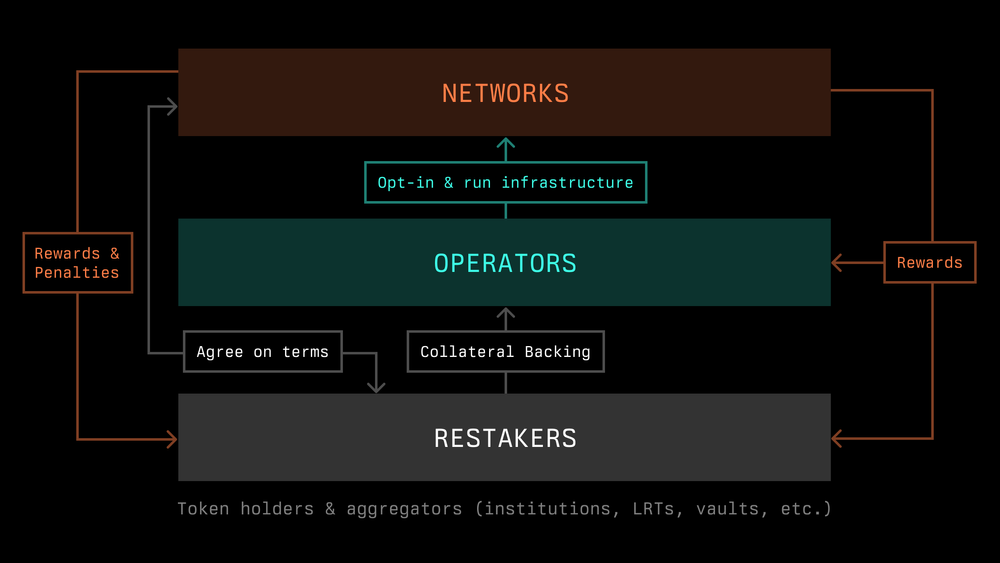
Symbiotic is a shared security protocol acting as an intermediate coordination layer, empowering network builders with control and configurability over the restaking process.
Symbiotic Ecosystem
Decentralized networks requiring economic security play a crucial role in bootstrapping the restaking ecosystem. Symbiotic offers a highly flexible design suitable for protocols at any stage of decentralization.
Projects can launch a decentralized and trust-minimized network from day one using existing operators, expand the set of operators within their existing ecosystem, increase attack costs via added staking, or integrate ecosystems by incorporating multiple tokens into network staking.
We’re excited to announce our first collaborators exploring Symbiotic’s restaking primitives:
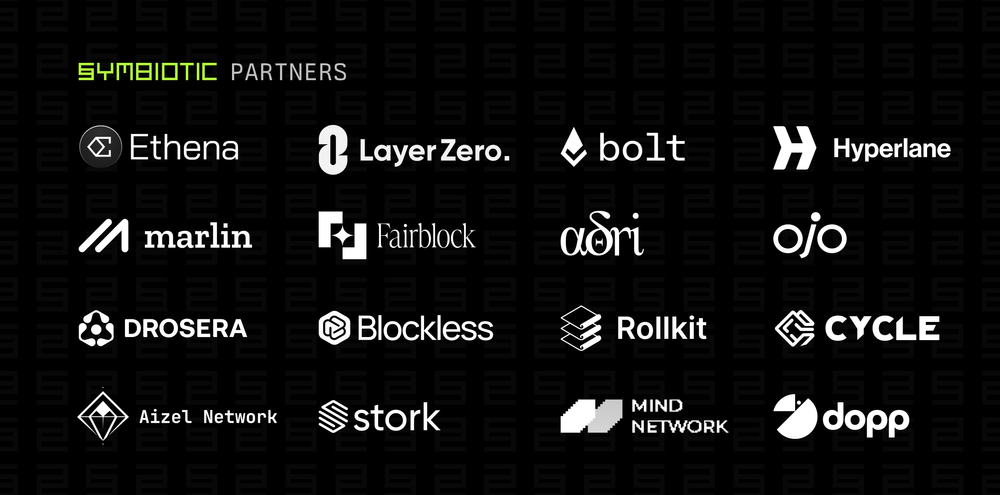
Ethena is integrating Symbiotic with LayerZero's Decentralized Verification Network (DVN) to protect Ethena assets like $USDe across chains.
Chainbound’s Bolt Protocol enables Ethereum block proposers to make credible commitments and plans to leverage Symbiotic for staking and unstaking.
Hyperlane is exploring Symbiotic-powered Interoperability Security Modules (ISMs) for its modular cross-chain interoperability framework.
Kalypso, a ZK proof marketplace, uses Symbiotic restaking to guarantee the validity and timeliness of generated proofs.
Fairblock is exploring Dynamic Cryptographic Service Networks (CSNs), secured via restaked assets, offering customizable services.
Aori plans to integrate Symbiotic restaking with stablecoin assets to ensure accountability in its high-frequency orderbook protocol.
Drosera is researching restaking-based security for Ethereum Layer-2 applications.
Ojo, a cross-chain oracle network, will use Symbiotic restaking to enhance economic security.
Blockless integrates Symbiotic’s security with its compute infrastructure, giving builders full autonomy and flexibility.
Rollkit is exploring integrating Symbiotic restaking into its modular stack to support Celestia-based rollups.
Cycle Network, a unified liquidity network, will use Symbiotic to power its shared sequencer service.
Stork is integrating Symbiotic restaking to enhance trustlessness in on-chain data utilization.
Aizel is building a verifiable AI network, studying how Symbiotic restaking can ensure verifiability across node roles from inference to execution.
Mind Network will leverage Symbiotic’s universal restaking service combined with FHE technology to enhance economic and consensus security in decentralized networks.
DOPP is building a fully on-chain options protocol and researching how Symbiotic restaking can help decentralize its oracle network to provide data sources for specific option prices.
Our goal is to make Symbiotic the ideal home for developers building sovereign, trust-minimized applications and infrastructure.
Funding
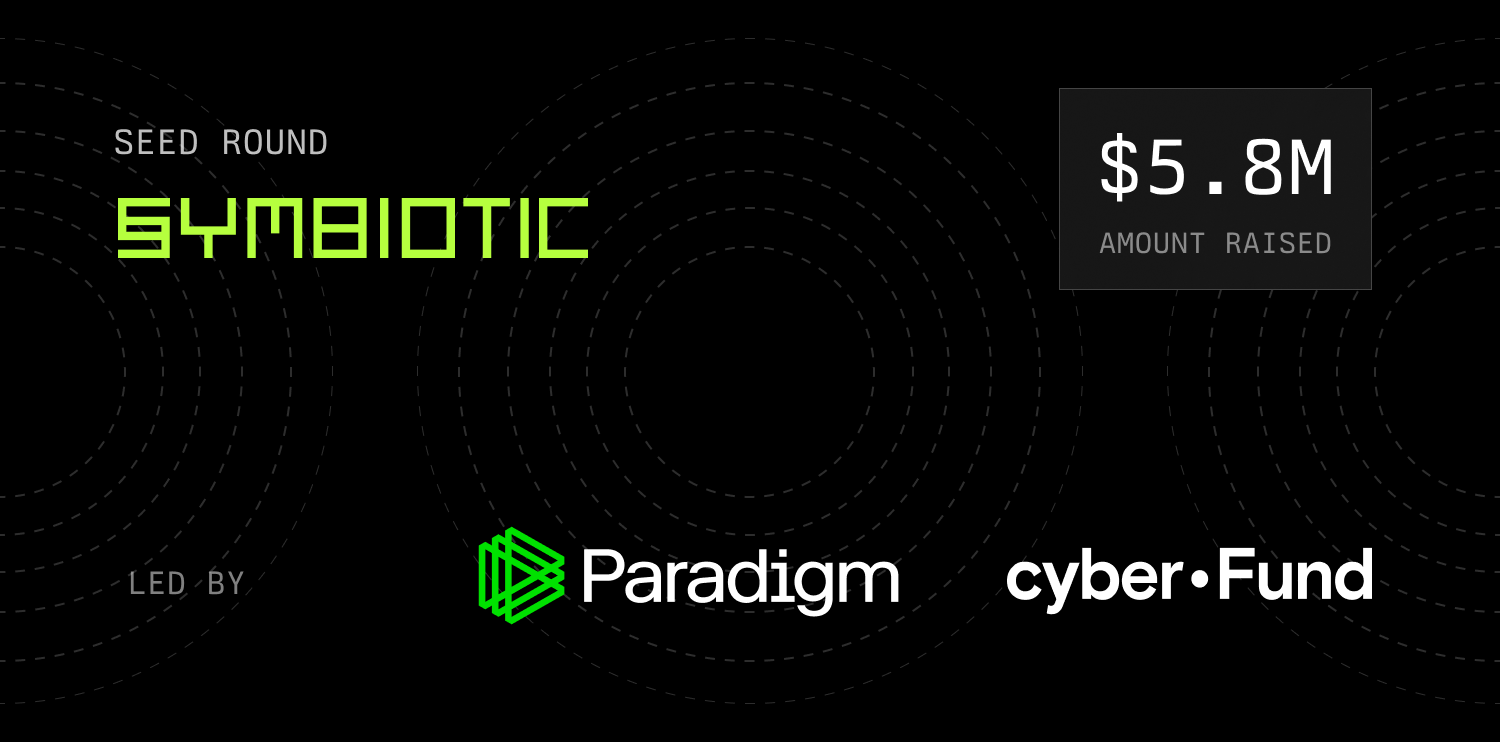
To further advance our mission, we've raised a $5.8 million seed round from Paradigm and cyber•Fund, who share our long-term vision for an open, permissionless restaking economy.
We're excited to see and support what will be built atop Symbiotic’s shared security primitives. If you’re interested in collaborating with Symbiotic, please reach out. (Link)
About Staked Tokens and Deposit Limits
The Symbiotic protocol is neutral and permissionless.
Early deposits aim to sustainably scale the shared security platform. Initially, restaked assets participating through the main protocol interface (Link) will be limited in scale and restricted to major token ecosystems to maintain neutrality.
New staking assets will be added in subsequent phases based on ecosystem demand.
Join TechFlow official community to stay tuned
Telegram:https://t.me/TechFlowDaily
X (Twitter):https://x.com/TechFlowPost
X (Twitter) EN:https://x.com/BlockFlow_News