From Strict Regulation to Policy Relaxation: SEC Greenlights Crypto Liquid Staking
TechFlow Selected TechFlow Selected
From Strict Regulation to Policy Relaxation: SEC Greenlights Crypto Liquid Staking
Participants in liquid staking activities are not required to register transactions with the Securities and Exchange Commission under securities laws, nor do they fall within the scope of registration exemptions provided by securities laws for these liquid staking activities.
 Navigating Web3 tides with focused insights
Author: Jaxon Gaines
Translation: TechFlow
The U.S. Securities and Exchange Commission (SEC) stated on Tuesday that crypto liquid staking activities are not considered securities activities.
The SEC has made multiple pro-crypto statements today, with this latest announcement further enhancing the SEC's transparency regarding crypto staking.
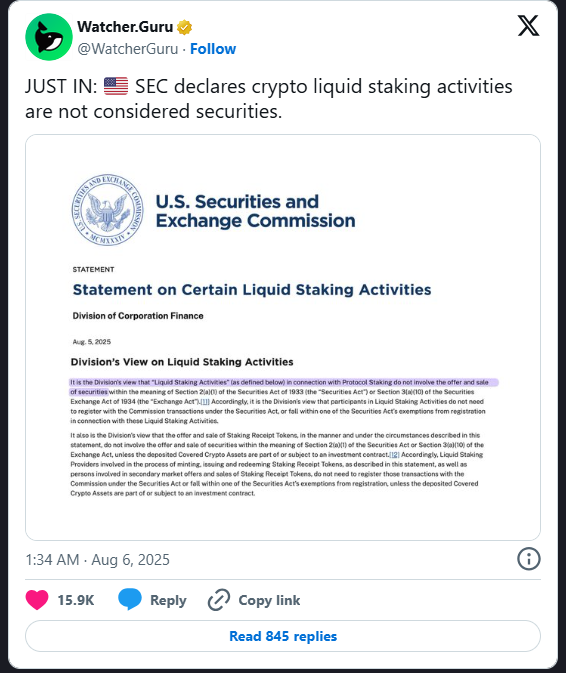
The SEC statement reads:
"The Division believes that 'liquid staking activities' related to protocol staking do not involve the offer and sale of a security as defined in Section 2(a)(1) of the Securities Act of 1933 ('Securities Act') or Section 3(a)(10) of the Securities Exchange Act of 1934 ('Exchange Act').[11] Therefore, the Division believes participants in liquid staking activities are not required to register transactions with the SEC under the Securities Act, nor do these activities fall within any registration exemptions under the Securities Act."
This statement provides clear guidance for participants in the liquid staking space, ensuring such activities are not subject to the regulatory frameworks typically applicable to securities. SEC Chair Paul Atkins said in a statement: "Today’s staff statement on liquid staking is an important step forward in clarifying the staff’s views on crypto asset activities that fall outside the SEC’s jurisdiction."
The Division also believes that Staking Receipt Tokens offered and sold in the manner and circumstances described in this statement do not involve the offer and sale of a security within the meaning of Section 2(a)(1) of the Securities Act or Section 3(a)(10) of the Exchange Act, unless the deposited covered crypto asset is part of, or subject to, an investment contract.[12]
Accordingly, liquid staking providers (LSPs) involved in the minting, issuance, and redemption of Staking Receipt Tokens (as described in this statement), as well as persons involved in the secondary market offering and sale of Staking Receipt Tokens, are not required to register these transactions with the SEC under the Securities Act, nor are they subject to Securities Act registration exemptions, unless the deposited covered crypto asset is part of, or subject to, an investment contract.
Earlier today, the U.S. Securities and Exchange Commission (SEC) classified stablecoins as cash.
In the months since the return of current U.S. President Donald Trump, the agency has shifted its tone toward the cryptocurrency industry.
According to a news release issued Friday, the SEC’s Crypto Task Force also plans to host a series of “crypto roundtables” across the United States. The SEC’s latest guidance aligns with the GENIUS Act signed by Trump in July, which formally recognizes regulated stablecoins as cash—a new category of financial instrument that is neither a security nor a commodity.
Join TechFlow official community to stay tuned
Telegram:https://t.me/TechFlowDaily
X (Twitter):https://x.com/TechFlowPost
X (Twitter) EN:https://x.com/BlockFlow_News
 @WatcherGuru