Understanding Render Network: Connecting Global GPU Power to Lead a New Revolution in 3D Rendering
TechFlow Selected TechFlow Selected
Understanding Render Network: Connecting Global GPU Power to Lead a New Revolution in 3D Rendering
The network is in a rapidly developing market with vast growth potential.
 Navigating Web3 tides with focused insights
Author: Chain Tea House
1. Project Overview
Render Network is a decentralized platform that leverages blockchain technology to deliver efficient and accessible rendering services.
The platform utilizes unused GPU cycles, connecting content creators in need of computational power with GPU providers who have excess capacity. By harnessing these idle GPUs, the project enables more efficient resource utilization, allowing creators to access GPU resources in a cost-effective manner.
Furthermore, Render Network connects artists requiring substantial computing power by tapping into underutilized GPUs from blockchain mining operations and those inefficiently used by artists during non-rendering periods. This supports the creation of large-scale graphics and major television productions, simplifying the process of rendering and streaming virtual content, making it easier for users to interact with immersive 3D environments, models, and objects.
Operating on the Ethereum blockchain, Render uses smart contracts to build a decentralized ecosystem for rendering services, with its native token, RNDR, serving as the transactional currency within the platform. The RNDR token is the native utility token of Render Network, built on the ERC-20 standard of the Ethereum blockchain. It plays a crucial role in enabling transactions and resource sharing between content creators and GPU providers, establishing Render Network as a decentralized rendering platform.
2. Workflow
The workflow of Render Network is designed to optimize and streamline the 3D rendering process by leveraging distributed computing resources. This approach not only enhances rendering efficiency but also reduces costs while delivering high-quality results.
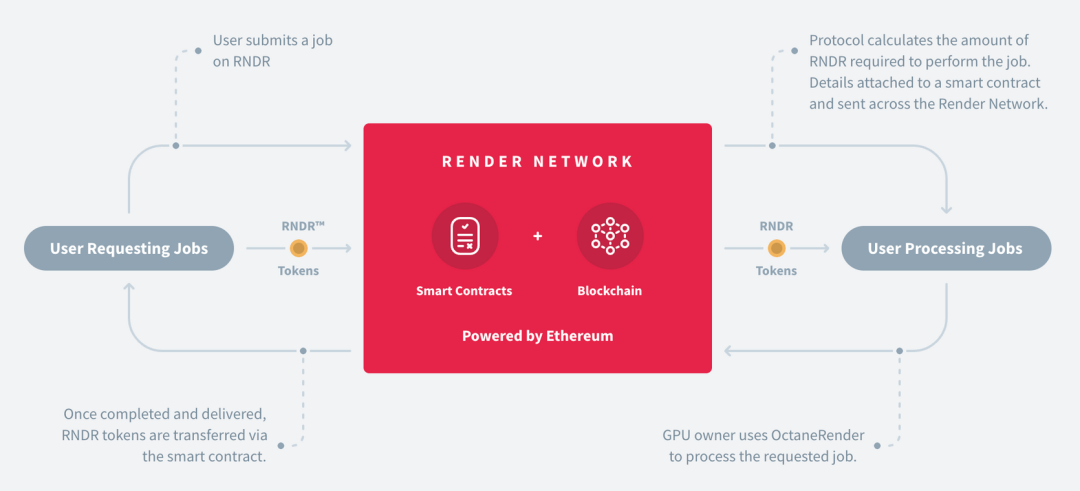
Below is a step-by-step breakdown of the detailed workflow of Render Network:
(1) Task Creation and Submission
Content creators—such as animators, game developers, or filmmakers—first define their rendering requirements on the Render Network platform. They submit tasks including 3D models, scene files, and specific rendering instructions such as resolution, format, and expected delivery time. This information is packaged into a task request and published onto the blockchain via smart contracts.
(2) Task Pricing
Once a task is submitted to the network, Render’s dynamic pricing system determines the price based on the complexity of the task, required computational resources, and urgency. This price reflects current market supply and demand conditions and the availability of GPU resources.
(3) Task Allocation
Task allocation is performed through Render’s advanced matching algorithm, which evaluates all available GPU resources. This process involves analyzing each GPU provider’s hardware performance, availability, and historical task completion records. The system automatically selects the most suitable GPU resources to execute the task, ensuring maximum efficiency and output quality.
(4) Rendering Execution
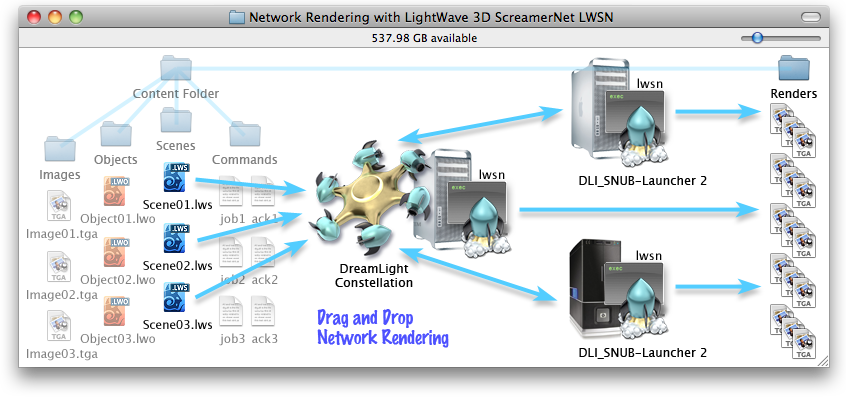
Once assigned to one or more GPU providers, the rendering process begins. The provider’s computer starts processing data and performing the necessary rendering operations, which may include ray tracing, texture mapping, shadow generation, and other complex computations.
(5) Progress Monitoring
During execution, Render Network provides real-time monitoring and progress updates, allowing content creators to track the status of their tasks. This process is enabled by the blockchain, ensuring all activities are transparent and verifiable.
(6) Result Verification
After rendering is complete, the generated images or videos undergo verification. Render Network employs a decentralized validation mechanism, such as "Proof of Render," to ensure outputs meet the original task specifications. This includes checking image quality, completeness, and potential errors.
(7) File Delivery and Payment Settlement
Once the rendered output is verified, the files are securely delivered to the content creator. Simultaneously, the smart contract-based payment system automatically processes the transaction, ensuring GPU providers receive their compensation in RNDR tokens. These transactions are recorded on the blockchain, guaranteeing immutability and traceability.
(8) Feedback and Rating
Upon task completion, content creators can rate the service provided by GPU providers. This feedback mechanism helps maintain and improve overall service quality and trust within the network.
This workflow not only improves accessibility and affordability for 3D rendering projects but also optimizes resource usage, enabling even creators with limited resources to afford high-quality rendering services. The decentralized approach also brings greater transparency and security, benefiting all participants.
3. RNDR Token
The Render Token (RNDR) is an ERC-20-based token primarily used for transactions between artists and GPU suppliers within the platform. Users spend RNDR tokens to access GPU computing power, while node operators earn tokens by providing resources. Render and its CEO, Anurag Goel, describe RNDR as “the first network to transform GPU computing power into a decentralized economy for interconnected 3D assets.”
3.1 Key Functions and Uses
-
Payment and Reward Mechanism: RNDR tokens are used to pay for rendering services. Content creators use RNDR to compensate nodes that provide the necessary GPU power for job processing. This ensures fair compensation for service providers and promotes efficient resource allocation.
-
Incentivizing GPU Providers: Through RNDR tokens, Render Network incentivizes individuals or organizations with underutilized GPU resources to join the network. Providers contribute their GPU resources to users executing high-performance rendering jobs and receive tokens in return.
-
Network Governance: In certain implementations, RNDR tokens may also be used for governance decisions within Render Network, such as protocol upgrades or adjustments to network parameters. Holders can influence the network’s development direction and policy changes through token-based voting rights.
-
Enhancing Market Liquidity: RNDR tokens are listed on multiple cryptocurrency exchanges, increasing market liquidity and enabling users to easily buy, sell, and exchange tokens. This liquidity is a key factor supporting the healthy operation and expansion of the network.
-
Driving Community and Ecosystem Growth: RNDR tokens are also used to reward community members for contributions such as participating in testing, providing feedback, or developing related applications, thereby promoting the growth and prosperity of the Render Network ecosystem.
3.2 Core Features
-
ERC-20 Compatibility: RNDR is a utility token compliant with the ERC-20 standard, primarily used to pay for rendering animations, motion graphics, and visual effects on the distributed Render Network.
-
Reward System: Users can earn RNDR tokens by registering workstations on the network and completing rendering tasks. These tokens can later be used to fund other rendering projects.
-
Advanced Infrastructure Options: Users can also choose to render projects using Tier 1 nodes within the Render Network, such as Microsoft Azure's high-security infrastructure.
3.3 Burn-and-Mint Equilibrium (BME)
The Burn-and-Mint Equilibrium (BME) is the tokenomics model of the RNDR token. According to the project, this mechanism is designed to create greater value for the token by offering better pricing and remittance arrangements for creators and node operators. Under this model, the network calculates job costs in USD. Creators must burn an equivalent USD value in RNDR tokens to initiate a job on the network. Creators without RNDR tokens will need to purchase them, creating sustained demand for the token.
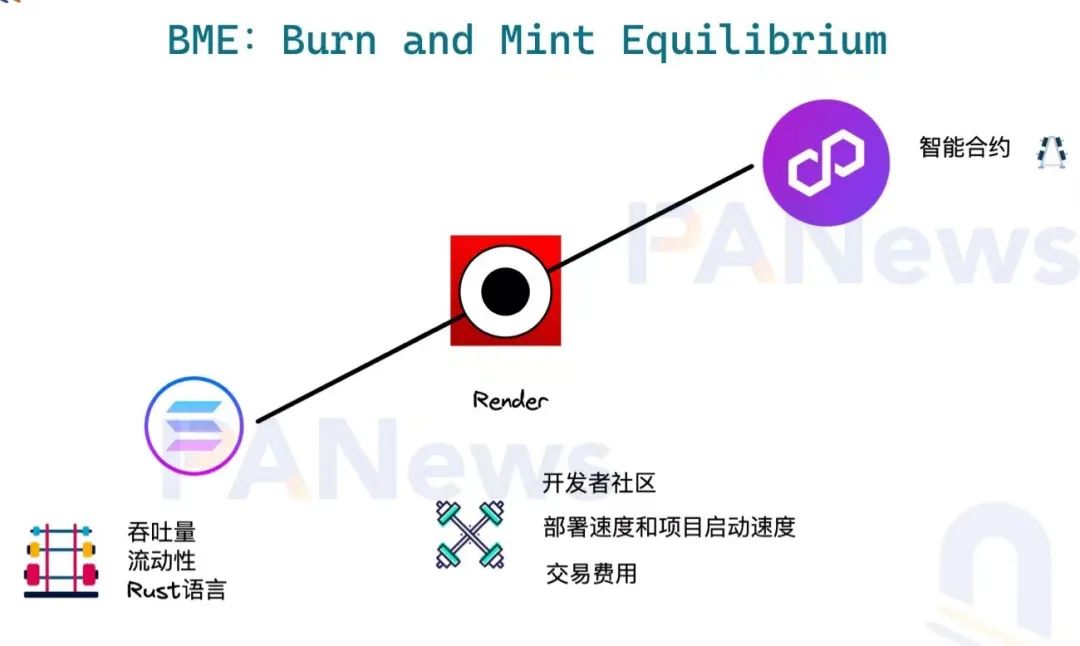
After a job is created, node operators processing the job receive RNDR token rewards. The network mints RNDR tokens each period. For every period, it calculates the percentage of jobs processed by each node operator. Ninety percent of the RNDR tokens minted per period are allocated as node operator rewards, while the remainder is distributed as availability rewards. Node operators are rewarded based on workflow and successful uptime challenges (also known as availability). A portion of the availability rewards is also used to incentivize creators to launch jobs on the Render Network. This mechanism adjusts emissions according to network demand.
3.4 Issuance and Management
-
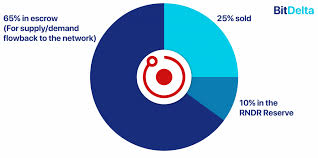
Token Supply: The total supply of RNDR is 536,870,912 tokens, of which 381,861,234 RNDR were allocated through public sales. In the initial public sale, 25% of tokens were sold, 10% were reserved in the RNDR reserve, and the remaining 65% were placed in a third-party custodial circulating adjustment account.
-
Circulating and Maximum Supply: There are currently 150,000,000 RNDR tokens in circulation, with a maximum supply capped at 536,000,000.
-
Token Sale and Price: The public sale of RNDR began in October 2017, with an initial sale price of 1 RNDR = 0.25 USD.
-
Token Migration: To enhance smart contract functionality, RNDR tokens were migrated from the old contract to a new one, introducing additional escrow smart contract features.
-
Excess Token Burn: During the migration process, 161,061,273.6 excess RNDR tokens from the original contract were burned to adjust the total supply.
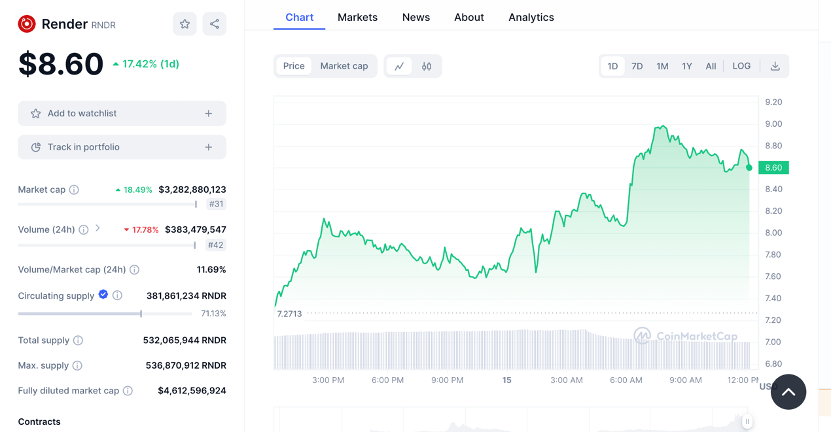
As of now, the market price of the RNDR token is $8.60, having increased by 17.42% over the past 24 hours. Its market capitalization stands at $3,282,880,123, ranking it 31st among all cryptocurrencies.
4. Project Advantages
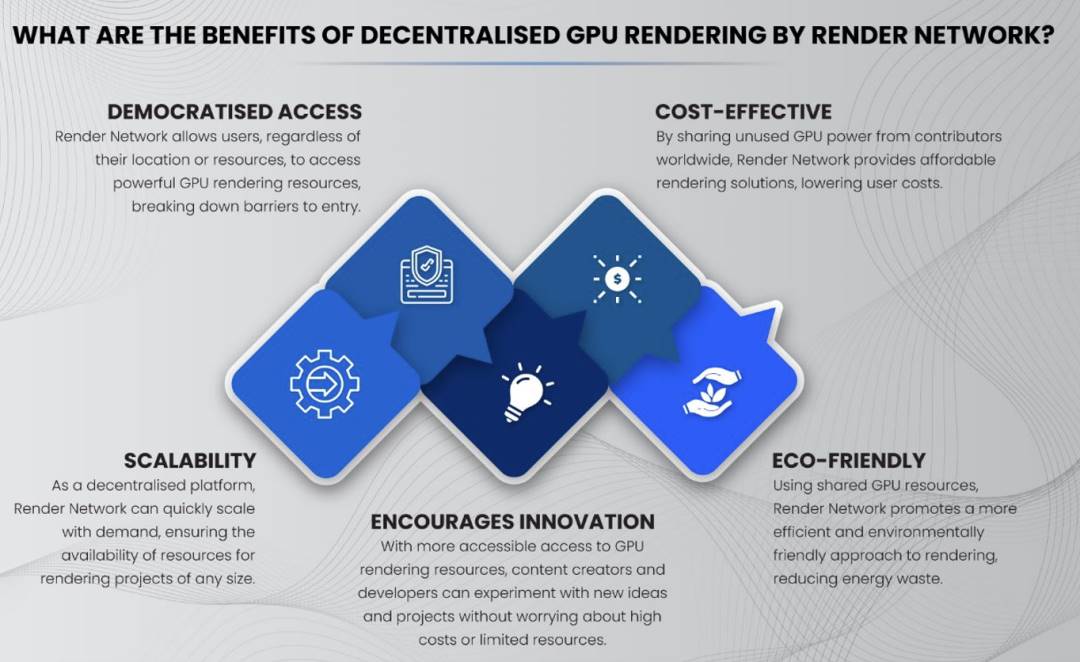
Render Network offers several benefits to the GPU processing domain:
-
Scalability: Creators using Render Network gain on-demand access to GPU power, renting as much capacity as needed to complete tasks. With reports indicating that Render Network possesses more GPUs than Amazon and Google combined, it is reasonable to say that creators on Render Network have access to a virtually infinitely scalable GPU power system.
-
Privacy and Security: Given that Render Network handles work ranging from individual creators to globally renowned studios, it has implemented measures to protect the privacy of creators and assets on the network. These include encrypting all assets, limiting individual asset storage to short durations, and watermarking individual frames to ensure payment before scene downloads.
-
Transparency and Fair Pricing: Render Network claims to offer a fully transparent system for creators and node operators. As mentioned earlier, by using blockchain to handle payments, all interactions between creators and node operators can be publicly verified on the blockchain’s ledger. Both creators and node operators must build reputation scores to access large concurrent GPU nodes (creators) or receive more jobs (node operators), based on successfully completed jobs. This is combined with a tiered pricing system, allowing users to pay according to their needs and budgets.
-
Cross-Industry Applications: Beyond rendering graphics and other assets, Render Network extends into AI computing, where GPU power can be rented for training generative AI models.
-
Driven by Growing Interest and Demand for AI: With rising interest in AI in 2023, the value of the RNDR token surged over 1000%, driven by demand for GPU-powered AI model training exceeding the supply offered by major cloud providers like Amazon Web Services, Microsoft, Google, and Oracle.
5. Real-World Use Cases
GPU processing power on Render Network can be rented for various applications—from film and game development to artificial intelligence. Use cases supported by Render Network go beyond those outlined below, including physical and mathematical simulations or projection mapping.
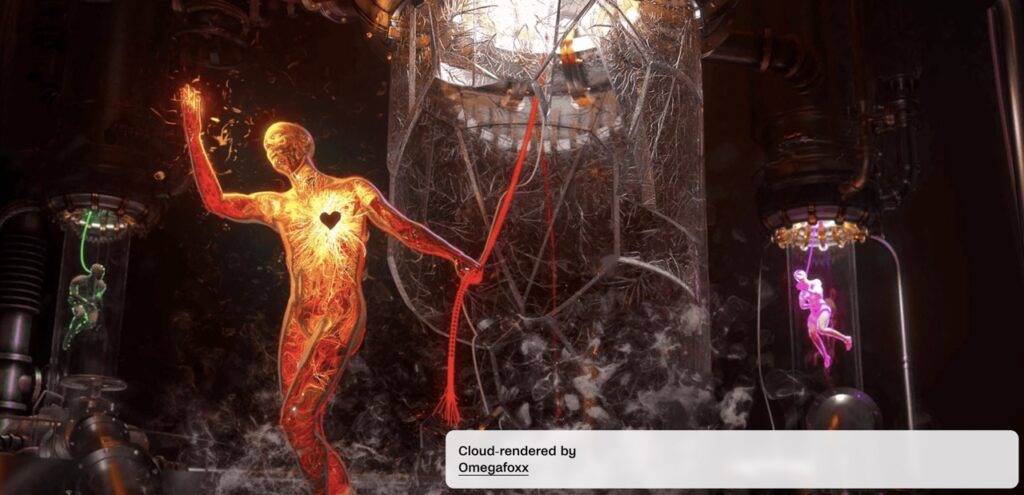
Film, Games, and Other Media: High-quality graphics are essential in film and game development, and creators in this space benefit from scalable GPU capacity to bring their visions to life. Artist and 3D motion designer Raoul Marks used Render Network to create title sequences for shows such as Season 4 of *Westworld*.
Artificial Intelligence (AI): On July 11, 2023, Render Network announced plans to support AI and machine learning tasks (jobs); this integration will allow node operators on the network to take on rendering work for AI-generated graphics and prototypes. Given the high computational demands of generating images, Render Network’s plug-and-play GPU access allows these applications to render high-quality images at lower costs.
Architecture and Product Design: Architects and product designers can also leverage the rendering network to develop high-quality 3D visualizations for their designs. Product designers can prototype at scale, testing textures and colors through parallel GPU rendering, while architects can create immersive virtual reality architectural renders.
6. Team / Partners / Funding
Render was founded in 2017 by Jules Urbach. Prior to this, Urbach also founded OTOY, a cloud graphics company whose products have been used by filmmakers to produce movies, by developers to create video games, and by pioneers in virtual reality and metaverse technologies. OTOY has received backing from major film studios such as Disney and HBO.
Since its inception, Render has been operated by OTOY, designed as a blockchain-based solution reflecting its centralized, cloud-based products. However, in January 2023, the newly established Render Network Foundation announced it would take over strategic management of the project and coordinate its community. OTOY, along with other supporters such as Swatchbook and MR Studios, will continue to participate in engineering, development, and other services.
Another key team member is Ari Emanuel. Currently, Emanuel serves as co-founder and co-CEO of the project.
Render has established strategic partnerships with several industry giants. Most notably, its collaboration with Nvidia is significant given Nvidia’s dominant position in the GPU and gaming markets. This partnership may involve technical collaboration, integration of Nvidia technologies, or joint marketing initiatives.
To date, Render has raised substantial funding, including a $50 million Series B round led by Bessemer Venture Partners. This funding aims to expand its product suite for large software teams and accelerate migration from legacy platforms. Such a significant investment reflects strong investor confidence in Render’s business model and future growth prospects.
7. Future Outlook Analysis
The future development of Render Network can be analyzed based on market demand for its services, technological advancements, and industry trends. Below are potential challenges and opportunities facing Render Network:
7.1 Opportunities
-
Growing Demand: As industries such as virtual reality, augmented reality, 3D printing, gaming, and filmmaking require higher-performance rendering, Render Network has the opportunity to expand its market share.
-
Decentralization Trend: More industries are seeking decentralized solutions to improve efficiency and reduce costs. Render Network is at the forefront of this trend.
-
Artistic Creation and NFTs: The popularity of digital art and NFTs increases demand for high-quality rendering, positioning Render Network as a preferred platform for artists and creators.
-
AI Development: The growth of AI and machine learning requires massive computational power, and Render Network can serve as a critical enabler for these sectors.
-
Technological Innovation: As GPU technology advances, Render Network can continuously integrate the latest rendering technologies to enhance service quality and efficiency.
7.2 Challenges
-
Intense Competition: The market already includes other cloud computing and rendering services. Render Network must deliver unique value propositions to attract and retain users.
-
Technical Complexity: Maintaining a stable and secure decentralized network requires deep technical expertise and continuous development efforts.
-
Regulatory Risks: The blockchain and cryptocurrency space faces legal and regulatory uncertainties that could impact Render Network’s operations and scalability.
-
Market Volatility: Fluctuations in cryptocurrency prices could affect participant incentives and, consequently, the health of the entire network.
-
User Education: Educating users about Render Network’s concepts and uses requires time and resources, especially among non-technical audiences.
-
Dependency Risks: If Render Network becomes overly dependent on specific hardware or software platforms, it may face single points of failure or risks of technological obsolescence.
Overall, Render Network operates in a rapidly evolving market with vast growth potential. However, to seize these opportunities, it must overcome challenges related to technology, market adoption, and regulatory compliance. As the market matures and technology evolves, Render Network may need to continuously adapt its strategies and services to meet changing demands.
Join TechFlow official community to stay tuned
Telegram:https://t.me/TechFlowDaily
X (Twitter):https://x.com/TechFlowPost
X (Twitter) EN:https://x.com/BlockFlow_News
![In-depth Analysis of Trade[XYZ]: How Were 92 Markets and 98% HIP-3 Trading Volume Established?](https://upload.techflowpost.com/upload/images/20260716/20260716061117965147.jpeg?x-oss-process=image/resize,p_50/quality,q_80)