Analyzing SANCTUM: Staking and Restaking on Solana (Part 1)
TechFlow Selected TechFlow Selected
Analyzing SANCTUM: Staking and Restaking on Solana (Part 1)
By introducing innovative restaking options and fostering a competitive landscape, Sanctum can offer Solana stakers greater flexibility, enhanced liquidity, and additional profit opportunities.
 Navigating Web3 tides with focused insights
Author: Greythorn
Market Opportunity
Liquid staking has revolutionized asset management in PoS networks by transforming traditionally illiquid staked assets into liquid ones. Staking typically involves locking up cryptocurrency holdings to support blockchain security and operations, rendering these assets inaccessible during the staking period. Liquid staking, however, issues liquid staking tokens (LSTs) in exchange for staked assets. These LSTs represent both the staked amount and accumulated rewards, allowing users to trade them, use them in DeFi applications, or leverage them as collateral without waiting for the staking period to end.
EigenLayer, a decentralized restaking protocol on Ethereum, takes this concept further. It enables users to restake by depositing LSTs into EigenLayer’s smart contracts, thereby receiving liquid restaking tokens (LRTs). These LRTs encapsulate the value of staked tokens, staking rewards, and additional rewards from EigenLayer operations, offering users greater flexibility and higher profit potential.
The total value locked (TVL) in liquid staking has surged from $30 million to over $57 billion in less than four years. Lido, one of the leading players in the liquid staking space, holds approximately $35 billion in staked assets.
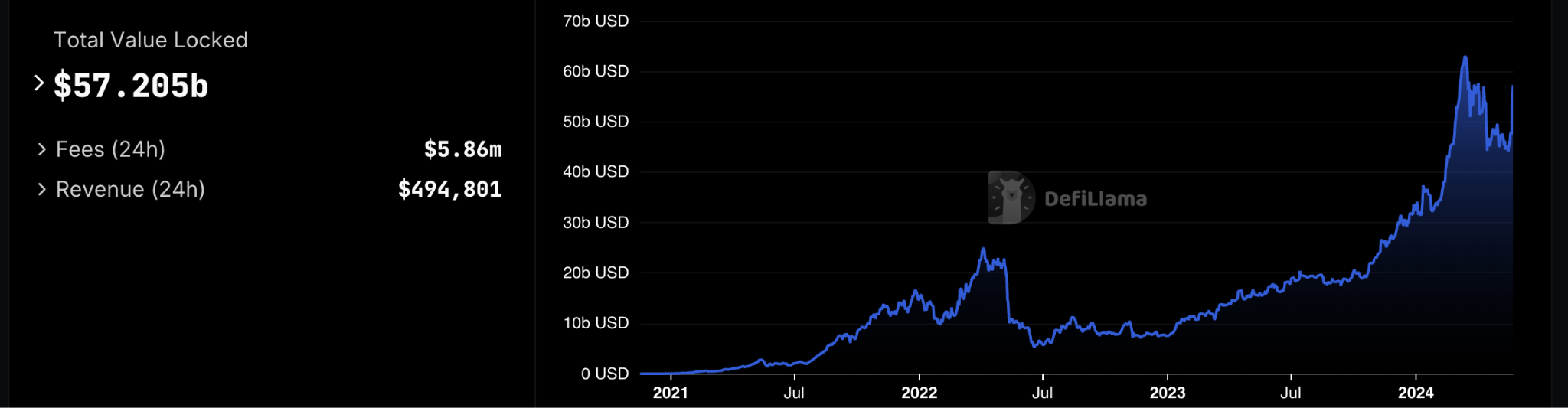
Source: DeFiLlama
Despite this growth, staking ratios vary significantly across networks. For example, Solana's staking ratio exceeds 70%, notably higher than Ethereum's 27%. However, according to Dune Analytics, LSTs account for only 6% of Solana’s staked supply, compared to over 40% on Ethereum.

Source: Dune Analytics
This presents a significant market opportunity for Sanctum within the Solana ecosystem. By introducing innovative restaking options and fostering a competitive landscape, Sanctum can offer Solana stakers increased flexibility, enhanced liquidity, and additional profit opportunities. This not only aligns with the growing DeFi movement but also addresses the demand for more efficient and diversified staking solutions, ensuring Solana does not become dominated by a single staking protocol like Lido on Ethereum.
Protocol
Sanctum’s Infinite Pool
Sanctum Infinity is an innovative liquidity pool designed to make trading and staking liquid staking tokens (LSTs) on Solana easier and more efficient. Think of it as a large, flexible pool that seamlessly swaps various LSTs.
When you buy an LST with SOL, you may notice receiving slightly less than one full LST. This is because LSTs earn staking rewards over time, increasing their value. For instance, JitoSOL trades at a premium to SOL because it has been accumulating rewards since launch, reflecting roughly an 11% return.
Sanctum Infinity uses Solana’s staking pool data to accurately price LSTs. Traditional AMMs can be inefficient when liquidity is low or during large trades, but Infinity’s approach ensures accurate pricing regardless of liquidity levels by relying on reliable on-chain data.
When you deposit LSTs into the Infinity pool, you receive INF tokens in return. These tokens are special because they earn staking rewards from all LSTs in the pool and collect trading fees, providing an additional revenue stream.
Infinity also maintains balance through dynamic fee adjustments. This means it incentivizes trades that help maintain a healthy mix of different LSTs in the pool, ensuring both new and established tokens grow and deliver strong returns.
The Infinity pool allocation strategy encourages the creation of new LSTs by reserving 20% of the pool for newly approved LSTs. Each new LST requires at least 1,000 SOL, with allocations adjusted based on its held value and recent performance. The remaining 80% is dedicated to a mix of existing LSTs and trading returns, aiming for diversified yields and high trading volume, with distribution based on each LST’s holding value. Future adjustments will consider yield performance and support for smaller LSTs.
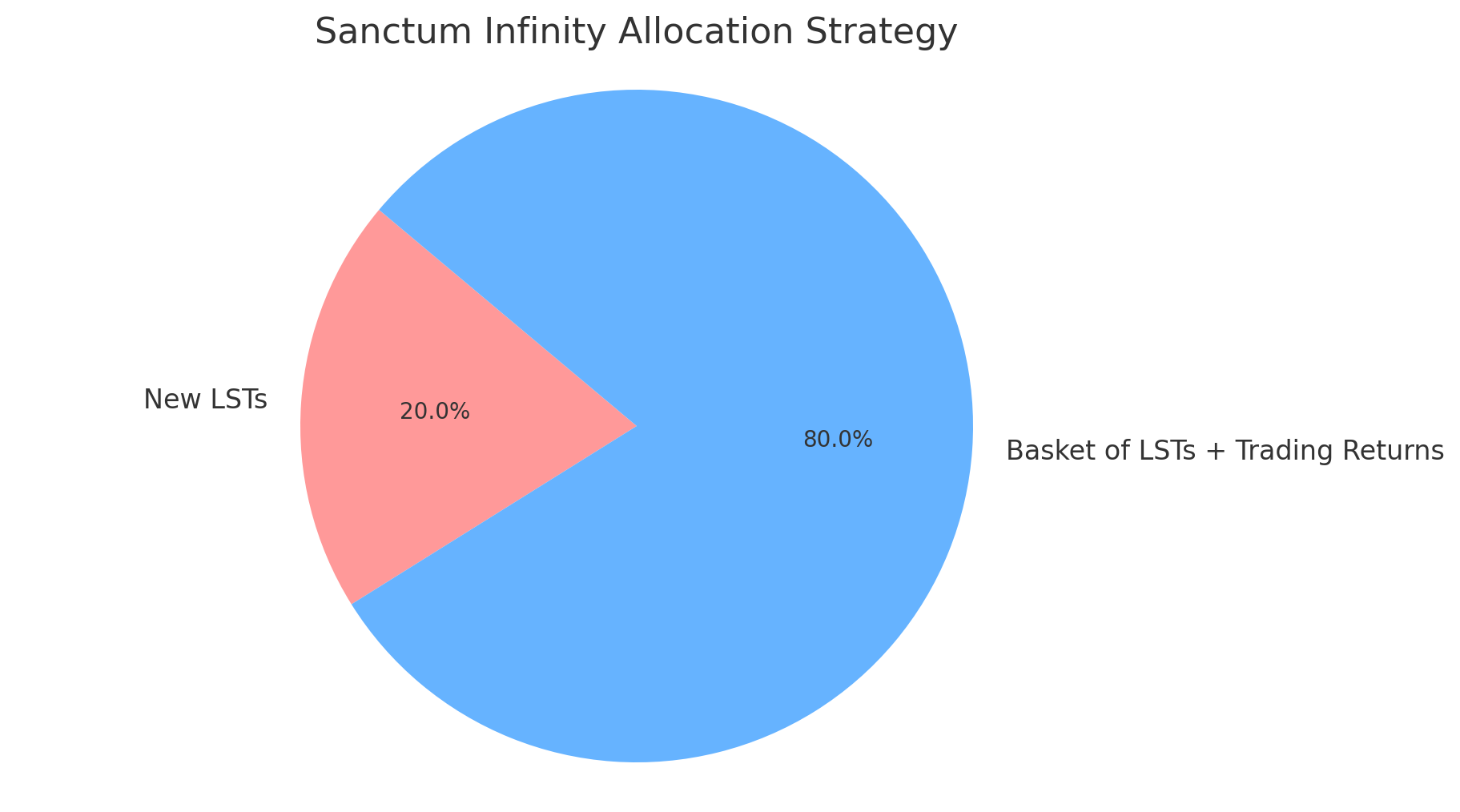
Source: Greythorn Internal
Validator LSTs
Validator LSTs are tokens representing your stake with a specific validator. These tokens appreciate as staking rewards accumulate, offering a flexible and efficient staking method.
When you stake SOL traditionally, a stake account is created and delegated to a validator. To unstake, you must deactivate this account, which takes time. In the liquid version, when you deposit SOL into a validator LST pool, a stake account is created and delegated on your behalf. In return, you receive a validator LST representing your stake.
Benefits of Validator LSTs
● Native staking APYs are generally similar across validators, making differentiation difficult.
● Validator LSTs enable validators to distinguish themselves by issuing their own tokens and offering unique incentives.
● LSTs allow stakers to participate more broadly in DeFi, unlocking additional reward opportunities.
● LSTs reduce the need for liquidity pools, enabling new and smaller validators to compete with larger ones, resulting in a more decentralized and competitive validator set.
● LSTs simplify the staking process, enabling instant swaps and eliminating the long waiting periods associated with undelegation in traditional methods.
The Reserve
Sanctum Reserve provides deep liquidity for all LSTs on Solana, offering distinct advantages and addressing key challenges in the staking ecosystem.
Users typically have two ways to redeem LSTs:
1. Deactivate and wait: Deactivate the stake account and wait 2–4 days to receive SOL.
2. Instant swap: Trade LSTs on a DEX for immediate liquidity.
Sanctum Reserve simplifies LST redemption by allowing users to swap LSTs for immediate SOL. The Reserve then deactivates the stake account and retrieves SOL after the cooldown period. It operates by accepting staked SOL and returning SOL, then undelegating staked SOL at the end of each epoch to replenish its reserves.
The Reserve also supports various DeFi protocols by enabling them to accept any LST as collateral. This broad compatibility enhances LST utility and adoption.
More importantly, the Reserve helps smaller validators compete more easily with larger ones by providing a shared liquidity source, promoting a more decentralized network. This democratizes staking, giving users more choices and potentially higher returns.
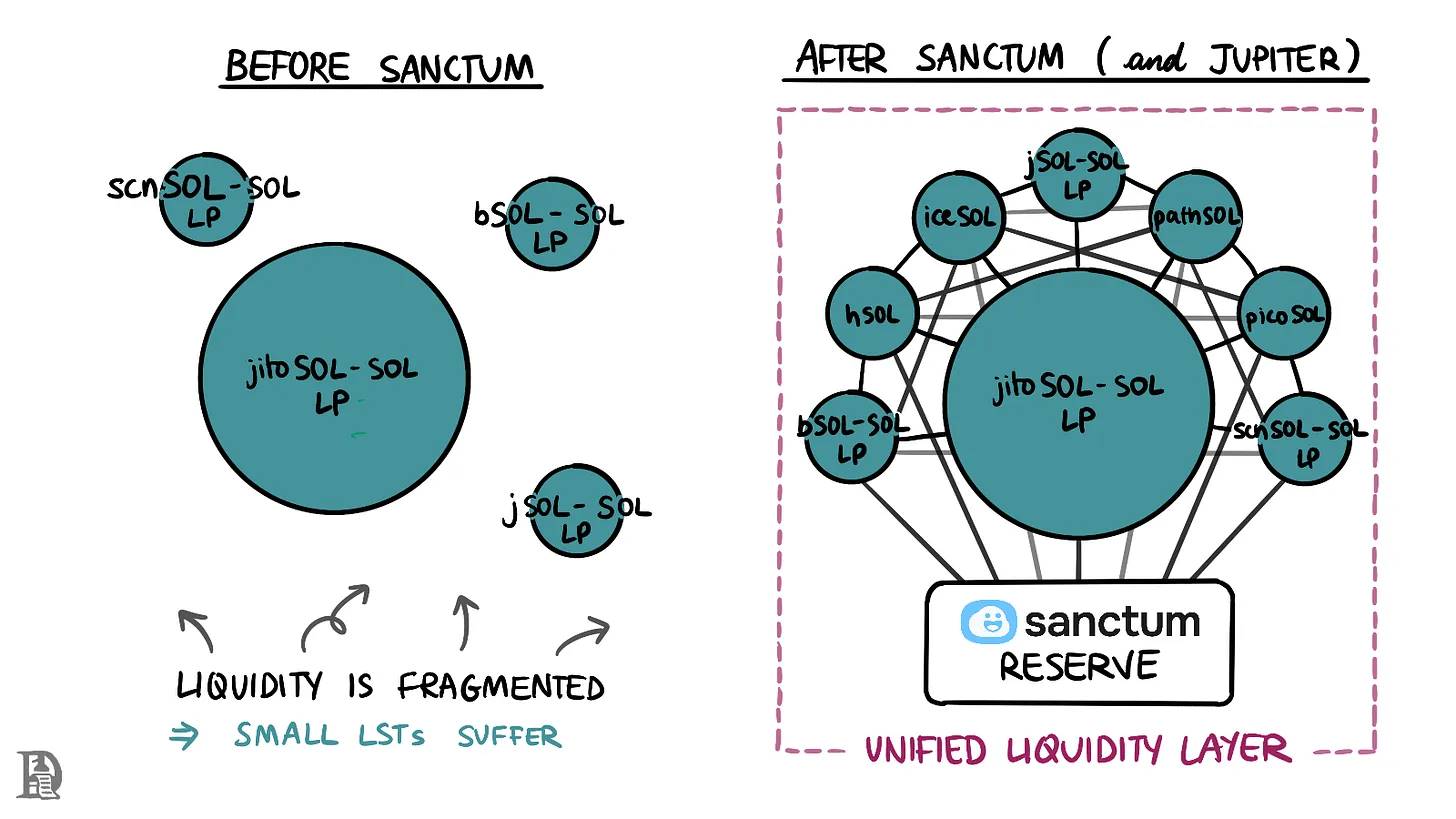
Source: Desentralised.co
The Router
Sanctum’s Router is a tool that makes swapping different LSTs on the Solana blockchain easy. Here’s a simplified explanation:
A stake account is a locked SOL account delegated to a validator. When you stake SOL or deposit it into an LST, a stake account is created and managed by the pool. Previously, LST liquidity was limited to their specific pools. Shallow pools made it difficult to quickly convert LSTs to SOL, reducing their effectiveness and appeal in DeFi.
Sanctum’s Router solves this by moving stake accounts between pools, enabling seamless swaps between any LSTs. This process unifies liquidity across all LSTs. Sanctum charges a fixed 0.01% fee on every LST-to-SOL swap conducted through the Router.
In essence, Sanctum’s Router unlocks the full potential of liquid staking on Solana by enabling easy and efficient LST exchanges, enhancing liquidity and usability within the DeFi ecosystem. Lido has become the dominant force in Ethereum’s staking ecosystem. Currently, 27% of ETH is staked, with nearly 30% deposited into Lido—representing approximately $35.5 billion in total value locked (TVL), far exceeding RocketPool, the second-largest staking protocol, which holds $4.6 billion. Lido’s TVL accounts for over half of all staked ETH and nearly one-third of total DeFi TVL across all chains.
Sanctum vs Lido
Lido’s liquid staking token, stETH, has become a cornerstone of the Ethereum ecosystem. Its liquidity and widespread acceptance have earned it the nickname “the dollar of staked assets.” The high liquidity of stETH has attracted many users, reinforcing its dominance. However, this concentration of power has also raised concerns. The Lido DAO controls about 30% of staked Ethereum, potentially exerting significant influence over the network and undermining decentralization.
In contrast, Sanctum takes a different approach on Solana. Their journey led to a key insight: LSTs are inherently interchangeable—they are simply wrappers around stake accounts. This realization shifted their strategy toward nurturing a multi-LST environment rather than competing directly with other staking pools.
Sanctum’s philosophy emphasizes collaboration over competition. Their goal is to build infrastructure that supports a variety of LSTs. By focusing on expanding the overall staking market instead of dominating it, Sanctum aims to achieve broader success.
Lido’s success on Ethereum stems from its dominant position and the widespread adoption of the stETH token. While highly effective, this model carries risks related to centralization. Conversely, Sanctum aims to build a more decentralized and cooperative ecosystem on Solana. By supporting multiple LSTs and encouraging collaboration, Sanctum hopes to create a healthier, more inclusive staking environment that could surpass Ethereum’s staking landscape in terms of innovation and participation.
Sanctum vs Jito
Jito, a Solana-native protocol, gained significant attention in 2023 through an airdrop. Since then, it has leveraged its governance token, JTO, to incentivize liquidity and integrate with other major Solana protocols, securing dominance in Solana’s LST market.
Key Features
● JitoSOL is the leading LST on Solana, boasting the highest APY, TVL, and trading volume in Kamino liquidity vaults.
● Partnerships with top-tier protocols such as Solend, Drift, Jupiter, and marginfi strengthen its ecosystem presence. Through Wormhole, Jito is extending its reach to Arbitrum, increasing JitoSOL’s utility.
● Jito excels in maximizing MEV (Maximal Extractable Value) through its innovative Solana client and blockchain engine. This technical edge allows it to deliver higher staking rewards and optimize transaction ordering.
While Jito’s growth mirrors Lido’s rise on Ethereum, it raises similar concerns about whether such dominance could pose risks to the health of Solana’s ecosystem.
Sanctum focuses on providing robust infrastructure support to ensure stability and security within the Solana ecosystem. Key features of Sanctum include:
● The Infinity multi-LST liquidity pool aggregates liquidity across various trading pairs, improving liquidity depth and reducing slippage.
● The Reserve and Router facilitate instant unstaking services and efficient LST swaps, supporting liquidity and system stability.
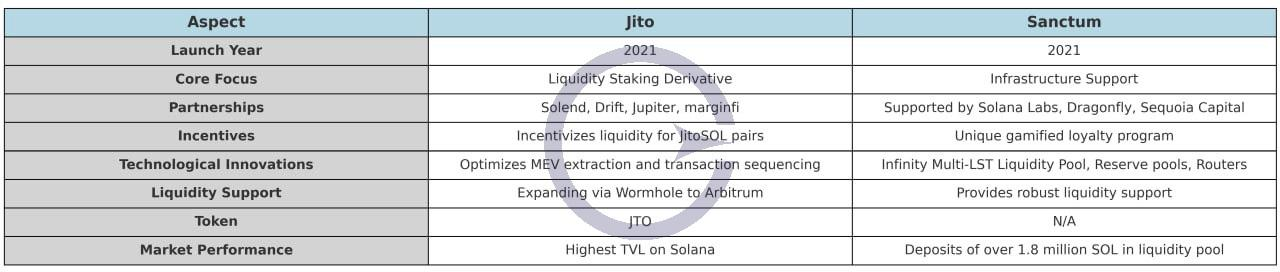
Source: Greythorn Internal
Bullish Fundamentals of Sanctum
1. Sanctum’s unique Reserve and Router mechanism offers capital-efficient LST redemption and exchange, enhancing liquidity and user appeal.
2. Sanctum’s Reserve holds over 200,000 SOL (approximately $30 million) in liquidity, ensuring instant redemptions for LST holders and minimizing slippage, making it an attractive option for users.
3. By lowering the barrier to LST creation, Sanctum empowers smaller validators to issue their own tokens, promoting decentralization and increasing validator competition on Solana.
4. Sanctum’s TVL has grown to over $700 million, ranking it as the fourth-largest protocol on Solana, indicating strong market adoption and trust.
Bearish Fundamentals of Sanctum
1. Despite its innovations, Sanctum faces intense competition from established players like Jito, which already holds a dominant position in Solana’s LST market.
2. Sanctum’s success is closely tied to the growth and stability of the Solana ecosystem, which has experienced volatility and infrastructure challenges in the past.
3. Although Solana currently does not implement slashing, future introduction could pose risks to validators and stakers, affecting the attractiveness of staking and LSTs. Sanctum’s innovative Reserve and Router mechanisms, while novel, may face challenges in user understanding and adoption compared to simpler staking solutions.
4. Like all crypto protocols, Sanctum is subject to regulatory scrutiny and potential legislative changes that could impact its operations and the broader liquid staking landscape.
Deep Dive into the Sanctum Ecosystem: Part 2
In the upcoming second part of our Sanctum research report, we will dive deeper into all liquid staking tokens within the Sanctum ecosystem. Our goal is to provide concise comparisons and analyze the risks and potential staking benefits of each LST. Additionally, we will share insights and perspectives on the future of this innovative project.
We recommend connecting and following our social media channels to stay updated with the latest updates and insights. Your engagement will ensure you don’t miss any critical developments, including our in-depth exploration of how innovative features like the Sanctum Router function within the broader blockchain environment.
Join TechFlow official community to stay tuned
Telegram:https://t.me/TechFlowDaily
X (Twitter):https://x.com/TechFlowPost
X (Twitter) EN:https://x.com/BlockFlow_News
 Greythorn