








Deep into Mind Network: When Fully Homomorphic Encryption Meets Restaking, Consensus Security for Encrypted AI Projects Is Within Reach
TechFlow Selected TechFlow Selected
Deep into Mind Network: When Fully Homomorphic Encryption Meets Restaking, Consensus Security for Encrypted AI Projects Is Within Reach
Explore Mind Network, a promising project that brings together trending narratives such as AI, restaking, and fully homomorphic encryption.
 Navigating Web3 tides with focused insights
Author: TechFlow
AI and Restaking are widely recognized as the leading narratives accompanying this bull market cycle.
The former has already produced various AI star projects, while the latter, centered around EigenLayer, has spawned multiple LRT projects with an ongoing emergence of points-earning strategies.
However, there's a clear sense that these two major narratives seem to have entered a halftime break—while the number of projects in these sectors is increasing, they're becoming increasingly homogeneous, making it harder than ever to find groundbreaking innovation from zero to one.
Meanwhile, when AI and Restaking become a form of "narrative correctness," such "correctness" does not necessarily mean "perfection":
Are most AI/DePIN projects truly decentralized? Recent data also shows that EigenLayer’s TVL is declining. Is Restaking only useful for securing AVS within the Ethereum ecosystem?
Therefore, in the second half of these hot narratives, projects solving critical common problems are the real treasures waiting to be unearthed.
From this perspective, Mind Network has caught our attention—it can address the insufficient decentralization of many current AI/DePIN projects and expand the utility and value of Restaking.
If EigenLayer serves as a restaking solution for the Ethereum ecosystem, Mind is essentially a restaking framework for the AI domain:
By flexibly leveraging restaking combined with fully homomorphic encryption (FHE) for consensus security, it ensures tokenomic and data security within decentralized AI networks.
More importantly, the project secured a $2.5 million seed round in 2023 led by Binance and other well-known institutions. It now has deep collaborations with rising AI/DePIN stars like io.net and Myshell. With mainnet launch and incentive campaigns on the horizon, expectations are high.
Yet, for most readers encountering this project for the first time, how can complex concepts like FHE and yield-driven Restaking come together to solve core issues in AI projects?
In this piece, we dive into Mind Network, exploring a promising project that integrates key narratives like AI, Restaking, and fully homomorphic encryption.
AI Projects Rush to Slay Dragons, But Become Dragons Themselves Due to Lack of “Trustlessness”
To understand what Mind Network actually does, we must first grasp the challenges faced by current AI projects.
Perhaps the phrase “slayers becoming dragons” best describes today’s crypto-based AI projects.
From the slayer’s perspective, the core narrative of crypto AI (or DePIN) lies in decentralization—using more decentralized compute power, algorithms (models), and data to challenge big tech monopolies over AI components and eliminate reliance on centralized authority.
While this narrative is valid and naturally popular, post-decentralization AI introduces new risks—ironically creating easier paths to becoming the very “dragon” it sought to destroy:
It fails to achieve “trustlessness” among validators in a decentralized environment.
Confusing? Let’s look at some concrete examples.
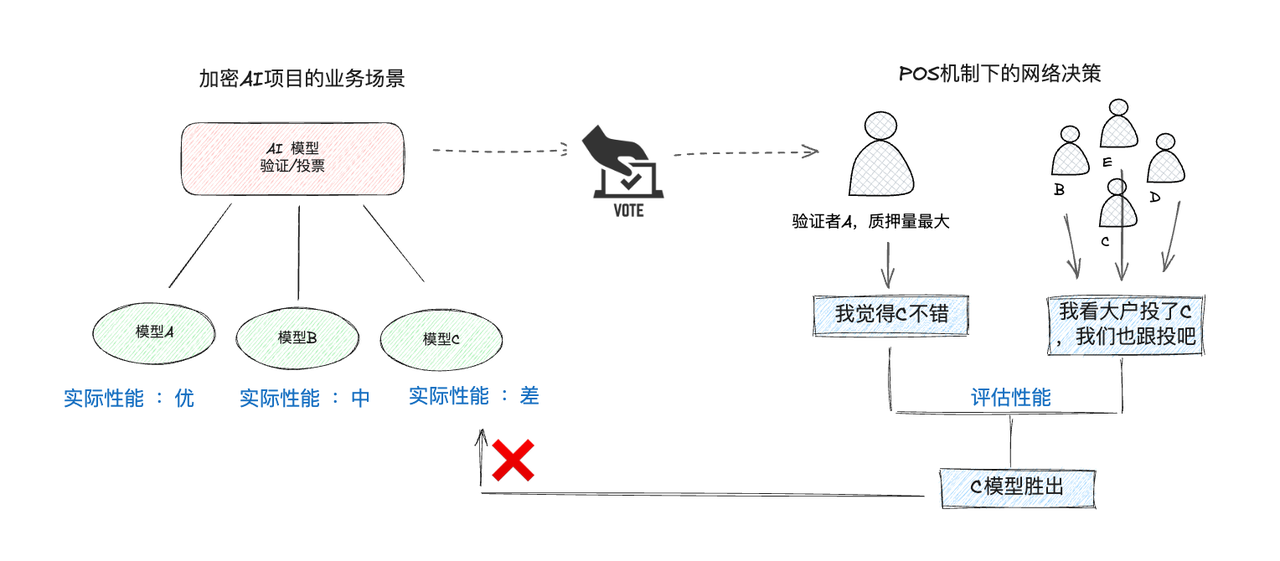
In typical crypto AI projects, users need to perform decentralized validation/voting on AI models to determine which model performs better.
But in practice, the business model often relies on validators (nodes) within the network to select the best-performing AI model. How do you ensure their selection is genuinely optimal?
In PoS systems, “following the majority” doesn’t equate to “choosing fairly” or “choosing correctly.”
Similarly, in AI agent services where top-performing providers are ranked, how can you be sure those at the top truly deliver the best results?
In DePIN scenarios, when a task is assigned to nodes for computation, how do you guarantee the validator fairly assigns it to the most suitable node instead of favoring familiar ones?
These examples reveal a critical common issue — in various decentralized AI networks, the decisions made by validators become centers you must trust.
Thus, you end up having to trust the decisions of validators or key participants, hoping they won’t act maliciously or make poor choices.
Projects shouting “decentralization” remain constrained by internal trust dependencies. True trustlessness remains unachieved—the current AI narrative is far from perfect.
So what’s needed to fix this?
Clearly, we need technical mechanisms and economic designs that minimize trust dependency on key participants during validation, voting, and decision-making across AI networks.
And this is precisely where Mind Network excels.
The Holy Grail of Fully Homomorphic Encryption Finds Its Perfect Home in Mind Network
Mind Network's greatest strength lies in fully homomorphic encryption (FHE), often hailed as the holy grail of cryptography.
But how does FHE relate to the problems exposed in AI and DePIN projects above?
At their core, these issues all converge on resource allocation, selection, and decision-making — not technical flaws, but governance issues rooted in human behavior (“rule by man”).
The precondition for manipulation in any human-driven system is that participants can fully observe known information (e.g., I know a whale invested, so I follow suit).
You’ve probably already sensed where FHE fits in:
What if information were no longer publicly visible to everyone?
Fully homomorphic encryption (hereafter FHE) is perfectly suited to solve these governance-related problems.
As a long-pursued holy grail in cryptography, even Vitalik Buterin recently highlighted its potential in Web3. We won't delve deeply into FHE mechanics here—just understand its function: enabling complex computations on encrypted data without decryption, ensuring data stays secure and private throughout processing.
But to hold the grail, one must bear its weight.
While FHE-based computation is powerful, it demands significant resources. Using it directly for AI model training would be prohibitively expensive—an impractical direction for crypto AI projects.
Mind Network’s use of FHE is remarkably strategic—placing the grail exactly where it belongs.
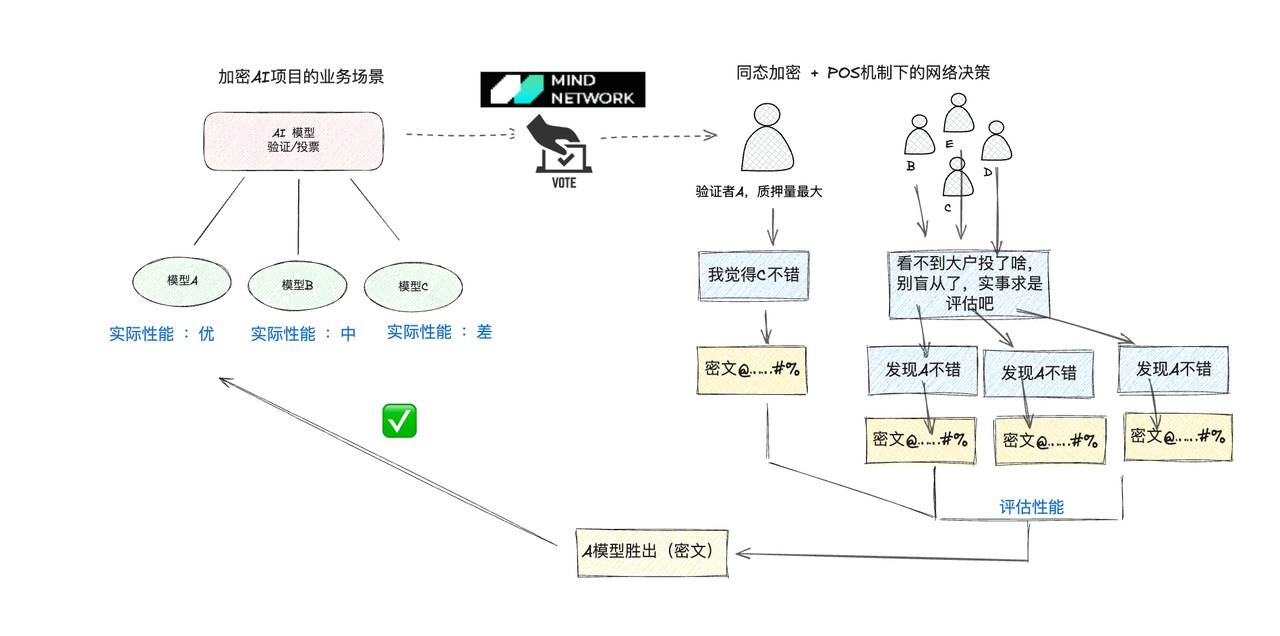
Instead of using FHE for model training or parameter updates, Mind applies it specifically to processes rife with human bias—cross-validation, selection, ranking, and voting—where resource costs are manageable and the goal is crystal clear:
If participants in an AI network conduct operations without knowing each other’s choices or votes, herd behavior (e.g., following whales or trusted nodes) disappears. Identity-driven biases vanish, restoring authenticity to decentralized decision-making and enabling accurate identification of superior AI models and services.
Thus, while general-purpose computing via FHE faces major hurdles, applying FHE to specific decentralized functions—like validation—is both coherent and feasible. Ensuring trustless validation enables consensus security and true decentralization in crypto AI projects.
On the other side of security lies fairness.
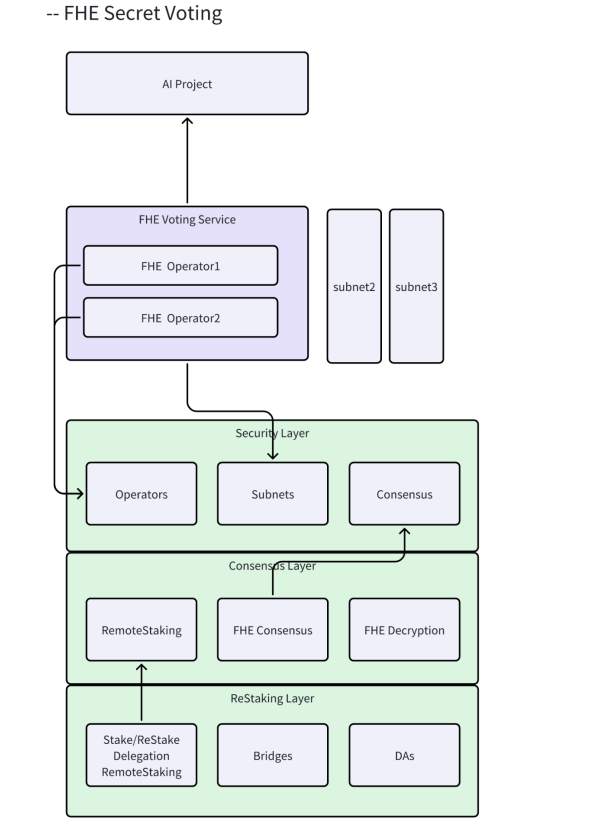
Let’s walk through a concrete example showing how Mind Network achieves fairness through encrypted validation execution:
-
1. An AI project integrates Mind’s FHE-powered validation service via SDK;
-
2. The AI project registers on the Mind Network to verify its identity. Mind then deploys a smart contract on the target project’s chain to synchronize future changes and execution outcomes;
-
3. The AI project posts a validation task (e.g., selecting the best AI model) on Mind Network. FHE voting activates, allowing validators to vote without seeing plaintext results, yet still completing the voting process;
-
4. Voting results and associated data changes are relayed via smart contract to Mind’s own chain for timely recording and synchronization;
-
5. Throughout this process, the AI project pays gas fees in Mind’s native token (not yet launched) for using its services.
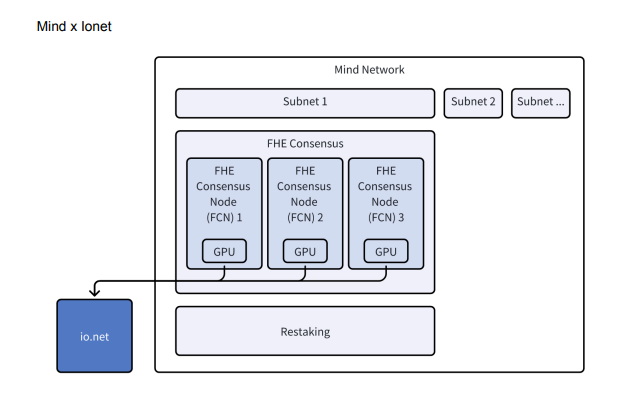
Likewise, when applied to a DePIN project, Mind Network enables fairer resource allocation. Take IO.net, a partner of Mind Network, as an example:
-
1. IO.net integrates Mind’s FHE validation service via SDK;
-
2. After integration, GPU-holding nodes gain FHE-enabled consensus capabilities. When AI compute tasks arrive, requests and data remain encrypted, enabling fair assignment of tasks to appropriate nodes.
Wait—What Does This Have to Do With Restaking?
Everything discussed so far seems purely technical—what connection does this have with asset-level Restaking?
Mind Network offers FHE-based solutions that technically enable validation security in AI networks; however, participating in this validation—and benefiting from its security—relates closely to the economic structures of most AI/DePIN projects.
PoS (Proof-of-Stake) is the foundational consensus mechanism for most crypto projects.
So, if an AI project adopts Mind Network’s FHE-supported, fairer approach to filtering, ranking, and validating AI models/services, and since most project nodes represent voting/validation rights via PoS, the size of staked assets under each node becomes directly tied to eligibility for FHE-secured fair validation.
Mind Network’s key move at the asset level is expanding Staking and Restaking access publicly, combining it with homomorphic encryption to secure consensus across AI networks.
Different roles within the network fulfill distinct interest needs:
For AI project validators, increasing Restaking volume increases opportunities and voting power in FHE-secured validation tasks on Mind Network.
For regular users, delegating their LST/LRT assets to these nodes offers APR returns.
This may sound similar to EigenLayer’s Restaking—but the goals align differently:
EigenLayer uses Restaking to secure different AVSs in the Ethereum ecosystem; Mind Network uses Restaking to secure consensus across diverse AI networks throughout the entire crypto ecosystem.
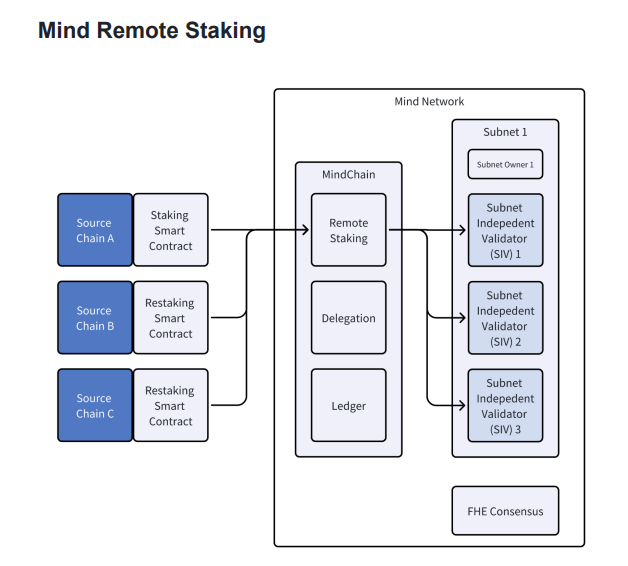
Notably, the term "entire ecosystem" is enabled by another key feature of Mind Network: Remote Restaking.
Thanks to Remote Restaking, users don’t need to bridge their LRT tokens across chains. Instead, they can seamlessly stake LRTs from multiple chains remotely to validators in an AI network, significantly lowering entry barriers and consolidating fragmented liquidity across multi-chain environments.
Broad Ecosystem Development and Solid Technical Capabilities
What other catalysts should we watch for in Mind Network?
First, product-wise: the testnet has already attracted 650,000 wallets and processed 3.2 million transactions—full mainnet functionality is likely imminent.
Second, regarding ecosystem development: since Mind Network positions itself as a platform empowering other AI projects, partnerships with leading projects are crucial.
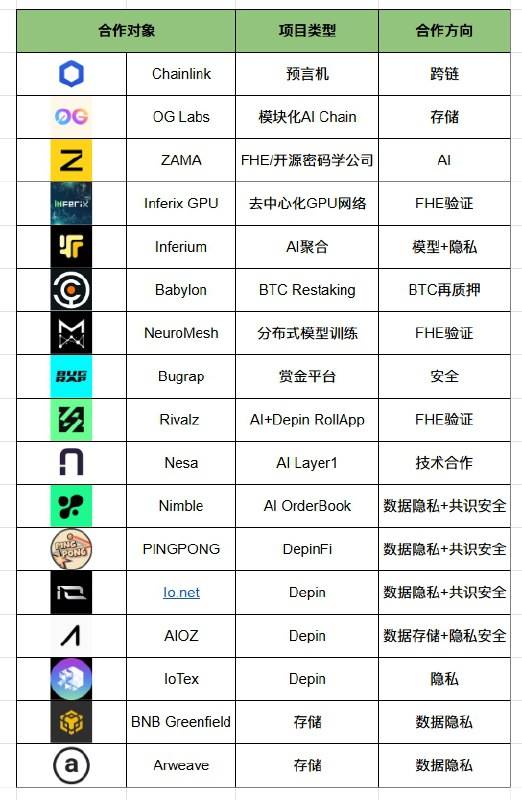
Currently, Mind Network provides consensus security services for io.net, Singularity, Nimble, Myshell, AIOZ, offers FHE Bridge solutions for Chainlink CCIP, and delivers AI data storage security for IPFS, Arweave, Greenfield—covering top-tier AI, storage, and oracle projects, potentially becoming the "pickaxe" in this gold rush.
Additionally, in 2023, the project was selected for Binance Labs incubation and completed a $2.5 million seed round backed by Binance and other notable investors. It also received an Ethereum Foundation Fellowship Grant, joined the Chainlink Build Program, and became an official Chainlink Channel Partner.
Technically, beyond assembling a team of experts in AI, security, and cryptography from top academic and industrial institutions, a key highlight is its collaboration with leading FHE research firms.
In February this year, Mind Network announced a partnership with ZAMA, a leading open-source FHE company. ZAMA recently closed a $73 million Series A led by Multicoin Capital and Protocol Labs.
More recently, the collaboration expanded further, launching a new Hybrid FHE (Hybrid Fully Homomorphic Encryption) AI network to advance AI algorithm applications on encrypted data—a significant technical boost for the project.
According to insiders, Mind Network leverages ZAMA’s底层 technology stack for its own R&D—a move demonstrating deep technical insight:
FHE is extremely resource-intensive, and using optimized底层 libraries ensures maximum capability without sacrificing performance.
Moreover, beyond enhancing its own tech, Mind Network actively contributes to improving the broader crypto ecosystem.
In May, the project partnered with Chainlink to launch the first Fully Homomorphic Encryption (FHE) interface built on the Cross-Chain Interoperability Protocol (CCIP). This enhances cross-chain communication and transaction security, paving the way for a more trustworthy and user-centric Web3 ecosystem.
As of publication, Mind Network has formed partnerships with multiple leading projects across various ecosystems and sectors. Given its role as an enabler, the “pickaxe effect” could amplify its impact moving forward.
Conclusion
When Fully Homomorphic Encryption meets Restaking, Mind Network might just become a new driving force in the second half of this year’s dominant crypto narratives.
FHE acts as the matchmaker, optimizing operations for numerous crypto AI projects and supporting genuine “decentralization” and trustlessness. Restaking paves the road, absorbing liquidity from multiple chains—rapid TVL growth is foreseeable.
Undeniably, the holy grail of FHE captures market attention for fresh narratives, while Restaking attracts capital flows. As consensus security for AI projects becomes accessible, concentration of attention and liquidity makes the project’s future trajectory highly anticipatable.
Projects like Mind Network, refining correct narratives (AI, Restaking) into something even more robust, may represent a gentler form of disruption in the second half of the mainstream narrative cycle.
Join TechFlow official community to stay tuned
Telegram:https://t.me/TechFlowDaily
X (Twitter):https://x.com/TechFlowPost
X (Twitter) EN:https://x.com/BlockFlow_News
 深潮TechFlow


