Lumoz Launches zkProver and zkVerifier Based on EigenLayer
TechFlow Selected TechFlow Selected
Lumoz Launches zkProver and zkVerifier Based on EigenLayer
On May 22, Lumoz announced the launch of its zkProver and zkVerifier based on EigenLayer, significantly enhancing computational and verification efficiency while effectively ensuring the security and profitability of the entire service process through EigenLayer's restaking mechanism.
 Navigating Web3 tides with focused insights
Despite recent controversies surrounding its airdrop, there is no doubt that EigenLayer has emerged as the most prominent project of 2024, thanks to its re-staking mechanism. Its outsized returns have not only driven explosive growth in total value locked (TVL), but also prompted users to swiftly exit meme-driven "pump-and-dump" cycles and reallocate capital and confidence back into the Ethereum ecosystem.
As of press time, EigenLayer’s ETH TVL has surpassed 5 million ETH, with over 54 million Eigen tokens staked. The number of active AVSs (Actively Validated Services) and Operators stands at 11 and 251, respectively. The EigenLayer ecosystem is now experiencing rapid expansion, with over 20 leading projects across various sectors—including Lumoz, Espresso, Near, and Dodo—joining the network.
In an instant, a revolution centered on ETH and powered by EigenLayer has begun reshaping blockchain security and yield generation.
This article takes Lumoz as a case study to explore its technical innovations on EigenLayer, shedding light on how such advancements are driving progress within Ethereum and the broader blockchain industry.
1. Lumoz Announces Launch of AVS Compute Layer Based on EigenLayer
As a leader in modular compute layers and ZKRaaS (Zero-Knowledge Rollup as a Service), Lumoz has consistently delivered strong performance in both capital markets and technological innovation. In April 2024, Lumoz first announced the completion of its Pre-A funding round (with a valuation reaching $300 million), followed by support for an Op Stack + ZK Fraud Proof Layer 2 architecture, ushering in a new model for L2 design.
This week, Lumoz officially launched its AVS compute layer built on EigenLayer, composed of zkProver and zkVerifier components, significantly enhancing network computing power and security.
Lumoz’s zkProver specializes in generating zero-knowledge proofs (ZKPs), verifying data authenticity without revealing underlying information. Leveraging powerful computational resources, zkProver can rapidly generate efficient ZKPs, greatly improving privacy and security across blockchain networks. The zkVerifier, meanwhile, is responsible for validating these proofs, ensuring their correctness and reliability. Integrated with EigenLayer’s re-staking mechanism, zkVerifier not only leverages Ethereum’s security but also offers additional economic incentives to validators. This dual-verification framework significantly strengthens overall network security and reduces trust assumptions.
Note: EigenLayer’s re-staking mechanism enhances the security of the Ethereum ecosystem by providing AVSs, thereby addressing trust issues and reducing capital costs.
By integrating robust computing infrastructure with EigenLayer’s re-staking mechanism, Lumoz has created a highly efficient and secure computing service ecosystem. This innovation not only boosts computational capacity and security but also unlocks new application scenarios and value propositions for developers and users alike. Through zkProver and zkVerifier, Lumoz brings unprecedented innovation to the blockchain space, advancing the entire industry’s technological frontier.
2. Lumoz Compute Layer
The Lumoz compute layer architecture is a highly integrated and collaborative system, consisting of the following core components:
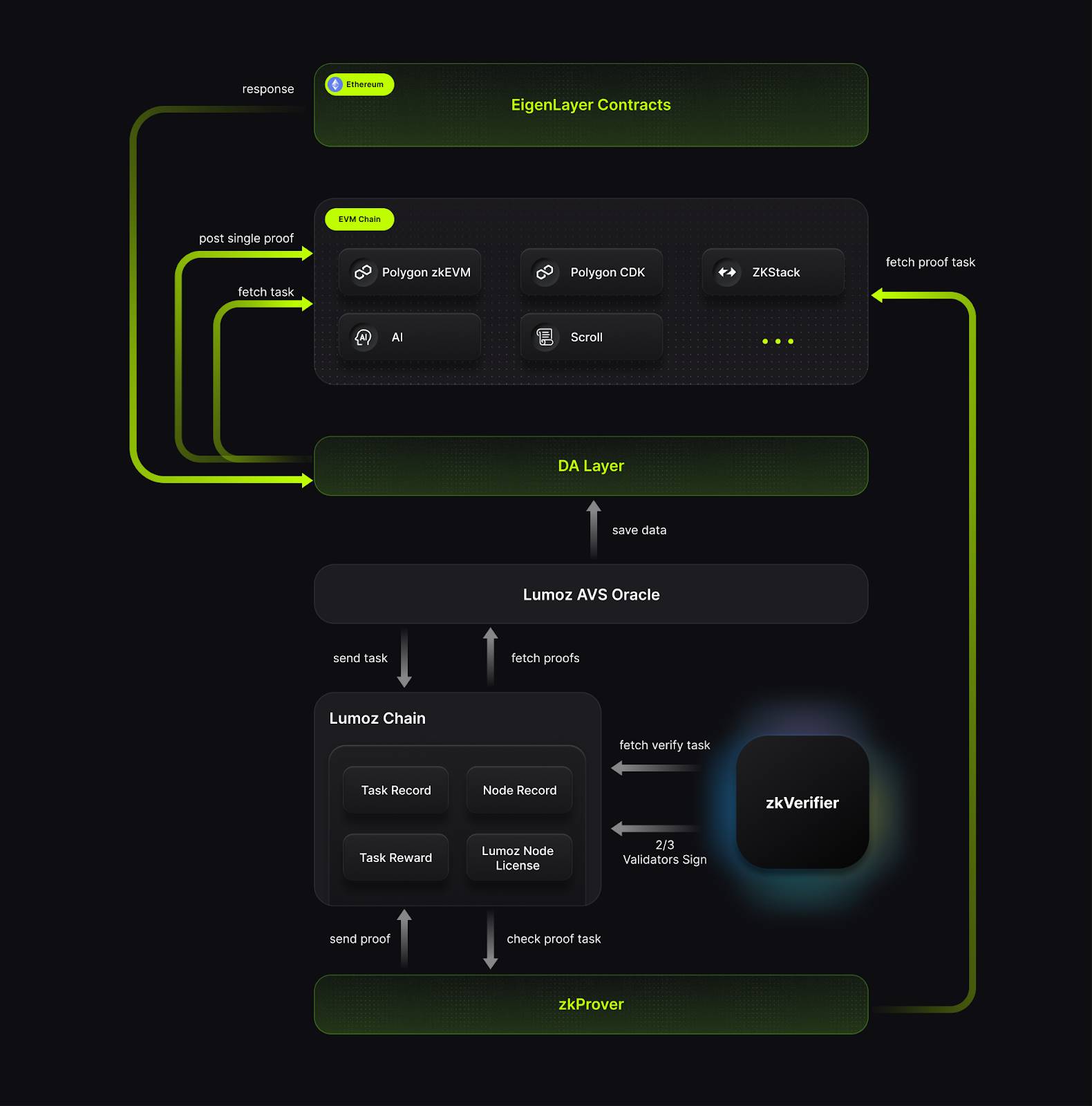
Key components include:
-
Ethereum: Implements standard protocols from EigenLayer to build Actively Validated Services (AVS). Leverages EigenLayer’s token staking mechanism to enhance AVS security
-
EVM Chain: Supports a diverse range of EVM-compatible blockchains, including Polygon zkEVM, Polygon CDK, ZKStack, and Scroll, ensuring broad compatibility and scalability
-
Lumoz AVS Oracle: Responsible for retrieving and storing data from EVM-compatible chains, ensuring high availability and integrity to form a solid data foundation for the compute layer
-
Lumoz Chain: Acts as the central management layer, overseeing task scheduling, reward distribution, and the management of zkProver and zkVerifier nodes—including node onboarding and exit processes
-
zkProver: Nodes that execute specific computational tasks
-
zkVerifier: Validation nodes that verify execution results
Through tight coordination among these modules, the Lumoz compute layer delivers a secure and efficient computing environment, while its modular design lays a solid foundation for future scalability and upgrades.
3. What Problems Can It Solve?
3.1 Large-Scale Computing Demand
Lumoz’s cloud infrastructure provides robust support for zero-knowledge proof computation—an essential capability for ZK-Rollups. As a blockchain scaling solution, ZK-Rollups execute transactions off-chain and use ZKPs to prove their validity before submitting them on-chain, thereby reducing mainnet load and increasing throughput.
Capabilities of Lumoz’s cloud infrastructure:
-
Compatibility: Lumoz’s cloud infrastructure is compatible with multiple ZK-Rollup solutions such as Polygon CDK, zkSync, StarkNet, and Scroll, enabling it to serve various platforms without requiring each to build separate infrastructure.
-
ZK-PoW Algorithm: By combining miners’ computational resources with cloud infrastructure via a Zero-Knowledge Proof of Work (ZK-PoW) algorithm, Lumoz enables miners to contribute computing power toward ZKP generation.
-
Performance and Efficiency: Parallel computation of ZKPs significantly improves efficiency, allowing multiple tasks to run simultaneously. Sequential submission ensures orderly transaction processing.
-
Recursive Aggregation Algorithm: Optimizing recursive aggregation reduces the number of required ZKPs, lowering computational complexity and cost.
-
Network Communication Improvements: Enhanced communication protocols reduce data transmission latency, improving overall system responsiveness.
-
Cost Efficiency: Through these optimizations, Lumoz lowers the cost of ZKP computation, making ZK-Rollup solutions more economically viable.
Lumoz’s cloud infrastructure offers a powerful, flexible, and cost-effective solution for ZKP computation, accelerating the development and adoption of blockchain technology.
3.2 Reducing zkProof Gas Costs
The design of zkVerifier focuses on improving efficiency, scalability, and reducing transaction costs in the following ways:
-
Integration of Multi-Source Proofs: zkVerifier can aggregate proofs from diverse sources, supporting a wide range of ZK applications. This flexibility is a key advantage in the blockchain ecosystem, enabling various projects to leverage zkVerifier services.
-
Gas Cost Savings: Through optimized proof processing and validation mechanisms, zkVerifier significantly reduces gas costs associated with proof submission, offering users a more cost-efficient blockchain experience.
-
Adaptability to Proof Characteristics: zkVerifier adapts to varying characteristics of proofs generated by different systems—including proof size, verification time, and logic—ensuring optimal system performance.
-
Customized Publishing Strategy: Based on proof characteristics, zkVerifier employs tailored publishing strategies to optimize on-chain resource usage and ensure efficient proof delivery, helping reduce network congestion and improve transaction speed.
-
Deployment of Dedicated Verifiers: zkVerifier deploys specialized verifier contracts—a critical mechanism to ensure proof validity. Only verified proofs are published to Ethereum, maintaining system security and reliability.
-
Optimization of Data Availability Layer: The data availability layer ensures persistence and accessibility of proofs while employing cost-effective storage strategies—crucial for minimizing operational expenses.
-
Deep Integration with Ethereum: zkVerifier publishes verification results to Ethereum, where Ethereum generates final verification proofs—an essential step for cross-chain interoperability and trust, enabling seamless collaboration between zkVerifier and major blockchain networks like Ethereum.
-
Authority of Verification Proof: The verification proof issued by Ethereum provides ultimate authoritative confirmation of data validity, which is crucial for establishing trust in zkVerifier’s outputs within the Ethereum network.
These innovative designs in zkVerifier not only address existing challenges in blockchain technology but also achieve significant progress in efficiency, cost reduction, and interoperability. This architecture paves the way for broader blockchain adoption and delivers a safer, more efficient service environment for users.
4. Detailed Workflow
4.1 zkProver
zkProver is the core component responsible for generating zero-knowledge proofs. ZKPs allow a prover to demonstrate the truth of a statement to a verifier without revealing any additional information. zkProver supports multiple types—including zkRollup Prover, zkFraud Prover, and zkML Prover—each optimized for specific computational tasks to ensure peak performance and system efficiency in their respective domains.
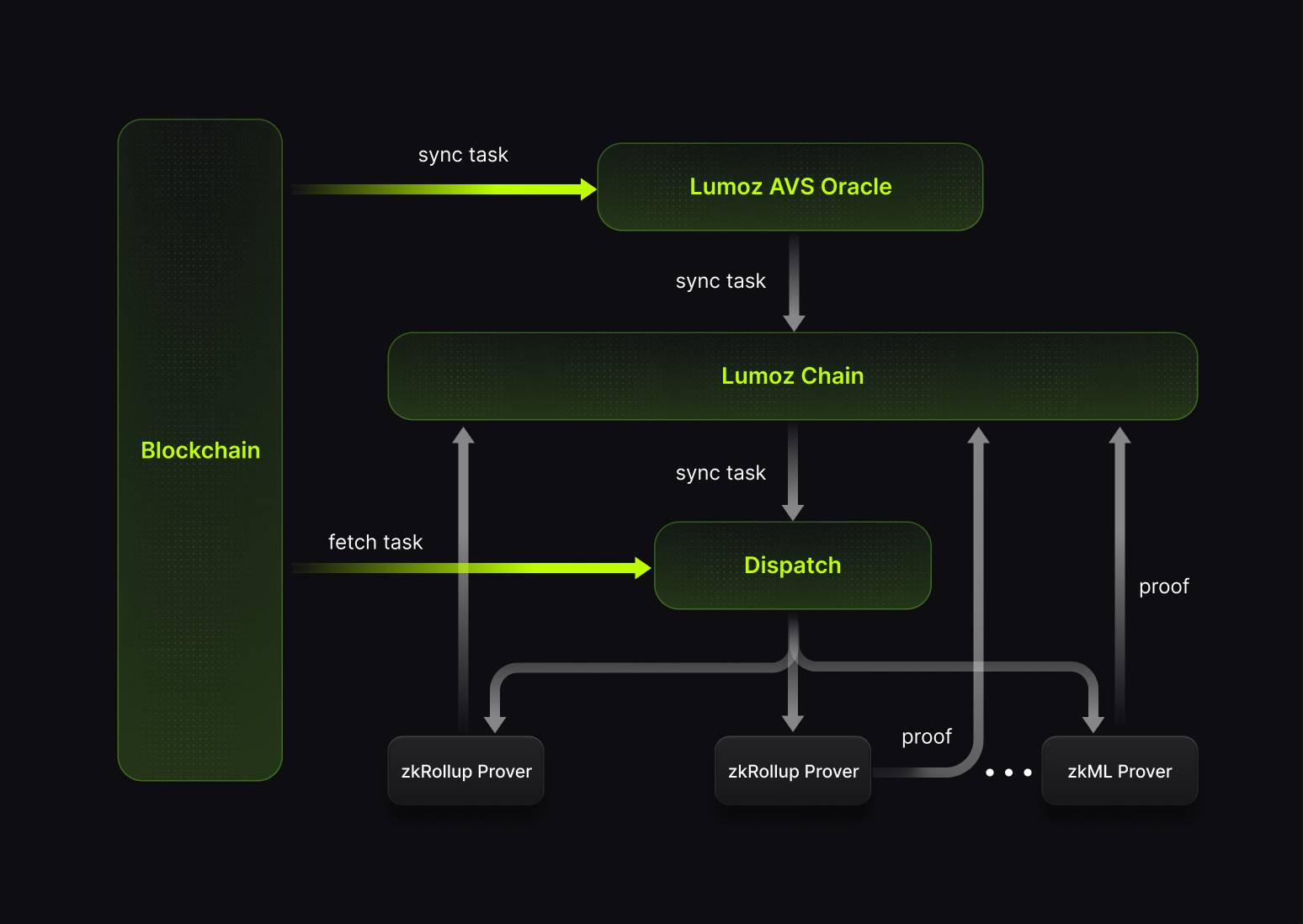
Workflow:
1. Task Acquisition: The Lumoz AVS Oracle and Dispatch module fetch tasks from the blockchain and synchronize them to Lumoz Chain—these are assertions or computations requiring proof.
2. Task Distribution: Tasks are assigned via the Dispatch module to appropriate provers. Acting as a task scheduler, Dispatch uses intelligent algorithms to dynamically allocate computing resources based on task type, load, and prover performance, ensuring system stability during peak demand.
3. Proof Generation:
-
zkRollup Prover: Focuses on proofs related to batch transaction compression, enhancing blockchain speed and scalability.
-
zkFraud Prover: Generates fraud proofs to detect and prevent malicious behavior.
-
zkML Prover: Handles complex proofs for machine learning model verification, confirming outputs without exposing the model or input data.
-
Other Prover: Additional provers for specialized proof types.
4. Proof Submission: Generated proofs are sent to Lumoz Chain for validation and archival.
4.2 zkVerifier
zkVerifier is another critical component in the architecture, tasked with validating ZKPs generated by zkProver. It ensures the correctness and validity of proofs submitted on-chain, safeguarding trust and security. Through optimized validation workflows, zkVerifier efficiently processes proofs while minimizing operational costs and gas consumption.
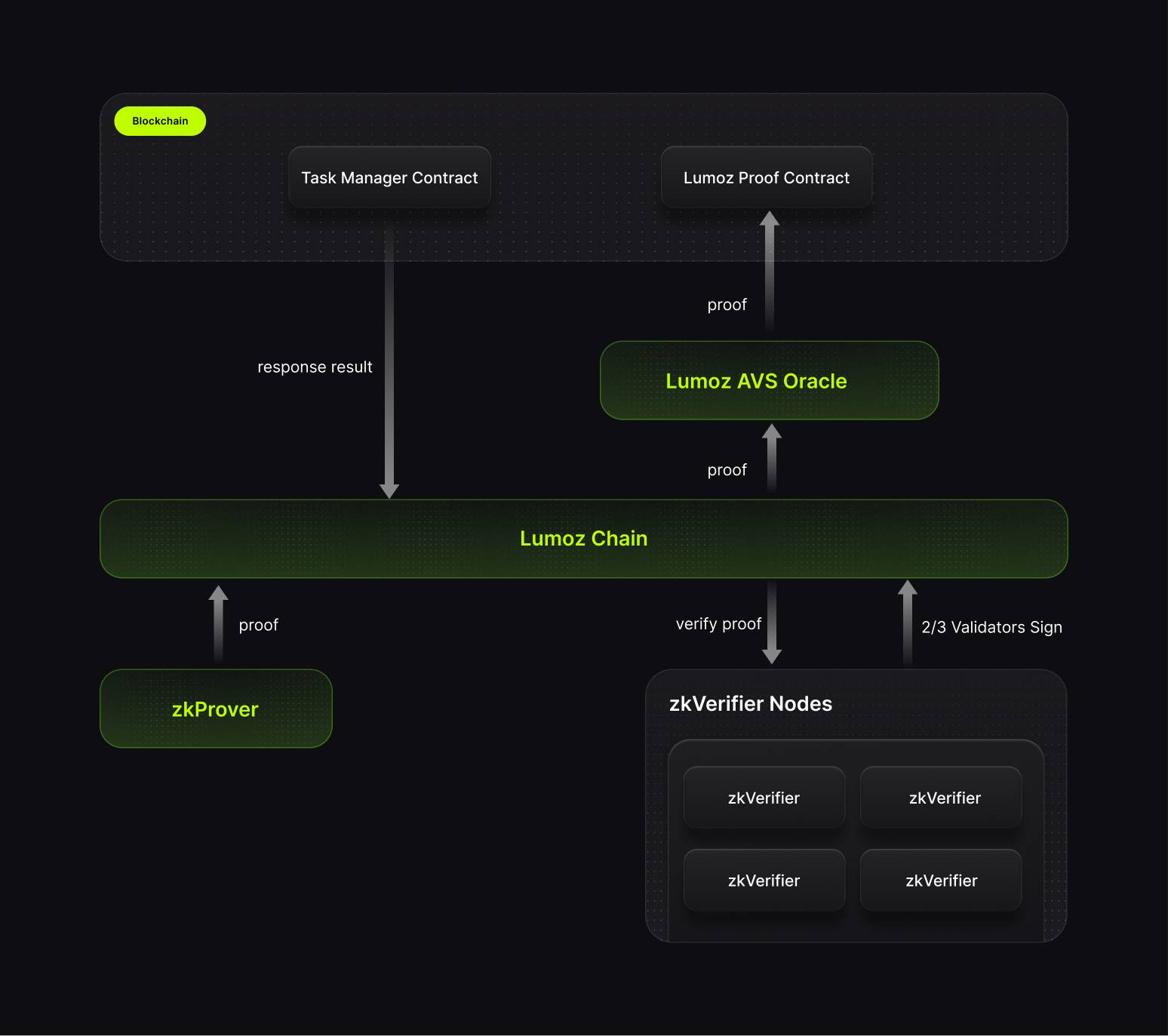
Workflow:
-
Proof Submission: Proofs generated by zkProver are submitted to Lumoz Chain, initiating the validation process.
-
Proof Verification: Lumoz Chain distributes the validation task to multiple zkVerifier nodes, which perform decentralized, independent verification.
-
Consensus Decision: At least two-thirds of the verifier nodes must confirm the proof as valid, ensuring authoritative and consistent validation outcomes.
-
Result Handling: Validated proofs and their results are relayed back by the Lumoz AVS Oracle to the Lumoz Proof Contract on the blockchain. The Task Manager Contract records the outcome and responds accordingly on Lumoz Chain.
5. Conclusion
Lumoz’s launch of zkProver and zkVerifier on EigenLayer significantly enhances computational and verification efficiency, while leveraging EigenLayer’s re-staking mechanism to ensure end-to-end security and yield generation. Through specialized node design, Lumoz delivers optimized solutions for diverse computational workloads, maximizing performance and efficiency. Moreover, the re-staking mechanism provides tangible rewards to participants, further strengthening the system’s economic security.
Looking ahead, we hope to see more projects like EigenLayer and Lumoz emerge—projects that directly confront current blockchain challenges, solve real user pain points, and actively explore efficient, secure solutions to drive the industry forward and foster long-term growth.
Join TechFlow official community to stay tuned
Telegram:https://t.me/TechFlowDaily
X (Twitter):https://x.com/TechFlowPost
X (Twitter) EN:https://x.com/BlockFlow_News
 @LumozOrg