How Arch Builds Bitcoin Infrastructure with Multicoin as Lead Investor?
TechFlow Selected TechFlow Selected
How Arch Builds Bitcoin Infrastructure with Multicoin as Lead Investor?
What Arch Network aims to do is not create a Layer 2 for Bitcoin, but rather bring programmability directly to Bitcoin itself.
 Navigating Web3 tides with focused insights
By 1912212.eth, Foresight News
ZK-based products and related protocols are sprouting up like mushrooms after rain, with even parallelization gradually becoming a trend. We see these two concepts frequently emerging on L2s and public blockchains, but they rarely appear together on Bitcoin.
This is partly due to Bitcoin's own limitations—restricted scripting language, lack of stateful data, and absence of a native execution environment capable of running complex smart contracts. Precisely because of these constraints, very few projects dare to build challenging foundational execution layers atop Bitcoin.
Recently, Arch Network, a Bitcoin-native application platform, raised $7 million in a seed funding round led by Multicoin Capital, with participation from OKX Ventures, CMS Holdings, and others. Arch aims to establish a foundational execution layer for Bitcoin.
Introduction to Arch
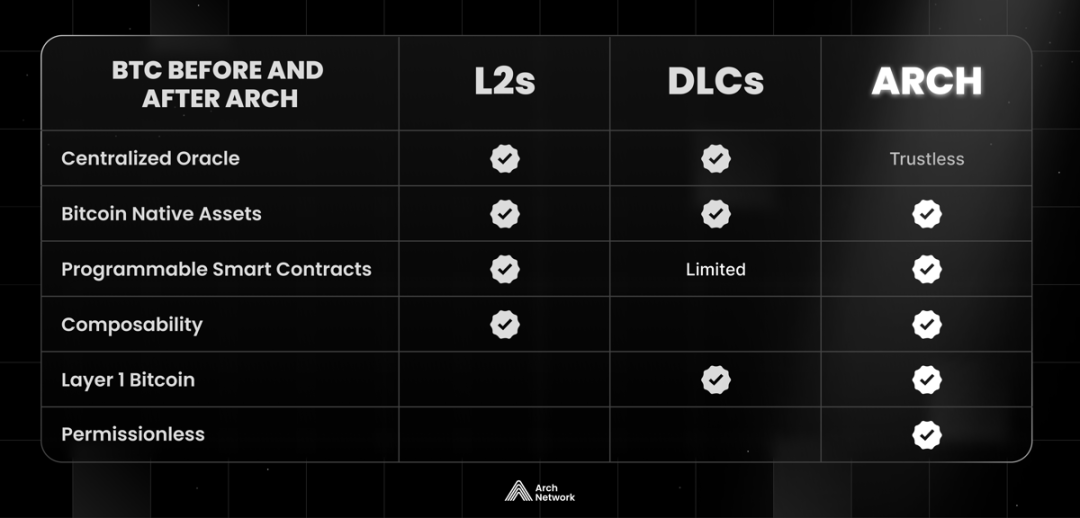
The number of rising L2 solutions is overwhelming—there are already over a dozen L2 options available. However, L2s inherently involve a bridging process for developers and users, requiring trust in both the bridge and the L2 itself. Another significant drawback is fragmented liquidity, which negatively impacts the overall ecosystem.
Arch does not aim to be a Bitcoin L2; instead, it brings programmability directly to Bitcoin. Arch Network is a parallelized Proof-of-Stake (PoS) network that uses zero-knowledge (ZK) proofs to enhance native Bitcoin programmability. The network consists of a Rust-based zkVM (called ArchVM) and a decentralized validator network.
Inspired by Solana and the Solana Virtual Machine (SVM), Arch operates without relying on any bridges or L2s. It offers three key features: programmability, parallelized execution speed, and trustless interoperability and composability.
How It Works
In the Arch Network, asset transfers and state changes involving Bitcoin occur directly on Bitcoin L1. Arch leverages "state chains" on Bitcoin L1, using ordinals to commit state changes within single transactions, thereby reducing fees and ensuring atomic execution.
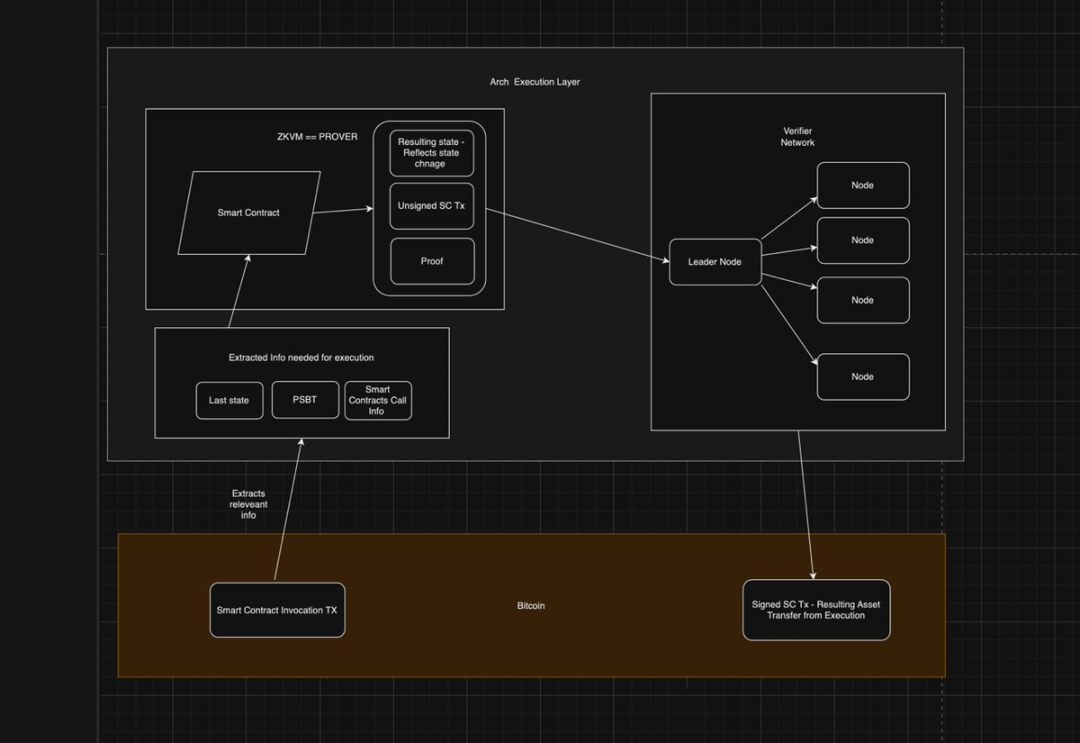
A typical transaction flow works as follows: Arch calls Bitcoin transaction data containing essential execution information, including the latest state, a partially signed Bitcoin transaction (PSBT), and smart contract inputs. Arch indexers continuously monitor new Bitcoin blocks, scanning each transaction in newly mined blocks to identify those matching the call format.
Once such a transaction is detected, Arch compiles the relevant details and proceeds to execute the smart contract. The smart contract then generates a resulting state and an unsigned transaction reflecting asset transfers during execution, along with a proof verifying the correctness of the contract execution. All this data is transmitted to the validator network, specifically to the leader node. During each Arch epoch, a leader is randomly selected, and this leader broadcasts the received information to all other nodes in the network.
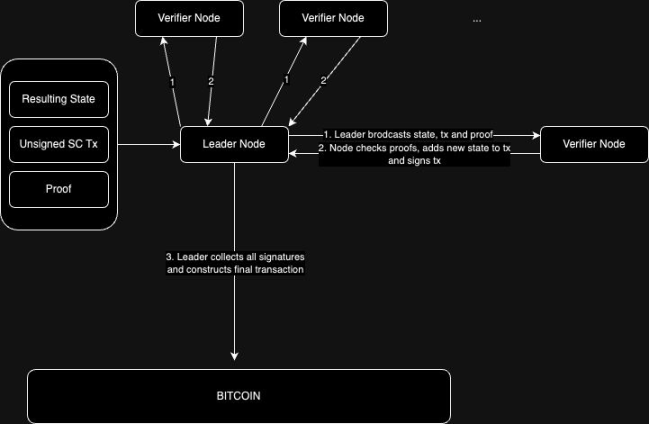
Each node verifies the proof and merges the state changes into the transaction before endorsing it. The leader aggregates signatures from these nodes until a predefined threshold is reached. Finally, once sufficiently signed, the transaction can be broadcast onto the Bitcoin network.
Currently, Liquidium, a lending protocol on Bitcoin, has integrated with Arch, reducing its reliance on third-party oracles and technical service providers while optimizing user experience. Additionally, applications such as DeFi, stablecoins, and oracles can also be built on top of Arch.
Transaction Fee Model
Arch charges users a fee for every BTC transaction processed through its infrastructure. The fee model incorporates multiple mechanisms: a “per-transaction fee” applies to operations such as deploying smart contracts, executing trades, and minting NFTs. “Dynamic pricing” functions as a priority fee (similar to a fast lane tip), dynamically adjusted based on network congestion and transaction complexity.
The collected fees are then distributed via a “fee allocation” mechanism to support network growth—partially allocated to node operators or validators, and another portion reinvested into developing and optimizing Arch’s infrastructure.
Although Arch has not yet announced its governance token or official roadmap, its core focus will remain on advancing smart contract infrastructure and expanding the decentralized node network. Initially, Arch will launch with a set of selected trusted nodes, and after ensuring stability and security, it will incentivize community participation to scale further.
Join TechFlow official community to stay tuned
Telegram:https://t.me/TechFlowDaily
X (Twitter):https://x.com/TechFlowPost
X (Twitter) EN:https://x.com/BlockFlow_News
 Foresight News