Zulu, a seed-stage player in the BTC ecosystem: Pioneering the dual-layer architecture
TechFlow Selected TechFlow Selected
Zulu, a seed-stage player in the BTC ecosystem: Pioneering the dual-layer architecture
If a new UTXO-based project suddenly surges, Zulu is one of the few in the current market that supports UTXO.
 Navigating Web3 tides with focused insights
Author: Riyue Xiaochu
The BTC ecosystem development race is in full swing, with participants such as Merlin, BounceBit, and B2 Network currently taking the lead. However, the finish line is still far off, and several close contenders shouldn't be underestimated—they could stage a comeback at any moment and deserve our attention.
Today we're looking into Zulu Network, a contestant in the BTC ecosystem and the first to adopt a dual-layer architecture.
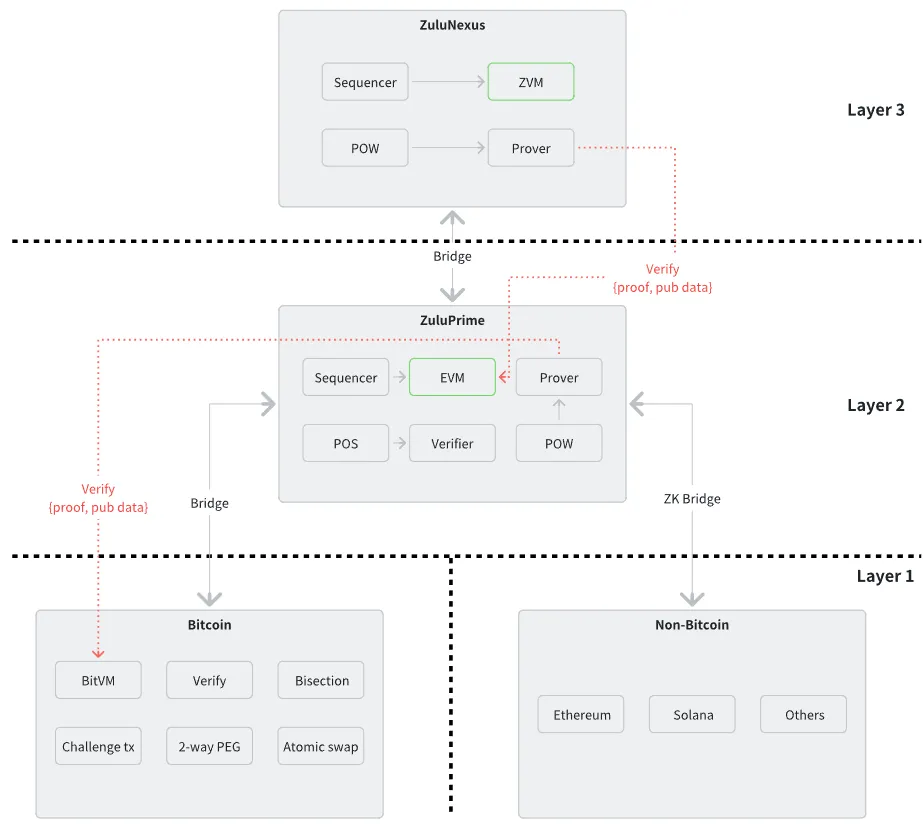
Zulu's Layer 2 is an EVM-compatible zkEVM. EVM-based projects can quickly and cost-effectively deploy onto ZuluPrime, enabling broader ecosystem expansion. The other layer is Layer 3, known as ZuluNexus. It innovatively unifies UTXO and account-based asset types and introduces smart contract capabilities based on the UTXO model. This means it can fully leverage the advantages of UTXO while supporting future innovations on UTXO.
Over the past few years, most blockchain innovation has centered around EVM. As a result, many Layer 2 ideas within the Bitcoin ecosystem aim to bring EVM-based ecosystems onto Bitcoin. However, over the past one to two years, it’s become increasingly evident that innovation on EVM seems to have hit a bottleneck.
Another path for innovation lies in UTXO. Since UTXO represents Bitcoin's native design, there's strong market anticipation for breakthroughs in this area, exemplified by recent interest in CKB, which fundamentally reflects market expectations for innovation enabled by UTXO. Infrastructure built on UTXO is maturing rapidly—CKB team has introduced RGB++, a programmable framework for Bitcoin. Bitcoin L2-as-a-service provider UTXO Stack offers developers one-click creation of Bitcoin L2s, akin to OP Stack, and integrates the RGB++ protocol. They are also developing shared sequencers and shared validation services. All signs point toward an imminent breakout of the UTXO ecosystem.
This is what makes Zulu particularly noteworthy—if new UTXO-based projects suddenly surge, Zulu stands out as one of the few platforms in today’s market supporting UTXO, and uniquely capable of supporting both EVM and UTXO ecosystems simultaneously.
Account Model vs. UTXO Model
As a decentralized ledger, blockchain employs two primary record-keeping models: UTXO (Unspent Transaction Output) and Account model. Ethereum uses the Account model—the familiar system of wallet addresses. Accounts maintain their own state. This model offers better programmability, is easier for developers to understand, and enables lower-cost batch transactions.
Bitcoin, on the other hand, uses the UTXO model. Simply put, when a miner mines a BTC block and sends BTC to address A, address A receives a UTXO. If sent to two addresses, it splits into two UTXOs. On the Bitcoin network, each address's balance is calculated by summing its UTXOs. Satoshi Nakamoto chose UTXO due to its high asset security—transactions cannot be double-spent. Additionally, multiple UTXOs can be processed simultaneously, enabling parallel transactions and encouraging scalability innovations.
In short, both account-based and UTXO models have their strengths and weaknesses. Their distinct logics mean UTXO holds great potential to enable novel developments.
Zulu Network Architecture
Layer 2
Zulu's Layer 2, ZuluPrime, operates as a second-layer solution for Bitcoin, focusing on EVM compatibility and enabling complex DApp applications on the Bitcoin network, allowing Ethereum-based ecosystems to quickly and affordably migrate to Zulu Network. ZuluPrime builds its zkEVM using zkSync’s ZK stack.
BitVM was proposed by Robin and brings programmability to Bitcoin through on-chain verification with off-chain computation. BitVM implies that Bitcoin can now achieve Turing completeness like any other chain—allowing developers to run complex contracts without altering Bitcoin’s core rules. However, BitVM proves inefficient in verifying execution validity. To solve this, Zulu introduces zero-knowledge proofs (ZKP). From a verification standpoint, this approach mitigates overhead for higher-level transaction types because the ZKP verifier runs consistently on BitVM regardless of transaction logic. Given the low computational demands of ZKP verifiers, these networks enable fast proof validation, enhancing system security.
Layer 3
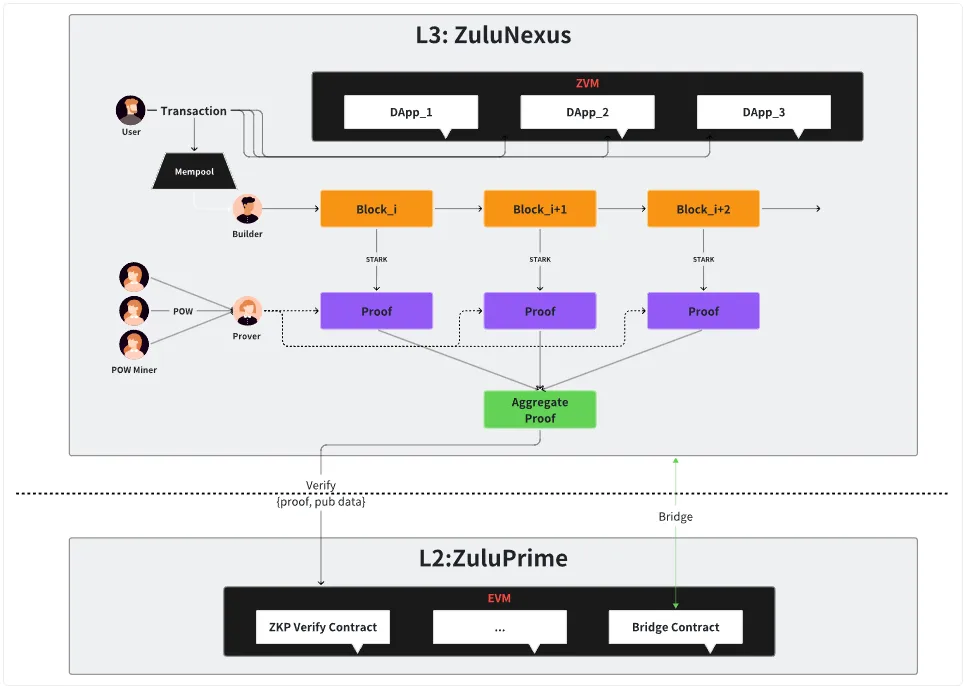
Zulu’s Layer 3, called ZuluNexus, is directly deployed on ZuluPrime and interacts with it seamlessly. The core innovation of Nexus is the unification of UTXO and account-based asset types across the Zulu network.
ZuluNexus develops a virtual machine entirely different from EVM—one that can support both account-based and UTXO-based states simultaneously. In practice, UTXO commitment trees may also be maintained. This approach draws from recent experience showing that account-based models exhibit greater compatibility with smart contracts, clearly demonstrated by Ethereum’s success. Meanwhile, UTXO models are better suited for private transactions, as UTXO-based transactions are executed locally by users and later verified by network nodes. Many privacy-focused projects—including Zcash, Aleo, Aztec, and Ola—are built on UTXO models.
Current Status of Zulu
Zulu has launched a testnet named Lwazi and initiated a campaign where participants earn Zulu Genesis Points (ZGP) by completing testing tasks. Within one day of launch, 25,000 users registered. As of yesterday, the number has grown to 640,000 registered users, with over 5 million transactions conducted on the testnet. Users can participate in various activities including registration, daily check-ins, faucet claims, transfers, cross-chain bridging, DEX trading, liquidity provision, and friend referrals.
Zulu has launched a testnet named Lwazi and initiated a campaign where participants earn Zulu Genesis Points (ZGP) by completing testing tasks. Within one day of launch, 25,000 users registered. As of yesterday, the number has grown to 640,000 registered users, with over 5 million transactions conducted on the testnet. Users can participate in various activities including registration, daily check-ins, faucet claims, transfers, cross-chain bridging, DEX trading, liquidity provision, and friend referrals.
For detailed information, please refer to the official documentation:
https://www.yuque.com/zulunetworkzhongwenshequn/zvggg8/ll78rsqpuigwhscg?singleDoc=#
Core Team
Zulu’s core team primarily hails from the United States and Canada, bringing extensive experience in blockchain development and operations. Co-founder Luke Vinci previously held strategic roles at J.P. Morgan and Nomura before transitioning into the cryptocurrency industry, where he served as a Senior Product Manager at OKX. Luke holds expertise in machine learning, financial products, and blockchain, and possesses a Master’s degree in Computer Science.
The other co-founder, Eric Lifson, brings seven years of experience in traditional marketing, having worked with major brands such as Procter & Gamble, McDonald’s, and General Mills. Since entering the blockchain space in 2017, he has founded ventures in public chains and DeFi.
Summary:
At a time when BTC ecosystem projects are flourishing, Zulu’s pioneering dual-layer structure not only supports the EVM ecosystem but also innovatively unifies UTXO and account-based asset types, positioning itself to capture future UTXO-driven innovations. Multiple international media outlets—including CoinMarketCap, CryptoSlate, Hackernoon, TechBullion, and NewsCrypto—have featured Zulu Network. Therefore, Zulu Network warrants close attention and could potentially leapfrog competitors at any moment.
Join TechFlow official community to stay tuned
Telegram:https://t.me/TechFlowDaily
X (Twitter):https://x.com/TechFlowPost
X (Twitter) EN:https://x.com/BlockFlow_News
 @riyuexiaochu



![In-depth Analysis of Trade[XYZ]: How Were 92 Markets and 98% HIP-3 Trading Volume Established?](https://upload.techflowpost.com/upload/images/20260716/20260716061117965147.jpeg?x-oss-process=image/resize,p_50/quality,q_80)